Introduction and History
The 8B10 is a duodecar-based (12-pin) multi-section vacuum tube containing twin diode units and twin medium-mu triode units within a single envelope. Developed primarily for television receiver applications during the late 1950s and early 1960s, the 8B10 is the higher-heater-voltage variant of the 6B10, designed for series-string heater circuits commonly found in transformerless television sets of the era.
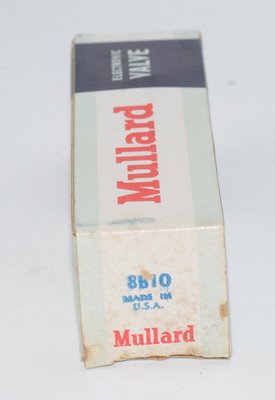
According to the RCA Receiving Tube Manual, the 8B10 is identical with type 6B10 except for heater ratings. The tube was manufactured by several companies including RCA, Mullard (USA), and other major valve producers of the period. Its multi-function design was typical of the era's drive toward miniaturization and parts-count reduction in consumer electronics, combining what would otherwise require two or three separate tubes into a single envelope.
The diode units were intended for use in horizontal-phase-detector circuits, while the triode units served in horizontal-oscillator circuits within television receivers. This combination of functions made the 8B10 a key component in the horizontal deflection systems of black-and-white and color television sets.
Technical Specifications and Design
Heater Ratings
| Parameter | 6B10 | 8B10 | Units |
|---|---|---|---|
| Heater Voltage (ac/dc) | 6.3 | 8.5 | volts |
| Heater Current | 0.6 | 0.45 | ampere |
| Heater Warm-Up Time (Average) | 11 | 11 | seconds |
The 8B10's heater is rated at 8.5 volts and 0.45 amperes, yielding approximately 3.825 watts of heater power — essentially the same thermal dissipation as the 6B10 (6.3V × 0.6A = 3.78W). This equivalent power consumption was by design, ensuring the tube could be used in series-string heater configurations where consistent voltage drops were required across each tube in the chain.
Heater-Cathode Voltage
| Parameter | Value | Units |
|---|---|---|
| Peak value | ±200 max | volts |
| Average value | 100 max | volts |
Triode Unit — Class A1 Amplifier
Maximum Ratings (Design-Maximum Values) — Each Triode Unit
| Parameter | Value | Units |
|---|---|---|
| Plate Voltage | 330 | volts |
| Average Cathode Current | 20 | mA |
| Plate Dissipation | 3 | watts |
Characteristics — Each Triode Unit
| Parameter | Value | Units |
|---|---|---|
| Plate Voltage | 250 | volts |
| Grid Voltage | −8 | volts |
| Amplification Factor (μ) | 18 | — |
| Plate Resistance (Approx.) | 7200 | ohms |
| Transconductance (gm) | 2500 | μmhos |
| Plate Current | 10 | mA |
| Grid Voltage (Approx.) for plate current of 50 μA | −20 | volts |
Maximum Circuit Values — Triode Units
| Parameter | Value | Units |
|---|---|---|
| Grid-Circuit Resistance: Fixed-bias operation | 0.25 | megohm |
| Grid-Circuit Resistance: Cathode-bias operation | 1 | megohm |
Diode Units (Each Unit)
Maximum Rating (Design-Maximum Value)
| Parameter | Value | Units |
|---|---|---|
| Plate Current | 5 | mA |
Characteristic, Instantaneous Value
| Parameter | Value | Units |
|---|---|---|
| Tube Voltage Drop for plate current of 20 mA | 5 | volts |
Physical Design
- Base Type: Duodecar 12-pin (12BF)
- Outline Section: 8A
- Socket: Duodecar 12-contact socket
Pin Configuration (12BF Base)
| Pin | Function |
|---|---|
| 1 | Heater (H) |
| 2 | Cathode, Triode 2 (KT2) |
| 3 | Grid, Triode 2 (GT2) |
| 4 | Plate, Triode 2 (PT2) |
| 5 | Grid, Triode 1 (GT1) |
| 6 | Plate, Triode 1 (PT1) |
| 7 | Cathode, Triode 1 (KT1) |
| 8 | Plate, Diode 2 (PD2) |
| 9 | Cathode, Diode 1 & Diode 2 (KD1, D2) |
| 10 | Plate, Diode 1 (PD1) |
| 11 | Internal Shield (IS) |
| 12 | Heater (H) |
Applications and Usage
The 8B10 was designed specifically for television receiver applications, where its multiple sections served distinct functions within the horizontal deflection and synchronization systems:
- Diode Units — Horizontal Phase Detector: The twin diode sections were employed in horizontal-phase-detector circuits, comparing the incoming sync pulses with the horizontal oscillator output to generate an error voltage for automatic frequency control (AFC). This was a critical function ensuring stable horizontal synchronization in television displays.
- Triode Units — Horizontal Oscillator: The twin triode sections were used in horizontal-oscillator circuits, typically in a multivibrator or synchroguide configuration. The medium-mu characteristic (μ = 18) and moderate plate resistance (7200 ohms) made these triode sections well-suited for generating the precise 15,750 Hz (for NTSC) horizontal sweep frequency.
The 8B10's 8.5-volt heater rating made it specifically suited for series-string heater designs in "transformerless" or "AC/DC" television receivers, where all tube heaters were connected in series across the mains supply. This was the dominant design approach for consumer television sets in the late 1950s and 1960s, as it eliminated the need for a costly and heavy power transformer.
Sound Characteristics
The 8B10 was not originally designed for audio applications, and its sonic characteristics must be understood in the context of repurposing a television tube for audio signal paths. That said, the triode sections of the 8B10 share fundamental characteristics with other medium-mu triodes that have found favor in audio circles:
- Tonal Character: The medium amplification factor of 18 places the 8B10's triode sections in a tonal territory between low-mu types (like the 6SN7 with μ ≈ 20) and higher-mu types. The relatively low plate resistance of 7200 ohms suggests a tube capable of driving loads with reasonable authority and good bass control. Users who have experimented with the 8B10 in audio circuits report a warm, slightly rounded midrange with a natural, unforced quality.
- Harmonic Structure: Medium-mu triodes generally produce a pleasing blend of even-order harmonics (primarily second harmonic) when driven into mild nonlinearity. The 8B10's triode sections, with their moderate transconductance of 2500 μmhos, would be expected to exhibit a gentle, musical clipping characteristic rather than an abrupt transition into distortion.
- Dynamics and Headroom: With a maximum plate voltage of 330 volts and plate dissipation of 3 watts per triode section, the 8B10 offers reasonable headroom for a small-signal tube. The −20 volt cutoff point provides a workable grid swing range for line-level audio applications.
- Noise Performance: As a television tube, the 8B10 was designed for environments where noise performance was important but not to the exacting standards of dedicated audio tubes. The internal shield (pin 11) can help reduce interference between sections, but microphonics may be more pronounced than in tubes specifically designed for audio preamplifier service.
It should be noted that sonic impressions of the 8B10 in audio applications are relatively rare in the literature, as this tube has not been widely adopted by the audio community. Those who have experimented with it generally do so out of curiosity or a desire to explore unusual tube types rather than because the 8B10 offers a clear sonic advantage over more conventional audio tubes.
Equivalent or Substitute Types
| Type | Relationship | Notes |
|---|---|---|
| 6B10 | Direct equivalent (different heater) | Identical in all respects except heater ratings: 6B10 uses 6.3V at 0.6A. Electrically interchangeable if heater supply is adjusted accordingly. Not a drop-in replacement in series-string circuits. |
The 8B10 is a specialized multi-function tube, and true drop-in substitutes are limited to the 6B10 with appropriate heater voltage considerations. The duodecar 12-pin base further limits substitution options, as few other tube types share this base configuration with the same internal arrangement.
For the individual sections, functional (but not pin-compatible) equivalents might be considered:
- The triode sections have characteristics broadly similar to a single section of a 6SN7 (μ = 20, rp = 7700 ohms, gm = 2600 μmhos), though the 6SN7 has a slightly higher mu and uses an octal base. These are not interchangeable without complete circuit redesign.
- The diode sections are simple signal-level diodes comparable to many other small-signal vacuum diodes, but again, not pin-compatible with any standard type.
Notable Characteristics
- Multi-Function Integration: The 8B10 is notable for combining four active sections — two diodes and two triodes — in a single envelope. This level of integration was impressive for the vacuum tube era and reflects the television industry's drive to reduce chassis size and component count.
- Duodecar Base: The 12-pin duodecar base was necessary to accommodate the many connections required by four separate tube sections plus heater, internal shield, and separate cathodes. This base type is relatively uncommon and requires a specific socket that may be difficult to source today.
- Series-String Design: The 8.5V/0.45A heater rating was specifically calculated for series-string heater chains. The heater wattage (approximately 3.825W) was carefully controlled to ensure compatibility with other tubes in the series string.
- Separate Cathodes: Each triode section has its own independent cathode, allowing the two triodes to be biased independently. The diode sections share a common cathode (pin 9). This arrangement provided maximum flexibility for circuit designers.
- Internal Shield: The internal shield (pin 11) provides electrostatic shielding between sections, reducing unwanted coupling — an important feature given the proximity of the oscillator and phase-detector circuits within the same envelope.
- Medium-Mu Triode Characteristics: With μ = 18, the triode sections fall into the medium-mu category. The combination of moderate gain, low plate resistance (7200 ohms), and reasonable transconductance (2500 μmhos) made these sections versatile for oscillator and switching applications.
- Rarity: The 8B10 is now a relatively uncommon tube. Mullard USA NOS (New Old Stock) examples are occasionally available from specialty tube dealers, but the tube is not in current production. Its specialized television application means that demand has been limited primarily to restorers of vintage television sets.
Usage in the Audio Community
The 8B10's presence in the audio community is minimal and largely confined to the experimental and DIY fringes of the hobby. Several factors contribute to this limited adoption:
Challenges for Audio Use
- Uncommon Socket: The duodecar 12-pin base requires a specialized socket that is not commonly stocked by audio parts suppliers. This alone is a significant barrier to casual experimentation.
- Non-Standard Heater Voltage: The 8.5V heater does not match common audio power transformer secondary voltages (6.3V or 12.6V), requiring either a dedicated heater supply or a series resistor arrangement.
- Limited Availability: As a television-specific tube that was never produced in enormous quantities, NOS stocks are limited. There is no current production from any manufacturer.
- Better Alternatives Exist: For audio preamplifier and driver applications, tubes like the 12AU7, 12AT7, 6SN7, and 6CG7 offer similar or superior performance with far better availability, standardized sockets, and extensive application literature.
Potential Audio Applications
For the adventurous builder willing to work around the practical challenges, the 8B10's triode sections could theoretically serve in several audio roles:
- Line-Stage Preamplifier: The twin triode sections could be configured as a stereo line-stage preamplifier, with one triode per channel. The μ of 18 provides moderate gain suitable for line-level signals, and the low plate resistance of 7200 ohms would allow good drive capability for subsequent stages or even moderately high-impedance headphones through a coupling capacitor.
- Phase Splitter / Driver: The matched triode sections within a single envelope could serve as a cathodyne or differential phase splitter for driving a push-pull output stage. The shared thermal environment would promote good balance between the two halves.
- Experimental Oscillator: Given the tube's original oscillator application, it could be used in audio-frequency oscillator circuits for test equipment or electronic music applications.
Community Perception
Among tube audio enthusiasts, the 8B10 is generally regarded as a curiosity rather than a serious audio tube. It occasionally appears in discussions about unusual or overlooked tubes that might offer interesting sonic characteristics, and Mullard-branded NOS examples may attract collectors interested in the Mullard name. However, the tube has not developed a following comparable to established audio types.
The 8B10 represents an interesting chapter in vacuum tube history — a highly integrated, purpose-built television component that exemplifies the engineering ingenuity of the vacuum tube era's final decades. While it may never achieve widespread audio use, it remains a fascinating subject for tube enthusiasts and historians alike.