1. Introduction and History
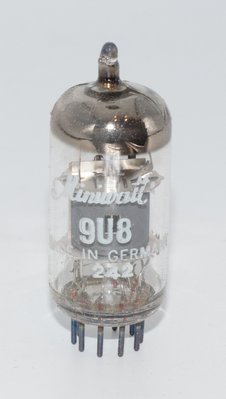
The 9U8, also known as the PCF82 in European nomenclature, is a dual-triode vacuum tube that emerged during the golden age of tube electronics in the mid-20th century. This tube represents a significant advancement in compact tube design, combining two independent triode sections within a single envelope. The 9U8 was primarily developed for use in consumer electronics, particularly in television receivers and FM tuners, where its compact size and dual functionality made it an economical choice for manufacturers.
The tube was manufactured by numerous respected tube makers including Telefunken, Mullard, Telefunken Miniwatt, and various other European and American manufacturers. The PCF82 designation became the standard European equivalent, while the 9U8 remained the primary North American designation. These tubes represent a transitional period in electronics history, manufactured until the 1980s as manufacturers gradually phased out vacuum tube production in consumer applications.
2. Technical Specifications and Design
Electrical Specifications
Tube Type: Dual Triode (Two independent triode sections)
Heater Specifications:
- Heater Voltage: 9.0V AC or DC
- Heater Current: 0.6A
- Heater Type: Directly heated cathode
Plate Characteristics (Per Triode):
- Maximum Plate Voltage: 330V
- Maximum Plate Dissipation: 2.5W
- Typical Operating Plate Voltage: 250V
- Typical Plate Current: 40-50mA at rated conditions
Grid Bias Voltage: -2V to -4V (typical operating range)
Amplification Factor (μ): Approximately 17-20 (moderate gain)
Plate Resistance (rp): Approximately 7,000-9,000 ohms
Transconductance (gm): Approximately 2,000-2,500 μmhos
Maximum Grid Voltage: -15V
Physical Characteristics
Base Type: Noval (9-pin) base
Overall Height: Approximately 2.75 inches (70mm)
Envelope Material: Glass with metal shield sleeve (optional)
Pin Configuration:
- Pin 1: Plate 1
- Pin 2: Grid 1
- Pin 3: Cathode 1
- Pin 4: Heater
- Pin 5: Heater
- Pin 6: Plate 2
- Pin 7: Grid 2
- Pin 8: Cathode 2
- Pin 9: No connection
Design Features
The 9U8 features two triode sections with identical specifications, allowing for balanced applications such as phase inverters or push-pull drivers. Each triode section is independently biased and can be operated at different plate voltages if required. The moderate amplification factor makes this tube suitable for both voltage amplification and driver applications. The compact noval base design minimizes space requirements while maintaining adequate heat dissipation through the glass envelope.
The heater design operates at 9V, making it suitable for applications requiring lower heater voltage supplies. This characteristic made the 9U8 particularly attractive for portable and battery-powered equipment designs.
3. Applications and Usage
Original Equipment Applications
The 9U8/PCF82 was extensively used in television receivers as a combined oscillator and mixer tube, leveraging its dual-triode configuration for UHF tuning circuits. It also found widespread application in FM tuners and AM/FM radio receivers, where one triode section served as a local oscillator and the other as a mixer or buffer amplifier. The compact size and efficient heater design made it ideal for portable radio applications.
In television receivers, the 9U8 often served as a vertical oscillator and driver tube, taking advantage of its moderate gain and stability characteristics. The tube's ability to handle moderate power levels without excessive heat generation made it reliable in consumer equipment operating continuously for extended periods.
Modern Audio Applications
Contemporary audio enthusiasts and professional technicians have rediscovered the 9U8 for specialized applications in vintage equipment restoration and boutique audio designs. The tube's moderate gain characteristics and pleasant tonal qualities make it suitable for:
- Phono Preamp Stages: The 9U8 can serve as a low-noise voltage amplifier in moving magnet cartridge preamps, offering excellent linearity across the audio spectrum
- Line-Level Amplifiers: As a general-purpose voltage amplifier in preamplifier circuits
- Phase Inverters: Utilizing both triode sections for balanced push-pull driver applications
- Microphone Preamplifiers: In professional and vintage recording equipment
- Tone Control Circuits: As a buffer or driver stage
- Vintage Equipment Restoration: As a direct replacement in original equipment requiring the 9U8 or PCF82
4. Sound Characteristics
The 9U8 possesses distinctive sonic qualities that have earned it appreciation among audio enthusiasts seeking vintage tube warmth with modern reliability. Understanding these characteristics helps explain its continued use in contemporary audio applications.
Tonal Profile
The 9U8 delivers a warm, slightly colored midrange with a natural, organic presentation. The tube exhibits subtle harmonic enhancement, particularly in the lower-order harmonics, which contributes to its pleasing character in audio applications. This coloration is less pronounced than in output tubes but more evident than in ultra-linear small-signal designs, making it an excellent compromise for applications where some character is desired without excessive coloration.
Frequency Response Characteristics
The moderate plate resistance and transconductance of the 9U8 result in a smooth, extended frequency response. The tube exhibits gentle rolloff at the frequency extremes rather than sharp cutoff, contributing to a non-fatiguing listening experience. The lower-frequency response is particularly warm, with a gentle emphasis in the 100-300Hz region that adds body and presence to audio signals. The upper midrange (2-5kHz) remains relatively flat, preserving vocal clarity and instrument definition.
Distortion Characteristics
Operating at moderate plate voltages and currents, the 9U8 generates primarily second and third-order harmonics when driven into mild distortion. These lower-order harmonics are generally considered musically pleasant, adding warmth without harshness. The distortion curve is relatively smooth, meaning harmonic content increases gradually with input signal level rather than exhibiting sharp transition points. This characteristic makes the tube forgiving of slightly elevated input levels.
Transient Response
The 9U8 demonstrates good transient response with clean attack and natural decay characteristics. The moderate gain and plate resistance allow for rapid signal changes without excessive ringing or overshoot. This makes the tube particularly suitable for music with complex transient content such as percussion and plucked strings.
Noise Floor
Well-maintained examples of the 9U8, particularly NOS (New Old Stock) units from reputable manufacturers, exhibit low noise floors suitable for preamplifier applications. The tube is inherently quieter than many larger triodes, making it an excellent choice for high-gain preamp stages where noise performance is critical. Typical noise levels range from 15-25dB below a 1V reference signal in properly designed circuits.
Impedance Characteristics
The moderate plate resistance of approximately 7,000-9,000 ohms makes the 9U8 suitable for driving moderate impedance loads (10k to 100k ohms) without significant frequency response alteration. This impedance range is ideal for driving passive tone controls, attenuators, or the input stages of subsequent amplifier stages.
5. Equivalent or Substitute Types
Direct Equivalents
PCF82: The European Mullard designation for the 9U8. Functionally identical with identical pin configuration and electrical specifications. Manufactured by Telefunken, Mullard, and Siemens.
9U8 (Various Manufacturers): RCA, Sylvania, GE, and Telefunken all manufactured versions with minor variations in construction quality and sonic characteristics. Telefunken Miniwatt examples are particularly sought by audio enthusiasts for superior construction and tonal qualities.
Functional Alternatives
12AU7: A more robust dual triode with higher heater voltage (12.6V) and greater power handling capability. Substitution requires heater voltage modification in 9V circuits. The 12AU7 exhibits lower amplification factor (approximately 17) and similar sonic characteristics but with greater headroom for higher-level applications.
ECC82 (12AX7): A higher-gain dual triode (amplification factor approximately 100) suitable for applications requiring greater voltage amplification. Not recommended for direct substitution due to significant gain differences, though both triodes can be used in the same circuit with appropriate biasing modifications.
6N6P: A Soviet-era dual triode with similar specifications and 6.3V heater voltage. Offers comparable sonic characteristics with slightly different construction. Requires 6.3V heater supply instead of 9V.
ECC81 (12AT7): A medium-gain dual triode with 12.6V heater voltage. Suitable for applications where the 9U8's gain is insufficient but lower gain than 12AX7 is desired. Requires voltage supply modifications.
Substitution Guidelines
When substituting tubes, ensure that heater voltage, maximum plate voltage ratings, and current requirements are compatible with the original circuit design. While the 9U8's moderate specifications make it relatively forgiving, substitutions with significantly different characteristics (such as 12AX7) require careful biasing verification. For critical audio applications, direct equivalent replacement with period-correct examples from quality manufacturers is recommended.
6. Notable Characteristics
Reliability and Longevity
The 9U8 demonstrates exceptional reliability when operated within specifications. The moderate plate dissipation and operating voltages result in cool tube operation, extending lifespan significantly. Many examples manufactured in the 1950s-1970s remain fully functional today, making NOS (New Old Stock) examples readily available. The tube's conservative design margins contribute to its reputation as one of the most durable dual triodes ever manufactured.
Manufacturing Quality Variations
Significant quality variations exist among different manufacturers and production periods. Telefunken Miniwatt examples, particularly those manufactured in Germany during the 1960s, are renowned for superior construction quality and sonic performance. These tubes feature robust internal construction, superior materials, and careful quality control. Mullard examples from Britain also command respect among audio professionals. Later examples from the 1970s-1980s often exhibit reduced construction quality as manufacturers reduced costs during the transition away from tube production.
Identification and Dating
The 9U8 can be identified by its noval (9-pin) base and dual-triode configuration. Dating codes vary by manufacturer but typically appear on the tube envelope. Telefunken tubes often feature date codes in the format of year and week of manufacture. Mullard tubes use different coding systems. Understanding these codes helps identify the manufacturing period and expected quality level.
Heater Voltage Flexibility
The 9V heater specification provides design flexibility for equipment designers. This voltage falls between standard 6.3V and 12.6V supplies, allowing for efficient operation in diverse applications. Some designers appreciated this characteristic for portable equipment and battery-powered designs where heater current efficiency was critical.
Thermal Characteristics
The 9U8 operates relatively cool compared to output tubes, with typical plate dissipation around 1-1.5W per triode under normal operating conditions. This cool operation results in minimal heat generation, allowing for closer component spacing and reduced cooling requirements. The tube's glass envelope provides adequate heat dissipation for extended operation without auxiliary cooling.
Biasing Stability
The moderate amplification factor and plate resistance contribute to stable biasing characteristics. The tube is relatively forgiving of bias point variations, making it suitable for designs without sophisticated bias adjustment circuits. This stability made the 9U8 popular in consumer equipment where manufacturing tolerances required robust designs.
Conclusion
The 9U8/PCF82 represents an excellent example of practical tube design, balancing performance, reliability, and economy. Its dual-triode configuration, moderate specifications, and warm tonal characteristics have ensured its continued appreciation among audio enthusiasts and professional technicians. Whether restoring vintage equipment or designing new audio circuits, the 9U8 offers proven performance and pleasing sonic character. Quality NOS examples, particularly from Telefunken Miniwatt and Mullard, continue to command respect in the audio community for their superior construction and tonal qualities. The tube's legacy as a reliable workhorse in consumer electronics, combined with its pleasant sonic characteristics, ensures its relevance in contemporary audio applications.