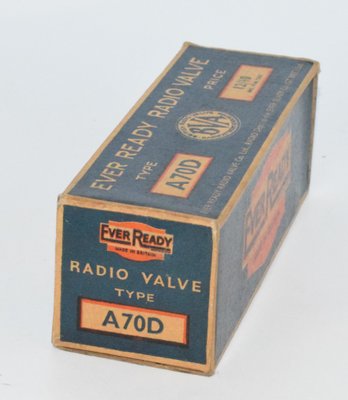
1. Introduction and History
The A70D is a pentode vacuum tube (valve) manufactured by Ever Ready, a British company historically known for its batteries and electronic components. This valve dates from the era of British domestic radio receivers, likely produced during the 1930s to 1940s period when Ever Ready was actively manufacturing valves for consumer radio equipment sold under their own brand. Ever Ready valves were commonly found in portable and mains-operated radio sets marketed to the British public.
The A70D belongs to a family of British-designation pentode valves designed primarily for audio output or intermediate frequency (IF) amplification duties in radio receivers. The "A" prefix in Ever Ready's naming convention typically indicated a specific heater voltage class, and the "D" suffix often denoted a particular variant or application category within their product lineup. As a pentode, the A70D features five active electrode elements: cathode, control grid (g1), screen grid (g2), suppressor grid (g3), and anode (plate), giving it the enhanced gain and output characteristics that made pentodes the workhorse of radio receiver design throughout the golden age of valve electronics.
Ever Ready valves were often equivalents or near-equivalents of types produced by major manufacturers such as Mullard, Osram (GEC/MOV), Mazda, or Cossor, but sold under Ever Ready's own proprietary type numbering system. This can make cross-referencing somewhat challenging for modern collectors and enthusiasts.
2. Technical Specifications and Design
Important Note: The A70D is a relatively obscure proprietary Ever Ready type, and comprehensive manufacturer datasheets are not widely available in commonly referenced online valve databases. The specifications listed below should be treated with caution and verified against an original Ever Ready datasheet or reliable cross-reference source where possible. Values flagged with an asterisk (*) are particularly uncertain and require confirmation.
Valve Type
- Type: Pentode (RF/IF or Audio Output Pentode)
- Manufacturer: Ever Ready (UK)
- Construction: Indirectly heated cathode pentode
Heater Ratings
- Heater Voltage (Vf): *Value requires confirmation against original datasheet — likely in the range of 2.0V, 4.0V, or 7.0V depending on the series designation. The "70" in the type number may suggest a relationship to a 7.0V heater class, but this is speculative and must be verified.
- Heater Current (If): *Value requires confirmation.
Maximum Ratings
- Maximum Plate (Anode) Voltage (Va max): *Requires confirmation — typical British pentodes of this era operated with plate voltages in the range of 150V to 250V.
- Maximum Screen Grid Voltage (Vg2 max): *Requires confirmation.
- Maximum Plate Dissipation (Pa max): *Requires confirmation — likely in the range of 2W to 9W depending on whether this is a small-signal or output pentode.
- Maximum Screen Grid Dissipation (Pg2 max): *Requires confirmation.
Typical Operating Characteristics
- Amplification Factor (μ): *Requires confirmation.
- Transconductance (gm): *Requires confirmation — typical values for pentodes of this class range from approximately 1.0 mA/V to 7.0 mA/V.
- Plate Resistance (rp): *Requires confirmation — pentodes typically exhibit high plate resistance, often in the range of tens to hundreds of kilohms.
- Control Grid Bias Range (Vg1): *Requires confirmation.
Physical Characteristics
- Base Type: *Requires confirmation — British valves of this era commonly used 4-pin, 5-pin, 7-pin, or International Octal bases. A pentode would require a minimum of 5 pins (plus possible top-cap connection for the control grid or anode).
- Envelope Type: Glass envelope, likely of the ST (shoulder type) or cylindrical form common to British valves of the period.
- Pin-out: *Requires confirmation against original datasheet or base diagram. Some British pentodes of this era featured a top-cap connection for the control grid (g1).
- Mounting: Vertical recommended (unless otherwise specified).
Collector's Note: Due to the proprietary nature of Ever Ready's type numbering system, researchers seeking full specifications are advised to consult original Ever Ready valve manuals, Brimar equivalence guides, or the comprehensive Babani valve data books that catalogued many British proprietary types. The Wireless World Valve Data supplements from the 1930s–1940s may also contain relevant information.
3. Applications and Usage
As a pentode valve, the A70D would have been designed for one or more of the following applications in radio receiver circuits:
- Audio Output Stage: If classified as an output pentode, the A70D would have served as the final audio amplification stage in domestic radio receivers, driving the loudspeaker through an output transformer. Small output pentodes were the standard choice for single-ended audio output stages in household radios of the 1930s and 1940s.
- IF (Intermediate Frequency) Amplification: Pentodes with high transconductance were widely used as IF amplifier stages in superheterodyne radio receivers, providing the gain necessary for sensitive reception.
- RF (Radio Frequency) Amplification: Some pentodes served as RF amplifiers ahead of the frequency converter stage.
- General-Purpose Voltage Amplification: Pentodes could also be employed as high-gain voltage amplifiers in various circuit positions.
The A70D was almost certainly intended for use in Ever Ready branded radio receivers or in sets designed around Ever Ready's valve lineup. These radios were popular consumer products in the United Kingdom and were sold through electrical retailers and department stores.
4. Sound Characteristics
While specific audiophile commentary on the A70D is scarce due to its relative obscurity, general observations about British pentode valves from this era can provide useful guidance:
- Tonal Character: Vintage British pentodes from manufacturers like Ever Ready, Mullard, and Mazda are generally regarded as having a warm, slightly rounded tonal character. When used in single-ended output configurations, they tend to produce a pleasant, harmonically rich sound with a characteristic emphasis on even-order harmonics when driven into mild distortion.
- Midrange Presence: British pentodes of this era are often noted for their engaging midrange presentation — voices and acoustic instruments tend to be rendered with a natural, present quality that many listeners find appealing.
- Treble Response: Pentodes in general can exhibit a brighter, more extended treble response compared to triodes, though vintage types tend to be smoother and less aggressive in the high frequencies than some later designs.
- Bass Response: In single-ended pentode output stages, bass response is typically adequate but may lack the tightness and authority of push-pull configurations or triode-connected operation.
- Pentode vs. Triode-Connected Operation: Many audio enthusiasts find that pentodes sound best when connected in triode mode (screen grid tied to anode) or in ultra-linear configuration, which reduces the characteristic "pentode hardness" that some listeners perceive in the upper harmonics. However, this comes at the cost of reduced output power and efficiency.
- NOS Quality: New Old Stock (NOS) examples of the A70D, such as those from Ever Ready's original production, are likely to exhibit the superior construction quality and careful material selection typical of the era, potentially contributing to lower microphonics and a more refined sound compared to later mass-produced equivalents.
It should be noted that the sonic character of any valve is heavily dependent on the circuit topology, operating point, associated components (particularly output transformers), and power supply design. Generalizations about "tube sound" should always be considered in this context.
5. Equivalent or Substitute Types
Important Note: Without confirmed access to the original Ever Ready cross-reference data for the A70D, definitive equivalents cannot be stated with certainty. The following guidance is provided for researchers:
- Potential Equivalents: Ever Ready valves were frequently re-branded or closely equivalent versions of types manufactured by Mullard, Mazda (Ediswan), Osram/GEC, or Cossor. The A70D likely corresponds to a standard British pentode type from one of these manufacturers. Identifying the correct equivalent requires matching the heater ratings, base type, and electrical characteristics.
- Research Approach: Collectors and restorers should consult Brimar equivalence tables, the Babani "Radio Valve Equivalents Handbook," or the "Encyclopaedia of Encyclopaedias of Valves" to identify the mainstream equivalent. Examining the physical construction of the valve (base type, number of pins, presence of top-cap connection) can significantly narrow down the possibilities.
If any reader has access to original Ever Ready documentation or can confirm the cross-reference for the A70D, this information would be a valuable contribution to the valve collecting community.
6. Notable Characteristics
- Proprietary Designation: The A70D uses Ever Ready's own type numbering system, which does not directly correspond to the standard Mullard-Philips, RETMA (American), or Pro Electron naming conventions. This makes identification and cross-referencing more challenging but also adds to the collector interest.
- British Heritage: Ever Ready was a quintessentially British brand, and their valves represent an interesting chapter in the history of UK consumer electronics. The company was better known for batteries (the "Ever Ready" name being synonymous with portable power in Britain), but their valve production, while less celebrated, served an important role in making radio accessible to the mass market.
- NOS Rarity: As a proprietary type from a secondary manufacturer, NOS examples of the A70D are relatively uncommon. This scarcity can make them of interest to collectors of British vintage valves, even if the electrical equivalent from a major manufacturer is more readily available.
- Construction Quality: British valves from the 1930s–1940s era were generally manufactured to high standards, with careful attention to electrode alignment, vacuum quality, and getter design. NOS examples that have been properly stored can be expected to perform well despite their age.
- Pentode Versatility: As a pentode, the A70D offers the flexibility of being usable in pentode, triode-connected, or (where applicable) ultra-linear configurations, giving circuit designers and audio experimenters multiple options for optimizing performance to their preferences.
7. Usage in the Audio Community
The A70D occupies a niche position in the audio community, primarily of interest to the following groups:
Vintage Radio Restoration
The most common application for the A70D today is in the restoration of original Ever Ready radio receivers. Collectors and restorers of vintage British radios seek out NOS examples to maintain the authenticity of their restorations. Using the original specified valve type ensures correct operating conditions and preserves the historical integrity of the set.
DIY Audio Experimentation
Adventurous DIY audio builders sometimes seek out obscure valve types like the A70D for experimental single-ended amplifier projects. The appeal lies in the novelty of using an unusual type, the potential for discovering hidden sonic gems, and the satisfaction of building something unique. British pentodes from this era can make charming low-power amplifiers suitable for high-efficiency speakers in near-field listening setups.
Valve Collecting
The A70D is of interest to collectors who specialize in British proprietary valve types. Ever Ready valves, with their distinctive branding and packaging, are collectible items that represent an important aspect of British electronic heritage. NOS examples in original packaging command a premium among serious collectors.
Practical Considerations for Audio Use
For those considering the A70D for audio projects, several practical points should be noted:
- Data Availability: The scarcity of published specifications may require empirical testing (curve tracing) to establish operating parameters for circuit design.
- Supply Limitations: As an obscure type, replacement valves may be difficult to source. Builders should consider acquiring multiple examples or identifying a confirmed equivalent type as a backup.
- Output Power: Vintage pentodes of this class typically deliver modest output power (often under 5 watts in single-ended configuration), making them best suited for use with high-efficiency loudspeakers.
- Matching: For any push-pull application, matched pairs would be essential but potentially difficult to obtain given the limited supply.
The A70D represents the kind of hidden treasure that makes the world of vintage valves endlessly fascinating. While it may never achieve the fame of an EL34 or a 6L6, it carries with it a piece of British electronic history and the potential to surprise those willing to explore beyond the well-trodden paths of mainstream valve audio.