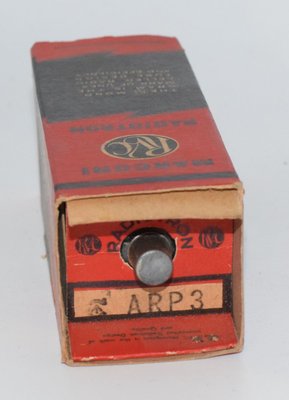
1. Introduction and History
The ARP3 is a British RF pentode valve developed during the late 1930s and widely used throughout World War II in military radio and radar equipment. The designation "ARP" follows the British military valve naming convention, where "A" indicates a valve intended for amplification, "R" denotes a receiving type, and "P" signifies a pentode construction. The numeral "3" is a sequential type identifier within this classification scheme.
Manufactured primarily by Marconi-Osram Valve (MOV), Mullard, and other British valve makers under wartime production agreements, the ARP3 was designed as a general-purpose RF and IF amplifier pentode. It was engineered to operate from a 13-volt heater supply, which was standard for many British military vehicle and airborne radio installations that used 12V battery systems (with a nominal 13V supply under charging conditions).
The valve saw extensive service in military communications receivers, radar IF strips, and various signal processing applications throughout WWII. Its robust construction and reliable performance under harsh field conditions made it a staple of British military electronics. After the war, surplus stocks became widely available, and the ARP3 found secondary use in amateur radio equipment and experimental circuits. The valve was catalogued under multiple CV (Common Valve) designations by the British Inter-Services Technical Valve Committee, reflecting its widespread adoption across the armed forces.
Production of the ARP3 is believed to have been carried out primarily between the early 1940s and the late 1940s, with the valve being superseded by more modern miniature types in the post-war era. Today, the ARP3 is a relatively uncommon valve on the surplus market, though NOS (New Old Stock) examples from manufacturers such as Marconi do appear from time to time, often verified by AVO valve tester measurements.
2. Technical Specifications and Design
Heater / Filament
| Parameter | Value |
|---|---|
| Heater Voltage (Vh) | 13.0 V |
| Heater Current (Ih) | 0.2 A |
| Heater Power | 2.6 W (calculated) |
| Heater Type | Indirectly heated cathode |
Inter-Electrode Capacitances
| Parameter | Value |
|---|---|
| Grid-to-Cathode Capacitance (Cgk) | 4.0 pF |
| Anode-to-Cathode Capacitance (Cak) | 10.0 pF |
| Grid-to-Anode Capacitance (Cga) | 0.005 pF |
The extremely low grid-to-anode capacitance of 0.005 pF is characteristic of a well-screened RF pentode, providing excellent isolation between input and output circuits and minimising the risk of instability at radio frequencies. This value confirms the ARP3's primary design intent as an RF/IF amplifier.
Typical Operating Conditions (Pentode Mode)
| Parameter | Value |
|---|---|
| Anode Voltage (Va) | 250 V |
| Screen Grid Voltage (Vg2) | 125 V |
| Control Grid Voltage (Vg1) | −3.0 V |
| Anode Current (Ia) | 10.5 mA |
| Screen Grid Current (Ig2) | 2.6 mA |
| Anode Load Resistance (Ra) | 600,000 Ω (600 kΩ) |
| Mutual Conductance / Transconductance (gm / S) | 1.65 mA/V |
Derived and Estimated Parameters
| Parameter | Value | Notes |
|---|---|---|
| Anode Dissipation (Pa) at typical conditions | ~2.6 W (calculated: 250V × 10.5mA) | Calculated from typical operating point |
| Maximum Anode Dissipation (Pa max) | ~3–4 W (estimated) | ⚠️ Should be confirmed against original manufacturer datasheet; not present in available reference data |
| Maximum Anode Voltage (Va max) | ~300 V (estimated) | ⚠️ Should be confirmed against original manufacturer datasheet |
| Maximum Screen Voltage (Vg2 max) | ~150 V (estimated) | ⚠️ Should be confirmed against original manufacturer datasheet |
| Amplification Factor (μ) | Not specified in available data | For pentodes, μ is very high and often not quoted; effective μ depends on screen voltage |
| Plate Resistance (rp) | Estimated ~350–600 kΩ | ⚠️ Typical for this class of pentode; should be confirmed. The high recommended load resistance of 600 kΩ suggests a high rp value. |
Note: The ARP3 is an RF pentode with a relatively modest transconductance of 1.65 mA/V. The total cathode current at the typical operating point is approximately 13.1 mA (10.5 mA anode + 2.6 mA screen), which would require a cathode bias resistor of approximately 229 Ω (3.0V / 13.1mA) if self-bias is employed.
Physical Construction
| Parameter | Detail |
|---|---|
| Envelope Type | Glass, medium-sized tubular (similar to octal-era British military types) |
| Base Type | British 7-pin base (B7 / British military standard base) — ⚠️ base type should be confirmed against original datasheet; some sources suggest a side-contact or International Octal base may have been used on certain variants |
| Mounting | Vertical (base down recommended) |
| Overall Height | Approximately 90–110 mm (should be confirmed) |
| Maximum Diameter | Approximately 30–38 mm (should be confirmed) |
Pin-Out
The ARP3 uses a British military-standard base. The exact pin configuration should be confirmed against the original service data sheet or manufacturer documentation. A typical pentode pin assignment for this base type would be:
- Pin 1 — Heater
- Pin 2 — Anode (Plate)
- Pin 3 — Screen Grid (g2)
- Pin 4 — Control Grid (g1)
- Pin 5 — Cathode
- Pin 6 — Heater
- Pin 7 — Suppressor Grid (g3) — may be internally connected to cathode
⚠️ The above pin-out is a typical arrangement for British military pentodes of this era. Users should verify the exact pin assignments against the original datasheet or a reliable valve manual before use, as incorrect connections can destroy the valve.
3. Applications and Usage
Original Military Applications
- RF Amplification: The ARP3's extremely low grid-to-anode capacitance (0.005 pF) made it ideal for RF amplifier stages in military communications receivers, where stability at high frequencies was essential.
- IF Amplification: Widely used in intermediate frequency amplifier strips in superheterodyne receivers, where its moderate gain and good screening characteristics provided stable, low-noise amplification.
- Radar IF Strips: Employed in radar receiver IF amplifier chains, where multiple stages of ARP3 valves would provide the necessary gain at standard IF frequencies (typically 45 MHz or similar).
- Signal Processing: Used in various military signal processing and instrumentation circuits where a reliable, general-purpose RF pentode was required.
Post-War and Civilian Applications
- Amateur Radio: Surplus ARP3 valves were popular among radio amateurs in the late 1940s and 1950s for building receivers and low-power transmitter stages.
- Experimental Electronics: The wide availability and low cost of surplus ARP3 valves made them popular for educational and experimental purposes.
- Audio Amplification: Though not originally designed for audio, the ARP3 has found niche use in audio preamplifier circuits, particularly among enthusiasts who appreciate the sonic character of military-specification pentodes.
Circuit Design Considerations
When designing circuits around the ARP3, several factors should be considered:
- The 13V heater requires a dedicated heater supply, as it is not directly compatible with the more common 6.3V or 12.6V heater standards used in most civilian audio equipment. A suitable transformer or regulated DC supply is necessary.
- The screen grid should be supplied through a suitable dropping resistor or from a regulated supply, with adequate decoupling to prevent instability.
- The low grid bias requirement (−3.0 V) makes cathode biasing straightforward with a relatively low-value cathode resistor.
- The high recommended load resistance of 600 kΩ is typical for RF pentode operation and may need to be adjusted for audio applications where different impedance matching requirements apply.
4. Sound Characteristics
The ARP3, while designed primarily as an RF/IF pentode rather than an audio valve, possesses sonic qualities that have attracted attention from a small but dedicated group of audio experimenters. The following observations are drawn from the audio community's experience with this valve type:
Tonal Character
- Clean and Articulate: The ARP3 tends to produce a clean, detailed sound when operated within its linear region. Its RF heritage means it was designed for signal fidelity rather than harmonic richness, and this translates to a relatively transparent sonic character in audio applications.
- Lean Midrange: Compared to audio-optimised pentodes such as the EF86 or EF37A, the ARP3 can sound somewhat lean or analytical in the midrange. It does not possess the warmth or body that some audio-specific pentodes are known for.
- Extended High Frequencies: The valve's RF design heritage gives it excellent high-frequency extension, with a crisp, airy top end that can be appealing in certain audio contexts, particularly for detail retrieval in preamplifier stages.
- Moderate Harmonic Content: When driven into mild non-linearity, the ARP3 produces a blend of second and third harmonics typical of pentode operation, though the harmonic signature is generally considered less musically pleasing than that of triodes or audio-optimised pentodes.
- Low Microphony: Military-grade construction typically results in lower microphonic sensitivity compared to civilian equivalents, which is beneficial in high-gain audio preamplifier applications.
Noise Performance
The ARP3 was designed for signal amplification in sensitive receiver front-ends, so it generally exhibits good noise performance. However, the age of surviving examples means that individual specimens may vary considerably in noise levels. NOS (New Old Stock) examples that have been properly stored tend to perform best.
Comparison to Common Audio Pentodes
Compared to the EF86 (a widely used audio pentode), the ARP3 is generally considered to be less "musical" but more "precise." It lacks the EF86's characteristic warmth and midrange richness but offers superior high-frequency clarity. This makes it an interesting choice for listeners who prioritise detail and transparency over tonal warmth.
5. Equivalent or Substitute Types
The following types are documented as close or identical substitutes for the ARP3:
| Type Designation | Relationship | Notes |
|---|---|---|
| 9D2 | Close/identical substitute | British military designation; believed to be electrically identical. Direct plug-in replacement. |
| CV1106 | CV (Common Valve) equivalent | The CV1106 is the Inter-Services standardised designation for the ARP3. Electrically and physically identical; direct plug-in replacement. |
| CV1321 | CV equivalent | Another CV designation associated with the ARP3 type. Direct plug-in replacement. May represent a specific manufacturer's version or a slightly different quality grade. |
| CV1423 | CV equivalent | Additional CV designation linked to the ARP3. Direct plug-in replacement. |
| VR106 | Close/identical substitute | British military VR (Valve, Receiving) designation. Electrically identical to the ARP3. Direct plug-in replacement. |
Important Notes on Substitution:
- All listed equivalents share the same 13V / 0.2A heater rating and should be directly interchangeable without circuit modifications.
- The multiple CV designations (CV1106, CV1321, CV1423) likely reflect different procurement batches, manufacturers, or minor specification variations within the same basic type. In practice, they are interchangeable.
- When substituting, always verify the base type and pin-out match, as manufacturing variations occasionally occurred during wartime production.
- There is no direct modern equivalent for the ARP3. Its unusual 13V heater voltage means it cannot be directly substituted with common civilian pentodes such as the EF39 (6.3V heater) without heater supply modifications.
6. Notable Characteristics
Exceptional Grid-to-Anode Screening
The ARP3's grid-to-anode capacitance of just 0.005 pF is remarkably low, even by the standards of dedicated RF pentodes. This level of internal screening indicates a sophisticated electrode structure with effective shielding between the control grid and anode compartments. This characteristic made the ARP3 particularly suitable for high-frequency amplification where even small amounts of feedback capacitance could cause oscillation.
Military-Grade Construction
As a valve designed to meet British military specifications, the ARP3 was built to withstand vibration, temperature extremes, and the general rigours of field service. This robust construction typically translates to long service life and reliable performance, qualities that are appreciated by modern users of NOS examples.
Unusual Heater Voltage
The 13V heater voltage is a distinctive feature of the ARP3 and reflects its military vehicle/airborne heritage. While this voltage was standard in British military equipment powered by 12V lead-acid battery systems (which typically charge at 13–14V), it is inconvenient for use in civilian equipment designed around 6.3V or 12.6V heater standards. This has limited the ARP3's adoption in post-war civilian applications and contributes to its relative obscurity compared to more common valve types.
Low Screen Current
The screen grid current of 2.6 mA at the typical operating point is relatively low compared to the anode current of 10.5 mA, giving a screen-to-anode current ratio of approximately 1:4. This indicates efficient electron beam focusing and suggests good linearity characteristics, as a lower proportion of the electron stream is intercepted by the screen grid.
Moderate Transconductance
The transconductance of 1.65 mA/V is moderate for an RF pentode of this era. While not as high as some later miniature pentode types, it was adequate for the intended applications and contributed to stable, predictable circuit behaviour.
7. Usage in the Audio Community
Niche Appeal
The ARP3 occupies a very niche position in the audio community. It is not a mainstream audio valve by any measure, but it has attracted interest from several groups:
- Military Valve Enthusiasts: Collectors and builders who specialise in circuits using British military surplus valves appreciate the ARP3 for its historical significance and robust construction.
- DIY Audio Experimenters: Hobbyists who enjoy exploring unusual valve types sometimes incorporate the ARP3 into experimental preamplifier designs, attracted by its low noise floor and detailed sound character.
- Vintage Radio Restorers: Those restoring original WWII-era British military radio equipment require ARP3 valves (or their CV equivalents) to maintain authenticity.
Typical Audio Applications
In audio contexts, the ARP3 is most commonly encountered in:
- Microphone Preamplifiers: The valve's low noise characteristics and high gain make it suitable for microphone preamplifier stages, though the 13V heater requirement adds complexity to the power supply design.
- Phono Preamplifiers: Some experimenters have used the ARP3 in phono stages, where its detail retrieval capabilities can be advantageous for extracting information from vinyl records.
- Line-Level Preamplifiers: The ARP3 can serve as a general-purpose voltage amplifier in line-level preamplifier circuits, particularly in designs that prioritise transparency and detail.
- Guitar Amplifier Experimentation: A small number of guitar amplifier builders have experimented with the ARP3 in preamp stages, seeking its particular tonal character as an alternative to more common types.
Practical Considerations for Audio Use
Audio builders considering the ARP3 should be aware of several practical issues:
- Heater Supply: The 13V / 0.2A heater is the most significant practical challenge. A dedicated heater winding or a regulated DC supply is required. Some builders use a 12.6V winding with a small series resistor or a 15V winding with a voltage regulator.
- Socket Availability: The British military base type used by the ARP3 may require sourcing NOS sockets, which can be difficult to find. Adapter solutions may be necessary.
- Valve Availability: The ARP3 is not a common valve on the surplus market. While NOS examples do appear, they are not as readily available as more popular types. The CV-numbered equivalents (CV1106, CV1321, CV1423) and the VR106 designation expand the pool of available specimens.
- Testing: Given the age of surviving examples (typically 70+ years old), thorough testing with a valve tester such as an AVO is recommended before use. Key parameters to check include emission, mutual conductance, and inter-electrode leakage.
- Pentode vs. Triode Strapping: For audio applications where lower gain and a more triode-like character are desired, the ARP3 can be operated with the screen grid connected to the anode (triode-strapped). This reduces gain but typically improves linearity and produces a warmer tonal character with predominantly second-harmonic distortion.
Community Verdict
The audio community's consensus on the ARP3 is that it is an interesting and capable valve that rewards experimentation, but it is not a first-choice audio tube due to its non-standard heater voltage and limited availability. Those who have built successful audio circuits around it generally praise its clarity, low noise, and the satisfying sense of using a piece of wartime electronic history. It is a valve for the adventurous builder rather than the mainstream audiophile.