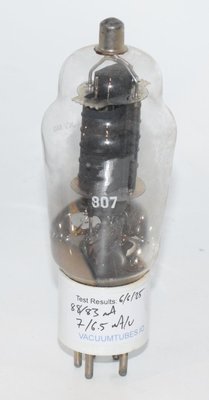
1. Introduction and History
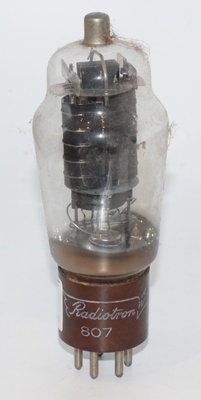
The ATS25 is a beam power tetrode of British military origin, closely related to the legendary 807 transmitting tube developed by RCA in the late 1930s. The ATS25 designation follows the British Air Ministry / Services naming convention, where "ATS" denotes an "Air Ministry Transmitting tube, Screen-grid" type. It was primarily manufactured for use in Royal Air Force (RAF) communications equipment during and after World War II, serving in airborne and ground-based radio transmitters, modulators, and audio amplifiers.
The ATS25 is distinguished from the standard commercial 807 by its use of a ceramic base, which provides superior insulation and thermal stability — critical requirements for military equipment operating in harsh environments. The ceramic base construction reduces dielectric losses at high frequencies and improves reliability under vibration, temperature extremes, and humidity conditions encountered in military service.
The tube was manufactured by several British firms including STC (Standard Telephones and Cables), MOV (Marconi-Osram Valve), Mullard, and others under various military contracts. It carries numerous military cross-reference designations including CV124, CV1060, VT60 (RAF), and the American VT100, reflecting its widespread adoption across Allied forces during the war years.
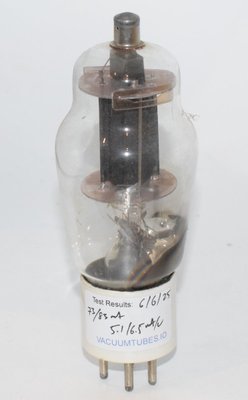
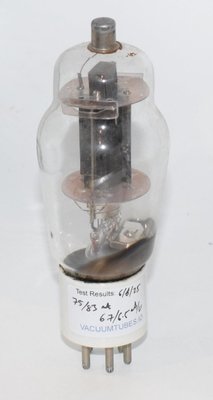
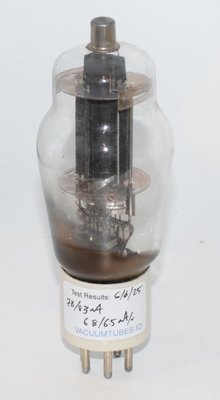
The ATS25 uses the same internal structure as the 807: a beam-forming tetrode with aligned grids and beam-confining plates, housed in a shouldered glass envelope (similar to the ST shape) mounted on a ceramic octal-style base. The plate connection is brought out through a separate top cap to maintain adequate insulation for the high plate voltages the tube is designed to handle — up to 600V in audio service and 750V in RF applications.
2. Technical Specifications and Design
2.1 General Characteristics
| Parameter | Value |
|---|---|
| Tube Type | Beam Power Tetrode |
| Base Type | Ceramic Octal (International Octal, IO) with top cap plate connection |
| Envelope Type | Shouldered glass (ST-16 style) |
| Mounting | Vertical or horizontal (check manufacturer recommendations for horizontal operation) |
| Plate Connection | Top cap (separate from base pins) |
2.2 Heater Ratings
| Parameter | Value |
|---|---|
| Heater Voltage (Vh) | 6.3 V |
| Heater Current (Ih) | 0.9 A |
2.3 Maximum Ratings (Absolute)
| Parameter | Value |
|---|---|
| Maximum Plate Voltage (Va(max)) | 600 V (audio); 750 V (RF/CW service) |
| Maximum Plate Dissipation (Pa(max)) | 25 W |
| Maximum Screen Grid Dissipation (Pg2(max)) | 3.5 W |
2.4 Typical Operating Characteristics
The transconductance (gm) is specified as 5.7 mA/V under the single-ended Class A operating conditions listed below. The amplification factor (μ) and plate resistance (rp) can be derived from the relationship μ = gm × rp. Note: Exact values for μ and rp under specific conditions should be confirmed against the manufacturer's published plate characteristic curves, but typical values for the 807 family are μ ≈ 22–25 and rp ≈ 4,000–5,000 Ω in pentode mode.
2.5 Pin-Out (Base Connections)
The ATS25 uses a standard International Octal (IO) base with ceramic construction. The pin-out follows the standard 807 configuration:
| Pin | Connection |
|---|---|
| Pin 1 | No Connection (NC) |
| Pin 2 | Heater |
| Pin 3 | Plate (internally — see note) |
| Pin 4 | Screen Grid (g2) |
| Pin 5 | Control Grid (g1) |
| Pin 6 | No Connection (NC) |
| Pin 7 | Heater |
| Pin 8 | Cathode (and beam-forming plates, internally connected) |
| Top Cap | Plate (Anode) |
Note: On the 807/ATS25, Pin 3 is connected internally to the plate but is NOT intended to carry the full plate current — the top cap is the primary plate connection. Pin 3 exists as a shield/internal connection point. The plate connection must always be made via the top cap.
2.6 Application Data — Audio Service
Class A Single-Ended (Pentode/Beam Tetrode)
| Parameter | Value |
|---|---|
| Plate Voltage (Va) | 500 V |
| Screen Voltage (Vg2) | 200 V |
| Grid Bias (Vg1) | −14.5 V |
| Plate Current (Ia) | 50.0 mA |
| Screen Current (Ig2) | 1.6 mA |
| Load Resistance (Ra) | 39,000 Ω |
| Transconductance (gm) | 5.7 mA/V |
| Cathode Resistor (Rk) | 280 Ω |
| Output Impedance (Zout) | 6,000 Ω |
| Power Output (Pout) | 11.5 W |
| Total Harmonic Distortion | 12% |
Class A Push-Pull (Pentode/Beam Tetrode)
| Parameter | Value |
|---|---|
| Plate Voltage (Va) | 500 V |
| Screen Voltage (Vg2) | 300 V |
| Plate Current (Ia) | 50–60 mA (per tube) |
| Screen Current (Ig2) | 1.25–8.3 mA |
| Cathode Resistor (Rk) | 270 Ω (shared) |
| Output Impedance (Zout) | 9,000 Ω (plate-to-plate) |
| Power Output (Pout) | 32.5 W |
| Total Harmonic Distortion | 2.7% |
Class A Push-Pull (Triode Connected)
| Parameter | Value |
|---|---|
| Plate Voltage (Va) | 325 V |
| Plate Current (Ia) | 40–42 mA (per tube) |
| Cathode Resistor (Rk) | 375 Ω (shared) |
| Output Impedance (Zout) | 8,000 Ω (plate-to-plate) |
| Power Output (Pout) | 6.0 W |
| Total Harmonic Distortion | 0.6% |
Class AB1 Push-Pull (Pentode/Beam Tetrode)
| Parameter | Value |
|---|---|
| Plate Voltage (Va) | 600 V |
| Screen Voltage (Vg2) | 300 V |
| Grid Bias (Vg1) | −29.5 V |
| Plate Current (Ia) | 40–75 mA |
| Screen Current (Ig2) | 0.75–8.8 mA |
| Output Impedance (Zout) | 10,000 Ω (plate-to-plate) |
| Power Output (Pout) | 47.5 W |
| Total Harmonic Distortion | 2.2% |
Class AB1 Push-Pull (Triode Connected)
| Parameter | Value |
|---|---|
| Plate Voltage (Va) | 400 V |
| Grid Bias (Vg1) | −45.0 V |
| Plate Current (Ia) | 30–70 mA |
| Output Impedance (Zout) | 3,000 Ω (plate-to-plate) |
| Power Output (Pout) | 15.0 W |
| Total Harmonic Distortion | 3.0% |
Class AB2 Push-Pull (Pentode/Beam Tetrode)
| Parameter | Value |
|---|---|
| Plate Voltage (Va) | 600 V |
| Screen Voltage (Vg2) | 300 V |
| Grid Bias (Vg1) | −30.0 V |
| Plate Current (Ia) | 30–100 mA |
| Screen Current (Ig2) | 2.5–10.5 mA |
| Output Impedance (Zout) | 6,400 Ω (plate-to-plate) |
| Power Output (Pout) | 80.0 W |
| Total Harmonic Distortion | 3.5% |
2.7 Application Data — RF Service
Class C — CW (Continuous Wave / Telegraphy)
| Parameter | Value |
|---|---|
| Plate Voltage (Va) | 750 V |
| Screen Voltage (Vg2) | 250 V |
| Grid Bias (Vg1) | −45 V |
| Plate Current (Ia) | 100 mA |
| Screen Current (Ig2) | 6 mA |
| Power Output (Pout) | 50 W |
Class C — AM (Amplitude Modulation)
| Parameter | Value |
|---|---|
| Plate Voltage (Va) | 600 V |
| Screen Voltage (Vg2) | 275 V |
| Grid Bias (Vg1) | −90 V |
| Plate Current (Ia) | 100 mA |
| Screen Current (Ig2) | 6.5 mA |
| Power Output (Pout) | 42.5 W |
Class AB1 — RF Linear Amplifier
| Parameter | Value |
|---|---|
| Plate Voltage (Va) | 750 V |
| Screen Voltage (Vg2) | 300 V |
| Grid Bias (Vg1) | −35 V |
| Plate Current (Ia) | 15–70 mA |
| Screen Current (Ig2) | 3–8 mA |
| Power Output (Pout) | 72 W |
Class B — RF (Grounded Grid / Input on g2)
| Parameter | Value |
|---|---|
| Plate Voltage (Va) | 750 V |
| Grid Bias (Vg1) | 0 V |
| Plate Current (Ia) | 15–240 mA |
| Power Output (Pout) | 120 W |
| Notes | Input applied to g2; g1 connected to g2 via 20 kΩ resistor |
3. Applications and Usage
The ATS25 was designed as a versatile beam power tetrode suitable for a wide range of applications:
3.1 Military Communications
The primary application for the ATS25 was in military radio transmitters, where it served as an RF power amplifier, frequency multiplier, and modulator. Its robust ceramic base construction made it ideal for airborne equipment in RAF aircraft, where vibration, altitude, and temperature extremes demanded exceptional reliability. The tube saw extensive service in WWII-era transmitters and continued in military use well into the 1950s and beyond.
3.2 RF Power Amplification
In RF service, the ATS25 is capable of delivering 50 W in Class C CW, 42.5 W in Class C AM, 72 W in Class AB1, and an impressive 120 W in the unusual Class B configuration with signal input on the screen grid. These capabilities made it a popular choice for amateur radio transmitters, particularly on the HF bands, where it could be driven to full output with relatively modest drive power.
3.3 Audio Power Amplification
The ATS25 is equally capable as an audio output tube. In single-ended Class A pentode mode, it delivers 11.5 W — more than adequate for many domestic and monitoring applications. In push-pull configurations, the tube truly excels:
- Class A push-pull (pentode): 32.5 W at 2.7% THD
- Class AB1 push-pull (pentode): 47.5 W at 2.2% THD
- Class AB2 push-pull (pentode): 80 W at 3.5% THD
- Class A push-pull (triode): 6.0 W at an exceptionally low 0.6% THD
- Class AB1 push-pull (triode): 15 W at 3.0% THD
The triode-connected Class A push-pull configuration is particularly noteworthy for its remarkably low distortion of just 0.6%, making it an attractive option for high-fidelity audio applications where sonic purity is paramount.
3.4 Modulator Service
In transmitter designs, pairs of ATS25 tubes were commonly used as Class AB or Class B modulators, providing the audio power necessary to plate-modulate the RF final amplifier stage. The tube's ability to deliver up to 80 W in AB2 push-pull made it well-suited for modulating transmitters running 50–75 W of carrier power.
4. Sound Characteristics
The ATS25, being electrically identical to the 807, shares the same fundamental sonic character — but many listeners and builders report that the military-specification construction and ceramic base of the ATS25 contribute to subtle improvements in microphonic rejection and overall stability that can translate to a quieter, cleaner listening experience.
4.1 Pentode / Beam Tetrode Mode
In pentode (ultralinear or straight beam tetrode) mode, the ATS25 delivers a sound that is often described as:
- Bold and dynamic: The beam tetrode topology provides excellent transient response and a sense of authority, particularly in the bass and lower midrange. The tube has a punchy, immediate quality that works well with dynamic music.
- Slightly forward midrange: Like many beam tetrodes of its era, the ATS25 can exhibit a mild midrange emphasis that gives vocals and instruments a present, engaging quality.
- Extended but not harsh treble: The high-frequency response is well-extended without the brittle or glassy quality sometimes associated with more modern beam tetrodes. The military-grade construction contributes to low microphonic noise, which helps preserve high-frequency detail.
- Powerful bass: With appropriate output transformer matching, the ATS25 delivers firm, well-controlled bass. The high plate voltage capability (up to 600V in audio service) provides excellent headroom and dynamic range.
4.2 Triode-Connected Mode
When triode-connected (screen tied to plate), the ATS25 undergoes a significant transformation in character:
- Smooth and refined: The triode mode dramatically reduces distortion (to as low as 0.6% in Class A push-pull), producing a smoother, more liquid sound with predominantly second-harmonic distortion content.
- Rich midrange: The triode connection brings out a lush, harmonically rich midrange that is particularly flattering to vocals, acoustic instruments, and chamber music.
- Natural decay and ambience: The lower output impedance in triode mode provides better damping and a more natural presentation of reverb tails and room ambience.
- Reduced power but increased finesse: While power output drops significantly (6 W in Class A P/P triode, 15 W in AB1 P/P triode), the sonic quality is considered by many to be superior for critical listening.
4.3 Comparison to Standard 807
Audiophiles who have compared the ATS25 directly against standard commercial 807 tubes often note that the ATS25 exhibits slightly lower noise floor and better microphonic rejection, attributed to its ceramic base and tighter military manufacturing tolerances. The sonic differences are subtle but can be appreciated in quiet passages and with high-efficiency speakers where tube noise becomes more apparent.
5. Equivalent or Substitute Types
5.1 Close / Identical Substitutes (Direct Drop-In Replacements)
The following types are considered electrically identical or very closely matched to the ATS25 and can generally be substituted directly, though base material may differ:
| Type | Notes |
|---|---|
| 807 | The commercial equivalent. Identical electrically; typically has a phenolic (Bakelite) base rather than ceramic. The most widely available substitute. |
| ATS25A | An improved or later-production variant of the ATS25, also with ceramic base. |
| CV1060 | British military CV (Common Valve) designation for the same tube. |
| CV124 | Earlier British military CV designation. |
| CV1364 | British military CV designation variant. |
| CV1374 | British military CV designation variant. |
| CV1572 | British military CV designation variant. |
| QV05/25 | Alternative designation (Quarter-Volt, 5-watt screen, 25-watt plate). |
| VT100 / VT100A | US military (Signal Corps) designation for the 807. |
| VT60 (RAF) / VT60A (RAF) | RAF designation for the same tube type. |
5.2 Different Rating Substitutes (NOT Direct Drop-In)
The following types are related but have different ratings, different base configurations, or other differences that prevent them from being direct drop-in replacements. Circuit modifications may be required:
| Type | Key Differences |
|---|---|
| 807W | Ruggedized version with different maximum ratings; may have different pin configuration or base. |
| CV3809 | Different rating variant. |
| 5B/245M | Different rating variant. |
| 6BG6 / 6BG6G | TV sweep tube derivative of the 807 family; standard octal base with plate brought out to a base pin (no top cap). Different pinout — NOT pin-compatible. |
| 6L6 / 6L6G / 6L6GT | The 807 was derived from the 6L6, but the 6L6 has significantly lower voltage ratings (360V max plate) and all connections on the octal base (no top cap). Different pinout and ratings — requires circuit redesign. |
| CV1286 / CV1947 / CV1948 / CV428 | Related CV-designated types with different ratings. |
| VT115 / VT115A | US military designations for related but differently-rated types. |
Important: When substituting any of the "different rating" types, always verify heater requirements, maximum voltage ratings, pinout, and bias conditions before installation. The 6BG6 and 6L6 family types in particular have fundamentally different base connections and cannot be used without circuit modification.
6. Notable Characteristics
6.1 Ceramic Base Construction
The most distinctive physical feature of the ATS25 is its ceramic base. While the standard commercial 807 uses a phenolic (Bakelite) base, the ATS25's ceramic base provides:
- Superior high-frequency insulation properties with lower dielectric losses
- Better thermal stability — ceramic does not soften or degrade at elevated temperatures
- Improved moisture resistance, critical for tropical and maritime military environments
- Greater mechanical strength and resistance to cracking under thermal shock
6.2 Exceptional Versatility
The ATS25 is remarkably versatile, with published application data covering no fewer than ten different operating configurations spanning audio single-ended, audio push-pull (both pentode and triode), and multiple RF classes of operation. Few tubes of this era offer such a comprehensive range of documented applications.
6.3 High Power Capability
For a tube with a 25 W plate dissipation rating, the ATS25 can deliver impressive output power — up to 80 W in Class AB2 push-pull audio service and 120 W in Class B RF service (with input on g2). This efficiency is a hallmark of the beam power tetrode design.
6.4 Top Cap Plate Connection
The plate connection via a top cap is both a feature and a consideration. It provides excellent insulation between the high-voltage plate circuit and the lower-voltage base connections, which is essential at the 600–750V plate voltages the tube operates at. However, it requires appropriate top cap connectors and careful lead dress to avoid parasitic oscillations, particularly in RF applications.
6.5 Military Build Quality
As a military-specification component, the ATS25 was manufactured to tighter tolerances than commercial 807 tubes. This typically results in better tube-to-tube matching, more consistent performance, and longer operational life. Many NOS (New Old Stock) ATS25 tubes remain in excellent condition decades after manufacture, a testament to the quality of materials and construction.
6.6 Parasitic Oscillation Tendency
Like all members of the 807 family, the ATS25 can be prone to parasitic oscillations, particularly VHF parasitics in RF amplifier service. Proper circuit layout, parasitic suppressors (small resistors or ferrite beads in the plate and screen leads), and adequate neutralization are essential for stable operation. In audio applications, this is less of a concern but good layout practices should still be observed.
7. Usage in the Audio Community
7.1 Revival and Rediscovery
The ATS25 and its 807 equivalents have experienced a significant revival in the audio community since the 1990s. Originally designed as a transmitting tube, the 807/ATS25 was largely overlooked by the hi-fi industry during the golden age of tube audio in the 1950s and 1960s, when purpose-designed audio output tubes like the EL34, KT66, and 6L6GC dominated. However, the DIY audio community and adventurous amplifier designers have rediscovered the tube's excellent audio capabilities.
7.2 Single-Ended Amplifiers
The ATS25 makes an excellent single-ended output tube, delivering 11.5 W in pentode mode — substantially more than the typical 6–8 W from a single-ended EL34 or 6L6. This extra power is valuable when driving less efficient loudspeakers. Single-ended ATS25 amplifiers are popular among DIY builders who appreciate the tube's combination of power, availability, and relatively low cost compared to premium audio tubes.
7.3 Push-Pull Amplifiers
In push-pull configurations, the ATS25 truly shines. A pair of ATS25 tubes in Class A push-pull pentode mode delivers 32.5 W — competitive with many commercial amplifiers using EL34 or KT88 tubes. The Class AB1 configuration at 47.5 W provides ample power for virtually any domestic loudspeaker system. For those seeking maximum power, the Class AB2 configuration delivers a remarkable 80 W from just two tubes, though this requires a driver stage capable of swinging the grid into the positive region.
7.4 Triode-Connected Applications
The triode-connected ATS25 has attracted particular attention from audiophiles seeking the lowest possible distortion. The Class A push-pull triode configuration at 0.6% THD is exceptionally low for a tube amplifier and rivals many solid-state designs. While the 6 W output in this mode limits speaker choices to higher-efficiency designs, the sonic purity is highly prized. The AB1 triode push-pull at 15 W and 3.0% THD offers a practical compromise between power and purity.
7.5 Guitar Amplifiers
The 807 family, including the ATS25, has found a niche in the guitar amplifier world. Some boutique amp builders use 807/ATS25 tubes for their distinctive tonal character, which differs from the more common 6L6 and EL34 tubes typically found in guitar amps. The higher voltage capability allows for greater headroom and a different clipping character that some players find desirable. The top cap plate connection adds a vintage aesthetic that appeals to players and collectors.
7.6 Practical Considerations for Audio Builders
- Output Transformers: The ATS25 requires output transformers with appropriate impedance ratios. For single-ended use, a primary impedance around 6,000 Ω is specified. Push-pull transformers should be rated for the plate-to-plate impedances listed in the application data (3,000–10,000 Ω depending on configuration). The transformer must be rated for the DC plate current and the B+ voltage used.
- Power Supply: The high plate voltages required (325–600V for audio) demand a well-designed, well-insulated power supply. Safety precautions appropriate for high-voltage equipment must be observed.
- Socket Selection: A high-quality ceramic octal socket is recommended to complement the tube's ceramic base. The top cap connector must be rated for the plate voltage and properly insulated.
- Bias Methods: Cathode bias (self-bias) is straightforward using the specified cathode resistor values. Fixed bias can also be used with the specified grid voltage values, offering slightly higher output power and efficiency.
- NOS Availability: NOS ATS25 tubes remain available from military surplus sources, though supplies are gradually diminishing. The standard 807 is more readily available and can be used interchangeably. When purchasing, look for matched pairs or quads for push-pull applications.
- Ultralinear Operation: Although not specified in the original military data, the ATS25 can be operated in ultralinear mode (with the screen connected to an appropriate tap on the output transformer primary), offering a compromise between pentode power and triode linearity. A 40–43% screen tap is commonly used with 807-type tubes.
7.7 Notable Audio Projects Using 807/ATS25
Several well-known DIY audio projects and commercial amplifiers have featured the 807/ATS25:
- Vintage military surplus amplifiers (such as those from wartime communications equipment) have been repurposed as hi-fi amplifiers, often with minimal modification.
- Various DIY audio forums and publications have featured 807-based amplifier designs, ranging from simple single-ended designs to sophisticated push-pull amplifiers with ultralinear output stages.
- Some boutique amplifier manufacturers have produced limited-edition amplifiers using NOS military 807/ATS25 tubes, capitalizing on their rugged construction and distinctive appearance.
The ATS25 represents an excellent value proposition for the audio enthusiast: military-grade construction, proven performance, versatile operating configurations, and a rich history — all in a tube that remains available and affordable compared to many sought-after audio types.