Introduction and History
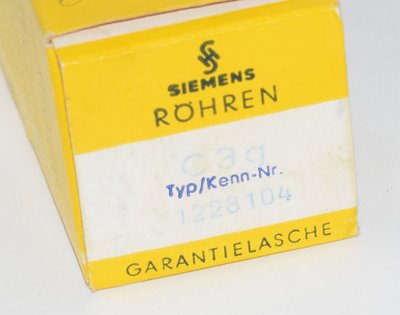
The C3g is a high-quality broadband pentode (Breitband-Pentode) manufactured by Siemens & Halske AG, one of Germany's most prestigious electronics companies. Developed primarily for professional telecommunications applications, the C3g was designed for use in HF (high-frequency), IF (intermediate-frequency), and broadband amplifier stages in post-war German telecommunications infrastructure. The tube's datasheet designation is RöK 3222, dated January 1, 1960.
The C3g belongs to the family of premium-grade German post tubes (Postroehren) — valves built to exacting military and telecommunications standards that far exceeded those of consumer-grade tubes. These tubes were manufactured with tight tolerances, special inter-layer-free cathodes (Zwischenschichtfreie Spezialkathode), and were guaranteed for long operational lifetimes exceeding 10,000 hours. The Siemens datasheet specifically highlights the following quality characteristics:
- Long lifespan (> 10,000 hours)
- High reliability (Große Zuverlässigkeit)
- Tight tolerances (Enge Toleranzen)
- Special cathode free of interlayer effects (Zwischenschichtfreie Spezialkathode)
Originally intended for repeater amplifiers in telephone trunk lines and broadband communications equipment, the C3g has found a remarkable second life in the high-end audio community, where its exceptional electrical characteristics and build quality make it a highly sought-after tube for preamplifier and headphone amplifier designs.
Technical Specifications and Design
Heater Data
| Parameter | Value |
|---|---|
| Heater Voltage (Uf) | 6.3 V |
| Heater Current (If) | 370 ± 20 mA |
| Heater Type | Indirectly heated, AC or DC, parallel feed |
Characteristic Data (Pentode Mode)
Measured at: Ua = 220 V, Ug3 = 0 V, Ug2 = 150 V, Rk = 115 Ω
| Parameter | Min | Typical | Max | Unit |
|---|---|---|---|---|
| Anode Current (Ia) | 10 | 13 | 16 | mA |
| Screen Grid Current (Ig2) | 2.6 | 3.3 | 4.0 | mA |
| Transconductance (S) | 12 | 14 | 16.3 | mA/V |
| Screen-to-Control Grid Amplification Factor (μg2g1) | — | 41 | — | — |
| Internal Resistance (Ri) | — | 300 | — | kΩ |
| Leakage Resistance (RiL) | — | 1.7 | — | kΩ |
| Equivalent Noise Resistance (Raq) | — | 650 | — | Ω |
| Effective Output Resistance Re (f=100 MHz) | — | 2 | — | kΩ (note 1) |
| Grid Voltage for Ia = 0.1 mA (-Ug1) | — | 4.5 | — | V |
| Grid Voltage for Ig1 = 0.3 μA (-Ug1) | — | ≤ 0.8 | — | V |
Note 1: Both cathode connections paralleled.
Characteristic Data (Triode Mode — g2 to anode, g3 to cathode)
Measured at: Ua = 200 V, Rk = 180 Ω
| Parameter | Value | Unit |
|---|---|---|
| Anode Current (Ia) | 17 | mA |
| Transconductance (S) | 17 | mA/V |
| Amplification Factor (μ) | 40 | — |
| Internal Resistance (Ri) | 2.3 | kΩ |
| Equivalent Noise Resistance (Raq) | ≈ 200 | Ω |
Maximum Ratings (Grenzdaten)
| Parameter | Max Value | Unit |
|---|---|---|
| Anode Voltage (peak) Uao | 550 | V |
| Anode Voltage Ua | 220 | V |
| Anode Dissipation Qa | 3.5 | W |
| Screen Grid Voltage (peak) Ug2o | 550 | V |
| Screen Grid Voltage Ug2 | 220 | V |
| Screen Grid Dissipation Qg2 | 0.7 | W |
| Suppressor Grid Voltage (peak) Ug3o | 550 | V |
| Suppressor Grid Voltage Ug3 | 220 | V |
| Suppressor Grid Dissipation Qg3 | 0.7 | W |
| Negative Control Grid Voltage -Ug1 | 50 | V |
| Control Grid Dissipation Qg1 | 50 | mW |
| Control Grid Resistance Rg1 | 0.5 | MΩ |
| Cathode Current Ik | 30 | mA |
| Heater-Cathode Voltage Ufk | 120 | V |
| Heater-Cathode Resistance Rfk | 20 | kΩ |
| Maximum Envelope Temperature thülse | 120 | °C |
Interelectrode Capacitances (Pentode Mode)
| Parameter | Value | Unit |
|---|---|---|
| Input Capacitance Ce | 9.5 ± 1.0 | pF |
| Effective Input Capacitance Ce' (Ik=16.3 mA) | ≈ 13.8 | pF |
| Output Capacitance Ca | 3.5 ± 0.5 | pF |
| Anode-to-Grid 1 Cag1 | < 12 | mpF (avg. 10 mpF) |
| Anode-to-Grid 3 Cag3 | 2 | pF |
| Anode-to-Cathode Cak | 8 | mpF |
| Anode-to-Filament Caf | 8 | mpF |
| Grid 3-to-Grid 2 Cg3g2 | 2 | pF |
| Grid 2-to-Grid 1 Cg2g1 | 2.7 | pF |
| Grid 1-to-Cathode Cg1k | 5.5 | pF |
| Grid 1-to-Filament Cg1f | < 40 | mpF (avg. 30 mpF) |
| Cathode-to-Filament Ckf | 3.8 | pF |
Capacitances (Triode Mode — g2 to anode, g3 to cathode)
| Parameter | Value | Unit |
|---|---|---|
| Ce | 7 | pF |
| Ca | 6 | pF |
| Cag1 | 2.7 | pF |
Operating Data as Power Amplifier (Single-Ended Class A)
| Parameter | No Signal | With Signal (Ug1~ = 0.85 V) | Unit |
|---|---|---|---|
| Anode Voltage Ua | 220 | V | |
| Suppressor Grid Voltage Ug3 | 0 | V | |
| Screen Grid Voltage Ug2 | 150 | V | |
| Anode Load Resistance Ra | 15 | kΩ | |
| Cathode Resistance Rk | 115 | Ω | |
| Anode Current Ia | 13 | 13 | mA |
| Screen Grid Current Ig2 | 3.3 | 4.7 | mA |
| Output Power Na~ | — | 1.2 | W |
| Distortion k | — | 10 | % |
End-of-Life Parameters
Measured at the same operating point as the characteristic data (pentode mode):
| Parameter | Limit | Unit |
|---|---|---|
| Ia | ≤ 8.3 | mA |
| S | ≥ 9.8 | mA/V |
| Ig1 | ≥ 1.0 | μA |
Isolation Resistances
| Electrode Pair | Test Voltage | Minimum Resistance |
|---|---|---|
| Anode / all other electrodes | Uis = 300 V | ≥ 1000 MΩ |
| Grid 1 / all other electrodes | Uis = 100 V | ≥ 1000 MΩ |
| Filament / Cathode | Uis = 100 V | ≥ 100 MΩ |
Negative Grid Current
-Ig1 ≤ 0.5 μA (measured at the characteristic data operating point)
Physical Construction
| Parameter | Value |
|---|---|
| Base Type | Continental key socket (Kontinentaler Schlüsselsockel), 9-pin |
| Sockets | Phenolic: 9 Rel lp 12; Ceramic: Rel stv 149 |
| Envelope | Metal-shielded (steel can), max diameter 32 mm, max height 55 mm |
| Weight | Approximately 30 g |
| Mounting Position | Any (beliebig) |
Pinout (Continental Key Socket — Bottom View)
| Pin | Function |
|---|---|
| 1 | Grid 1 (g1) |
| 2 | Grid 3 / Suppressor (g3,s) |
| 3 | Anode (a) |
| 4 | Screen Grid (g2) |
| 5 | Cathode (k) |
| 6 | (not used / internal connection) |
| 7 | Cathode (k) — second connection |
| 8 | Filament (f) |
| 9 | Filament (f) |
| Metal shell (m) | Internal shield / metal envelope |
Note: The C3g has two cathode pins (pins 5 and 7), which should be connected in parallel for normal operation. The metal shell serves as an internal shield.
Applications and Usage
The C3g was originally designed by Siemens for professional telecommunications applications, specifically:
- HF (High-Frequency) Amplifiers: The tube's high transconductance and low noise made it ideal for RF amplification stages in communications receivers and transmitters.
- IF (Intermediate-Frequency) Amplifiers: The C3g's broadband characteristics and tight tolerances made it well-suited for IF strip amplifiers in superheterodyne receivers.
- Broadband Amplifiers: As the datasheet title "Breitband-Pentode" indicates, this was the tube's primary intended application — wideband amplification in telephone repeater stations and similar telecommunications infrastructure.
- Video Amplifiers: The combination of high transconductance (14 mA/V typical in pentode mode, 17 mA/V in triode mode) and relatively low interelectrode capacitances made the C3g suitable for video-frequency amplification.
The tube's extremely low equivalent noise resistance — 650 Ω in pentode mode and approximately 200 Ω in triode mode — made it particularly valuable in applications where signal-to-noise ratio was critical. The special interlayer-free cathode construction contributed significantly to this low-noise performance and also to the tube's exceptional longevity.
In pentode mode, the C3g offers an internal resistance of 300 kΩ, providing very high voltage gain when used with appropriate load resistances. In triode mode (with g2 connected to the anode and g3 connected to the cathode), the internal resistance drops dramatically to 2.3 kΩ, while maintaining a high amplification factor of 40 and an impressive transconductance of 17 mA/V.
Sound Characteristics
The C3g has earned a devoted following among audiophiles and tube audio enthusiasts, who consistently praise its sonic qualities. The tube's sound character varies significantly depending on whether it is operated in pentode or triode mode:
In Triode Mode (Most Common Audio Configuration)
When wired as a triode (screen grid tied to anode, suppressor grid tied to cathode), the C3g is widely regarded as one of the finest-sounding small-signal tubes available. Audiophiles and reviewers commonly describe its sound as:
- Exceptionally transparent and detailed: The C3g's low noise floor (Raq ≈ 200 Ω in triode mode) allows micro-details and spatial cues to emerge from a very black background. This is one of the quietest tubes available for preamplifier service.
- Fast and dynamic: The high transconductance of 17 mA/V in triode mode gives the C3g excellent transient response. Listeners frequently note a sense of speed and immediacy that is more commonly associated with solid-state amplification, yet without the clinical or sterile quality.
- Extended and airy treble: The broadband design heritage of the C3g translates directly into audio performance. The high-frequency response is open, extended, and free of the rolled-off or soft character sometimes associated with other tube types.
- Tight, controlled bass: The low plate resistance of 2.3 kΩ in triode mode provides excellent damping and control, resulting in bass that is articulate, well-defined, and punchy rather than bloomy or loose.
- Neutral tonal balance: Unlike some tubes that are prized for their euphonic colorations, the C3g is valued for its accuracy and neutrality. It does not impose a heavy "tube sound" on the signal but rather presents music with a natural, unforced quality.
- Excellent soundstaging: The combination of low noise, wide bandwidth, and high linearity allows the C3g to render spatial information with precision, creating a convincing three-dimensional soundstage with well-defined instrument placement.
In Pentode Mode
When operated as a pentode, the C3g offers even higher gain but with a slightly different sonic character:
- Higher gain and more forward presentation: The very high plate resistance (300 kΩ) and high transconductance yield enormous voltage gain, which can be useful in low-output source applications.
- Slightly more analytical: Some listeners find the pentode mode to be more revealing and analytical compared to the warmer, more relaxed triode mode.
- Greater sensitivity to power supply quality: The high gain in pentode mode makes the tube more susceptible to power supply noise, requiring more careful circuit design.
Overall, the C3g is often compared favorably to other legendary small-signal tubes such as the E88CC/6922, the 5687, and even the Western Electric 437A. Many experienced listeners consider the C3g in triode mode to be superior to all of these in terms of resolution, dynamics, and noise performance.
Equivalent or Substitute Types
| Type | Relationship | Notes |
|---|---|---|
| CV10522 | Direct equivalent | British CV (Common Valve) designation for the C3g. Electrically and physically identical; direct drop-in replacement. |
The C3g uses a Continental key socket (Kontinentaler Schlüsselsockel), which is a specialized 9-pin base that is not the same as the standard Noval (B9A) base used by most 9-pin miniature tubes. This means the C3g cannot be directly substituted into circuits designed for standard Noval-based tubes without a socket adapter. The key socket has a different pin arrangement and a keying mechanism to prevent incorrect insertion.
There are no widely recognized direct substitutes from other tube families that share the same socket and identical characteristics. Some designers have used adapter sockets to allow the C3g to be used in place of other tube types, but this requires careful attention to pinout differences and operating point compatibility.
Tubes sometimes mentioned in the same context as the C3g due to similar applications or performance class include the E80F (Philips/Mullard pentode) and the D3a (Siemens/Telefunken), but these are not pin-compatible and have different electrical characteristics. The D3a in particular is sometimes compared to the C3g as both are high-transconductance Siemens pentodes used in telecommunications, but the D3a uses a different base and has different ratings.
Notable Characteristics
- Exceptional build quality: As a German Postroehre (post/telecommunications tube), the C3g was manufactured to standards far exceeding those of consumer tubes. Each tube was individually tested and had to meet tight tolerance specifications before leaving the factory.
- Special interlayer-free cathode: The Zwischenschichtfreie Spezialkathode is a key feature that contributes to both the tube's low noise performance and its exceptional longevity. This cathode construction minimizes the formation of resistive interface layers between the cathode base metal and the emissive coating, which is a common cause of noise and performance degradation in conventional tubes.
- Dual cathode pins: The C3g features two separate cathode connections (pins 5 and 7), which are intended to be connected in parallel. This design reduces cathode lead inductance, which is critical for maintaining performance at high frequencies — a direct reflection of the tube's broadband amplifier heritage.
- Metal envelope with internal shielding: The steel can construction provides excellent electromagnetic shielding, reducing susceptibility to external interference. The metal shell is connected to an internal shield and is accessible via the socket.
- Remarkably high transconductance: At 14 mA/V (typical) in pentode mode and 17 mA/V in triode mode, the C3g offers transconductance figures that rival or exceed many larger power tubes, despite being a small-signal type with modest heater power consumption (approximately 2.3 W).
- Very low noise: The equivalent noise resistance of 650 Ω in pentode mode and approximately 200 Ω in triode mode places the C3g among the quietest vacuum tubes ever manufactured. This makes it exceptionally well-suited for phono preamplifier and microphone preamplifier applications.
- Long guaranteed lifespan: The > 10,000 hour lifespan guarantee (with heater voltage maintained within ± 5% of nominal) was a testament to the tube's robust construction. Many C3g tubes in audio service today have been operating reliably for decades.
- Versatile operating modes: The ability to operate effectively as either a pentode or a triode gives circuit designers significant flexibility. The triode mode, in particular, offers an unusually attractive combination of high μ (40), high transconductance (17 mA/V), and low plate resistance (2.3 kΩ).
- Continental key socket: While the specialized socket can be seen as a disadvantage in terms of availability, it also ensures that the tube cannot be accidentally inserted into the wrong socket, and the keyed design prevents incorrect orientation.
Usage in the Audio Community
The C3g has become one of the most celebrated tubes in the high-end audio community, particularly among headphone amplifier and preamplifier enthusiasts. Its journey from telecommunications workhorse to audio darling is a fascinating example of how professional-grade components can find new life in audiophile applications.
Headphone Amplifiers
The C3g has become particularly popular in headphone amplifier designs, where its characteristics are ideally suited:
- Bottlehead designs: The Bottlehead community has embraced the C3g, with various DIY designs featuring this tube as a driver or gain stage.
- Custom OTL (Output Transformerless) designs: The C3g's low plate resistance in triode mode (2.3 kΩ) makes it more suitable than many other small-signal tubes for driving headphones through relatively simple output stages.
- Commercial headphone amplifiers: Several boutique manufacturers have produced headphone amplifiers featuring the C3g, capitalizing on its exceptional noise performance and dynamic capabilities.
Preamplifiers
The C3g is widely used in line-stage and phono preamplifier designs:
- Line-stage preamplifiers: In triode mode, the C3g's amplification factor of 40 provides ample gain for line-level applications, while its low noise and high linearity ensure transparent signal handling. The low plate resistance allows it to drive long interconnect cables and low-impedance loads with ease.
- Phono preamplifiers: The extraordinarily low noise of the C3g makes it an excellent choice for phono stages, where the very small signals from a phono cartridge demand the quietest possible amplification. The equivalent noise resistance of approximately 200 Ω in triode mode is competitive with the best available alternatives.
- Microphone preamplifiers: Studio engineers and recording enthusiasts have used the C3g in microphone preamplifier designs, where its low noise and wide bandwidth contribute to faithful capture of acoustic signals.
Driver Stages
The C3g's high transconductance and current capability make it an effective driver tube for power output stages. It can deliver sufficient voltage swing and current to drive power tubes such as the 300B, 2A3, 845, and others in single-ended triode amplifier designs.
Tube Rolling and Collecting
The C3g has become a collector's item, with different production vintages and manufacturer markings commanding varying prices:
- Siemens production: The most common and generally most sought-after, with various date codes and internal construction variations across production years.
- Telefunken-branded C3g: Some C3g tubes bear Telefunken markings, as Telefunken was part of the same corporate family. These are often considered sonically equivalent to Siemens-branded examples.
- Lorenz and other manufacturers: Other German manufacturers also produced the C3g to the same specifications.
Prices for NOS (New Old Stock) C3g tubes have risen significantly over the years as audio demand has increased while the finite supply of these no-longer-manufactured tubes continues to diminish. Matched pairs command premium prices, particularly for use in balanced or push-pull circuit topologies.
Practical Considerations for Audio Use
Designers and builders working with the C3g should be aware of several practical considerations:
- Socket availability: The Continental key socket is less common than standard Noval sockets, but ceramic and phenolic versions are still available from specialty suppliers. The Siemens datasheet specifies phenolic socket 9 Rel lp 12 and ceramic socket Rel stv 149.
- Heater supply: The 6.3 V, 370 mA heater can be powered by AC or DC. For the lowest noise in audio applications, DC heater supply with appropriate filtering is recommended, though the tube's excellent internal shielding and cathode construction make it relatively tolerant of AC heating.
- Operating point selection: In triode mode at Ua = 200 V with Rk = 180 Ω, the tube draws 17 mA — a relatively high current for a small-signal tube that ensures operation in a linear region of the characteristic curves.
- Power supply requirements: While the C3g's maximum anode voltage is 220 V (or 550 V peak), most audio designs operate it at modest voltages between 100 V and 220 V, simplifying power supply design.
The C3g represents a convergence of telecommunications engineering excellence and audiophile aspiration. Its combination of low noise, high transconductance, wide bandwidth, and exceptional build quality make it one of the most technically accomplished small-signal tubes ever produced — qualities that translate directly into outstanding audio performance.