1. Introduction and History
The C3M is a small-signal sharp-cutoff pentode manufactured primarily by Siemens & Halske (and to some extent by other German manufacturers) for the Deutsche Bundespost (German Federal Post Office) and professional broadcast/telecommunications applications. Developed in the 1950s, the C3M belongs to a family of high-reliability, long-life tubes designed to meet the exacting standards of the German postal and telecommunications system. These tubes were built to operate continuously for tens of thousands of hours with minimal parameter drift — a requirement that resulted in exceptionally tight manufacturing tolerances and premium materials.
The 'C' designation in the tube's name follows the Siemens/German postal naming convention for professional-grade receiving tubes. The C3M was used extensively in carrier-frequency (Trägerfrequenz) telephone systems, measurement equipment, and studio-grade broadcast electronics throughout Germany and Europe. Because of their exceptional build quality and consistent performance, C3M tubes were produced in very large quantities and many remain available today as new-old-stock (NOS), making them highly sought after in the audiophile community.
The C3M uses a loctal (B8G) base, which provides excellent contact reliability and mechanical stability — critical features for professional rack-mounted equipment that might be subject to vibration. The loctal base also offers superior high-frequency performance compared to octal bases due to shorter pin lengths and better pin-to-pin isolation.
2. Technical Specifications and Design
Electrical Ratings
| Parameter | Value |
|---|---|
| Heater Voltage (Uf) | 20 V (DC) |
| Heater Current (If) | 100 mA |
| Maximum Plate Voltage (Ua max) | 250 V |
| Maximum Screen Grid Voltage (Ug2 max) | 150 V |
| Maximum Plate Dissipation (Wa max) | 1.5 W |
| Maximum Screen Grid Dissipation (Wg2 max) | 0.5 W |
| Transconductance (gm) | ~6.2 mA/V (typical at recommended operating point) |
| Amplification Factor (μ) | ~40–45 (note: this value varies with operating conditions; confirm against specific Siemens datasheet) |
| Plate Resistance (rp) | ~7–8 kΩ (typical, derived from μ/gm) |
| Grid Bias (Ug1) at typical operating point | Approximately −2 V (at Ua = 220 V, Ug2 = 120 V) |
| Plate Current (Ia) at typical operating point | ~7–8 mA |
| Screen Current (Ig2) at typical operating point | ~2 mA |
Typical operating point as specified by Siemens: Ua = 220 V, Ug2 = 120 V, Ug1 = −2 V, Ia ≈ 7.5 mA.
Note: The C3M was designed for DC heater operation at 20 V. In the original Bundespost equipment, heaters were series-connected and fed from a regulated DC supply. For audio applications, a regulated DC heater supply is strongly recommended to minimize hum, given the tube's high gain and low noise floor. Some builders use a series resistor from a higher-voltage DC supply to achieve the correct 20 V / 100 mA heater conditions.
Physical Details
| Parameter | Detail |
|---|---|
| Base Type | Loctal (B8G) — 8-pin loctal socket with center spigot |
| Envelope Type | Miniature all-glass envelope (similar in size to a small noval tube), approximately 20 mm diameter × 55 mm seated height (confirm exact dimensions against datasheet) |
| Mounting | Standard loctal socket (B8G) |
| Construction | Frame grid (Rahmengitter) construction for high transconductance and low noise |
Pin-Out (B8G Loctal Base — Bottom View)
| Pin | Connection |
|---|---|
| Pin 1 | Heater (one end) |
| Pin 2 | Plate (Anode) |
| Pin 3 | Suppressor Grid (g3) — internally connected to cathode in some references; verify per specific datasheet |
| Pin 4 | Screen Grid (g2) |
| Pin 5 | Control Grid (g1) |
| Pin 6 | Cathode |
| Pin 7 | Shield / Internal screen (connected to cathode or ground) |
| Pin 8 | Heater (other end) |
Important: The heater connections are on Pin 1 and Pin 8. The loctal base features a central locating spigot that ensures correct orientation in the socket. Always verify the pin-out against the original Siemens datasheet before wiring, as some secondary sources contain errors. The internal shield connection on Pin 7 should typically be grounded for optimal noise performance.
3. Applications and Usage
The C3M was originally designed for and deployed in:
- Carrier-frequency telephone systems: Used as low-noise amplifier stages in the Trägerfrequenz (carrier frequency) multiplex equipment of the Deutsche Bundespost, where thousands of telephone channels were transmitted over coaxial cables.
- Professional broadcast equipment: Employed in studio-grade preamplifiers, mixing consoles, and measurement equipment by German broadcasters (ARD, ZDF, and regional stations).
- Measurement and test equipment: Used in precision voltmeters, oscilloscopes, and signal generators by Siemens, Rohde & Schwarz, and other German instrument manufacturers.
- Military and industrial electronics: Found in various high-reliability military and industrial systems where long service life and parameter stability were essential.
The tube's frame-grid construction, combined with the stringent quality control of the Bundespost specification, resulted in a tube with exceptionally low noise, low microphonics, and high transconductance — characteristics that make it ideal for high-gain, low-noise front-end amplifier stages.
4. Sound Characteristics
The C3M has earned a devoted following among audiophiles and tube audio designers, who describe its sonic qualities in glowing terms:
- Exceptionally low noise: The frame-grid construction and tight manufacturing tolerances result in a noise floor that rivals or surpasses many modern low-noise tubes. This makes the C3M ideal for phono preamplifiers and microphone preamps where signal levels are very low.
- Transparency and detail: Listeners consistently describe the C3M as highly transparent and revealing, with excellent resolution of fine musical detail. The tube seems to "get out of the way" of the music, presenting a clean, uncolored window into the recording.
- Extended, airy treble: The high-frequency response is often described as open, extended, and delicate — without the harshness or grain that can afflict lesser pentodes. This airiness is attributed in part to the frame-grid's superior high-frequency transconductance characteristics.
- Tight, articulate bass: Despite being a small-signal pentode, the C3M delivers bass that is well-defined and controlled, without the wooliness sometimes associated with triode-connected stages.
- Neutral tonal balance: The C3M is generally considered tonally neutral rather than warm or euphonic. It does not impose a strong "tube character" on the signal, which makes it appealing to listeners who value accuracy over coloration.
- Excellent dynamics: The tube's high transconductance and relatively low plate resistance contribute to a lively, dynamic presentation with good transient response.
- Low microphonics: The robust loctal base and rigid internal construction make the C3M highly resistant to microphonic noise — a significant advantage in sensitive preamplifier circuits.
In pentode mode, the C3M offers maximum gain and the most extended frequency response. When triode-connected (screen tied to plate), the tube trades some gain for even lower distortion and a slightly warmer, more "liquid" midrange character. Many audio designers offer both options or use a combination in multi-stage designs.
5. Equivalent or Substitute Types
True equivalents for the C3M are limited due to its specialized loctal base and 20 V heater:
- C3o: An earlier Siemens Bundespost pentode with similar specifications but slightly different characteristics. Uses the same loctal (B8G) base. The C3o is sometimes considered interchangeable in audio circuits, but operating points may differ slightly. Check datasheets carefully before substituting.
- D3a: Another Siemens Bundespost frame-grid pentode, but this is a different tube with different specifications (higher transconductance, different operating points) and uses a 9-pin Magnoval (B9D) base — not pin-compatible with the C3M. However, the D3a is often discussed alongside the C3M in audio circles as a comparable high-quality Bundespost pentode.
Important note: There is no direct drop-in equivalent from other manufacturers (such as American or British tube families) due to the C3M's unique combination of loctal base, 20 V DC heater, and specific electrical characteristics. Any substitution requires careful circuit adaptation. The EF804S (Telefunken) is sometimes mentioned in similar contexts as a high-quality frame-grid pentode, but it uses a noval (B9A) base and has different specifications — it is not a substitute.
6. Notable Characteristics
- Frame-grid construction: The C3M uses a precision frame grid (Rahmengitter), where the control grid wires are wound on a rigid metal frame rather than the traditional ladder-style supports. This results in extremely consistent grid-to-cathode spacing, which directly translates to high transconductance, low noise, and excellent unit-to-unit consistency.
- 20 V DC heater: The 20 V heater voltage is unusual and was chosen for the series-heater strings used in Bundespost rack equipment. Audio builders must provide a dedicated DC heater supply, which adds complexity but also eliminates AC heater-induced hum — a net benefit for audio applications.
- Extraordinary longevity: These tubes were specified for service lives of 10,000 hours or more in continuous professional operation. Many NOS examples test as new after decades in storage.
- Tight parameter matching: Bundespost specifications required very tight parameter tolerances. This means that NOS C3M tubes are often remarkably well-matched, simplifying the task of building balanced or push-pull circuits.
- Loctal base advantages: The loctal base provides a positive mechanical lock (via the center spigot), excellent contact reliability, and good high-frequency characteristics due to short, well-separated pins. The socket also shields the base connections, reducing stray coupling.
- Internal shielding: The C3M features an internal electrostatic shield (connected to Pin 7) that further reduces noise and stray signal pickup.
- Compact size: Despite its professional pedigree, the C3M is physically small — comparable to a noval miniature tube — making it easy to incorporate into compact audio designs.
7. Usage in the Audio Community
The C3M has become one of the most celebrated small-signal tubes in the high-end audio community, particularly among DIY builders and boutique amplifier manufacturers. Its applications in audio include:
Phono Preamplifiers
The C3M's ultra-low noise and high gain make it an outstanding choice for moving-magnet (MM) and, with appropriate step-up transformers or additional gain stages, moving-coil (MC) phono preamplifiers. Several highly regarded DIY phono preamp designs are built around the C3M, taking advantage of its low noise floor to extract maximum detail from vinyl recordings.
Line-Stage Preamplifiers
Used in both pentode and triode-connected configurations, the C3M serves as an excellent line-stage amplifier. In pentode mode, a single C3M stage can provide sufficient gain to drive most power amplifiers directly. In triode mode, the lower gain is often still adequate for line-level duties, with the bonus of reduced distortion.
Microphone Preamplifiers
Professional and DIY microphone preamplifier designs have adopted the C3M for its combination of low noise, high gain, and low microphonics — all critical parameters for capturing delicate acoustic sources.
Driver Stages
The C3M's high transconductance and good linearity make it suitable as a driver stage for power tubes, particularly in single-ended triode (SET) amplifiers where a clean, high-swing driver signal is essential.
Headphone Amplifiers
Some boutique headphone amplifier designs use the C3M as a gain stage, capitalizing on its low noise and transparency to deliver detailed, dynamic sound through high-quality headphones.
Practical Considerations for Audio Builders
- Heater supply: A regulated 20 V DC supply is essential. Many builders use an LM317 or similar adjustable regulator circuit. The 100 mA heater current is modest and easy to supply.
- Socket sourcing: Loctal (B8G) sockets are less common than octal or noval types but remain available from specialty suppliers. NOS ceramic loctal sockets from European manufacturers offer the best quality.
- Operating points: The Siemens datasheet operating point (Ua = 220 V, Ug2 = 120 V, Ug1 = −2 V) is a good starting point for audio use. Many designers experiment with lower plate voltages and adjusted screen voltages to optimize linearity and distortion characteristics for audio.
- Triode connection: Connecting the screen grid (Pin 4) to the plate (Pin 2) through a small stopper resistor (typically 100–470 Ω) converts the C3M to triode operation, reducing gain but also reducing distortion and output impedance.
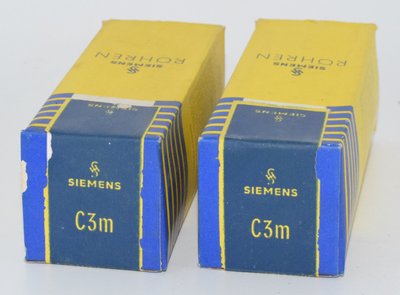
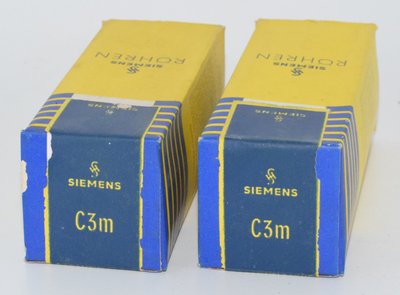
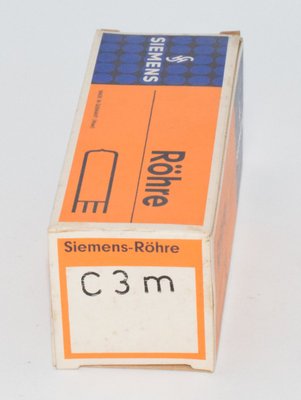
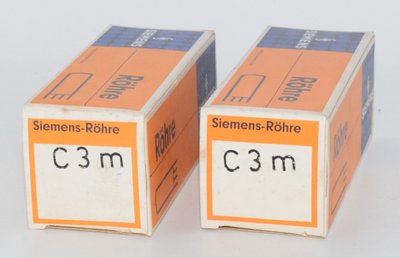
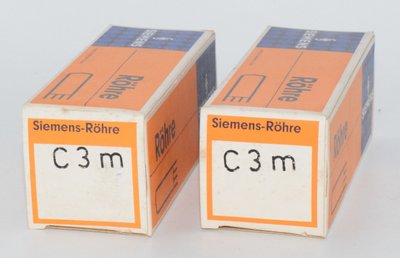
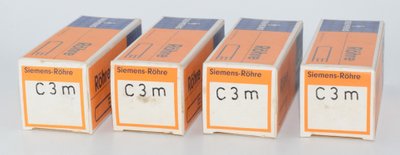
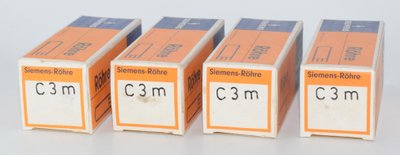
- Availability: As of recent years, NOS C3M tubes remain available from European tube dealers, though prices have risen as audiophile demand has increased. The tubes are typically found in their original Siemens or Bundespost packaging, often with individual test data sheets — a testament to the quality control of the original production.
The C3M represents a pinnacle of European tube manufacturing — a component designed without compromise for professional applications, which has found a second life as a prized audio tube. Its combination of frame-grid precision, loctal-base reliability, and Bundespost-grade quality control makes it one of the finest small-signal pentodes ever produced.