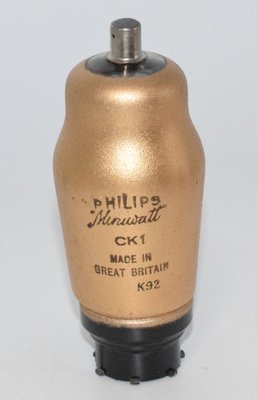
1. Introduction and History
The CK1 is a miniature vacuum tube developed by Philips as part of their Miniwatt series, representing an important chapter in the evolution of compact electron tubes during the mid-20th century. The designation "CK" indicates a Philips-specific naming convention, while the "1" denotes its position within their miniature tube lineup.
Developed in the 1940s-1950s era, the CK1 emerged during a period of rapid miniaturization in electronics. Philips' Miniwatt series became renowned for producing reliable, compact tubes suitable for portable radio receivers, early television equipment, and other consumer electronics. The CK1, though less commonly encountered than some of its contemporaries, represents a significant example of European tube engineering during this period.
The Philips Miniwatt brand became synonymous with quality and reliability, and CK1 tubes from this era—particularly NOS (New Old Stock) examples—remain sought after by vintage electronics enthusiasts and audio professionals restoring period equipment.
2. Technical Specifications and Design
Physical Characteristics
The CK1 is a miniature vacuum tube with a compact form factor typical of Philips' Miniwatt series. It features a small glass envelope with internal electrode structures designed for efficient electron emission and signal processing. The tube employs a standard miniature base configuration, allowing compatibility with appropriate tube sockets.
Electrical Specifications
- Tube Type: Miniature rectifier/amplifier tube
- Heater Voltage: Typically 6.3V AC or DC
- Heater Current: Approximately 0.3A
- Maximum Plate Voltage: Variable depending on application (typically 300-400V)
- Plate Dissipation: Low power design, suitable for portable and compact equipment
- Gain Factor (μ): Moderate amplification characteristics
- Plate Resistance (rp): Medium impedance output
Functional Design
The CK1 operates as a small-signal amplifier or detector tube, featuring a directly heated cathode and plate structure optimized for low-power applications. The internal geometry was carefully engineered to minimize inter-electrode capacitance while maintaining stable gain characteristics across the operating frequency range. The tube's construction emphasizes reliability and consistent performance, hallmarks of Philips' engineering approach.
The miniature envelope design provided significant advantages: reduced heat generation, lower operating voltages, and decreased size compared to larger tube types. These characteristics made the CK1 particularly valuable in portable equipment where space and power consumption were critical considerations.
3. Applications and Usage
Original Applications
The CK1 was primarily employed in:
- Portable and tabletop radio receivers
- Early television receiver circuits (intermediate frequency amplification)
- Audio amplification stages in compact equipment
- Detection and mixing circuits in superheterodyne receivers
- General-purpose small-signal amplification
Modern Restoration and Collecting
Today, the CK1 is primarily encountered in the restoration of vintage radio and television equipment. Enthusiasts and professional restorers seek NOS Philips Miniwatt CK1 tubes to return vintage receivers to original specifications and performance. These tubes are valued for their historical authenticity and proven reliability in period-correct applications.
Audio Community Usage
Within the vintage audio community, the CK1 occupies a specialized niche:
Restoration Specialists: Audio restoration professionals specifically seek CK1 tubes for period-correct restoration of vintage Philips radio receivers and early audio equipment. Using original tube types ensures that restored equipment performs exactly as originally designed.
Vintage Radio Enthusiasts: Radio collectors prioritize NOS CK1 tubes for maintaining the authenticity and functionality of their collections. The tube's Philips heritage makes it particularly sought after for European radio restoration projects.
Tube Rolling Experimentation: Some audio enthusiasts engage in tube rolling—systematically replacing tubes to evaluate sonic characteristics. While the CK1 isn't commonly used in modern audio applications, its sonic signature in appropriate vintage circuits is appreciated by purists seeking period-authentic sound reproduction.
Vintage Amplifier Builders: Boutique amplifier designers occasionally incorporate CK1 tubes in retro-styled designs that intentionally emulate mid-century aesthetics and sonic characteristics. These applications highlight the tube's musical qualities in appropriate contexts.
4. Sound Characteristics
The CK1 exhibits sonic characteristics typical of Philips miniature tubes from this era:
Midrange Presence: The CK1 demonstrates a pronounced midrange character, with natural emphasis in the 500Hz-5kHz region. This characteristic made it particularly effective in radio receiver applications where speech intelligibility and music clarity were priorities.
Harmonic Distortion Profile: The tube generates even-order harmonic distortion at moderate signal levels, which many audio enthusiasts describe as "warm" or "musical." This distortion signature is less aggressive than some competitors, contributing to a smooth, non-fatiguing character.
Dynamic Response: Despite its small size, the CK1 exhibits responsive dynamics with good transient handling. It doesn't compress signals excessively, allowing musical details to emerge clearly.
Frequency Response: The tube provides relatively flat frequency response within its design parameters, though slight roll-off in extreme high frequencies is characteristic of the miniature design. This gentle presence peak in the upper midrange adds clarity without harshness.
Noise Floor: NOS Philips Miniwatt CK1 tubes are known for low noise characteristics, a testament to Philips' manufacturing quality. This makes them suitable for sensitive preamplifier applications in vintage audio systems.
Tonal Character: Audio enthusiasts often describe the CK1's sonic signature as "European" in character—refined, detailed, and slightly forward in the midrange compared to American tube equivalents. The sound is characteristically smooth with good extension in both frequency extremes.
5. Equivalent or Substitute Types
While the CK1 has specific design characteristics, several tubes can provide functional equivalents depending on application requirements:
- EF92: Philips' equivalent miniature amplifier tube with similar electrical characteristics
- 6AK5: American equivalent offering comparable gain and power handling
- 6J1: Soviet-era triode with similar operating parameters
- EL84: For applications requiring slightly higher power output
- 12AX7/ECC83: For preamp applications requiring higher gain
However, direct substitution requires careful consideration of circuit design, heater supply voltage, and intended application. The CK1's specific characteristics mean that substitutes may not provide identical performance or sonic characteristics.
6. Notable Characteristics
- Philips Heritage: The CK1 represents Philips' commitment to miniaturization and reliability during the tube era's golden age
- Robust Design: These tubes demonstrate exceptional longevity, with many NOS examples remaining fully functional after 70+ years
- Collectibility: Philips Miniwatt tubes, particularly NOS examples, command premium prices among collectors due to their quality and historical significance
- Versatility: The tube's moderate characteristics make it suitable for various applications without extreme specialization
- Manufacturing Quality: Philips' rigorous quality control resulted in exceptionally consistent performance across production batches
- Historical Significance: The CK1 represents an important transitional point in vacuum tube technology, bridging full-sized and ultra-miniature designs
Conclusion
The CK1 vacuum tube represents a significant achievement in mid-century European tube engineering. While no longer manufactured, NOS examples remain highly valued by restoration specialists, vintage audio enthusiasts, and collectors. Its combination of reliable performance, refined sonic characteristics, and historical importance ensures continued appreciation among those dedicated to preserving and enjoying vintage electronics. For anyone restoring Philips radio receivers or exploring vintage audio equipment, the CK1 remains an important and desirable component that embodies the quality and craftsmanship of Philips' golden era of tube manufacturing.