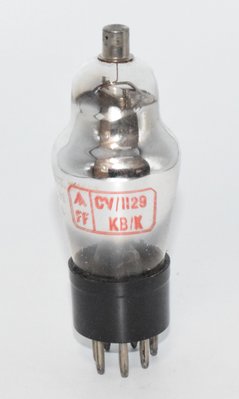
1. Introduction and History
The CV1129 is a British military Common Valve (CV) designation assigned to a high-frequency RF pentode valve originally developed during the Second World War era. The CV numbering system was established by the UK Ministry of Supply (later Ministry of Defence) to standardize and rationalize the vast number of valve types used across military equipment. The CV1129 corresponds to the commercial/service type VR137, which is itself closely related to the EF54 (Mullard designation) — a sharp-cutoff RF pentode designed for use in high-frequency amplifier and mixer stages.
The VR137/CV1129 was manufactured by several British firms, most notably Mullard, Marconi-Osram (MOV/GEC), Cossor, and Brimar, among others. It saw extensive use in wartime radar receivers, communications equipment, and IF amplifier stages. The valve was designed to offer excellent high-frequency performance with low noise and high gain, making it a critical component in sensitive receiver front-end circuits during the 1940s.
The designation "CV1129" was used to ensure interchangeability across different manufacturers' production runs for military procurement. Valves bearing this marking were subject to rigorous quality control and testing standards, often exceeding those of their commercial equivalents. Today, NOS (New Old Stock) examples of the CV1129 are sought after by collectors, vintage radio restorers, and — increasingly — by the audio community for use in high-fidelity preamplifier circuits.
2. Technical Specifications and Design
The CV1129 (VR137 / EF54) is a sharp-cutoff RF pentode with an all-glass construction. Below are the key specifications drawn from available wartime and post-war data references. Note: Some values may vary slightly between manufacturers; the figures below represent typical/maximum ratings as published in standard references.
Heater Ratings
- Heater Voltage (Vf): 6.3 V
- Heater Current (If): 0.2 A
Maximum Ratings (Absolute Maximum)
- Maximum Plate (Anode) Voltage (Va max): 250 V
- Maximum Screen Grid Voltage (Vg2 max): 250 V
- Maximum Plate Dissipation (Pa max): 2.5 W (this value should be confirmed against the specific manufacturer's datasheet, as some references cite slightly different figures)
- Maximum Screen Grid Dissipation (Pg2 max): 0.5 W (approximate — confirm against datasheet)
Typical Operating Conditions (as RF/IF Amplifier)
- Plate Voltage (Va): 250 V
- Screen Grid Voltage (Vg2): 250 V
- Control Grid Voltage (Vg1): −2 V (typical bias point)
- Plate Current (Ia): approximately 8–10 mA
- Screen Current (Ig2): approximately 2.5–3 mA
Characteristic Parameters (at typical operating point)
- Transconductance (gm): approximately 6.5 mA/V (6,500 µS) — some references cite values in the range of 6.0–7.5 mA/V depending on operating conditions
- Amplification Factor (µ): Not commonly specified directly for RF pentodes of this type; the effective µ is very high (typically >1,000) due to the pentode configuration. This value should be confirmed against specific datasheets.
- Plate Resistance (rp): Approximately 0.5–1.0 MΩ (typical for sharp-cutoff RF pentodes at the stated operating point) — confirm against manufacturer data
- Grid Bias Range (Vg1): 0 V to approximately −6 V to cutoff (sharp-cutoff characteristic)
- Input Capacitance (Cin): Approximately 5.0 pF
- Output Capacitance (Cout): Approximately 8.0 pF
- Grid-to-Plate Capacitance (Cag): Approximately 0.003 pF (very low, by design for RF use)
Physical Construction
- Envelope Type: All-glass, tubular (similar in size to the B7G miniature family but uses the older British base — see below). The envelope is a relatively compact glass tube.
- Base Type: B8G (Loctal / British 8-pin lock-in base). Note: Some early references may describe this as a Mazda Octal or similar British 8-pin configuration. The B8G loctal base features 8 pins arranged in a circle with a central locating spigot/key. Confirm the exact base variant against the specific manufacturer's documentation, as some VR137 variants used the British B9G (EF50-style) base.
- Pin-out: The pin connections follow the standard B8G/Loctal arrangement for this valve type. A typical pin-out is as follows (viewed from the underside/pin side):
- Pin 1: Grid 3 (Suppressor Grid) — often internally connected to cathode
- Pin 2: Heater
- Pin 3: Plate (Anode)
- Pin 4: Grid 2 (Screen Grid)
- Pin 5: Grid 1 (Control Grid)
- Pin 6: Cathode
- Pin 7: Heater
- Pin 8: Internal screen / no connection
- Overall Length: Approximately 65–75 mm (varies by manufacturer)
- Maximum Diameter: Approximately 22–25 mm
- Mounting Position: Any (designed for military use in various orientations)
3. Applications and Usage
The CV1129/VR137 was designed primarily for high-frequency applications in military and professional communications equipment. Its principal uses include:
- RF Amplification: Front-end RF amplifier stages in VHF and UHF receivers, where its low grid-to-plate capacitance and high transconductance provided excellent gain with minimal feedback.
- IF Amplification: Intermediate frequency amplifier stages in superheterodyne receivers, particularly in radar and military communications equipment operating at IF frequencies of 10–60 MHz.
- Mixer/Frequency Converter: Used as a mixer valve in receiver front-ends, taking advantage of its sharp-cutoff characteristic for clean signal mixing.
- Oscillator Circuits: Local oscillator stages in receivers and test equipment.
- Wartime Radar Equipment: The CV1129 was widely used in British wartime radar receivers, including various Chain Home and airborne radar sets, where reliable high-frequency performance was critical.
- Post-War Test Equipment: Found in laboratory-grade signal generators, frequency meters, and other precision instruments manufactured in the late 1940s and 1950s.
The sharp-cutoff characteristic of the CV1129 makes it particularly suitable for applications requiring a well-defined and predictable gain control range, as opposed to variable-mu (remote cutoff) types used in AGC-controlled stages.
4. Sound Characteristics
While the CV1129 was never designed with audio applications in mind, its adoption by the audio community — particularly in high-fidelity preamplifier and phono stage circuits — has led to a body of subjective listening impressions. The following descriptions represent commonly reported sonic attributes:
- Detail and Resolution: The CV1129 is frequently praised for its exceptional detail retrieval and micro-dynamic resolution. Its high transconductance and low noise floor (a legacy of its RF heritage) translate into an ability to reveal subtle textural information in recordings that lesser valves may obscure.
- Tonal Balance: Listeners typically describe the CV1129 as having a neutral-to-slightly-warm tonal balance. It avoids the excessive warmth or "syrupy" quality sometimes associated with audio-specific pentodes, instead offering a more transparent and honest presentation.
- Treble Character: The high-frequency extension is often described as smooth, airy, and extended — again reflecting the valve's RF design heritage. There is a natural sweetness to the treble that avoids harshness or grain.
- Midrange: The midrange is typically characterized as clear, articulate, and slightly forward. Vocal reproduction is often singled out as a particular strength, with good presence and natural timbre.
- Bass Response: When used in well-designed circuits, the CV1129 can deliver surprisingly taut and well-defined bass, though it is not typically described as having the weight or authority of larger power pentodes. Bass quality is clean rather than voluminous.
- Noise Floor: One of the CV1129's greatest assets in audio use is its very low noise floor, making it particularly suitable for phono preamplifier stages and other high-gain, low-signal applications where noise performance is critical.
- Soundstage: Users report a wide and well-defined soundstage with good depth and precise imaging, attributes likely related to the valve's low interelectrode capacitances and clean signal handling.
It should be noted that sonic characteristics are highly dependent on the specific circuit topology, associated components, power supply quality, and the individual specimen. Military-grade NOS examples (as denoted by the CV marking) tend to be more consistent in performance than commercial equivalents due to tighter manufacturing tolerances.
5. Equivalent or Substitute Types
The following types are generally considered equivalent or closely related to the CV1129. However, care must be taken to verify base type, pin-out, and operating parameters before substitution:
- VR137: The direct UK service equivalent. The CV1129 IS the VR137 under the CV numbering system. Fully interchangeable.
- EF54: The Mullard commercial designation for essentially the same valve. Generally interchangeable, though confirm the base type matches (B8G Loctal vs. B9G). Some EF54 variants may use the B9G base (similar to the EF50 family), which is NOT pin-compatible with the B8G Loctal version.
- VR137A / CV1936: An improved or tightened-specification variant. Generally interchangeable with the CV1129 but may have slightly different maximum ratings. Verify before substitution.
- 8D3: Sometimes listed as a related type in cross-reference guides, but this should be verified carefully. The 8D3 is a different valve with different characteristics and may not be a true substitute.
Types that are NOT direct equivalents but are sometimes confused:
- EF50 (VR91 / CV1091): A related but different RF pentode with a B9G base. While similar in general concept and era, the EF50 has different electrical characteristics (notably different transconductance and capacitance values) and a different pin-out. NOT a drop-in replacement.
- EF36 (VR56 / CV1056): Another wartime RF pentode, but with an International Octal base and different characteristics. NOT interchangeable.
Always verify the base type and pin-out before attempting any substitution. The use of an incorrect valve type can result in damage to the equipment or the valve itself.
6. Notable Characteristics
- Military-Grade Quality: As a CV-designated valve, the CV1129 was manufactured to stringent military specifications with enhanced quality control, tighter parameter tolerances, and often superior materials compared to commercial equivalents. This makes NOS CV1129 specimens particularly desirable for critical applications.
- Low Noise: The CV1129 was designed for use in sensitive receiver front-ends where noise performance was paramount. This characteristic makes it exceptionally well-suited for high-gain audio preamplifier stages.
- Excellent High-Frequency Performance: With very low grid-to-plate capacitance (approximately 0.003 pF), the CV1129 offers outstanding stability and performance at high frequencies, a characteristic that contributes to its clean, extended treble response in audio applications.
- Sharp Cutoff: The sharp-cutoff characteristic provides a well-defined and predictable relationship between grid voltage and plate current, which can be advantageous in certain audio circuit topologies where precise biasing and predictable gain are required.
- Robust Construction: Military valves were designed to withstand vibration, shock, and temperature extremes. The CV1129's robust construction contributes to long service life and reliable performance.
- Manufacturer Variations: NOS CV1129 valves from different manufacturers (Mullard, GEC/MOV, Cossor, Brimar, etc.) may exhibit subtle differences in construction and, consequently, in sonic character. Collectors and audiophiles often have preferences for specific manufacturers' production.
- Rarity: As a wartime/post-war production valve that has been out of manufacture for decades, genuine NOS CV1129 specimens are becoming increasingly scarce. This rarity, combined with growing audio community interest, has driven prices upward in recent years.
7. Usage in the Audio Community
The CV1129's adoption by the audio community represents a fascinating case of a military/RF component finding new life in a completely different application domain. Here is how the audio community has embraced this valve:
Preamplifier Applications
The most common audio application for the CV1129 is in high-gain preamplifier stages, particularly phono preamplifiers for moving-coil and moving-magnet cartridges. The valve's low noise floor and high transconductance make it ideally suited for amplifying the very small signals produced by phono cartridges. Several boutique and DIY preamplifier designs have been developed specifically around the EF54/VR137/CV1129 family.
DIY and Custom Builds
The DIY audio community has shown particular interest in the CV1129. Designs circulate on forums and in publications that use this valve in various configurations — as a pentode-connected gain stage, in triode-strapped mode (where the screen grid is tied to the plate for lower gain but potentially lower distortion), or as part of SRPP (Shunt Regulated Push-Pull) and cascode topologies. The valve's RF heritage means that careful attention to layout and shielding is required to prevent oscillation in audio circuits.
Headphone Amplifiers
Some headphone amplifier designs incorporate the CV1129 as a voltage gain stage, taking advantage of its high gain and low noise to drive headphones with excellent detail and dynamics. These designs typically use the CV1129 in the front end, followed by a suitable output stage.
Microphone Preamplifiers
Studio engineers and recording enthusiasts have experimented with the CV1129 in microphone preamplifier circuits, where its low noise and high gain are particularly valuable. The valve's neutral tonal character is appreciated in recording applications where coloration should be minimal.
Collector and NOS Market
The CV1129 occupies an interesting position in the NOS valve market. While not as widely known as iconic audio tubes like the 12AX7 or EL34, it has developed a dedicated following among knowledgeable enthusiasts. NOS examples from premium manufacturers — particularly Mullard — command premium prices. The military CV marking is seen as a guarantee of quality, and matched pairs or sets are especially valued.
Practical Considerations for Audio Use
Audio enthusiasts considering the CV1129 should be aware of several practical considerations:
- Base Compatibility: The B8G Loctal base requires appropriate sockets, which may be less readily available than standard Octal or Noval sockets. Quality Loctal sockets should be sourced for best results.
- Circuit Design: The CV1129's high gain and RF capabilities mean that audio circuits must be carefully designed and laid out to prevent instability and oscillation. Proper grounding, shielding, and decoupling are essential.
- Operating Point: While the valve's datasheet operating points are optimized for RF service, audio applications may benefit from different bias points that optimize linearity and distortion performance for audio frequencies. Experimentation and measurement are recommended.
- Triode Strapping: Many audio designers prefer to operate the CV1129 in triode mode (screen tied to plate through a suitable resistor) for lower distortion and a more "triode-like" sonic character, at the expense of reduced gain.
- Supply Considerations: The CV1129's relatively modest heater requirements (6.3V at 0.2A) make it easy to incorporate into existing power supply designs.
The CV1129 represents an excellent example of how military-specification components, designed for entirely different purposes, can find new appreciation and application in the world of high-fidelity audio. Its combination of low noise, high gain, robust construction, and military-grade quality control make it a compelling choice for the discerning audio enthusiast willing to design around its specific requirements.