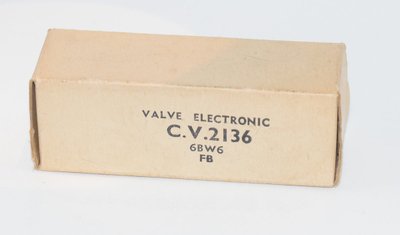
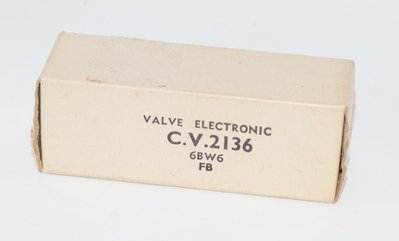
1. Introduction and History
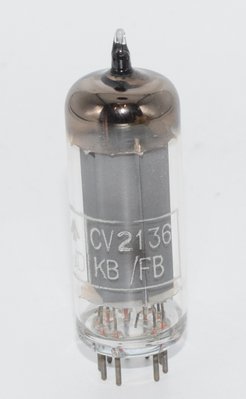
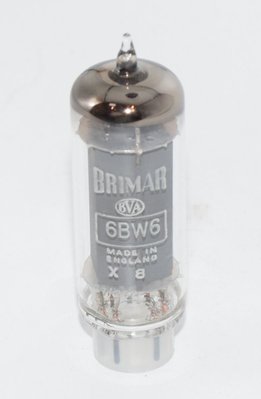
The CV2136 is a British military-specification (CV = Common Valve) designation for a beam power tetrode/pentode designed primarily for audio output service. It is the military-rated equivalent of the commercial 6BW6, a tube developed by Brimar (Standard Telephones and Cables, STC) in the United Kingdom during the early-to-mid 1950s. The CV numbering system was used by the UK Ministry of Defence to ensure consistent, high-reliability valve procurement across multiple manufacturers, and the CV2136 designation guaranteed that any valve bearing this number met stringent military quality and performance standards.
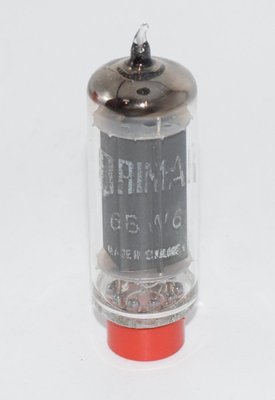
The 6BW6 / CV2136 was designed as a compact, efficient beam power tube for use in audio output stages, particularly in equipment where moderate power output was required from a relatively small envelope. It found widespread use in British military communications equipment, public address systems, and domestic radio and television receivers of the era. The tube was manufactured primarily by Brimar, though other UK manufacturers produced it under the CV2136 designation to meet military contracts.
As a Noval-based (B9A) beam power tube, the CV2136 represented the post-war trend toward miniaturization — offering performance comparable to older octal-based output tubes in a significantly smaller package. Its design lineage places it in the family of medium-power output pentodes that were the workhorses of British audio equipment throughout the 1950s and 1960s.
2. Technical Specifications and Design
Heater / Filament
| Parameter | Value |
|---|---|
| Heater Voltage (Vh) | 6.3 V |
| Heater Current (Ih) | 0.45 A |
| Heater Type | Indirectly heated cathode |
Maximum Ratings
| Parameter | Value |
|---|---|
| Max Plate Voltage (Va max) | 315 V (as used in typical operating conditions; absolute maximum should be confirmed against the full Brimar datasheet — some sources suggest up to 350 V) [⚠ flag: confirm absolute max Va against original Brimar datasheet] |
| Max Screen Grid Voltage (Vg2 max) | 225 V (operating value per reference data; absolute max may be slightly higher) [⚠ flag: confirm absolute max Vg2] |
| Max Plate Dissipation (Pa max) | ~12 W (typical for this class of tube) [⚠ flag: confirm exact max plate dissipation against Brimar datasheet — commonly cited as 11–12 W] |
| Max Screen Dissipation (Pg2 max) | ~2.5–3 W (estimated; confirm against datasheet) |
Typical Operating Conditions — Single-Ended Class A
| Parameter | Value |
|---|---|
| Plate Voltage (Va) | 315 V |
| Screen Grid Voltage (Vg2) | 225 V |
| Control Grid Voltage (Vg1) | −13.0 V |
| Plate Current (Ia) | 34.0 mA |
| Screen Current (Ig2) | 2.2 mA |
| Cathode Resistor (Rk) | 360 Ω |
| Load Resistance (Ra) | 77,000 Ω (this is the effective plate-to-plate or reflected load impedance) |
| Output Impedance (Zout) | 8,500 Ω |
| Power Output (Pout) | 5.5 W |
| Total Harmonic Distortion (THD) | 12% |
Valve Characteristics
| Parameter | Value |
|---|---|
| Transconductance (gm / S) | 3.75 mA/V |
| Amplification Factor (μ) | ~20–25 (estimated from gm × rp relationship; confirm against datasheet) [⚠ flag: not directly provided in reference data] |
| Plate Resistance (rp) | ~5,500–7,000 Ω (estimated; confirm against datasheet) [⚠ flag: not directly provided in reference data] |
Note: The amplification factor (μ) and plate resistance (rp) are not explicitly stated in the available reference data. The estimates above are derived from the general relationship μ = gm × rp and typical values for beam power tubes of this class. Users should verify these values against the original Brimar or STC datasheet.
Physical Construction
| Parameter | Detail |
|---|---|
| Base Type | Noval (B9A) — 9-pin miniature |
| Envelope Type | Glass miniature (T-9 or similar small glass envelope) |
| Mounting | Vertical or horizontal (with appropriate socket) |
| Construction | Beam power tetrode with beam-forming plates |
Pin-Out (B9A / Noval Base — Bottom View)
| Pin | Connection |
|---|---|
| Pin 1 | Grid 3 (Suppressor) / Beam plates — typically connected internally to cathode, or brought out |
| Pin 2 | Heater |
| Pin 3 | Plate (Anode) |
| Pin 4 | Screen Grid (g2) |
| Pin 5 | Control Grid (g1) |
| Pin 6 | Internal Connection — DO NOT GROUND OR CONNECT EXTERNALLY |
| Pin 7 | Heater |
| Pin 8 | Cathode |
| Pin 9 | Grid 3 (Suppressor) / Internal shield or beam plates |
⚠ Important Note: Pin 6 is an internal connection and must not be connected to any external circuit. This is a critical design consideration when building or servicing equipment using the CV2136. The exact pin assignments for pins 1 and 9 should be confirmed against the original Brimar datasheet, as some sources show slight variations in the assignment of suppressor/beam plate connections. [⚠ flag: exact pinout for pins 1, 3, 4, 5, 8, 9 should be verified against the original manufacturer datasheet — the above is based on typical 6BW6 pinout conventions]
3. Applications and Usage
The CV2136 / 6BW6 was designed and deployed across a range of applications:
- Audio Output Stages: The primary intended application. In single-ended Class A configuration, the CV2136 delivers 5.5 watts of audio output power — sufficient for driving loudspeakers in radio receivers, intercommunication systems, and small public address amplifiers. In push-pull configurations, higher power output with lower distortion is achievable.
- Military Communications Equipment: Under its CV2136 designation, this tube was widely used in British military radio receivers and transmitter-receiver sets where reliable audio output was required under demanding environmental conditions. The CV specification ensured consistent performance across production batches and manufacturers.
- Television Receivers: Used as an audio output valve in many British television sets of the 1950s and 1960s, where its compact Noval base and moderate power output were ideal.
- Industrial and Commercial Audio: Found in public address systems, factory intercoms, and institutional audio equipment where moderate power levels and reliability were paramount.
- Instrument Amplifiers: Some smaller guitar and instrument amplifiers of the era utilized the 6BW6 as an output tube, particularly in British-made equipment.
The tube's relatively low screen current (2.2 mA) and moderate plate current (34 mA) make it economical in terms of power supply demands, while its 5.5-watt output capability is well-suited to applications where a single output tube must drive a speaker directly through an output transformer.
4. Sound Characteristics
The CV2136 / 6BW6 occupies an interesting niche in the sonic landscape of beam power tubes. While it has not achieved the widespread fame of tubes like the EL84 or 6V6, those who have used it in audio applications consistently note several distinctive tonal qualities:
- Warm, Rich Midrange: The CV2136 is frequently described as having a characteristically "British" warmth in the midrange frequencies. This quality lends vocals and acoustic instruments a pleasing presence and body that is neither overly forward nor recessed.
- Smooth, Controlled Highs: Unlike some beam power tubes that can exhibit a bright or edgy top end, the CV2136 tends toward a smooth, slightly rolled-off high-frequency response. This makes it forgiving with harsh source material and contributes to a relaxed, fatigue-free listening experience.
- Tight, Articulate Bass: For a tube of its power class, the CV2136 delivers surprisingly well-defined bass response. The beam-forming plate structure contributes to good linearity at lower frequencies, resulting in bass that is controlled rather than bloomy or loose.
- Pleasant Harmonic Distortion Character: At the rated 12% THD at full output, the distortion spectrum is dominated by even-order harmonics (primarily second harmonic), which the ear perceives as musical warmth rather than harshness. At lower power levels, distortion drops significantly, and the tube exhibits excellent linearity.
- Dynamic Response: The CV2136 has a lively, responsive dynamic character. Transients are handled with good speed and definition, giving music a sense of immediacy and engagement that is sometimes lacking in larger, higher-power output tubes operating well below their maximum ratings.
- Single-Ended Character: In single-ended Class A operation — the configuration specified in the reference data — the CV2136 exhibits the classic single-ended qualities: a dimensional, holographic soundstage with excellent depth, a slightly euphonic coloration that flatters most music, and a natural, organic quality to instrumental timbres.
Overall, the CV2136 can be characterized as a "sweet" and "musical" tube that prioritizes tonal beauty and listening pleasure over absolute analytical transparency. It shares some sonic DNA with the EL84/6BQ5 family but with a slightly darker, more refined tonal balance that many listeners find appealing for extended listening sessions.
5. Equivalent or Substitute Types
The following types are confirmed as close or identical substitutes for the CV2136, based on verified reference data:
| Type | Relationship | Notes |
|---|---|---|
| 6BW6 | Commercial equivalent (identical) | The CV2136 is the direct military-grade version of the 6BW6. Electrically and physically identical; direct drop-in replacement. Manufactured by Brimar and others. |
| 6061 | Close/identical substitute | Listed as a direct substitute in reference data. Verify pinout compatibility before substitution. [⚠ Note: the 6061 designation has been used for different tube types by different manufacturers — confirm that the specific 6061 in question is the beam power pentode equivalent, not the 6061 triode used in some American applications.] |
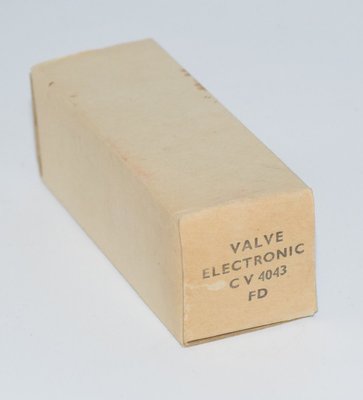
| CV4043 | Close/identical substitute | Another CV-series designation for the same or very closely related type. Military specification; direct replacement. |
| CV8048 | Close/identical substitute | Additional CV-series designation. Direct replacement for the CV2136. |
Types That Are NOT Direct Substitutes
It is important to note that while the CV2136 / 6BW6 shares some general characteristics with other Noval beam power tubes, the following are not direct drop-in replacements without circuit modifications:
- EL84 / 6BQ5: While also a Noval beam power pentode with similar power output capability, the EL84 has different operating points, pinout, and bias requirements. Not a direct substitute.
- 6AQ5 / EL90: Different operating characteristics and pinout. Not interchangeable without circuit changes.
- 6V6: Octal base — physically incompatible without an adapter, and operating parameters differ significantly.
Always verify pinout compatibility and operating conditions before substituting any tube type, even those listed as equivalents. The internal connection on Pin 6 of the CV2136 is a particular point to verify when considering substitutes.
6. Notable Characteristics
- Pin 6 Internal Connection: Perhaps the most critical design note for the CV2136 is that Pin 6 is an internal connection and must not be connected to any external circuit element. This is explicitly noted in the manufacturer's data. Connecting Pin 6 to ground or any other circuit point could damage the tube or cause unpredictable operation. Circuit designers and technicians must ensure that the socket position for Pin 6 is left unconnected.
- Military-Grade Construction: As a CV-designated valve, the CV2136 was manufactured to enhanced quality standards compared to its commercial 6BW6 counterpart. This typically includes tighter parameter tolerances, more rigorous testing (including vibration, temperature cycling, and life testing), and superior materials. NOS (New Old Stock) CV2136 tubes are often preferred by audiophiles over commercial 6BW6 examples for this reason.
- Efficient Screen Grid Design: The remarkably low screen current of just 2.2 mA (compared to 34 mA plate current) indicates an efficient beam-forming structure. This low screen current reduces screen grid dissipation and contributes to longer tube life and more stable operation over time.
- Self-Bias Capability: The specified cathode resistor value of 360 Ω allows straightforward self-biased (automatic bias) operation, simplifying circuit design and eliminating the need for a separate negative bias supply. This makes the CV2136 particularly attractive for simple, reliable amplifier designs.
- Moderate Heater Current: At 0.45 A, the heater current is modest, reducing demands on the power transformer's heater winding and minimizing heat generation — beneficial in compact equipment designs.
- Brimar Heritage: Brimar (British Made) valves, produced by Standard Telephones and Cables (STC), are highly regarded among collectors and audiophiles for their consistent quality and distinctive sonic character. The CV2136 benefits from this manufacturing heritage, and NOS Brimar-made examples are particularly sought after.
- Compact Form Factor: The Noval (B9A) base allows the CV2136 to be used in significantly more compact equipment than octal-based output tubes of similar capability, making it ideal for portable or space-constrained applications.
7. Usage in the Audio Community
The CV2136 / 6BW6 occupies a somewhat under-the-radar position in the audio community, but it has developed a dedicated following among enthusiasts who appreciate its unique qualities:
Single-Ended Triode (SET) and Pentode Amplifiers
The CV2136 is an excellent candidate for low-power single-ended amplifier projects. At 5.5 watts in pentode mode, it provides enough power to drive efficient loudspeakers (90 dB/W/m and above) to satisfying listening levels in small to medium rooms. Many DIY builders have constructed single-ended amplifiers around this tube, often using it in ultralinear or triode-strapped configurations for reduced distortion at the expense of some output power. In triode mode, output typically drops to approximately 2–3 watts, but distortion decreases substantially and the sonic character becomes even more refined and dimensional.
DIY and Hobbyist Projects
The CV2136 is popular in the DIY audio community for several practical reasons:
- Availability and Cost: NOS CV2136 and 6BW6 tubes remain available at reasonable prices compared to more popular types like the EL84 or 6V6, making them attractive for budget-conscious builders.
- Simple Circuit Requirements: The self-biasing capability (360 Ω cathode resistor) and moderate voltage requirements make it straightforward to design amplifiers around this tube without exotic or expensive components.
- Forgiving Nature: The CV2136 is relatively tolerant of component variations and minor circuit imperfections, making it a good choice for builders who are still developing their skills.
Vintage Equipment Restoration
Restorers of vintage British radio and television equipment frequently seek CV2136 and 6BW6 tubes to maintain originality in their restorations. The military-grade CV2136 is often preferred for restorations where long-term reliability is important, as the enhanced manufacturing standards typically result in longer service life.
Guitar and Instrument Amplifiers
A small but enthusiastic group of guitar amplifier builders has discovered the CV2136 as an alternative output tube for low-wattage practice and recording amplifiers. The tube's smooth overdrive characteristics and warm tonal balance make it well-suited to blues, jazz, and classic rock tones at bedroom-friendly volume levels. The 5.5-watt output is ideal for recording situations where power tube saturation is desired without excessive volume.
Headphone Amplifiers
Some headphone amplifier designers have employed the CV2136 in output stages driving high-impedance headphones (such as Sennheiser HD600/650 or Beyerdynamic DT880 600Ω models), where its moderate output power and refined tonal character are well-matched to the intimate listening experience that headphone use provides.
Community Perception
Within audio forums and communities, the CV2136 / 6BW6 is often described as a "hidden gem" — a tube that delivers sonic performance exceeding its modest reputation and price point. Enthusiasts who have compared it to more popular types frequently comment on its refined, musical character and its ability to create an engaging listening experience without the analytical coldness that some associate with higher-powered output tubes. The Brimar manufacturing heritage adds a layer of collector appeal, and NOS examples in original military packaging command a modest premium over unmarked or commercial-grade 6BW6 tubes.
The CV2136 represents an excellent entry point for anyone interested in exploring single-ended tube amplification, offering a combination of accessible pricing, straightforward circuit requirements, and genuinely rewarding sonic performance that belies its relative obscurity in the broader audio marketplace.