Introduction and History
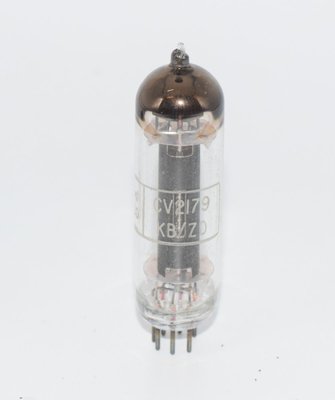
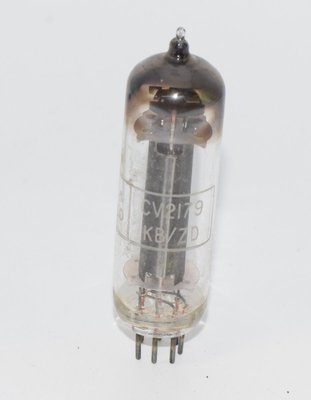
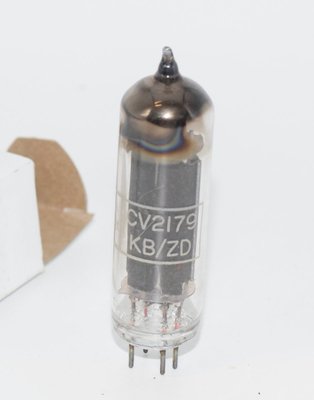
The CV2179 is a British military-designated miniature output pentode manufactured by the M-O Valve Company (Marconi-Osram), a division of Marconi's Wireless Telegraph Company Limited. The tube's commercial equivalent is the A2134, as explicitly stated in the manufacturer's datasheet dated March 1955. The CV designation (Common Valve) indicates its inclusion in the UK military's standardised valve numbering system, ensuring interchangeability and quality control across defence equipment suppliers.
The A2134/CV2179 was designed as a versatile output pentode particularly suitable for use as the series valve in voltage stabilising equipment. Its robust construction, generous power handling capability, and ability to operate in both pentode and triode configurations made it a valuable component in military and industrial electronics of the 1950s and beyond. The tube also found application in audio output stages, where its relatively high transconductance and moderate power dissipation made it well-suited for small to medium power amplifier designs.
The tube is also known by the designation N78, as evidenced by markings found on surviving examples from the M-O Valve Company. This additional designation likely corresponds to an internal Marconi-Osram type number or an alternative military/commercial cross-reference.
Technical Specifications and Design
Physical Construction
| Parameter | Value |
|---|---|
| Base | B7G (7-pin miniature) |
| Bulb | Tubular |
| Overall Length | 64–70 mm |
| Seated Length | 58–64 mm |
| Maximum Diameter | 19 mm |
| Screening | No internal or external screening fitted |
| Mounting | Any position |
| Microphony | Free from microphony in all normal receiver applications |
Pin Connections (B7G Base — viewed from underside)
| Pin | Connection |
|---|---|
| Pin 1 | Grid 1 (Control Grid, g₁) |
| Pin 2 | Grid 3 (Suppressor Grid, g₃) and Cathode (k) |
| Pin 3 | Heater (h) |
| Pin 4 | Heater (h) |
| Pin 5 | Anode (a) |
| Pin 6 | Internal Connection (I.C.) |
| Pin 7 | Grid 2 (Screen Grid, g₂) |
Note: The suppressor grid (g₃) is internally connected to the cathode (k) at pin 2.
Heater Ratings
| Parameter | Value |
|---|---|
| Heater Voltage (Vh) | 6.3 V |
| Heater Current (Ih) | 0.635 A |
Maximum Ratings (Design Centre)
Pentode Connection
| Parameter | Value |
|---|---|
| Maximum Anode Voltage (Va) | 300 V |
| Maximum Screen Grid Voltage (Vg2) | 300 V |
| Maximum Heater-Cathode Voltage (Vh-k peak) | 150 V |
| Maximum Anode Dissipation (Pa) | 9 W |
| Maximum Screen Grid Dissipation (Pg2) | 3 W |
Triode Connection
| Parameter | Value |
|---|---|
| Maximum Anode + Screen Voltage (Va,g2) | 300 V |
| Maximum Anode + Screen Dissipation (Pa,g2) | 12 W |
Characteristics — Pentode Connection
Measured at Va = 165 V, Vg2 = 165 V, Vg1 = −9 V:
| Parameter | Value |
|---|---|
| Amplification Factor (μ) | 220 |
| Anode Resistance (ra) | 23.2 kΩ |
| Transconductance (gm) | 9.5 mA/V |
Characteristics — Triode Connection
Measured at Va,g2 = 165 V, Vg1 = −9 V:
| Parameter | Value |
|---|---|
| Amplification Factor (μ) | 10 |
| Anode Resistance (ra) | 835 Ω |
| Transconductance (gm) | 12 mA/V |
Capacitances (Unscreened Valve)
| Parameter | Value |
|---|---|
| Anode to All (ca-all) | 10 pF |
| Grid 1 to All (cg1-all) | 10 pF |
| Anode to Grid 1 (ca-g1) | 0.3 pF |
Grid Resistor Limits
| Bias Method | Maximum Grid Resistance |
|---|---|
| Auto-bias (cathode resistor) | 0.27 MΩ ±20% |
| Fixed bias | 0.1 MΩ |
Typical Operating Conditions — Pentode Connection, Single Valve, Class A
The datasheet provides extensive operating data across multiple supply voltage conditions. Selected examples:
| Parameter | Condition 1 | Condition 2 | Condition 3 | Condition 4 | Condition 5 |
|---|---|---|---|---|---|
| % Full Input | 45% | 100% | 100% | 75% | 50% |
| Va | 100 V | 150 V | 165 V | 165 V | 165 V |
| Vg2 | 100 V | 150 V | 165 V | 165 V | 165 V |
| Vg1 (operating) | −4.6 V | −7.8 V | −9.3 V | −10 V | −11.4 V |
| Ia (operating) | 39 mA | 56 mA | 53 mA | 40 mA | 29 mA |
| Ig2 (operating) | 6.5 mA | 9.5 mA | 9 mA | 7.2 mA | 5.4 mA |
| Rk | 100 Ω | 120 Ω | 150 Ω | 220 Ω | 330 Ω |
| vin (peak) | 5 V | 7 V | 8.5 V | 6.7 V | 4.7 V |
| RL | 2.5 kΩ | 3 kΩ | 3 kΩ | 4 kΩ | 6 kΩ |
| Pout | 1.45 W | 3.5 W | 4.1 W | 2.84 W | 2.3 W |
| Distortion (D) | 8.6% | 11% | 10% | 10% | 10% |
The datasheet notes that the last two columns (75% and 50% input power conditions) represent over-biased operation, useful when H.T. power is limited and reduced power output can be tolerated.
Typical Operating Conditions — Push-Pull, Class AB₁
Pentode Connection (data per pair)
The push-pull pentode configuration offers significantly higher output power with lower distortion. At Va = 250 V, Vg2 = 165 V, RL (a-a) = 7.5 kΩ, Rk (per valve) = 300 Ω, the pair delivers 13.3 W output power at only 4.5% distortion.
At Va = 165 V, Vg2 = 165 V, RL (a-a) = 3 kΩ, Rk (per valve) = 150 Ω, the pair delivers 9 W at 4.6% distortion.
Triode Connection, Push-Pull, Class AB₁ (data per pair)
At Va,g2 = 165 V, Vg1 (operating) = −10.5 V, RL (a-a) = 3 kΩ, Rk (per valve) = 330 Ω:
| Parameter | Value |
|---|---|
| Ia,g2 (operating) | 65 mA |
| Ia,g2 (max. signal) | 74 mA |
| vin (peak, g₁ to g₁) | 24 V |
| Pout | 2.6 W |
| Distortion (D) | 1.4% |
Ventilation Requirements
Free air circulation around the bulb is preferable. If a retaining device in the form of a canister is employed, the surfaces should be blackened. The temperature of the hottest part of the bulb must not exceed 250°C.
Applications and Usage
The CV2179/A2134 was designed for several key applications:
- Voltage Stabilising Equipment: The datasheet specifically notes that the A2134 is "particularly suitable for use as the series valve in voltage stabilising equipment." The tube's ability to handle significant current and voltage while maintaining stable characteristics made it ideal for series-pass voltage regulator circuits in military and industrial power supplies.
- Audio Output Stage: With up to 4.1 W single-ended Class A output in pentode mode and up to 13.3 W in push-pull pentode Class AB₁, the CV2179 was well-suited for audio amplifier output stages in communications equipment, public address systems, and domestic receivers.
- Triode-Connected Audio Output: When connected as a triode (screen grid tied to anode), the tube offers a low plate resistance of only 835 Ω and an amplification factor of 10, making it attractive for applications where lower distortion was more important than maximum power output. In push-pull triode, a pair delivers 2.6 W at a remarkably low 1.4% distortion.
- Military Equipment: The CV designation ensured the tube met stringent military specifications for reliability, consistency, and environmental tolerance, making it suitable for deployment in field communications equipment, radar systems' power supplies, and other defence electronics.
Sound Characteristics
The CV2179/A2134 is a tube that offers distinctly different sonic personalities depending on its connection mode, making it unusually versatile for audio experimentation.
Pentode Mode
In pentode connection, the CV2179 exhibits the classic characteristics associated with beam and power pentodes of the era: a lively, dynamic presentation with strong transient response and good detail retrieval. The relatively high transconductance of 9.5 mA/V contributes to a sense of immediacy and punch. However, as with most pentodes operated single-ended, harmonic distortion is relatively high — the datasheet shows 10% THD at full output in typical Class A conditions — and this distortion is predominantly odd-order, which can lend a somewhat aggressive or edgy quality at higher power levels. At lower listening levels (well below clipping), the pentode mode offers excellent clarity and a wide, open soundstage.
The high plate resistance of 23.2 kΩ in pentode mode means that the output transformer's characteristics will significantly influence the overall tonal balance, and careful transformer selection is essential for optimal results.
Triode Mode
Connected as a triode, the CV2179 transforms into a remarkably refined performer. The very low plate resistance of just 835 Ω provides excellent damping factor and tight control over the loudspeaker, resulting in firm, well-defined bass response. The amplification factor of 10 and transconductance of 12 mA/V in triode mode suggest a tube with good linearity and a smooth, even-order harmonic distortion profile.
The push-pull triode data is particularly telling: 2.6 W at only 1.4% distortion represents genuinely high-fidelity performance. Listeners who have experienced similar British output pentodes in triode mode often describe the sound as warm, liquid, and musically engaging — with a midrange richness that is particularly flattering to vocals and acoustic instruments.
General Sonic Character
As a British-made valve from the Marconi-Osram stable, the CV2179 benefits from the high manufacturing standards associated with UK military production. Users of similar M-O Valve types often report a refined, slightly warm tonal balance with good resolution of fine detail. The tube's freedom from microphony (as noted in the datasheet) is a practical advantage in sensitive audio circuits, contributing to a quiet, low-noise background that allows musical details to emerge clearly.
The moderate power output — whether 4 W single-ended pentode or 2.6 W push-pull triode — places this tube firmly in the realm of desktop, nearfield, or high-efficiency speaker systems, where its sonic qualities can be fully appreciated without demanding excessive volume levels.
Equivalent or Substitute Types
The manufacturer's datasheet explicitly states:
- A2134 — The commercial equivalent of CV2179. These are the same tube under different designation systems. The A2134 is the Marconi-Osram commercial type number; CV2179 is the UK military Common Valve designation.
- N78 — An additional designation found on surviving examples, likely an alternative type number used within the M-O Valve Company or by specific equipment manufacturers.
Important Note: The CV2179/A2134 is a miniature output pentode on a B7G (7-pin) base. It should not be confused with small-signal RF pentodes such as the EF91, EF95/6AK5, or similar types, which are entirely different classes of valve with different electrical characteristics, power handling capabilities, and intended applications. There are no widely documented direct equivalents from other manufacturers for this specific type, and substitution with other output pentodes should only be attempted after careful comparison of all electrical parameters, pinout, and operating conditions.
Notable Characteristics
- Dual-Mode Operation: The CV2179 can be operated as either a pentode or a triode, with the datasheet providing comprehensive operating data for both modes. This versatility is a significant design advantage, allowing engineers and hobbyists to tailor the tube's performance to specific requirements.
- Voltage Stabiliser Suitability: The tube was specifically recommended for series-pass voltage stabiliser circuits, indicating excellent linearity and stability across a wide range of operating currents — characteristics that also benefit audio applications.
- Compact Form Factor: With a maximum diameter of only 19 mm and an overall length of 64–70 mm on a B7G miniature base, the CV2179 packs considerable output capability into a very small package. This makes it attractive for compact amplifier designs.
- High Transconductance: At 9.5 mA/V in pentode mode and 12 mA/V in triode mode, the CV2179 offers high mutual conductance for its class, contributing to good sensitivity and dynamic response.
- Low Triode Plate Resistance: The 835 Ω plate resistance in triode connection is remarkably low, providing excellent output transformer coupling and loudspeaker damping — a highly desirable characteristic for audio applications.
- Microphony-Free: The datasheet certifies the tube as free from microphony in all normal receiver applications, indicating robust internal construction.
- Flexible Mounting: The valve can be mounted in any position, providing maximum design flexibility.
- Generous Push-Pull Performance: A pair of CV2179s in push-pull pentode Class AB₁ can deliver up to 13.3 W at 4.5% distortion (at Va = 250 V), which is substantial output for miniature valves of this era.
- Over-Biased Operation: The datasheet provides specific operating data for reduced-input (over-biased) conditions at 75% and 50% input power, useful when H.T. supply power is limited — a practical consideration in portable or battery-operated military equipment.
Usage in the Audio Community
The CV2179/A2134 occupies an interesting niche in the audio community. While not as widely known as mainstream output pentodes like the EL84 or EL34, it has attracted attention from several quarters:
DIY Amplifier Builders
The CV2179 appeals to DIY audio enthusiasts who enjoy working with unusual or lesser-known valve types. Its B7G miniature base allows for very compact amplifier construction, and the comprehensive operating data provided in the Marconi datasheet — covering single-ended pentode, single-ended triode, push-pull pentode, and push-pull triode configurations — gives builders a wealth of proven circuit starting points. The ability to switch between pentode and triode modes (often implemented with a simple toggle switch) adds an appealing feature to home-built amplifiers.
Low-Power / High-Efficiency Speaker Systems
With output power ranging from approximately 2.3 W (single-ended pentode, over-biased) to 4.1 W (single-ended pentode, full drive), the CV2179 is well-matched to high-efficiency loudspeakers. The growing interest in single-ended amplifiers paired with horn-loaded or full-range high-efficiency drivers has created a receptive audience for tubes in this power class. The triode-connected push-pull configuration delivering 2.6 W at 1.4% distortion is particularly attractive for this application.
Military Surplus and Collector Appeal
CV-designated valves carry a certain cachet in the audio community, as they are associated with stringent military quality control and testing standards. Surviving NOS (New Old Stock) examples of the CV2179, often found with original M-O Valve Company markings and sometimes bearing the additional N78 designation, are sought after by collectors and audio experimenters alike. The military provenance suggests tighter manufacturing tolerances and more rigorous testing than commercial equivalents, which can translate to better consistency when matching pairs for push-pull operation.
Desktop and Headphone Amplifiers
The compact B7G package and moderate power output make the CV2179 an excellent candidate for desktop headphone amplifiers. In triode mode, the very low 835 Ω plate resistance provides good drive capability for a wide range of headphone impedances, while the low distortion characteristics ensure clean, detailed sound reproduction at the intimate listening levels typical of headphone use.
Practical Considerations for Audio Use
Audio builders should note several practical points when working with the CV2179:
- The 6.3 V, 0.635 A heater draws approximately 4 W per tube — a non-trivial consideration for the power transformer specification, especially in multi-tube designs.
- The maximum grid resistance limits (0.27 MΩ for auto-bias, 0.1 MΩ for fixed bias) must be respected to ensure reliable operation and tube longevity.
- Free air circulation is important; the bulb temperature must not exceed 250°C. Adequate ventilation should be designed into any enclosure.
- A retaining device is recommended, particularly in portable or vibration-prone applications.
- The tube's suitability for voltage stabiliser service indicates excellent long-term stability, which is a positive indicator for consistent audio performance over the tube's lifetime.
While the CV2179/A2134 may never achieve the mainstream popularity of more common audio output tubes, its combination of compact size, versatile operating modes, excellent triode-mode characteristics, and British military build quality make it a rewarding choice for the adventurous audio builder seeking something distinctive.