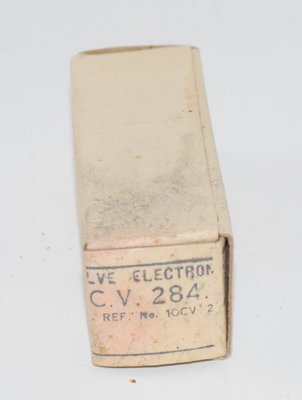
1. Introduction and History
The CV284 is a British military-specification (CV = Common Valve) cold-cathode gas-filled voltage stabilizer tube. It is the UK military registered equivalent of the STV3020, a neon-based voltage reference/stabilizer tube designed to maintain a stable voltage drop across its terminals when operated within a specified current range. The CV designation was assigned under the UK's Common Valve naming system, which was developed during and after World War II to standardize valve types across all branches of the British armed forces and government agencies.
Manufactured by several British firms — including notably Ericsson at their Beeston factory in Nottinghamshire — the CV284 was produced to exacting military quality standards. These tubes were used extensively in military electronics, laboratory instrumentation, and precision power supply circuits where voltage regulation was critical. The Ericsson Beeston factory was a well-known production facility for specialized and military-grade valves throughout the mid-20th century.
Cold-cathode voltage stabilizer tubes like the CV284 operate on the principle of a controlled gas discharge. When a sufficient voltage is applied across the tube, the gas (typically neon or a neon-argon mixture) ionizes and maintains a relatively constant voltage drop regardless of variations in current within the tube's operating range. This made them invaluable in an era before solid-state voltage regulators became widely available.
2. Technical Specifications and Design
The CV284 / STV3020 is a cold-cathode gas-filled voltage stabilizer tube. Unlike conventional amplifying valves, it does not have a heated cathode, control grid, or plate in the traditional sense. Instead, it has two electrodes (anode and cathode) in a gas-filled envelope. The key specifications relate to its voltage stabilization characteristics and current operating range.
Key Electrical Ratings
| Parameter | Value |
|---|---|
| Tube Type | Cold-cathode gas-filled voltage stabilizer |
| Heater Voltage / Current | N/A — Cold cathode (no heater) |
| Stabilizing Voltage (nominal) | ~30 V (as indicated by the "30" in STV3020) *see note below |
| Operating Current Range | ~5 mA to 20 mA (the "20" in STV3020 typically denotes the max operating current in mA) *see note below |
| Striking Voltage | Higher than stabilizing voltage; typically specified with series resistor — value should be confirmed against manufacturer datasheet |
| Max Plate Voltage | N/A (voltage stabilizer — not an amplifying tube) |
| Max Plate Dissipation | N/A in conventional sense; limited by max operating current × stabilizing voltage (~0.6 W at 20 mA) |
| Amplification Factor (μ) | N/A |
| Transconductance (gm) | N/A |
| Plate Resistance (rp) | N/A (dynamic impedance of the gas discharge is very low, typically a few ohms to tens of ohms) |
| Grid Bias Range | N/A — no control grid |
⚠ Important Note: The STV3020 designation follows the convention where the first two digits after "STV" indicate the approximate stabilizing voltage (~30 V) and the last two digits indicate the maximum operating current (~20 mA). However, the exact stabilizing voltage, striking voltage, minimum/maximum current, and voltage regulation tolerance should be confirmed against the original manufacturer datasheet, as slight variations exist between manufacturers and production runs. Some sources suggest the stabilizing voltage may be in the range of 28–33 V. If precise values are critical for your application, consult the original Ericsson or MOD specification sheet.
Physical Details
| Parameter | Detail |
|---|---|
| Envelope Type | Small glass envelope (miniature tubular or GT-style, depending on manufacturer) |
| Base Type | Typically a wire-ended or small pin base — exact base type should be confirmed against manufacturer datasheet; some versions may use a B7G (miniature 7-pin) or a 2-pin/wire-ended configuration |
| Mounting | Varies by manufacturer — chassis-mount or socket-mount |
| Pin-Out | Two active connections: Anode and Cathode. Exact pin assignments depend on base type and should be confirmed against the specific manufacturer's data |
| Overall Length | Should be confirmed against manufacturer datasheet |
| Maximum Diameter | Should be confirmed against manufacturer datasheet |
The tube typically features a visible orange-red glow when operating, characteristic of neon gas discharge. The glow should be stable and uniform during normal operation; flickering or uneven glow may indicate the tube is operating outside its specified current range or is nearing end of life.
3. Applications and Usage
The CV284 / STV3020 was designed primarily for voltage regulation and stabilization in electronic circuits. Its principal applications include:
- Power Supply Voltage Regulation: Used as a shunt voltage regulator in power supplies for military and laboratory equipment. By placing the tube in parallel with the load (with an appropriate series dropping resistor), a stable reference voltage of approximately 30 V could be maintained despite fluctuations in input voltage or load current.
- Voltage Reference: Employed as a precision voltage reference in measurement instruments, calibration equipment, and test gear where a stable, repeatable voltage was required.
- Cascaded Regulation: Multiple stabilizer tubes could be connected in series to achieve higher regulated voltages in precise increments (e.g., two CV284s in series for ~60 V regulation).
- Bias Supply Stabilization: Used to stabilize bias voltages in complex radio receivers, radar equipment, and other military electronics where stable operating points were essential for reliable performance.
- Oscillator Stabilization: In some applications, the stable voltage provided by these tubes was used to maintain consistent operating conditions for oscillator circuits.
- Military and Government Equipment: As a CV-designated valve, it was specified for use in a wide range of British military and government electronic systems from the 1940s through the 1960s and beyond.
The tube requires a series resistor to limit current and must be operated within its specified current range. Below the minimum current, the discharge may extinguish; above the maximum current, the tube may overheat and its life will be significantly shortened.
4. Sound Characteristics
It is important to note that the CV284 / STV3020 is not an amplifying tube — it is a voltage stabilizer. As such, it does not directly process or amplify audio signals and does not have "sound characteristics" in the way that a triode, pentode, or beam tetrode would. It does not introduce harmonic distortion, coloration, or tonal shaping to an audio signal path in the manner of signal tubes.
However, in audio applications where the CV284 is used in the power supply of an amplifier or preamplifier, its contribution to sound quality is indirect but potentially significant:
- Noise Floor: Gas-discharge stabilizer tubes can introduce a small amount of low-level noise into the power supply. In well-designed circuits with adequate filtering, this is negligible. However, in sensitive preamplifier circuits, any noise from the stabilizer can potentially be audible as a faint hiss or low-frequency rumble if filtering is inadequate.
- Voltage Stability: By providing a rock-solid regulated voltage to critical circuit stages, the CV284 can contribute to a tighter, more controlled sound with improved dynamic stability. Audiophiles who use gas-discharge regulators in tube amplifier power supplies sometimes report a sense of "solidity" and "authority" in the bass and midrange, attributable to the stable operating conditions the regulator provides.
- Perceived Warmth: Some enthusiasts in the tube audio community ascribe a subtle "organic" or "natural" quality to circuits that use gas-discharge voltage regulation compared to solid-state regulators, though this is highly subjective and debated. The argument is that the gas-discharge tube's regulation characteristics (soft knee, gentle dynamic impedance) interact with the power supply in a way that is more sympathetic to the audio signal than the hard, fast regulation of semiconductor devices.
- Microphonics: Cold-cathode gas tubes are generally less microphonic than heated-cathode signal tubes, which is a positive attribute in audio applications.
In summary, the CV284's "sound" is best described as its contribution to the stability, quietness, and consistency of the power supply in which it operates, rather than any direct tonal coloration.
5. Equivalent or Substitute Types
| Type | Equivalence | Notes |
|---|---|---|
| STV3020 | Direct equivalent / identical | The CV284 is the military-registered version of the STV3020. Electrically and physically interchangeable. |
Caution: While other cold-cathode voltage stabilizer tubes exist (such as the OA2/150C2 for ~150 V, OB2/108C1 for ~108 V, OC3/VR105 for ~105 V, OD3/VR150 for ~150 V, and various other STV-series types), these operate at different stabilizing voltages and are not interchangeable with the CV284. Only the STV3020 is confirmed as a direct substitute based on verified reference data. Any other potential equivalents should be verified against manufacturer datasheets before substitution, paying close attention to stabilizing voltage, current range, and physical base/pinout compatibility.
6. Notable Characteristics
- Cold-Cathode Operation: The CV284 requires no heater power, making it instantly operational and reducing overall power consumption compared to heated-cathode regulator tubes. There is no warm-up time for the heater, though the gas discharge itself establishes within milliseconds of the striking voltage being reached.
- Military-Grade Quality: As a CV-registered type, the CV284 was manufactured to stringent military specifications with tighter tolerances, more rigorous testing, and better quality control than commercial equivalents. This makes NOS (New Old Stock) examples particularly desirable for critical applications.
- Ericsson Beeston Production: Examples manufactured at the Ericsson Beeston factory are known among collectors and engineers for their high build quality. The Beeston facility was one of the UK's premier valve manufacturing plants.
- Long Service Life: Cold-cathode stabilizer tubes generally have very long operational lifespans — often tens of thousands of hours — because there is no heated cathode to degrade. The primary wear mechanism is sputtering of electrode material, which gradually changes the gas composition and can alter the stabilizing voltage over very long periods.
- Low Stabilizing Voltage: At approximately 30 V, the CV284 operates at a relatively low stabilizing voltage compared to many common stabilizer tubes (which typically operate at 75 V, 105 V, or 150 V). This makes it suitable for low-voltage regulation applications or for use in series combinations to achieve specific intermediate voltages.
- Visible Glow Indicator: The characteristic neon glow serves as a built-in visual indicator that the tube is operating correctly. Loss of glow indicates circuit failure or that the tube has reached end of life.
- NOS Availability: As a relatively specialized military type, NOS CV284 tubes are uncommon but can still be found through specialist valve dealers and military surplus channels. Their scarcity adds to their collector value.
7. Usage in the Audio Community
The CV284 / STV3020 occupies a niche but respected position in the tube audio community, primarily in the context of power supply design for high-end tube amplifiers and preamplifiers:
Power Supply Regulation
Audiophile amplifier builders and designers sometimes use gas-discharge voltage stabilizer tubes — including types like the CV284 — to regulate bias supplies, screen grid supplies, or other critical voltage rails in tube amplifiers. The approximately 30 V stabilizing voltage of the CV284 makes it particularly useful for:
- Regulating negative bias supplies for output tubes
- Providing stable reference voltages in regulated power supply circuits
- Stabilizing voltages in phono preamplifier stages where low-level signals demand exceptionally quiet and stable supply rails
DIY and Custom Amplifier Projects
The DIY tube audio community values gas-discharge regulators for their simplicity, reliability, and the perception that they are more "in keeping" with an all-tube design philosophy than semiconductor regulators. Builders who pursue a "no solid-state devices" approach to amplifier construction find tubes like the CV284 essential for voltage regulation without resorting to Zener diodes or integrated circuit regulators.
Vintage Equipment Restoration
The CV284 is encountered in vintage military and laboratory equipment that is sometimes repurposed or restored for audio use. Collectors restoring vintage British military receivers, signal generators, or other equipment may need CV284 tubes to maintain originality and correct operation.
Aesthetic and Collector Appeal
The warm neon glow of gas-discharge stabilizer tubes has an undeniable visual appeal that adds to the aesthetic experience of a tube amplifier. Some builders incorporate visible stabilizer tubes into their designs partly for this reason. NOS military-grade tubes like the CV284, especially those with clear Ericsson Beeston factory markings, are prized by collectors of British military valves.
Practical Considerations for Audio Use
When using the CV284 in audio power supplies, builders should note:
- Adequate RF-grade bypass capacitance should be placed across the tube to suppress any high-frequency noise generated by the gas discharge
- The series dropping resistor must be carefully calculated to ensure the tube operates within its specified current range under all load conditions
- Multiple tubes can be series-connected for higher regulated voltages, with each tube contributing its ~30 V stabilizing voltage to the total
- The tube should be physically located away from sensitive input stages to minimize any potential noise coupling
While the CV284 will never be as famous in audio circles as signal tubes like the ECC83 or EL34, it represents an important and elegant solution to voltage regulation in all-tube audio designs, and its military pedigree ensures a level of quality and reliability that discerning builders appreciate.