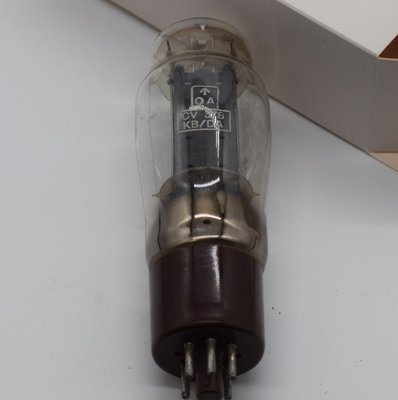
1. Introduction and History
The CV378 is a British military-specification (Common Valve designation) full-wave vacuum rectifier tube designed for use in high-quality power supplies. The "CV" prefix denotes the UK Ministry of Defence's Common Valve numbering system, which was established to standardize valve procurement across military equipment. The CV378 was manufactured primarily during the 1950s and 1960s by leading British valve makers, most notably Mullard at their famous Blackburn factory.
The CV378 is an indirectly heated, full-wave rectifier employing an octal base, designed to deliver substantial current for demanding power supply applications. Its military heritage means it was manufactured to tighter tolerances and more rigorous quality control standards than typical commercial equivalents. The verified close/identical substitute for the CV378 is the 53KU, a Mullard designation. The tube is also widely cited in collector and audio communities as being related to the GZ37, though this equivalence is not confirmed by the primary reference data available and should be treated with caution (see Section 5 for further discussion).
Surviving examples from Mullard's Blackburn plant, particularly those dating from the late 1950s, are highly sought after by vintage audio enthusiasts and command premium prices on the secondary market.
2. Technical Specifications and Design
Heater / Filament Ratings
| Parameter | Value | Source Confidence |
|---|---|---|
| Heater Voltage (Vh) | 5.0 V | ✅ Verified from reference data |
| Heater Current (Ih) | 2.8 A | ✅ Verified from reference data |
Maximum Ratings
| Parameter | Value | Source Confidence |
|---|---|---|
| Max RMS Voltage per Plate | ~450 V (typical for this class) | ⚠️ Should be confirmed against manufacturer datasheet |
| Max Peak Inverse Voltage (PIV) | ~1400 V (typical for this class) | ⚠️ Should be confirmed against manufacturer datasheet |
| Max DC Output Current | ~250 mA (typical for this class) | ⚠️ Should be confirmed against manufacturer datasheet |
| Max Peak Plate Current | ~800 mA (typical for this class) | ⚠️ Should be confirmed against manufacturer datasheet |
| Max Reservoir Capacitor | ~60 µF (typical for indirectly heated rectifiers) | ⚠️ Should be confirmed against manufacturer datasheet |
Note: The values marked with ⚠️ are typical estimates for full-wave indirectly heated rectifiers of this class and era. Users should verify these against the original Mullard or UK MoD datasheet for the CV378 or 53KU before using them in a design.
Valve Characteristics
As a full-wave rectifier, the CV378 does not have amplification parameters (µ, gm, rp) in the conventional sense. Its key performance characteristics are defined by its forward voltage drop, regulation curve, and maximum current handling. The internal resistance of each diode section contributes to the "soft" power supply behavior that is valued in audio applications.
| Parameter | Value | Source Confidence |
|---|---|---|
| Voltage Drop (approximate, at rated current) | ~15–25 V per section (typical) | ⚠️ Should be confirmed against manufacturer datasheet |
| Internal Resistance per Section | ~50–100 Ω (typical estimate) | ⚠️ Should be confirmed against manufacturer datasheet |
Physical Details
| Parameter | Detail |
|---|---|
| Base Type | International Octal (IO) — 8-pin ✅ Verified |
| Envelope Type | ST-16 or similar shouldered glass envelope (typical for this class) |
| Mounting | Vertical (base down preferred) |
Pin-Out (International Octal Base)
The International Octal base has 8 pins arranged around a central locating spigot. The following is a typical pinout for a full-wave indirectly heated rectifier on an octal base. However, users must verify this against the specific CV378/53KU datasheet, as variations exist among rectifier types.
| Pin | Function (Typical) |
|---|---|
| Pin 1 | No Connection (or internal shield) |
| Pin 2 | Heater / Cathode |
| Pin 3 | No Connection |
| Pin 4 | Anode 1 (Plate 1) |
| Pin 5 | No Connection |
| Pin 6 | Anode 2 (Plate 2) |
| Pin 7 | No Connection |
| Pin 8 | Heater / Cathode |
⚠️ Important: This pinout is a typical arrangement for octal-based full-wave rectifiers and should be confirmed against the actual CV378 or 53KU datasheet before use. Some sources associate the CV378 with designs that may use a top cap connection for one anode — if a top cap is present, it is a separate physical connection and is not designated as "pin 9" of the octal base, since the octal base has only 8 pins. Builders must inspect the physical tube and consult the correct datasheet.
3. Applications and Usage
The CV378 was originally designed for military and professional equipment power supplies where reliability and consistent performance were paramount. Its primary applications include:
- Military radio and radar equipment: The CV designation ensured interchangeability across different equipment platforms used by the UK armed forces.
- Professional audio equipment: High-quality power supplies for broadcast and studio amplifiers.
- Laboratory and test equipment: Precision power supplies where stable, well-regulated HT voltage was required.
- High-fidelity amplifier power supplies: The CV378's generous current rating and indirectly heated cathode make it suitable for powering amplifiers using tubes such as EL34, KT66, and similar output valves.
As a full-wave rectifier, the CV378 is used in conjunction with a centre-tapped high-voltage transformer secondary winding. Each anode section conducts on alternate half-cycles of the AC mains, producing a full-wave rectified DC output that is then filtered by the power supply's smoothing network.
4. Sound Characteristics
While a rectifier tube does not directly process the audio signal, experienced audiophiles and engineers widely acknowledge that the rectifier has a meaningful influence on the sonic character of a tube amplifier. The CV378, being an indirectly heated rectifier with appreciable internal resistance, imparts several distinctive qualities:
- Soft, organic dynamics: The inherent internal resistance of the CV378 creates a degree of "sag" in the power supply under transient demands. This manifests as a gentle, natural compression that many listeners describe as musically pleasing and organic, particularly on dynamic peaks.
- Warm, full-bodied midrange: The slightly higher voltage drop and softer regulation compared to solid-state rectification tends to produce a warmer tonal balance. The midrange is often described as rich, liquid, and three-dimensional.
- Smooth, extended treble: The gradual power supply response tends to soften the leading edges of transients slightly, resulting in a treble presentation that is detailed but never harsh or fatiguing.
- Deep, controlled bass: While the power supply sag can theoretically reduce bass authority compared to silicon diode rectification, the CV378's relatively robust current capability means that bass remains well-controlled and tuneful in properly designed amplifiers. The bass is often described as "textured" rather than "tight."
- Spacious soundstage: Many listeners report that valve rectification with tubes like the CV378 contributes to a more spacious, three-dimensional soundstage with better separation of instruments and a more natural sense of depth.
- Slow, graceful start-up: The indirectly heated cathode provides a gradual warm-up, which applies HT voltage progressively to the amplifier circuit. This is gentler on filter capacitors and other tubes, and contributes to the overall sense of refinement.
Military-grade examples such as the CV378 are often preferred over commercial equivalents because their tighter manufacturing tolerances can result in lower noise, better balance between the two diode sections, and more consistent performance over the tube's lifespan.
5. Equivalent or Substitute Types
| Type | Equivalence | Notes |
|---|---|---|
| 53KU | Close/Identical substitute ✅ Verified | Mullard commercial designation. This is the confirmed equivalent per reference data. Direct drop-in replacement. |
| GZ37 | Widely cited as equivalent | ⚠️ Not confirmed by the primary reference data provided. The GZ37 is frequently listed in collector guides and online sources as equivalent to the CV378, and Mullard Blackburn production examples are often cross-referenced. However, since this equivalence is not verified in the reference data, users should confirm compatibility by consulting the specific datasheets for both types before substitution. Pin configuration and ratings should be cross-checked. |
| 5U4G / 5U4GB | Potentially similar application | ⚠️ The 5U4G is a directly heated rectifier with a 5.0 V / 3.0 A heater. While it serves a similar function and shares the octal base, it is a different design (directly heated vs. indirectly heated) and has different electrical characteristics. It is not a guaranteed drop-in replacement. Pinout differences may exist. Consult both datasheets before attempting substitution. |
| GZ34 / 5AR4 | Not a direct equivalent | The GZ34 is another popular indirectly heated octal rectifier (5.0 V / 1.9 A heater), but it has different current ratings, different internal resistance characteristics, and a lower heater current draw. It is not interchangeable without verifying that the power transformer can accommodate the different heater current and that the amplifier circuit is compatible. |
Important: When substituting rectifier tubes, always verify: (1) heater voltage and current compatibility with the power transformer, (2) maximum voltage and current ratings, (3) pinout compatibility, and (4) maximum reservoir capacitor ratings. An incorrect substitution can damage the rectifier, the power transformer, or other components in the amplifier.
6. Notable Characteristics
- Military-grade construction: The CV378 was built to UK Ministry of Defence specifications, meaning enhanced quality control, tighter tolerances, and more rigorous testing compared to commercial equivalents. This often translates to longer service life and more consistent performance.
- Mullard Blackburn provenance: The most prized examples were manufactured at Mullard's Blackburn factory in Lancashire, England. Tubes from this facility are renowned for their build quality and are identifiable by factory date codes and construction details familiar to experienced collectors.
- Indirectly heated cathode: Unlike directly heated rectifiers (such as the 5U4G), the CV378 uses an indirectly heated cathode. This provides a slower, more controlled warm-up that applies HT voltage gradually — a feature that is gentler on associated components and valued in audio applications.
- Robust heater design: The 5.0 V, 2.8 A heater indicates a substantial cathode structure capable of delivering high emission current with good longevity.
- Excellent longevity: Military-specification rectifiers like the CV378 were designed for extended service in demanding environments. Many NOS (New Old Stock) examples from the 1950s still test at or near new specifications on valve testers.
- Collector value: Due to their military provenance, Mullard manufacture, and reputation in audio circles, NOS CV378 tubes — particularly those with original military packaging and documentation — command significant prices among collectors and audiophiles.
7. Usage in the Audio Community
The CV378 occupies a respected position in the vintage audio and hi-fi community, valued both for its technical merits and its provenance. Here is how it is typically used and regarded:
High-Fidelity Amplifier Builds
The CV378 is a popular choice for custom-built and boutique single-ended and push-pull amplifiers. Builders of amplifiers using output tubes such as the EL34, KT66, 6L6, and similar types appreciate the CV378's ability to deliver clean, well-regulated HT power with the sonic benefits of valve rectification. It is particularly favored in designs where the slightly "softer" power supply characteristic is considered musically beneficial.
Vintage Equipment Restoration
Restorers of vintage British amplifiers and receivers — including equipment by Leak, Quad, Radford, and others — seek out CV378 tubes as premium replacements for the original rectifier valves. The military-grade quality provides confidence that the restored equipment will perform reliably for years to come.
Tube Rolling
"Tube rolling" — the practice of swapping different tube brands and types to fine-tune an amplifier's sound — is a popular pursuit among audiophiles. The CV378 is often tried as a premium alternative to more common rectifiers. Users frequently report that substituting a CV378 (where compatible) brings improvements in midrange liquidity, soundstage depth, and overall musical engagement. However, as noted in Section 5, compatibility must be carefully verified before rolling rectifier tubes.
Guitar Amplifiers
While less common in guitar amplifier applications than types like the GZ34 or 5U4G, the CV378 is used by discerning players and amp builders who value its particular sag characteristics and tonal contribution. The natural compression imparted by the CV378's power supply behavior can enhance sustain and touch sensitivity in guitar amplifier circuits.
Market and Collectibility
NOS CV378 tubes, especially those confirmed as Mullard Blackburn production from the 1950s, are considered premium items. They are traded through specialist vintage tube dealers, online auction platforms, and audio forums. Prices reflect their scarcity, military provenance, and audio reputation. Buyers should be aware of the importance of proper testing (ideally on a calibrated valve tester such as the AVO) and should purchase from reputable sources to avoid relabeled or substandard examples.
Community Consensus
The audio community generally regards the CV378 as a top-tier rectifier valve — one that combines military reliability with genuine sonic benefits. It is frequently mentioned in the same breath as other revered rectifiers like the Mullard GZ34 and the Philips Miniwatt 5AR4. For builders and listeners who believe that every component in the signal chain (including the power supply) contributes to the final sound, the CV378 represents an excellent choice where circuit compatibility permits.