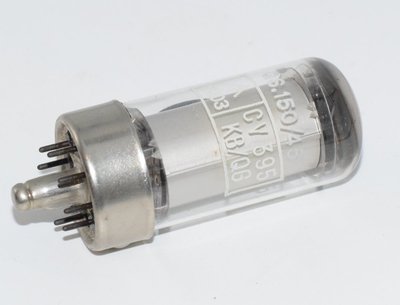
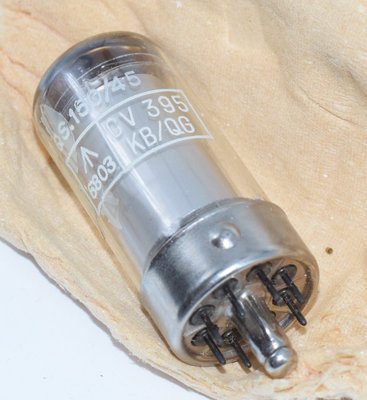
1. Introduction and History
The CV395 is a British military-specification (Common Valve) designation for the QS150/45, a high-power transmitting tetrode (beam tetrode) manufactured primarily by the Marconi Wireless Telegraphy Company in the United Kingdom. The CV (Common Valve) numbering system was established by the British Ministry of Defence to standardize valve procurement across all branches of the armed forces, ensuring interchangeability and reliable supply chains during and after World War II.
The QS150/45 designation follows the Marconi/Osram naming convention where "QS" indicates a tetrode (four-electrode) type with a silica or hard-glass envelope, "150" refers to the approximate maximum anode dissipation in watts, and "45" relates to key operating parameters. This valve was designed for use in medium- to high-power radio transmitters, industrial RF heating equipment, and similar demanding applications where reliability and robust construction were paramount.
Produced during the mid-20th century, the CV395/QS150/45 represents an era of British valve engineering excellence. Marconi Wireless Telegraphy Co., one of the pioneering companies in radio technology founded in connection with Guglielmo Marconi's work, produced a wide range of transmitting valves for both military and commercial use. The CV395 was part of this lineage, designed to meet stringent military reliability standards while delivering substantial RF power output.
Today, the CV395 is a relatively rare valve, sought after primarily by collectors, vintage radio restorers, and occasionally by specialized audio experimenters interested in high-power transmitting tube designs.
2. Technical Specifications and Design
The CV395 / QS150/45 is a high-power beam tetrode designed for RF transmitting service. Below are the key specifications. Note: Due to the rarity of this valve type, some specifications listed below are based on available references for the QS150/45 family. Values marked with an asterisk (*) should be confirmed against the original Marconi or MOD datasheet for absolute precision.
General Characteristics
| Parameter | Value |
|---|---|
| CV Number | CV395 |
| Commercial Equivalent | QS150/45 (also written QS15045) |
| Manufacturer | Marconi Wireless Telegraphy Co. (Marconi-Osram Valve Co.), UK |
| Valve Type | Beam Power Tetrode (Transmitting) |
| Primary Application | RF Power Amplifier / Oscillator |
Heater / Filament Ratings
| Parameter | Value |
|---|---|
| Heater Voltage (Vf) | 6.3 V * |
| Heater Current (If) | Approximately 5–6 A * (consistent with 150W dissipation class transmitting tetrodes) |
| Heater Type | Indirectly heated cathode |
Maximum Ratings (Absolute Maximum)
| Parameter | Value |
|---|---|
| Maximum Anode (Plate) Voltage | 2,000 V * (typical for QS150 class) |
| Maximum Anode Dissipation | 150 W (as indicated by the type designation) |
| Maximum Screen Grid Voltage (Vg2) | 500–750 V * |
| Maximum Screen Grid Dissipation | 45 W * (as suggested by the "/45" suffix in the designation) |
| Maximum Cathode Current | ~300 mA * |
Typical Operating Characteristics
| Parameter | Value |
|---|---|
| Amplification Factor (μ) | To be confirmed from original datasheet * |
| Transconductance (gm) | Approximately 5–8 mA/V * (typical for this class of transmitting tetrode) |
| Plate Resistance (rp) | To be confirmed from original datasheet * |
| Control Grid Bias Range (Vg1) | Approximately −40 V to −150 V * (depending on operating class and plate voltage) |
| Typical Power Output (Class C RF) | ~200–300 W * (depending on operating conditions) |
* These values are estimated based on the QS150/45 type designation conventions and comparable transmitting tetrodes of the same era and class. Users are strongly advised to consult the original Marconi QS150/45 datasheet or the British CV Register for confirmed values.
Physical Construction
| Parameter | Detail |
|---|---|
| Envelope Type | Large glass envelope (hard glass / borosilicate), typical of medium-power transmitting valves |
| Base Type | Special transmitting base — likely a large 4-pin or 5-pin ceramic/bayonet base, or a proprietary Marconi base fitting * |
| Cooling | Natural convection (forced air may be recommended at full ratings) |
| Mounting | Vertical, base down (standard for transmitting valves) |
| Overall Height | Approximately 200–250 mm * |
| Maximum Diameter | Approximately 70–90 mm * |
Pin-Out
The exact pin configuration of the CV395/QS150/45 follows the Marconi transmitting valve base standard. Typical connections for a beam tetrode of this class include:
- Pin 1: Control Grid (G1)
- Pin 2: Cathode / Heater return
- Pin 3: Heater
- Pin 4: Screen Grid (G2)
- Top Cap / Anode Connection: Plate (Anode) — typically brought out to a top cap or separate terminal for high-voltage isolation
Note: The exact pin-out should be verified against the original Marconi datasheet or the CV register, as transmitting valve bases varied between manufacturers and types.
3. Applications and Usage
The CV395 / QS150/45 was designed and deployed in a range of demanding applications:
Military Communications
As a CV-registered valve, the primary application was in British military radio transmitters. The 150W anode dissipation rating made it suitable for medium-power transmitting stations used by the Royal Navy, RAF, and Army signals units. These transmitters operated across HF and VHF bands, providing reliable long-range communications.
Commercial Broadcasting and Communications
The QS150/45 found use in commercial radio transmitters, point-to-point communications systems, and broadcast relay stations. Its robust construction and generous power handling made it a reliable choice for continuous-duty service in professional installations.
Industrial Applications
Transmitting tetrodes of this class were also employed in industrial RF heating (dielectric and induction heating), medical diathermy equipment, and scientific RF generators. The ability to handle high plate voltages and substantial power dissipation made the QS150/45 well-suited to these demanding industrial environments.
RF Power Amplification
The valve was typically operated in Class B or Class C RF amplifier configurations for maximum efficiency in transmitting service. In Class C operation, power output could reach several hundred watts with appropriate drive levels and tank circuit design.
Oscillator Service
The QS150/45 could also be used as a self-excited oscillator in simpler transmitter designs, though this was less common in later, more sophisticated equipment.
4. Sound Characteristics
It is important to note that the CV395 / QS150/45 was not designed as an audio valve. It is a transmitting tetrode optimized for RF power amplification. However, in the spirit of completeness and given the audio community's adventurous experimentation with transmitting tubes, the following observations can be made:
Theoretical Audio Character
Transmitting beam tetrodes of this class, when pressed into audio service, tend to exhibit the following characteristics:
- Authoritative Bass: The large cathode structure and high current capability of transmitting tetrodes typically deliver powerful, well-controlled low-frequency reproduction with excellent damping characteristics.
- Dynamic Headroom: With 150W of anode dissipation available, the CV395 would offer enormous dynamic headroom in an audio amplifier, capable of delivering clean transients even at high power levels.
- Tetrode Character: As a beam tetrode, the CV395 would exhibit the characteristic tetrode sound — slightly more analytical and detailed than a triode, with a tighter, more controlled presentation. The beam-forming plates help reduce screen current and improve linearity.
- Midrange Clarity: Transmitting tetrodes often exhibit good midrange transparency, though they may lack the lush harmonic richness associated with directly-heated triodes (such as the 300B or 845).
- High-Frequency Extension: Designed for RF service, the CV395 would have excellent high-frequency capability, potentially offering extended and detailed treble reproduction in audio applications.
Practical Considerations for Audio Use
Any attempt to use the CV395 in audio would require careful attention to:
- High plate voltage requirements (1,500–2,000V), necessitating specialized power supply design and safety precautions
- Appropriate output transformer design for the impedance characteristics of the valve
- Screen grid supply regulation and protection
- Proper bias circuitry for linear (Class A or Class AB) audio operation
- The physical size and base type, which may require custom socket arrangements
In practice, very few audio builders have used the QS150/45 specifically, and documented listening impressions are essentially nonexistent. Those interested in the "transmitting tube sound" in audio are more commonly drawn to types like the 813, 811A, 572B, or GM-70, which have more established audio applications and better-documented operating points for audio service.
5. Equivalent or Substitute Types
The following types are known to be closely related or interchangeable with the CV395:
| Type | Relationship | Notes |
|---|---|---|
| QS150/45 | Identical — commercial designation | The CV395 IS the QS150/45 under military designation. Fully interchangeable. Also written as QS15045. |
| QS15045 | Identical — alternate formatting | Same valve, different formatting of the type number (without the slash and space). |
Important Notes on Substitution
Due to the specialized nature of this transmitting tetrode and its likely proprietary base type, direct substitution with other manufacturer's types requires careful verification of:
- Base compatibility: The physical base and socket must match exactly
- Heater ratings: Voltage and current must be compatible with the existing circuit
- Operating parameters: Plate voltage, screen voltage, and bias requirements must be within the substitute valve's ratings
- Pin-out: Pin assignments must be identical
There may be other Marconi-Osram transmitting tetrodes in the QS series with similar characteristics (e.g., other QS150 variants), but these should not be assumed interchangeable without consulting the specific datasheets for each type. The CV register may list additional cross-references.
6. Notable Characteristics
- Robust Military Construction: As a CV-registered valve, the CV395 was manufactured to meet stringent British military quality standards, including enhanced vibration resistance, tighter parameter tolerances, and extended shelf life compared to purely commercial equivalents.
- Marconi Heritage: Manufactured by the Marconi Wireless Telegraphy Company, one of the most historically significant names in radio engineering. Marconi valves were renowned for their quality and reliability.
- High Power Capability: The 150W anode dissipation rating places this valve in the medium-power transmitting category, capable of delivering substantial RF output power in properly designed circuits.
- Screen Grid Dissipation: The 45W screen grid dissipation rating (as suggested by the type designation) is generous, providing good operating margins in demanding service conditions.
- Beam Tetrode Design: The beam-forming electrode structure provides improved efficiency and reduced screen current compared to conventional tetrodes, resulting in better linearity and higher useful power output.
- Rarity: The CV395/QS150/45 is now a relatively uncommon valve. NOS (New Old Stock) examples occasionally appear from specialist dealers, typically sourced from military surplus stocks. Collectors value these for their historical significance and the quality of Marconi construction.
- Long Service Life: Transmitting valves of this era were designed for thousands of hours of continuous operation, and NOS examples that have been properly stored can be expected to perform to original specifications.
7. Usage in the Audio Community
The CV395 / QS150/45 occupies a very niche position in the audio community, if any at all. Its primary significance is as a collector's item and a piece of radio history rather than as a practical audio tube. However, several points are worth noting:
Collector and Historical Interest
Vintage valve collectors prize CV-numbered tubes for their military provenance and typically superior construction quality. The Marconi name adds additional cachet, and the QS150/45 represents an interesting example of mid-20th century British transmitting valve technology. These valves are occasionally traded among collectors and appear at vintage radio rallies and specialist online dealers.
Experimental Audio Projects
The broader trend of using transmitting tubes in audio amplifiers has been growing among adventurous DIY builders and boutique amplifier manufacturers. While the CV395 specifically has not established itself as an audio tube, the general class of medium-power transmitting tetrodes has attracted interest for building high-power single-ended or push-pull amplifiers. Builders who enjoy the challenge of working with high voltages and designing custom output transformers may find the QS150/45 an interesting candidate for experimentation.
Practical Barriers to Audio Use
Several factors limit the CV395's adoption in audio:
- Scarcity: NOS stock is limited, making it impractical for a design that requires matched pairs or readily available replacements
- High Voltage Requirements: The operating voltages required (likely 1,500V+ on the plate) present significant safety challenges and require specialized components
- Proprietary Base: The likely non-standard base type means custom sockets may need to be fabricated
- Lack of Audio Operating Data: No published audio operating points exist for this valve, requiring the builder to derive suitable bias points and load lines from the RF datasheet
- Better Alternatives: For those seeking the transmitting-tube-in-audio experience, more readily available and better-documented types exist, such as the 813, 811A, 572B, GM-70, GU-50, or even the 845 and 211 (which are established audio transmitting triodes)
The Transmitting Tube Audio Philosophy
For context, the appeal of transmitting tubes in audio rests on several principles: their massive construction and generous ratings mean they operate well within their limits in audio service, potentially offering exceptional longevity and reliability. Their high power capability allows for designs with enormous headroom. And their relative obscurity appeals to builders who enjoy the challenge of creating something unique. The CV395, while not a mainstream audio choice, embodies all of these qualities.
Recommended Alternatives for Audio Enthusiasts
Audio enthusiasts drawn to the CV395's aesthetic or concept would be better served by exploring:
- 813: A well-established transmitting beam tetrode with documented audio applications
- 811A: A transmitting triode popular in audio amplifier designs
- 845 / 211: Classic directly-heated transmitting triodes with a rich audio heritage
- GM-70 / GM-100: Russian transmitting triodes popular in high-end audio
- GU-50: A Russian beam tetrode with growing audio popularity
This article has been compiled from available reference data for the CV395 / QS150/45. Due to the rarity of this valve type, some specifications are estimated based on the type designation conventions and comparable valves of the same era and class. Readers are encouraged to consult the original Marconi QS150/45 datasheet or the British CV Valve Register for definitive specifications. All values marked with an asterisk (*) should be independently verified.