1. Introduction and History
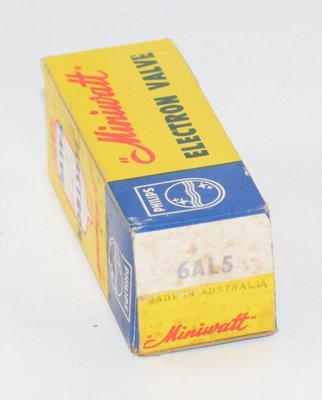
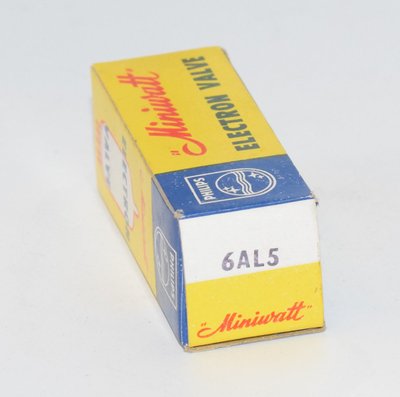
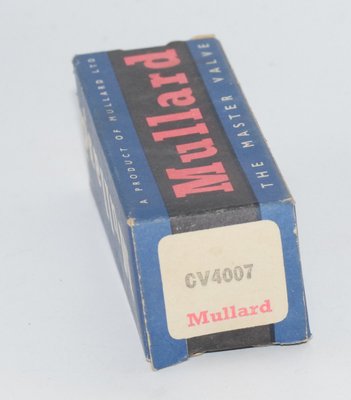
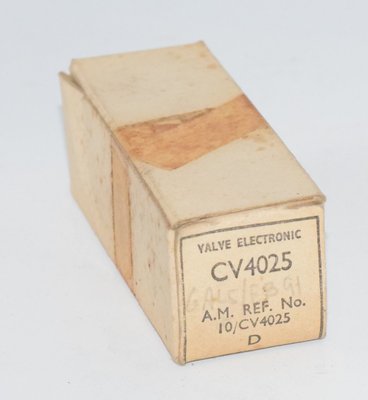
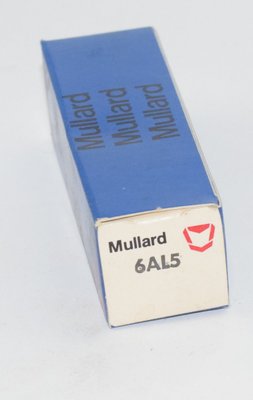
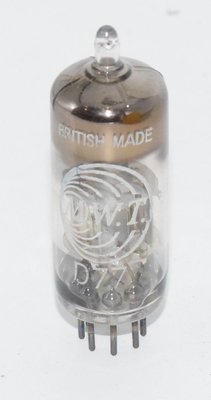
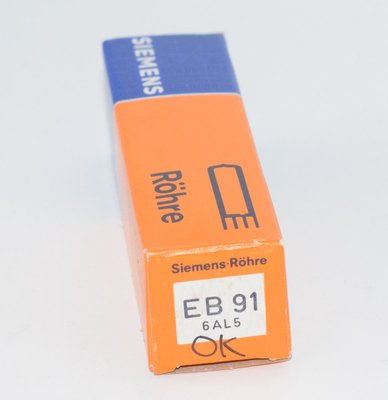
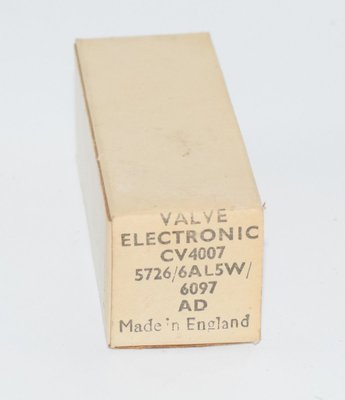
The CV4007 is a British military-specification (CV = Common Valve) designation for a ruggedized miniature twin diode vacuum tube. It is the direct military-rated equivalent of the 6AL5W, itself the ruggedized ('W' suffix) version of the widely used 6AL5 (also known as EB91 in European nomenclature). The CV4007 was manufactured primarily by Mullard at their Whyteleafe factory in Surrey, England, a facility renowned for producing some of the finest valves ever made for both military and professional applications.
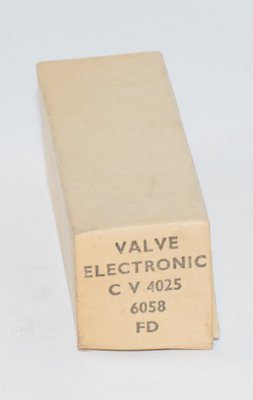
The CV (Common Valve) numbering system was established by the UK Ministry of Defence to standardize valve procurement across all branches of the armed forces. Valves carrying CV numbers were required to meet stringent specifications for reliability, consistency, vibration resistance, and extended operating life — standards that went well beyond typical commercial requirements. The CV4007 emerged during the post-World War II era when miniature all-glass (B7G base) tubes were replacing the older octal designs in military electronics, radar systems, and communications equipment.
The 6AL5 family of twin diodes was originally developed in the United States and became one of the most ubiquitous signal diodes in valve electronics. The 'W' suffix denoted a version built to tighter mechanical and electrical tolerances, with enhanced resistance to shock and vibration — essential qualities for airborne, shipboard, and field-deployed equipment. Mullard's CV4007 represented the pinnacle of this design, combining British manufacturing excellence with military-grade quality control.
2. Technical Specifications and Design
General Description
The CV4007 is a miniature twin diode (double diode) housed in a compact all-glass envelope. It contains two independent diode sections sharing a common cathode, making it ideal for full-wave rectification, detection, and discriminator circuits at signal-level voltages.
Heater / Filament Ratings
| Heater Voltage (Vh) | 6.3 V |
| Heater Current (Ih) | 0.3 A |
Maximum Ratings (Per Diode Section)
| Peak Inverse Voltage (PIV) | 330 V (peak) |
| Max DC Output Current (per section) | 9 mA |
| Max Peak Plate Current (per section) | 54 mA |
| Max Plate Dissipation (per section) | Approximately 1 W (confirm against manufacturer datasheet) |
Typical Operating Characteristics
As a diode, the CV4007 does not have amplification factor (μ), transconductance (gm), or plate resistance (rp) in the conventional sense — these parameters apply to triodes, pentodes, and other amplifying tubes. Instead, the key characteristics are:
| Forward Voltage Drop | Approximately 2–10 V depending on current (typical of thermionic diodes) |
| Diode Resistance (dynamic) | Varies with operating point; typically a few hundred ohms at rated current |
| Contact Potential | Approximately 1–2 V (the small voltage at which current begins to flow with zero applied plate voltage) |
Note: Since the CV4007 is a diode, there is no grid bias range — it has no control grid. The tube functions purely as a rectifier/detector element.
Physical Details
| Base Type | Miniature 7-pin (B7G / Miniature Button Base) |
| Envelope Type | T-5½ miniature all-glass |
| Mounting Position | Any (designed for universal mounting orientation) |
| Overall Length | Approximately 48 mm (1.89 inches) (confirm against datasheet) |
| Maximum Diameter | Approximately 19 mm (0.75 inches) |
Pin-Out (B7G Base, Bottom View)
| Pin | Connection |
|---|---|
| 1 | Diode Plate 1 (Anode 1) |
| 2 | Diode Plate 2 (Anode 2) |
| 3 | Heater |
| 4 | Heater |
| 5 | Cathode (common) |
| 6 | No connection (or internal shield — confirm against datasheet) |
| 7 | Cathode (common, tied to pin 5) |
Note: The standard 6AL5/EB91 pinout has the two diode plates on pins 1 and 5, with the cathode on pin 7, and heaters on pins 3 and 4. Some sources differ on the exact pin assignments for pins 2, 5, 6, and 7. The pinout above follows the most commonly published 6AL5W configuration, but builders should always verify against the specific manufacturer's datasheet before wiring.
Construction Quality (CV4007 / Military Grade)
- Enhanced mica spacers — precision-positioned to resist microphonic vibration
- Ruggedized internal structure — spot-welded elements designed to withstand severe mechanical shock (typically rated to 500g shock pulses)
- Tighter parameter matching — both diode sections matched more closely than commercial equivalents
- Extended life rating — typically 10,000 hours minimum under rated conditions
- Controlled heater warm-up characteristics
3. Applications and Usage
The CV4007 was designed for and widely used in the following applications:
Military and Professional Applications
- AM and FM detection / demodulation — The twin diode configuration is ideal for ratio detector and Foster-Seeley discriminator circuits used in FM receivers.
- AGC (Automatic Gain Control) rectification — Deriving DC control voltages from signal levels to regulate receiver gain.
- Noise limiter circuits — Series or shunt noise clipping in communications receivers.
- Radar systems — Signal detection and video processing in military radar equipment.
- Full-wave signal rectification — Converting AC signal voltages to DC for metering, control, and instrumentation purposes.
- Clamping and DC restoration circuits — In television and oscilloscope circuits.
- Voltage doubler circuits — Using both diode sections in a voltage-multiplier configuration for low-current applications.
General Circuit Applications
In civilian equipment, the 6AL5 family found its way into virtually every AM/FM radio receiver and television set of the 1950s and 1960s. The tube served as the primary detector in superheterodyne receivers and as the ratio detector in FM tuner sections. Its twin-diode configuration allowed a single tube to perform two separate functions — for example, one section for detection and the other for AGC.
4. Sound Characteristics
While the CV4007 is a diode and does not amplify signals in the traditional sense, it nonetheless has a meaningful impact on the sonic character of circuits in which it is employed. Audiophiles and engineers who have used the CV4007 and its equivalents in detector, rectifier, and signal-processing roles describe the following qualities:
- Transparency and purity — The Mullard CV4007 is praised for its exceptionally clean signal rectification. In FM detector circuits, users report a notably pure, low-distortion recovered audio signal compared to semiconductor diode replacements or lesser-quality tube equivalents.
- Low noise floor — The military-grade construction results in minimal microphonic noise and very low shot noise, contributing to a black, silent background in sensitive receiver circuits.
- Smooth, natural transient behavior — Unlike silicon or germanium diodes, thermionic diodes exhibit a soft, gradual turn-on characteristic. This produces what listeners describe as a more natural, less harsh handling of signal peaks — particularly noticeable in AM detection where the diode directly shapes the audio waveform.
- Warmth without coloration — When used in signal-level rectification (such as in compressor/limiter sidechain circuits or meter driver circuits), the CV4007 imparts a subtle warmth that is often described as musical and organic, without adding obvious coloration or distortion.
- Excellent section matching — The tight matching of the two diode sections in CV4007 specimens results in superior balance in push-pull detector circuits, reducing even-order distortion products and improving stereo separation in FM multiplex decoders.
It should be noted that in many applications, the diode's contribution to overall sound is subtle compared to the amplifying stages. However, in circuits where the diode is directly in the signal path — such as AM detectors, ratio detectors, or audio-frequency rectifiers — the quality of the diode can be clearly audible.
5. Equivalent or Substitute Types
| Type | Relationship | Notes |
|---|---|---|
| 6AL5W | Identical / direct equivalent | The CV4007 IS the British military designation for the 6AL5W. Fully interchangeable, same pinout, same ratings. |
| 6AL5 | Commercial equivalent | Electrically identical but built to commercial (not ruggedized) standards. Direct plug-in replacement, though with potentially shorter life and less vibration resistance. |
| EB91 | European commercial equivalent | The Mullard/Philips designation for the same tube type. Same B7G base and pinout. Fully interchangeable. |
| 6D2 (6Д2) | Soviet equivalent | Russian-manufactured equivalent of the 6AL5. Generally interchangeable; verify pinout against specific manufacturer's documentation. |
| DD6 | Philips/Mullard alternative designation | An older Mullard designation sometimes encountered. Same tube, same pinout. |
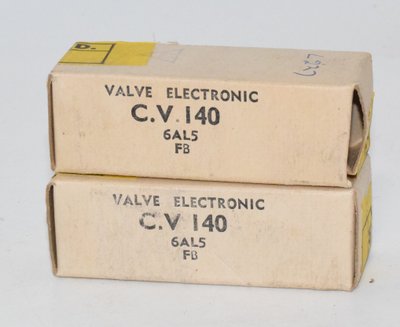
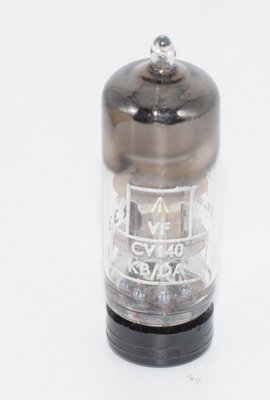
| CV140 | Earlier CV designation | An earlier British military CV number for the 6AL5 (non-W). Similar but may not meet the tighter CV4007 specifications. |
Important note: The 6AL5 / EB91 / CV4007 should NOT be confused with the EAA91 or other double diodes that may use different base types or pinouts. Always verify the base type (B7G) and pinout before substitution. All genuine equivalents listed above share the same miniature 7-pin B7G base and identical pin connections.
6. Notable Characteristics
- Mullard Whyteleafe provenance — CV4007 tubes manufactured at Mullard's Whyteleafe plant are particularly sought after. This factory was dedicated to special-quality and military-grade production, and its output is considered among the finest British valve manufacturing ever achieved. Tubes from this facility often bear distinctive factory codes and are identifiable by their precise, clean construction.
- Exceptional consistency — As a CV-rated component, every CV4007 was individually tested and guaranteed to fall within tight parameter windows. This makes NOS (New Old Stock) CV4007 tubes remarkably consistent from sample to sample — a significant advantage over commercial-grade equivalents where parameter spread can be substantial.
- Vibration and shock resistance — The 'W' (ruggedized) construction makes the CV4007 particularly suitable for mobile and portable equipment, guitar amplifiers subjected to stage vibration, and any application where microphonic sensitivity is a concern.
- Long shelf life — Military-specification tubes were typically sealed and stored under controlled conditions. NOS CV4007 tubes, even decades after manufacture, typically test as new when properly stored, thanks to the high-quality vacuum seal and getter material used in their construction.
- Dual-section independence — The two diode sections are electrically independent (sharing only the cathode), allowing them to be used in completely separate circuit functions. This versatility made the tube extremely popular in compact equipment designs where minimizing tube count was important.
- Soft recovery characteristic — Like all thermionic diodes, the CV4007 exhibits no reverse recovery transient (unlike semiconductor diodes), making it inherently free of switching noise — a property valued in high-fidelity audio detection circuits.
7. Usage in the Audio Community
The CV4007 occupies a specialized but respected niche in the audio community. While it is not an amplifying tube and therefore does not feature in the signal chain in the same way as a celebrated preamp triode or output pentode, it finds meaningful use in several audio-related applications:
Vintage and High-End FM Tuners
Perhaps the most significant audio application for the CV4007 is in high-quality FM tuner restoration. Classic tuners from manufacturers such as Marantz (10B), McIntosh (MR-71, MR-78 era predecessors), Fisher, Scott, and others used 6AL5-type tubes in their ratio detector and discriminator stages. Replacing worn commercial 6AL5 or EB91 tubes with NOS CV4007 specimens is a well-known upgrade path among vintage tuner enthusiasts. The improved section matching and lower noise of the CV4007 can yield audible improvements in distortion, stereo separation, and signal-to-noise ratio.
Compressor and Limiter Circuits
Several classic studio compressor and limiter designs use twin diodes in their sidechain rectification circuits to derive the control voltage from the audio signal. The characteristics of the diode directly influence the attack and release behavior of the compressor. The CV4007's consistent, well-matched sections and smooth transfer characteristics make it a premium choice for these applications. DIY audio builders constructing replicas of vintage compressor designs often seek out CV4007 tubes for their sidechain circuits.
Guitar Amplifier Modifications
Some boutique guitar amplifier builders and modifiers have incorporated 6AL5-type diodes (including the CV4007) into effects loops, tremolo circuits, and signal-clipping stages. The soft clipping characteristic of a thermionic diode produces a different — and to many ears, more musical — distortion character compared to silicon or germanium diodes. The CV4007's ruggedized construction is particularly advantageous in guitar amplifiers, which are subjected to significant vibration during live performance.
Metering and VU Circuits
In professional audio equipment and high-end preamplifiers that incorporate VU meters or signal-level indicators, twin diodes are used to rectify the audio signal for meter drive. The CV4007's matched sections ensure accurate, balanced metering, and its thermionic characteristics provide a natural ballistic response that complements traditional VU meter movements.
DIY and Experimental Audio
The maker and DIY audio community values the CV4007 for experimental projects. Its low cost (relative to premium amplifying tubes), simple two-element structure, and well-documented characteristics make it an excellent tube for learning about thermionic devices. Projects include crystal radio upgrades, simple AM receivers, audio peak detectors, and experimental signal-processing circuits.
Collectibility and Market
NOS Mullard CV4007 tubes from the Whyteleafe factory command a modest premium over standard commercial 6AL5 tubes. They are not among the most expensive NOS tubes — the relatively limited demand for signal diodes keeps prices reasonable — but they are increasingly recognized as a quality component worth seeking out. Collectors value them for their Mullard provenance, military heritage, and the distinctive quality of Whyteleafe production. As with all NOS military-specification tubes, supply is finite and gradually diminishing, which has led to a slow but steady appreciation in value among knowledgeable collectors.
In summary, the CV4007 represents the highest expression of a humble but essential circuit element — the signal diode. Its Mullard military pedigree, exceptional build quality, and consistent performance make it a valued component for anyone working with valve-based detection, rectification, or signal-processing circuits, whether in vintage restoration, professional audio, or new creative designs.