1. Introduction and History
The CV4014 is a high-reliability, military-grade miniature pentode valve developed in the United Kingdom under the British CV (Common Valve) registration system. The CV numbering scheme was established by the UK Ministry of Defence (and its predecessors) to standardize and qualify vacuum tubes for use in military and government communications, radar, instrumentation, and other critical electronic equipment. Tubes bearing a CV4xxx designation (the 4000-series) were specifically selected for enhanced reliability, tighter tolerances, and extended operational life compared to their commercial equivalents.
The CV4014 is the high-reliability version of the well-known EF91 (also designated 6AM6 in the American system and Z77 in the original Mullard designation). The EF91/6AM6 family was one of the most widely produced and versatile sharp-cutoff RF pentodes of the post-war era, finding use in everything from IF amplifier stages in radio and television receivers to laboratory instrumentation and early computing equipment.
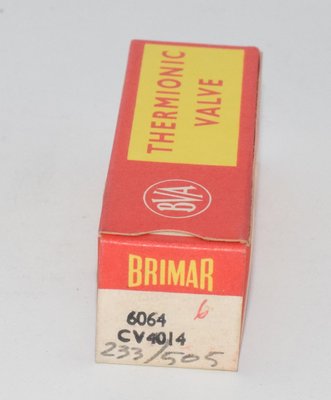
The primary manufacturer of the CV4014 was Brimar (Standard Telephones and Cables, STC), though other UK manufacturers including Mullard and GEC also produced tubes to this specification. Brimar, in particular, is closely associated with the CV4014 and its direct commercial equivalent, the 6064. The 6064 was Brimar's own commercial designation for the same high-reliability pentode, and the two designations (CV4014 and 6064) are considered identical in specification.
Production of the CV4014 spanned roughly from the early 1950s through the 1960s, with NOS (New Old Stock) examples still available on the vintage tube market today. These tubes are prized by audiophiles and vintage equipment restorers for their consistent quality and refined sonic characteristics.
2. Technical Specifications and Design
The CV4014 is a sharp-cutoff RF pentode designed for use as a voltage amplifier in IF and RF stages, as well as in video amplifier and general-purpose amplification circuits. Below are the key specifications. Values are drawn from available manufacturer data for the CV4014/6064 and the parent EF91/6AM6 type where the CV4014 conforms to the same basic electrical design but with tighter selection criteria.
Heater / Filament
| Parameter | Value |
|---|---|
| Heater Voltage (Vh) | 6.3 V |
| Heater Current (Ih) | 0.3 A |
| Heater Type | Indirectly heated cathode |
Maximum Ratings (Absolute Maximum)
| Parameter | Value |
|---|---|
| Maximum Plate (Anode) Voltage (Va max) | 250 V |
| Maximum Screen Grid Voltage (Vg2 max) | 250 V |
| Maximum Plate Dissipation (Pa max) | 2.5 W |
| Maximum Screen Grid Dissipation (Pg2 max) | 0.7 W |
| Maximum Cathode Current (Ik max) | 15 mA |
Typical Operating Conditions (as IF/RF Amplifier)
| Parameter | Value |
|---|---|
| Plate Voltage (Va) | 250 V |
| Screen Grid Voltage (Vg2) | 250 V |
| Control Grid Voltage (Vg1) | −2 V (typical bias point) |
| Plate Current (Ia) | ~10 mA |
| Screen Current (Ig2) | ~3.5 mA |
Characteristic Parameters (at typical operating point)
| Parameter | Value |
|---|---|
| Transconductance (gm) | ~7.5 mA/V (7,500 µS) |
| Plate Resistance (rp) | ~1 MΩ (typical for sharp-cutoff pentode) |
| Amplification Factor (µ) | ~7,500 (calculated from µ = gm × rp; note: this very high value is characteristic of pentodes and is of limited practical significance compared to gm) |
| Grid Bias Range (Vg1) | 0 V to approximately −15 V (cutoff) |
| Input Capacitance (Cin) | ~5.5 pF |
| Output Capacitance (Cout) | ~5.5 pF |
| Grid-to-Plate Capacitance (Cag) | ~0.004 pF |
Note: The amplification factor (µ) and plate resistance (rp) values for pentodes are inherently high and variable depending on operating conditions. The transconductance (gm) is the most practically useful parameter for circuit design with this tube type. Values should be confirmed against the specific Brimar or STC datasheet for the CV4014/6064 if precision is required for a particular application.
Physical Construction
| Parameter | Detail |
|---|---|
| Base Type | Miniature 7-pin (B7G) — also known as "miniature button base" |
| Envelope Type | Miniature glass envelope (T-6½ / approximately 19–20 mm diameter) |
| Mounting Position | Any (designed for universal mounting orientation) |
| Overall Length | Approximately 55 mm (excluding pins) |
| Weight | Approximately 10–12 g |
Pin-Out (B7G Base, Bottom View)
| Pin | Connection |
|---|---|
| 1 | Suppressor Grid (g3) — internally connected to cathode in most versions |
| 2 | Heater |
| 3 | Plate (Anode) |
| 4 | Screen Grid (g2) |
| 5 | Control Grid (g1) |
| 6 | Cathode |
| 7 | Heater |
Note: Pin 1 (suppressor grid) is typically connected internally to the cathode. An internal screen/shield may be connected to pin 1 or to the cathode in some variants. Always verify against the specific manufacturer's datasheet for the exact internal connections of the CV4014 variant in hand.
3. Applications and Usage
The CV4014 was designed and specified for demanding applications where reliability, consistency, and long operational life were paramount. Its primary applications include:
- Military Communications Equipment: IF and RF amplifier stages in military radio receivers and transceivers, where the CV4000-series reliability grading ensured dependable performance under harsh environmental conditions.
- Radar Systems: Video amplifier and IF amplifier stages in radar receivers, where the tube's high transconductance and wide bandwidth capability were essential.
- Instrumentation: Precision laboratory instruments, oscilloscopes, and measurement equipment where low noise and consistent gain were required.
- Television Receivers: The commercial equivalents (EF91/6AM6) were extensively used in IF amplifier strips of early television receivers. The CV4014 would have been used in military or government-specification television monitoring equipment.
- Early Computing: Some early British computers and data processing equipment used EF91-family tubes in logic and amplifier circuits.
- Audio Preamplification: While not originally designed as an audio tube, the CV4014's low noise characteristics and high gain made it suitable for microphone preamplifiers, phono stages, and other high-gain audio applications.
The CV4014's high-reliability rating means that each tube was subjected to more rigorous testing, burn-in, and selection than the standard commercial EF91/6AM6. This included tighter tolerances on transconductance, lower microphony, reduced heater-cathode leakage, and verified performance over extended temperature ranges.
4. Sound Characteristics
While the CV4014 was not originally conceived as an "audio" tube, its adoption by the audio community — particularly in high-gain preamplifier stages — has led to a well-documented body of subjective listening impressions. Audiophiles and recording engineers who have used the CV4014 (and its 6064 equivalent) describe its sonic character as follows:
- Clarity and Detail: The CV4014 is frequently praised for its exceptional clarity and resolution. Its sharp-cutoff characteristic and high transconductance contribute to a detailed, articulate presentation that reveals subtle nuances in recordings.
- Low Noise Floor: As a high-reliability selected tube, the CV4014 typically exhibits a lower noise floor than standard-production EF91/6AM6 tubes. This makes it particularly attractive for phono stages and microphone preamplifiers where signal-to-noise ratio is critical.
- Neutral to Slightly Warm Tonal Balance: Users generally describe the CV4014 as tonally neutral with a slight warmth in the midrange — not as overtly "warm" or "lush" as some triode-based designs, but more refined and controlled than many other miniature pentodes.
- Tight, Controlled Bass: The bass response is described as well-defined and controlled rather than loose or bloomy. This characteristic makes the CV4014 well-suited to applications where bass accuracy is valued over euphonic coloration.
- Extended but Smooth Highs: The treble is typically described as extended and airy without being harsh or sibilant. The high-frequency performance benefits from the tube's low inter-electrode capacitances and wide bandwidth design heritage.
- Good Dynamics and Transient Response: The CV4014's fast transconductance response translates to good dynamic contrast and clean transient reproduction, making it effective in circuits handling complex musical material.
- Low Microphony: The military-grade construction and selection process results in notably low microphonic sensitivity compared to standard EF91/6AM6 production, which is a significant practical advantage in sensitive audio circuits.
Compared to the standard EF91/6AM6, the CV4014 is generally considered to offer a more refined, quieter, and more consistent sonic performance — a direct consequence of its tighter manufacturing tolerances and selection criteria. Brimar-manufactured examples are particularly sought after for their smooth, musical character.
5. Equivalent or Substitute Types
Understanding the equivalency relationships of the CV4014 is important for both equipment restoration and audio experimentation. The following categories clarify which tubes are genuinely interchangeable and which require caution:
Direct / Identical Substitutes (Drop-in Replacements)
| Type | Notes |
|---|---|
| 6064 | Brimar's commercial designation for the same high-reliability pentode. Electrically and physically identical to CV4014. Fully interchangeable. |
| CV8732 | Another CV-registered designation for the same tube or a very closely matched variant. Fully interchangeable with CV4014. |
Different Rating Substitutes (NOT Direct Drop-in — Use with Caution)
The following tubes are from the same family and share the same B7G base and pin-out, but they are standard commercial-grade types with different (typically wider or less tightly controlled) specifications. They can generally be used in the same circuits, but they do not meet the CV4014's high-reliability specifications and may differ in noise, microphony, transconductance tolerance, and longevity:
| Type | Notes |
|---|---|
| EF91 | The European commercial equivalent (Mullard designation). Same basic electrical design and pin-out. Standard commercial grade — not high-reliability selected. |
| 6AM6 | American (RETMA) designation for the EF91. Same pin-out and general specifications. Standard commercial grade. |
| Z77 | Original Mullard designation for the EF91. Same tube, different naming convention. |
| 6F12 | Related type; verify specifications before substitution. |
| CV138 | Earlier CV registration for the EF91 type. Standard military grade (not 4000-series high-reliability). |
| CV1955 | Another CV registration related to the EF91 family. Standard military grade. |
| CV2195 | CV-registered variant of the EF91 family. Standard military grade. |
| CV8020 | CV-registered variant. Verify specific ratings before use. |
| CV10327 | CV-registered variant. Verify specific ratings before use. |
Important: While the standard EF91/6AM6 types will physically fit and generally function in any circuit designed for the CV4014, the CV4014's tighter specifications mean that replacing a CV4014 with a standard EF91 may result in higher noise, greater microphony, or less consistent performance. Conversely, a CV4014 can always be used as a premium replacement for an EF91/6AM6.
6. Notable Characteristics
- High-Reliability (CV4000-Series) Selection: The defining characteristic of the CV4014 is its qualification under the stringent CV4000-series standards. This involved extended burn-in testing, tighter parametric limits (especially on transconductance, leakage currents, and noise), vibration and shock testing, and verification of performance over a wider temperature range than commercial types.
- Brimar Heritage: The majority of CV4014 tubes encountered on the market are of Brimar (STC) manufacture. Brimar was renowned for the quality of its miniature valve production, and their CV4014/6064 tubes are considered among the finest examples of the EF91 type ever produced.
- Excellent Consistency: Due to the selection process, CV4014 tubes tend to be remarkably consistent from sample to sample. This is a significant advantage when matching tubes for stereo pairs or for use in balanced circuits.
- Low Microphony: The CV4014's construction was optimized to minimize microphonic sensitivity — the tendency of a tube to convert mechanical vibration into electrical noise. This is particularly important in high-gain audio applications and in equipment subject to vibration (military vehicles, aircraft, shipboard installations).
- Sharp-Cutoff Characteristic: Unlike variable-mu (remote-cutoff) pentodes, the CV4014 has a sharp-cutoff control grid characteristic. This means that the tube transitions relatively abruptly from full conduction to cutoff as the grid bias is increased. This characteristic is advantageous for applications requiring linear amplification at a fixed operating point but makes the tube less suitable for AGC (Automatic Gain Control) applications compared to variable-mu types.
- Wide Bandwidth: The CV4014's low inter-electrode capacitances and high transconductance give it excellent high-frequency performance, with useful gain extending well into the tens of MHz range. This wide bandwidth contributes to its clean, detailed sound in audio applications.
- Compact Construction: The B7G miniature base and small glass envelope make the CV4014 physically compact, allowing dense circuit layouts — an advantage in both military equipment and modern boutique audio designs.
7. Usage in the Audio Community
The CV4014 has earned a dedicated following in the audio community, despite — or perhaps because of — its origins as a military/industrial tube rather than a purpose-designed audio valve. Its applications in audio include:
Microphone Preamplifiers
The CV4014's high gain, low noise, and low microphony make it an excellent choice for tube microphone preamplifier designs. Several boutique and DIY microphone preamp circuits have been designed around the EF91 family, and the CV4014 is considered the premium choice for these applications. Its consistent performance ensures reliable, quiet operation in professional recording environments.
Phono Stages (RIAA Preamplifiers)
The very low signal levels from moving-magnet and especially moving-coil phono cartridges demand a preamplifier tube with low noise and high gain. The CV4014 excels in this role, and several high-end phono stage designs — both commercial and DIY — specify the CV4014 or 6064 as the preferred tube. Its neutral-to-slightly-warm tonal character complements the RIAA equalization curve well, producing a detailed yet musically engaging presentation.
Line-Level Preamplifiers
In line-level preamplifier and buffer stages, the CV4014 can provide voltage gain with minimal coloration. Its pentode configuration offers higher gain per stage than a triode, which can simplify circuit topology and reduce the number of gain stages required.
Guitar Amplifiers
While less common in guitar amplifiers than types like the EF86 or 12AX7, the EF91 family — including the CV4014 — has been used in some vintage and boutique guitar amplifier designs, particularly in the preamp section. The Vox AC15 and some early Selmer amplifiers used EF91-type tubes. The CV4014 is sought after as a premium, low-noise replacement in these applications.
Headphone Amplifiers
Some DIY and boutique headphone amplifier designs incorporate the EF91/CV4014 as a voltage amplification stage driving a power tube or solid-state output stage. The tube's detail retrieval and dynamic response are well-suited to the intimate listening experience of headphones.
Tube Rolling and Collecting
The CV4014 is a popular "tube rolling" choice for audiophiles who own equipment designed for the EF91/6AM6 family. Swapping a standard-production EF91 for a CV4014 is one of the most cost-effective upgrades available, often yielding audible improvements in noise floor, clarity, and overall refinement. NOS Brimar CV4014 tubes, while not as expensive as some rare audio tubes, command a premium over standard EF91 production and are actively collected by enthusiasts.
Availability and Market
NOS CV4014 and 6064 tubes remain available from specialist vintage tube dealers, though supplies are finite and gradually diminishing. Prices vary depending on manufacturer, condition, and testing results, but they are generally considered good value relative to their performance. Brimar-manufactured examples are the most commonly encountered and the most sought after. Tubes are typically sold individually and tested for transconductance, noise, and microphony before sale by reputable dealers.
Practical Considerations for Audio Use
- Shielding: Like all high-gain pentodes, the CV4014 benefits from a metal tube shield (screen can) to minimize hum pickup and electromagnetic interference, especially in sensitive audio circuits.
- Socket Quality: The B7G miniature socket should be of high quality with good contact tension to ensure reliable, low-noise connections. Ceramic or high-quality phenolic sockets are recommended for audio applications.
- Power Supply: The CV4014's performance in audio circuits is sensitive to power supply quality. Well-filtered, low-noise B+ and screen grid supplies are essential to realize the tube's full potential.
- Operating Point: For audio use, the CV4014 is often operated at somewhat lower plate and screen voltages than its maximum ratings to optimize linearity and extend tube life. Typical audio operating points might use 150–200 V on the plate and screen with appropriate grid bias.