1. Introduction and History
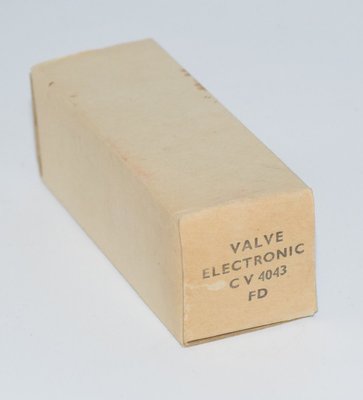
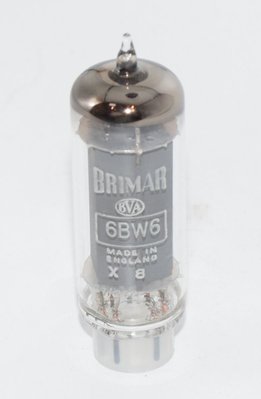
The CV4043 is a British military-specification (CV-series) beam power pentode designed for audio output and general-purpose amplification duties. It is the controlled-quality (CV) equivalent of the commercial 6BW6 type, manufactured primarily by STC (Standard Telephones and Cables) and Brimar in the United Kingdom. The CV designation indicates that the tube was manufactured to tighter tolerances and more rigorous quality-control standards than its commercial counterpart, making it suitable for military and professional communications equipment where reliability and consistency were paramount.
The 6BW6 was developed in the early-to-mid 1950s as a compact beam power output tube intended for use in audio output stages of radio receivers, public address systems, and similar equipment. It was designed to deliver moderate output power — approximately 5.5 watts in single-ended configuration — from a relatively small noval (B9A) envelope. The tube found widespread use in British-made equipment, and its CV4043 military variant was specified for defence electronics, field communications gear, and other government applications where long service life and predictable performance were essential.
As with many CV-series tubes, the CV4043 was produced in carefully controlled batches, with each tube individually tested and often marked with date codes and batch numbers. Today, NOS (New Old Stock) examples of the CV4043 are sought after by audiophiles and guitar amplifier enthusiasts who value the tube's robust construction, consistent performance, and distinctive sonic character.
2. Technical Specifications and Design
Heater / Filament
| Parameter | Value |
|---|---|
| Heater Voltage (Vh) | 6.3 V |
| Heater Current (Ih) | 0.45 A |
| Heater Type | Indirectly heated cathode |
Maximum Ratings
| Parameter | Value |
|---|---|
| Max Plate Voltage (Va max) | 315 V (as per typical operating conditions; absolute maximum may be slightly higher — confirm against full manufacturer datasheet) |
| Max Screen Grid Voltage (Vg2 max) | 225 V (operating value; absolute maximum should be confirmed) |
| Max Plate Dissipation (Pa max) | ~12 W (typical for 6BW6 type; confirm against manufacturer datasheet — this value is not explicitly provided in the reference data) |
| Max Screen Dissipation (Pg2 max) | ~2.5 W (estimated; confirm against manufacturer datasheet) |
Typical Operating Conditions — Class A Single-Ended
| Parameter | Value |
|---|---|
| Plate Voltage (Va) | 315 V |
| Screen Grid Voltage (Vg2) | 225 V |
| Control Grid Voltage (Vg1) | -13.0 V |
| Plate Current (Ia) | 34.0 mA |
| Screen Current (Ig2) | 2.2 mA |
| Transconductance (gm / S) | 3.75 mA/V |
| Load Resistance (Ra / RL) | 77,000 Ω (Note: this is an unusually high value for a beam power tube in pentode mode; this may represent a specific ultra-linear or distributed-load operating condition, or a triode-strapped configuration. Typical pentode-mode load impedance for similar tubes is often in the 5,000–8,000 Ω range. The value of 77 kΩ is taken directly from the reference data.) |
| Cathode Resistor (Rk) | 360 Ω |
| Output Impedance (Zout) | 8,500 Ω |
| Power Output (Pout) | 5.5 W |
| Total Harmonic Distortion (THD) | 12% |
Derived / Estimated Valve Parameters
| Parameter | Value |
|---|---|
| Amplification Factor (μ) | ~70–100 (estimated for pentode connection; confirm against manufacturer curves) |
| Plate Resistance (rp) | ~20–30 kΩ in pentode mode (estimated; confirm against manufacturer datasheet) |
Note: The amplification factor and plate resistance values are not explicitly provided in the available reference data and are estimated based on the transconductance and typical characteristics of similar beam power pentodes. Users requiring precise values should consult the original Brimar or STC datasheet.
Physical Construction
| Parameter | Detail |
|---|---|
| Base Type | Noval (B9A) — 9-pin miniature |
| Envelope Type | Glass miniature (similar in size to EL84/6BQ5) |
| Mounting | Vertical or horizontal (with appropriate socket) |
| Construction | Beam power tetrode with beam-forming plates |
Pin-Out (B9A / Noval Base — Bottom View)
| Pin | Connection |
|---|---|
| Pin 1 | Grid 3 (Suppressor) / Internal shield (confirm) |
| Pin 2 | Grid 1 (Control Grid) |
| Pin 3 | Cathode |
| Pin 4 | Heater |
| Pin 5 | Heater |
| Pin 6 | Internal Connection — Do Not Ground or Connect Externally |
| Pin 7 | Plate (Anode) |
| Pin 8 | Grid 2 (Screen Grid) |
| Pin 9 | Grid 2 (Screen Grid) or Internal connection (confirm against datasheet) |
⚠ Important Note: Pin 6 is an internal connection and must not be connected to any external circuit. This is a critical design consideration when substituting the CV4043/6BW6 into circuits designed for other noval output tubes, as pin 6 usage varies between tube types.
The exact pinout assignments for pins 1 and 9 should be confirmed against the original manufacturer datasheet, as slight variations exist in published references. The pin 6 internal connection is verified.
3. Applications and Usage
The CV4043 / 6BW6 was designed for and used in a variety of applications:
- Audio Output Stages: The primary application for the 6BW6 was as a single-ended Class A audio output tube in radio receivers, intercommunication systems, and small public address amplifiers. With 5.5 watts of output power, it was well-suited for driving loudspeakers in domestic and commercial equipment.
- Military Communications Equipment: As CV4043, the tube was specified for use in British military radio receivers, field communications sets, and other defence electronics where reliable audio output was required under demanding environmental conditions.
- Industrial and Professional Equipment: The tube found use in test equipment, signal generators, and industrial control systems where a compact, reliable output stage was needed.
- Television Receivers: Some British television sets of the 1950s and 1960s employed the 6BW6 in their audio output stages.
- Push-Pull Configurations: While commonly used in single-ended circuits, pairs of 6BW6 tubes could be used in push-pull Class AB configurations to deliver higher output power (approximately 10–13 watts) for more demanding audio applications.
The tube's moderate power output, compact size, and relatively low heater current consumption made it an attractive choice for portable and space-constrained equipment. Its beam power tetrode design provided good efficiency and power sensitivity, requiring only modest drive voltage from the preceding stage.
4. Sound Characteristics
The CV4043 / 6BW6 occupies an interesting niche in the world of audio tubes. While it is not as widely discussed as the ubiquitous EL84 or 6V6, those who have used it in audio circuits consistently describe a distinctive and appealing sonic character:
- Warm and Rich Midrange: The CV4043 is frequently praised for its lush, full-bodied midrange presentation. Vocals and acoustic instruments are rendered with a natural warmth and presence that many listeners find highly engaging. The midrange has a slightly "forward" quality without being aggressive.
- Smooth, Non-Fatiguing Treble: The high-frequency response is characterised as smooth and refined, with a gentle roll-off that avoids the harshness or "etch" sometimes associated with more modern output tubes. This makes the tube particularly well-suited for extended listening sessions.
- Solid, Controlled Bass: Despite its modest power rating, the 6BW6 delivers surprisingly well-defined bass. The low-frequency response is tight and controlled rather than boomy or loose, though it naturally lacks the deep bass authority of larger output tubes like the EL34 or KT88.
- Musical and Harmonically Complex: The tube produces a pleasing harmonic structure with predominantly even-order harmonics (particularly second harmonic), which contributes to its perceived musicality. This harmonic signature adds a subtle richness and "sweetness" to the sound that is characteristic of well-designed beam power tubes.
- Dynamic and Expressive: For a tube of its power class, the CV4043 exhibits good dynamic range and transient response. It handles dynamic swings with grace, preserving the micro-dynamics and nuances in music that contribute to a sense of "life" and expressiveness.
- Gentle Overdrive Characteristics: When pushed into clipping, the 6BW6 exhibits a smooth, gradual compression rather than a hard, abrupt distortion onset. This makes it appealing for guitar amplifier applications where a touch-sensitive, dynamically responsive overdrive is desired.
- Comparison to Similar Types: Sonically, the CV4043 is often compared to the EL84/6BQ5, with which it shares a noval base and similar power class. However, listeners generally describe the 6BW6 as having a slightly warmer, more "vintage British" character compared to the EL84's brighter, more forward presentation. Some compare it favourably to the 6V6 in terms of warmth and musicality, though the 6BW6 has its own distinct tonal signature.
- CV4043 vs. Commercial 6BW6: The military-grade CV4043 is often reported to sound slightly more refined and controlled than commercial 6BW6 examples, likely due to tighter manufacturing tolerances and more consistent electrode geometry. NOS CV4043 tubes from Brimar/STC are particularly prized for their consistency and sonic quality.
5. Equivalent and Substitute Types
The following types are verified as close or identical substitutes for the CV4043:
| Type | Relationship | Notes |
|---|---|---|
| 6BW6 | Commercial equivalent | Direct substitute. The CV4043 is the CV (military) version of the 6BW6. Identical pinout and electrical characteristics. The CV4043 is manufactured to tighter tolerances. |
| 6061 | Close/identical substitute | Verified as interchangeable. This is a ruggedised or special-quality version of the same basic design. |
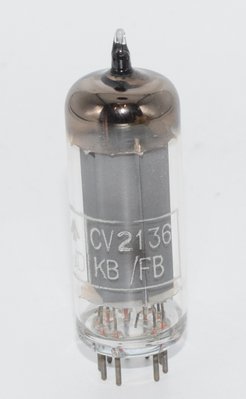
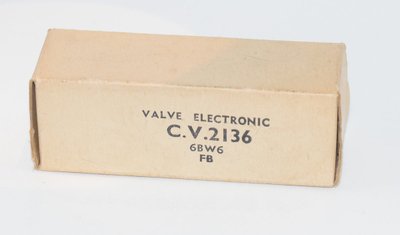
| CV2136 | Close/identical substitute | Another CV-series designation for the same or very closely related type. Direct substitute. |
| CV8048 | Close/identical substitute | Additional CV-series designation. Direct substitute. |
Important Substitution Notes
- Pin 6 Internal Connection: When substituting the CV4043/6BW6 for other noval output tubes (or vice versa), always verify that pin 6 is handled correctly. The CV4043 has an internal connection on pin 6 that must not be connected to external circuitry. Other noval output tubes may use pin 6 differently.
- Not a direct substitute for EL84/6BQ5: Although both are noval-based output pentodes of similar power class, the 6BW6 and EL84 have different pinouts, different bias requirements, and different operating parameters. They are not interchangeable without circuit modifications.
- Not a direct substitute for 6V6: The 6V6 uses an octal base and has different electrical characteristics. While the tubes are sometimes compared sonically, they are not physically or electrically interchangeable.
6. Notable Characteristics
- Pin 6 Internal Connection: This is perhaps the most important practical consideration when working with the CV4043. Pin 6 is connected internally and must be left unconnected in the external circuit. This is clearly documented in the manufacturer's data and is a critical point for circuit designers and those adapting existing amplifier designs.
- Military-Grade Construction: As a CV-series tube, the CV4043 benefits from enhanced quality control, including tighter tolerances on electrode spacing, more rigorous screening for microphonics and noise, and extended life testing. This results in tubes that are more consistent from sample to sample and generally more reliable over long service periods.
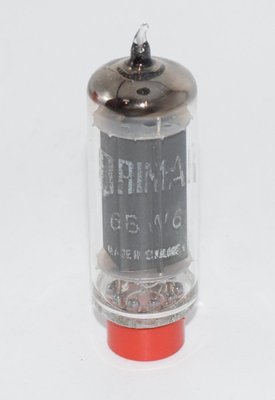
- Brimar / STC Manufacturing Quality: Brimar (a division of STC) was renowned for producing high-quality valves with excellent consistency. Their manufacturing processes, particularly for CV-series tubes, were among the best in the British valve industry. NOS Brimar CV4043 tubes are considered premium components.
- Compact Form Factor: The noval (B9A) base and miniature glass envelope make the CV4043 significantly smaller than octal-based output tubes of similar power rating, allowing for more compact equipment designs.
- Moderate Heater Current: At 0.45 A, the heater current is modest, making the tube suitable for battery-operated or portable equipment where power consumption is a concern.
- Self-Bias Operation: The specified cathode resistor value of 360 Ω allows straightforward self-bias (automatic bias) operation, simplifying circuit design and eliminating the need for a separate negative bias supply.
- Beam Power Design: As a beam power tetrode, the CV4043 uses beam-forming plates rather than a conventional suppressor grid to direct the electron beam and suppress secondary emission. This design approach typically results in higher power sensitivity and efficiency compared to true pentodes of similar ratings.
- Relative Rarity: The CV4043 / 6BW6 is less commonly encountered than tubes like the EL84 or 6V6, which adds to its appeal among collectors and experimenters seeking distinctive alternatives for audio projects.
7. Usage in the Audio Community
The CV4043 / 6BW6 has developed a dedicated following within the audio community, despite being less well-known than mainstream output tubes. Its usage spans several areas:
Single-Ended Triode (SET) and Single-Ended Pentode (SEP) Amplifiers
The CV4043 is a popular choice for DIY single-ended amplifier projects. With 5.5 watts of Class A output power, it delivers sufficient volume for high-efficiency speakers (typically 93 dB/W/m and above). Many builders operate the tube in triode-strapped mode (screen grid tied to plate through a suitable resistor), trading some output power for lower distortion and a more "triode-like" sonic character. In pentode or ultra-linear mode, the full 5.5 watts provides a useful increase in headroom and dynamic capability.
Guitar Amplifiers
A growing number of boutique guitar amplifier builders have discovered the CV4043/6BW6 as an alternative to the EL84 and 6V6 for low-wattage practice and recording amplifiers. The tube's smooth overdrive characteristics, touch sensitivity, and warm tonal character make it well-suited for blues, jazz, and classic rock tones. Its relative obscurity also appeals to builders seeking a unique voice that distinguishes their amplifiers from the crowd.
Headphone Amplifiers
The moderate power output of the CV4043 makes it an interesting candidate for high-end headphone amplifier designs, particularly for driving high-impedance headphones (such as Sennheiser HD600/650 or Beyerdynamic DT880). The tube's low noise floor (especially in CV4043 military-grade form) and refined sonic character are well-suited to the intimate, detail-revealing nature of headphone listening.
Vintage Equipment Restoration
Collectors and restorers of vintage British radio and television equipment seek out CV4043 and 6BW6 tubes to maintain or restore original equipment to working condition. NOS examples from Brimar/STC are particularly valued for their authenticity and reliability in these applications.
Tube Rolling and Experimentation
Audio enthusiasts who enjoy "tube rolling" — swapping different tube brands and types to explore sonic differences — find the CV4043 an interesting subject. Comparing NOS examples from different manufacturers (Brimar, STC, Mullard, and others) reveals subtle but audible differences in tonal character, dynamics, and spatial presentation. The military-grade CV4043 is generally considered the premium choice, with the most consistent performance and refined sound quality.
Community Resources
Discussion of the CV4043/6BW6 can be found on audio forums such as DIYAudio, AudioKarma, and the Valve Wizard community. Several published amplifier designs featuring the 6BW6 are available, ranging from simple single-ended designs to more sophisticated push-pull configurations. The tube's relative affordability (compared to premium types like the EL34 or KT66) makes it an accessible entry point for those exploring the world of valve audio.
Availability and Pricing
NOS CV4043 tubes remain available from specialist valve dealers, though supplies are gradually diminishing. Pricing is generally moderate compared to more sought-after types, making the CV4043 an excellent value proposition for audio enthusiasts. Matched pairs for push-pull applications can be sourced from dealers who offer tube testing and matching services. As awareness of this tube's qualities grows within the audio community, prices have shown a gradual upward trend, making current acquisition a potentially wise investment for future projects.