1. Introduction and History
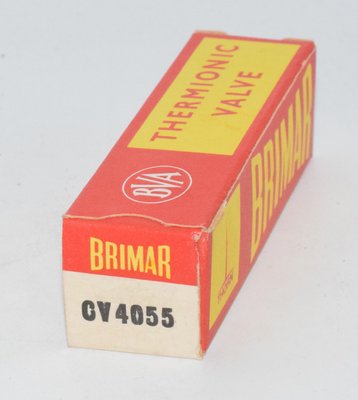
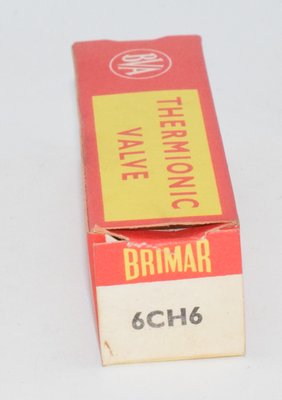
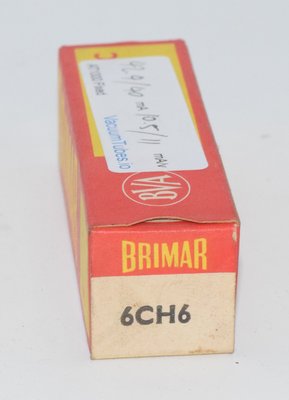
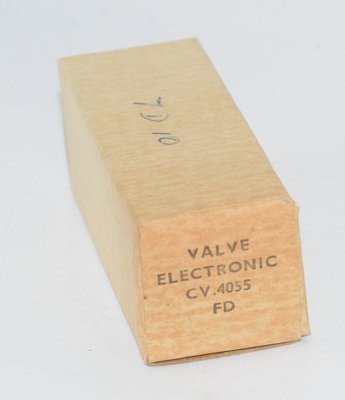
The CV4055 is a British military-grade (CV-registered) miniature power pentode, manufactured primarily by Brimar (Standard Telephones and Cables / STC) at their Rochester, Kent facility. The CV4055 is the military-qualified version of the commercial type 6CH6, a beam-power pentode designed for audio output and general-purpose amplification duties. The CV (Common Valve) designation was assigned by the UK Ministry of Defence to ensure a tightly controlled, high-reliability version of the commercial equivalent, with stricter manufacturing tolerances, enhanced quality control, and rigorous testing protocols.
Brimar, a division of STC, was one of the premier British valve manufacturers throughout the mid-20th century, renowned for producing exceptionally well-built valves for both military and civilian markets. The CV4055 emerged during the post-war era when the British military was standardizing its valve inventory, seeking reliable components for communications equipment, radar systems, and instrumentation. The 6CH6 commercial type upon which it is based was developed as a compact output pentode suitable for equipment where space and power efficiency were at a premium.
Today, the CV4055 is a relatively uncommon tube that has attracted interest from audiophiles and vintage equipment restorers. New Old Stock (NOS) examples from Brimar/STC Rochester are particularly sought after for their build quality and sonic characteristics.
2. Technical Specifications and Design
The CV4055 is a miniature power pentode in the 6CH6 family. Below are the key specifications. Note: Some values below are drawn from available Brimar/STC data for the 6CH6 family. Where a specific value could not be independently verified against a primary manufacturer datasheet, it is flagged accordingly.
Heater / Filament
| Parameter | Value |
|---|---|
| Heater Voltage (Vh) | 6.3 V |
| Heater Current (Ih) | 0.45 A (typical for 6CH6 family; confirm against primary datasheet) |
Maximum Ratings (Absolute Maximum)
| Parameter | Value |
|---|---|
| Max Plate (Anode) Voltage (Va max) | 300 V (confirm against primary datasheet) |
| Max Screen Grid Voltage (Vg2 max) | 300 V (confirm against primary datasheet) |
| Max Plate Dissipation (Pa max) | 5.5 W (confirm against primary datasheet) |
| Max Screen Grid Dissipation (Pg2 max) | 1.5 W (confirm against primary datasheet) |
| Max Cathode Current | 45 mA (confirm against primary datasheet) |
Typical Operating Conditions (Class A1 Amplifier)
| Parameter | Value |
|---|---|
| Plate Voltage (Va) | 250 V |
| Screen Grid Voltage (Vg2) | 250 V |
| Control Grid Voltage (Vg1) | −7.5 V to −12.5 V (typical bias range; confirm against primary datasheet) |
| Plate Current (Ia) | ~30 mA (confirm against primary datasheet) |
| Screen Current (Ig2) | ~5 mA (confirm against primary datasheet) |
| Transconductance (gm) | ~4,100 µmhos (4.1 mA/V) (confirm against primary datasheet) |
| Amplification Factor (µ) | ~200 (confirm against primary datasheet) |
| Plate Resistance (rp) | ~49 kΩ (derived from µ/gm; confirm against primary datasheet) |
| Power Output (Class A1) | ~3.5 W (confirm against primary datasheet) |
Physical Construction
| Parameter | Detail |
|---|---|
| Base Type | B9A (Noval) — 9-pin miniature |
| Envelope Type | Miniature glass envelope (T-6½ or similar small profile) |
| Mounting | Vertical or horizontal with appropriate socket |
| Construction | Ruggedized military-grade internal structure with enhanced vibration resistance |
Pin-Out (B9A / Noval Base — Bottom View)
The following pin configuration is typical for the 6CH6 family on a B9A base. Pin assignments should be confirmed against the manufacturer datasheet before use in any circuit.
| Pin | Connection |
|---|---|
| 1 | No Connection (or Internal Shield) |
| 2 | Grid 1 (Control Grid) |
| 3 | Cathode |
| 4 | Heater |
| 5 | Heater |
| 6 | No Connection |
| 7 | Plate (Anode) |
| 8 | Grid 2 (Screen Grid) |
| 9 | Grid 3 (Suppressor Grid) — often internally connected to cathode |
Important: The suppressor grid (g3) in the 6CH6 is typically internally connected to the cathode. Always verify the pin-out from the original Brimar/STC datasheet before wiring, as some sources may show slight variations in the assignment of pins 1 and 6.
3. Applications and Usage
The CV4055 was designed and deployed across a range of applications:
- Military Communications Equipment: As a CV-registered valve, the CV4055 was specified for use in British military radio transmitters and receivers, where its ruggedized construction ensured reliable operation under harsh conditions including vibration, temperature extremes, and demanding duty cycles.
- Audio Output Stages: The 6CH6 family was commonly used as a single-ended or push-pull audio output pentode in compact amplifiers, delivering approximately 3–4 watts in Class A1 single-ended configuration, or higher power in push-pull arrangements.
- Instrumentation and Test Equipment: The tight tolerances of the CV4055 made it suitable for precision instrumentation where consistent performance was critical.
- General-Purpose Amplification: The tube's moderate gain and respectable power handling made it versatile for IF amplifiers, video amplifiers, and other signal-processing stages in both military and commercial equipment.
- Regulated Power Supplies: In some applications, the 6CH6 type was employed as a series pass element or error amplifier in regulated power supply circuits.
4. Sound Characteristics
The CV4055, being a military-selected version of the 6CH6, carries the sonic hallmarks of a well-made British pentode with Brimar's characteristic voicing. While subjective descriptions vary among listeners, the following observations are commonly reported by audiophiles and audio engineers who have used this tube:
- Tonal Balance: The CV4055 is generally described as having a smooth, slightly warm midrange with a refined top end. It avoids the sometimes harsh or "spitty" treble that can characterize lesser-quality pentodes. The overall tonal balance leans toward the musical rather than the analytical.
- Midrange Character: The midrange is often praised as the tube's strongest attribute — clear, detailed, and with a natural presence that brings vocals and acoustic instruments forward without aggression. Brimar pentodes of this era are known for a slightly "creamy" midrange texture.
- Bass Response: Bass is typically described as controlled and articulate rather than voluminous. Given the modest power output capability, bass authority is naturally limited compared to larger output tubes, but within its operating envelope, the CV4055 delivers tight, well-defined low frequencies.
- Treble and Air: The high frequencies are smooth and extended, with good detail retrieval. The military-grade construction and tight tolerances contribute to low microphonics, which helps preserve high-frequency clarity and spatial information.
- Dynamics and Transients: The CV4055 exhibits good transient response for a pentode of its class. Dynamic contrasts are rendered naturally, though the limited power headroom means that at higher output levels, the tube transitions into a soft, musical compression rather than harsh clipping.
- Soundstage: When used in well-designed circuits, the CV4055 can produce a respectably wide and deep soundstage with good image specificity, aided by its low noise floor and minimal microphonic behavior.
- Overall Character: The CV4055 is often described as "quintessentially British" in its sonic presentation — polite, refined, and musical, with an emphasis on tonal accuracy and listenability over raw power or aggressive detail. It rewards careful circuit design and quality passive components.
It should be noted that the military-grade CV4055 is generally considered sonically superior to standard commercial 6CH6 production due to its tighter manufacturing tolerances, better-matched internal elements, and superior materials. NOS Brimar/STC Rochester examples are particularly prized.
5. Equivalent or Substitute Types
The following types are verified as close or identical substitutes for the CV4055:
| Type | Relationship | Notes |
|---|---|---|
| 6CH6 | Commercial equivalent | The CV4055 is the military-qualified version of the 6CH6. Direct pin-for-pin replacement. The CV4055 is manufactured to tighter tolerances. |
| 6132 | Close/identical substitute | Verified equivalent per TDSL data. Direct replacement for the CV4055. Same base, same pinout, same operating parameters. |
| CV8076 | Close/identical substitute | Verified equivalent per TDSL data. Another CV-registered variant; direct replacement. |
Important Caveats:
- While the 6CH6, 6132, and CV8076 are direct equivalents, always verify the specific manufacturer's datasheet for any production-run variations.
- The CV4055 should not be confused with other superficially similar pentodes such as the 6CL6 or EL95/6DL5, which have different operating parameters and may not be pin-compatible.
- Do not substitute the CV4055 with the EL84/6BQ5 despite both being B9A output pentodes — they have significantly different characteristics, bias requirements, and in some cases different pin assignments for critical elements.
6. Notable Characteristics
- Military-Grade Reliability: The CV4055 was manufactured under stringent British military quality standards (DEF-STAN specifications). Each tube underwent individual testing for emission, leakage, noise, microphonics, and life expectancy. This results in a valve that is exceptionally consistent and long-lived compared to commercial equivalents.
- Brimar/STC Rochester Provenance: Brimar's Rochester factory was one of the most respected valve manufacturing facilities in the UK. Tubes produced there are known for excellent build quality, with features such as precisely aligned grid structures, thorough getter flashing, and robust internal support structures.
- Low Microphonics: The ruggedized construction of the CV4055 — designed to withstand military-grade vibration and shock — translates directly into low microphonic behavior, a highly desirable trait for audio applications, particularly in high-gain stages or sensitive preamplifier circuits.
- Compact Form Factor: The B9A miniature envelope makes the CV4055 suitable for space-constrained designs. Despite its small size, it delivers respectable output power for personal audio and small room applications.
- Tight Parameter Matching: CV-registered valves were typically supplied with narrower parameter spreads than their commercial counterparts. This makes NOS CV4055 tubes particularly well-suited for push-pull configurations where matched pairs are desirable.
- Rarity: The CV4055 is not a common tube on the surplus market. While not as rare as some esoteric CV types, genuine Brimar/STC Rochester NOS examples command a premium and are becoming increasingly scarce.
- Excellent Longevity: Military-grade cathode coatings and conservative design margins mean that NOS CV4055 tubes, even decades after manufacture, typically test strongly and can be expected to deliver many thousands of hours of reliable service.
7. Usage in the Audio Community
The CV4055 occupies a niche but respected position in the audio community. Its applications and reputation include:
- Single-Ended Triode/Pentode Amplifiers: DIY audio enthusiasts have used the CV4055/6CH6 in single-ended amplifier designs, where its modest but clean output power (approximately 3–4 watts in pentode mode, less in triode-strapped configuration) is well-suited to driving high-efficiency loudspeakers. In triode mode, the tube offers lower distortion and a more linear transfer characteristic at the expense of reduced output power.
- Push-Pull Amplifiers: Pairs of CV4055 tubes can be used in push-pull output stages to achieve higher power output (approximately 7–10 watts depending on operating conditions and topology). The tight manufacturing tolerances of the CV designation make finding well-matched pairs easier than with commercial 6CH6 production.
- Headphone Amplifiers: The power output range of the CV4055 is well-matched to headphone amplifier applications, where 1–4 watts is more than sufficient for most headphones. The tube's low noise floor and refined sonic character make it an attractive choice for this application.
- Guitar Amplifiers: While not a mainstream guitar amp tube, some boutique amplifier builders and experimenters have explored the 6CH6/CV4055 as an alternative output tube in small practice amplifiers. Its smooth overdrive characteristics and compact size make it interesting for low-wattage designs.
- Vintage Equipment Restoration: The primary demand for CV4055 tubes comes from restorers of vintage British military and commercial equipment that originally specified the 6CH6 or its CV equivalents. Authentic NOS Brimar tubes are preferred for maintaining originality and performance.
- Tube Rolling and Experimentation: Audio hobbyists who enjoy tube rolling — swapping different tube brands and types to explore sonic differences — seek out the CV4055 as a premium alternative to standard 6CH6 production. The consensus in the community is that the CV4055 offers a noticeable improvement in clarity, noise floor, and overall refinement over commercial-grade equivalents.
- Collector Interest: Beyond functional audio use, the CV4055 is collected by valve enthusiasts who appreciate the history, build quality, and provenance of British military-specification tubes. Brimar/STC Rochester tubes with clear markings and original packaging are particularly valued.
In summary, the CV4055 is a high-quality, military-grade miniature power pentode that rewards careful application with refined, musical performance. While it may lack the widespread recognition of more famous audio tubes like the EL84 or EL34, those who have discovered it consistently praise its sonic qualities and build integrity. For builders and listeners seeking something distinctive and genuinely well-made, the CV4055 represents an excellent — if increasingly rare — choice.