Introduction and History
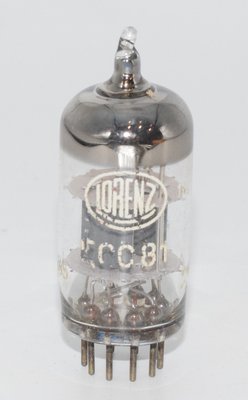
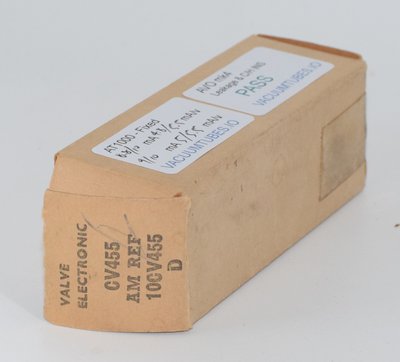
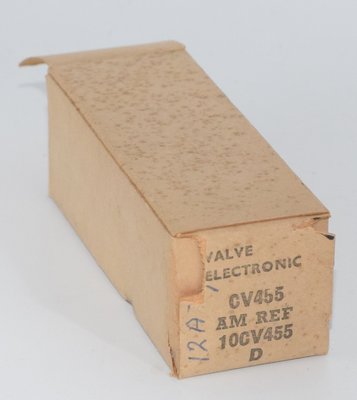
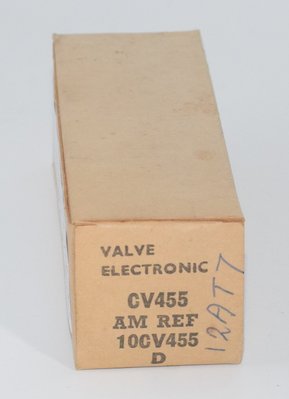
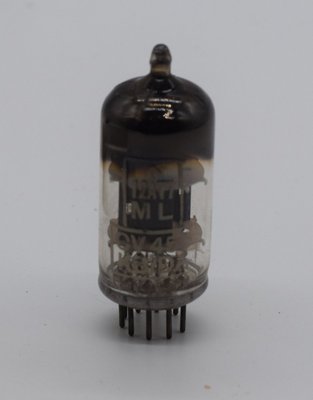
The CV455 is a British military-specification (Common Valve) designation for a high-mu medium-gain double triode vacuum tube, closely related to the widely known 12AT7 and its European equivalent, the ECC81. Developed during the post-war era of standardised military electronics, the CV455 was assigned its designation under the United Kingdom's Common Valve (CV) numbering system, which was administered by the Ministry of Defence to ensure consistent, interchangeable valve supplies across military equipment from multiple manufacturers.
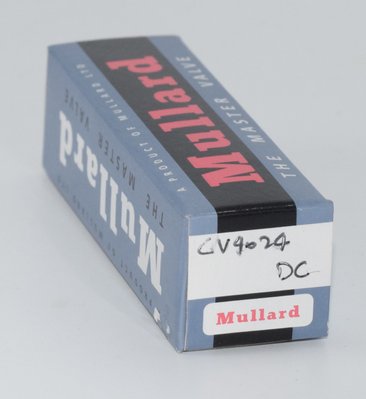
The CV numbering system was created to eliminate confusion caused by the proliferation of commercial type numbers from different manufacturers. By assigning a single CV number, the military could procure valves from Mullard, Brimar, GEC, and other approved suppliers with confidence that they would meet identical minimum performance standards. The CV455 was manufactured primarily during the 1950s and into the 1960s by leading British valve makers, with Mullard (at both their Blackburn and Mitcham facilities) and Brimar being among the most prominent producers.
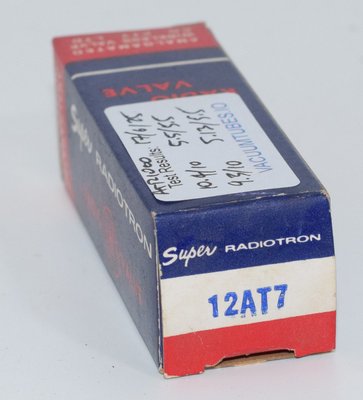
The 12AT7 family of tubes was originally developed in the late 1940s by RCA in the United States as part of the 9-pin miniature (noval) tube series. It was designed as a high-frequency amplifier triode with a relatively high amplification factor of approximately 60, moderate transconductance, and good performance at VHF frequencies up to 300 MHz. The type quickly found widespread adoption in television receivers, FM tuners, oscillator circuits, and communications equipment. Its inclusion in the British military inventory as the CV455 reflected the tube's proven reliability and versatility.
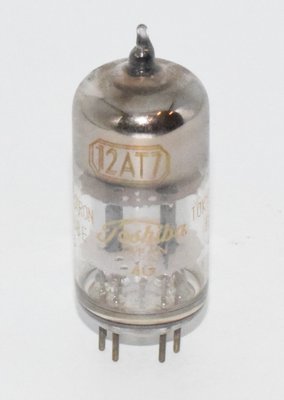
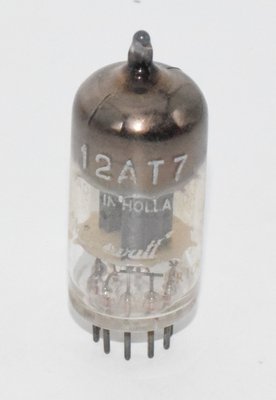
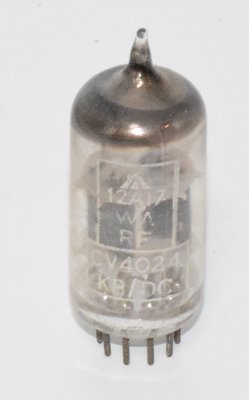
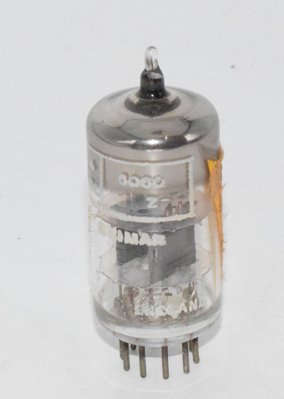
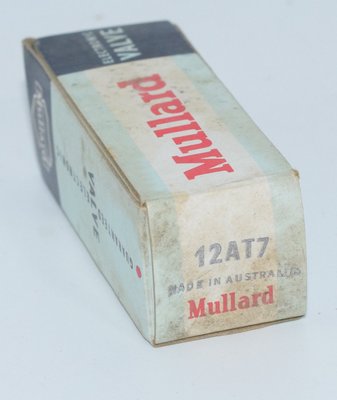
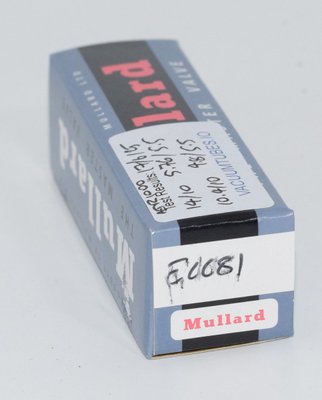
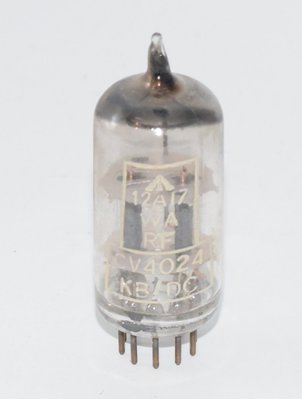
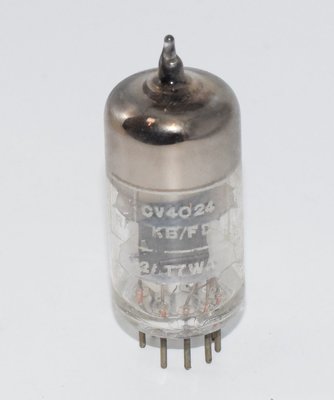
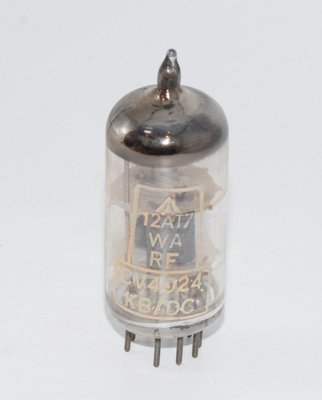
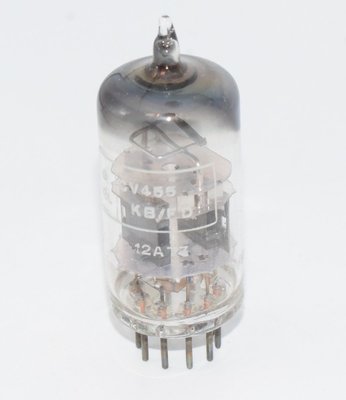
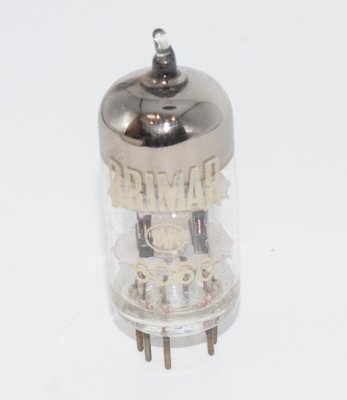
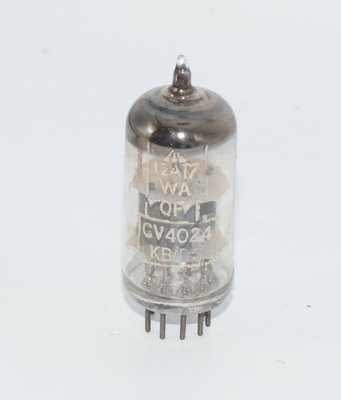
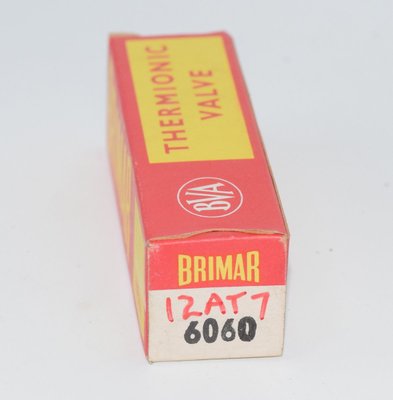
Surviving examples of CV455 tubes are highly sought after by collectors and audiophiles. Notable production variants include Mullard Blackburn examples from 1956, Mullard Mitcham production from 1959 (featuring the distinctive double crossbar getter construction), and Brimar-manufactured examples. These vintage British-made tubes are prized for their build quality and sonic characteristics in high-fidelity audio applications.
Technical Specifications and Design
General Description
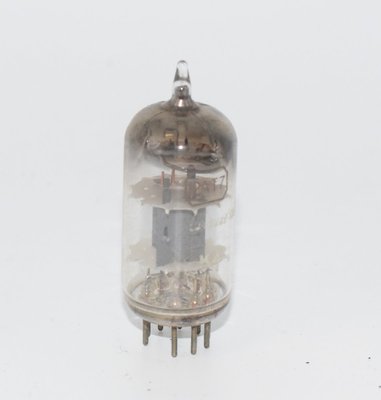
The CV455 is a miniature double triode with two electrically independent triode sections sharing a common glass envelope. It features oxide-coated cathodes with indirect heating. The tube is designed for use as a high-frequency amplifier, oscillator, and mixer at frequencies up to 300 MHz.
Heater Ratings
| Parameter | Value |
|---|---|
| Heater Voltage (Vh) | 6.3 V |
| Heater Current (Ih) | 0.3 A |
Note: The CV455 is rated with a 6.3 V heater supply. While the commercial 12AT7 designation implies 12.6 V series heater operation (with a centre-tapped filament allowing either 6.3 V parallel or 12.6 V series connection), the CV455 specification as referenced in military documentation lists only the 6.3 V heater voltage. Designers should consult the specific CV455 procurement specification if 12.6 V series operation is contemplated.
Absolute Maximum Ratings (Per Section)
| Parameter | Maximum Value |
|---|---|
| Anode Voltage (Va max) | 300 V |
| Anode Dissipation (Pa max) | 2.5 W |
| Cathode Current (Ik max) | 15 mA |
| Heater-Cathode Voltage (Vhk max) | 90 V |
Typical Operating Conditions — Class A1 Amplifier (Per Section)
| Parameter | Condition 1 | Condition 2 | Condition 3 | Condition 4 |
|---|---|---|---|---|
| Anode Voltage (Va) | 100 V | 170 V | 200 V | 250 V |
| Grid Voltage (Vg1) | −1 V | −1 V | −1 V | −2 V |
| Anode Current (Ia) | 3 mA | 8.5 mA | 11.5 mA | 10 mA |
| Plate Resistance (Ra) | 16,500 Ω | 11,000 Ω | 10,500 Ω | 11,000 Ω |
| Transconductance (S / gm) | 3.75 mA/V | 5.9 mA/V | 6.7 mA/V | 5.5 mA/V |
From these operating conditions, the amplification factor (μ) can be calculated as μ = gm × Ra. At the 250 V operating point: μ = 5.5 mA/V × 11,000 Ω = 60.5, which is consistent with the nominal amplification factor of approximately 60 for this tube type.
Physical Construction
| Parameter | Detail |
|---|---|
| Base Type | Noval (B9A) — 9-pin miniature |
| Envelope | Miniature glass (T-6½ style) |
| Mounting | All positions |
| Weight | Approximately 12 g |
Pin Configuration (B9A Noval Base, Bottom View)
| Pin | Function |
|---|---|
| 1 | Anode (Plate), Section 2 |
| 2 | Grid, Section 2 |
| 3 | Cathode, Section 2 |
| 4 | Heater (Filament) |
| 5 | Heater (Filament) |
| 6 | Anode (Plate), Section 1 |
| 7 | Grid, Section 1 |
| 8 | Cathode, Section 1 |
| 9 | Heater Centre Tap |
Interelectrode Capacitances (Typical, Without External Shield)
| Capacitance | Value (pF) |
|---|---|
| Grid to Anode (per section) | 1.6 |
| Input (per section) | 2.5 |
| Output, Section 1 | 0.5 |
| Output, Section 2 | 0.4 |
| Heater to Cathode | 2.8 |
| Anode to Anode | 0.33 |
Note: Capacitance values above are drawn from the attached CSF 12AT7WA datasheet, which shares the same fundamental electrode geometry. Exact CV455 capacitance limits may vary slightly per the specific military procurement specification.
Applications and Usage
The CV455 was designed for and deployed across a wide range of military and professional electronic equipment. Its principal applications include:
- High-Frequency Amplification: The tube's relatively low interelectrode capacitances and high transconductance make it well-suited for grounded-grid RF amplifier stages at frequencies up to 300 MHz. This was its primary intended application in military communications receivers and radar equipment.
- Oscillator Circuits: The CV455's high gain and good frequency stability made it an excellent choice for local oscillator stages in superheterodyne receivers, particularly in VHF and UHF communications equipment.
- Mixer/Frequency Converter: One or both triode sections could be employed in frequency conversion circuits, often with one section serving as the local oscillator and the other as the mixer.
- Phase Splitter/Driver: The dual triode configuration is ideal for phase-splitter circuits that drive push-pull output stages, a common topology in both military communications transmitters and high-fidelity audio amplifiers.
- Voltage Amplification: With an amplification factor of approximately 60, the CV455 provides substantial voltage gain in audio and intermediate-frequency amplifier stages.
- Cathode Follower: The tube's moderate plate resistance makes it suitable for cathode follower (common-plate) buffer stages, providing low output impedance for driving cables or subsequent stages.
In military service, the CV455 was found in a diverse array of equipment including communications receivers, signal generators, radar systems, electronic countermeasures equipment, and test instrumentation. The tube's reinforced internal construction — a characteristic emphasised in the related 12AT7WA military specification — provided the mechanical robustness and operational reliability demanded by field conditions.
Sound Characteristics
The CV455, like its commercial 12AT7/ECC81 counterparts, occupies a distinctive sonic niche among the popular noval double triodes. Its sound character is shaped by its electrical parameters — a moderate amplification factor of 60 (lower than the 12AX7's 100, higher than the 12AU7's 17–20), moderate transconductance, and relatively low plate resistance compared to the 12AX7.
General Tonal Character
Audiophiles and recording engineers consistently describe the 12AT7/CV455 family as possessing a clean, detailed, and slightly forward sonic signature. Compared to the 12AX7/ECC83, the CV455 tends to produce:
- Greater clarity and transient definition: The lower gain and lower plate resistance contribute to a more immediate, less compressed presentation. Transient attacks on percussion and plucked strings are rendered with notable precision.
- A leaner, more neutral midrange: Where the 12AX7 can sound warm and slightly thick in the midrange, the CV455 tends toward a more transparent, less coloured midrange presentation.
- Extended and articulate high frequencies: The tube's excellent high-frequency performance (designed for operation up to 300 MHz) translates into an open, airy top end in audio applications. Cymbal shimmer and vocal sibilance are reproduced with clarity without the slight softening sometimes attributed to higher-gain types.
- Tight, controlled bass: The lower plate resistance provides better damping and control of subsequent stages, resulting in bass that is taut and well-defined rather than loose or bloomy.
Vintage British Production Character
Specifically, vintage British-made CV455 tubes — particularly those from Mullard — are described by enthusiasts as having a slightly warmer and more refined character compared to American-made 12AT7s. Mullard Blackburn production (such as the documented 1956 examples) is noted for a rich, full-bodied midrange with excellent harmonic texture, while Mullard Mitcham production (such as the 1959 double crossbar getter examples) is praised for exceptional smoothness and low microphonics. Brimar-manufactured CV455 tubes are often characterised as having a slightly brighter, more detailed presentation with excellent transient response.
Overdrive Characteristics
When pushed into overdrive in guitar amplifier applications, the CV455/12AT7 produces a tighter, more focused distortion compared to the 12AX7. The clipping character is described as more symmetrical and less compressed, with a grittier, more aggressive edge that some players find desirable for blues and rock tones, particularly in the phase inverter position.
Equivalent and Substitute Types
Close/Identical Substitutes (Direct Drop-In Replacements)
The following types are recognised as closely identical to the CV455 and can generally be used as direct replacements without circuit modification:
| Type | Notes |
|---|---|
| 12AT7 | The standard commercial equivalent. Identical electrical characteristics and pinout. |
| ECC81 | European (Mullard/Philips) designation for the same tube type. Identical in all respects. |
| CV10662 | Alternative British CV designation for the same type. |
| CV8154 | Alternative British CV designation for the same type. |
| CV9859 | Alternative British CV designation for the same type. |
Different Rating Substitutes (NOT Direct Drop-In)
The following types are related to the CV455/12AT7 but have different ratings, tighter specifications, or other variations that mean they are not guaranteed drop-in replacements. They may work in many circuits but should be evaluated on a case-by-case basis:
| Type | Notes |
|---|---|
| 12AT7WA | Ruggedised military version with reinforced construction. Higher max anode voltage (330 V per the attached CSF datasheet vs. 300 V for CV455), higher max dissipation (2.8 W vs. 2.5 W). Heater rated for 12.6 V or 6.3 V operation. Different maximum ratings. |
| 12AT7WC | Further ruggedised military variant with controlled heater warm-up characteristics. |
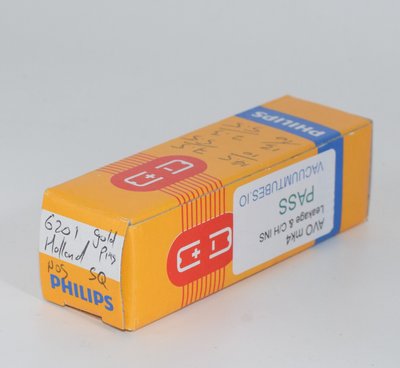
| 6201 | Premium/industrial version with tighter parameter tolerances and different ratings. Not a direct equivalent despite pin compatibility. |
| E81CC | European premium long-life version (Philips/Mullard). Enhanced specifications and different ratings compared to the standard ECC81/CV455. |
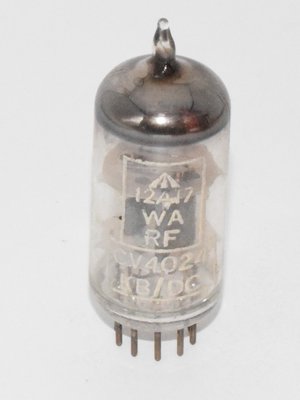
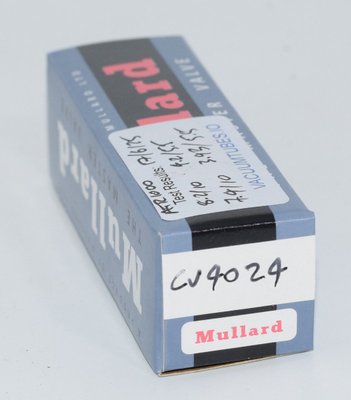
| CV4024 | British military designation for a related but differently specified type. Despite being a CV-numbered tube, it has different ratings from the CV455 and should not be assumed to be a direct substitute. |
| ECC801 / ECC801S | Special quality versions with enhanced reliability specifications and different ratings. |
| M8162 | Mullard special quality designation with tighter specifications. |
| 6060 | Related type with different ratings. |
| 6679 | Related type with different ratings. |
| 7492 / 7728 | Related types with different ratings. |
| A2900 | Related type with different ratings. |
| B152 / B309 / B739 | Alternative manufacturer designations with different ratings. |
| CC81E | Related type with different ratings. |
| CK6201 | Related type with different ratings. |
| E2157 | Related type with different ratings. |
| QA2406 / QS2406 | Related types with different ratings. |
Important Substitution Warnings
Do NOT substitute a 12AX7/ECC83 or 12AU7/ECC82 directly for a CV455 without understanding the circuit implications. While all three share the same B9A noval pinout, their electrical characteristics differ dramatically:
- The 12AX7 has a much higher amplification factor (~100) and much higher plate resistance (~62,500 Ω), with lower transconductance (~1.6 mA/V).
- The 12AU7 has a much lower amplification factor (~17–20) and lower plate resistance (~7,700 Ω), with lower transconductance (~2.2 mA/V).
Substituting these types can result in incorrect bias points, oscillation, insufficient gain, or excessive gain depending on the circuit. The CV455/12AT7 occupies a unique middle ground in the 12A_7 family and circuits designed for it generally require its specific characteristics.
The 5751 is NOT a substitute for the CV455/12AT7. The 5751 is a reduced-gain military substitute for the 12AX7/ECC83, with an amplification factor of approximately 70. Despite having a mu that is numerically close to the 12AT7's 60, the 5751's other parameters (plate resistance, transconductance, bias requirements) are entirely different, and it is not a recognised substitute for the 12AT7 family.
Notable Characteristics
- Military-Grade Construction: CV455 tubes were manufactured to stringent British military specifications, requiring enhanced mechanical robustness, tighter parameter tolerances, and extended life testing compared to commercial 12AT7 production. This included shock resistance testing (five shocks of 450 g applied in four directions along three perpendicular axes) and vibration fatigue testing (sinusoidal vibration at 2.5 g, 25 Hz, applied for 3 × 24 hours along three perpendicular directions), as documented in the related 12AT7WA specification.
- Excellent Section Matching: Military procurement specifications for the CV455 demanded close matching between the two triode sections, making these tubes particularly desirable for differential amplifier, phase splitter, and balanced circuit applications.
- High-Frequency Capability: The CV455 was designed for operation at frequencies up to 300 MHz, making it one of the more capable noval triodes for VHF applications. Its low interelectrode capacitances (grid-to-anode capacitance of approximately 1.6 pF) contribute to this high-frequency performance.
- Versatile Operating Range: The tube performs well across a wide range of anode voltages from 100 V to 300 V, with transconductance ranging from 3.75 mA/V at low voltages to 6.7 mA/V at 200 V. This versatility made it suitable for diverse circuit topologies.
- Double Crossbar Getter: Certain production runs, notably the 1959 Mullard Mitcham examples, featured a double crossbar getter construction. This getter design provides superior gas absorption over the tube's lifetime, contributing to long-term stability and consistent performance.
- Low Microphonics: The reinforced internal structure of military-grade CV455 tubes results in notably low microphonic sensitivity, an important characteristic for both military equipment subject to vibration and for sensitive audio preamplifier applications.
- Controlled Heater-Cathode Voltage: The maximum heater-cathode voltage of 90 V allows the CV455 to be used in circuits where significant DC potential exists between the heater and cathode, such as in series-string heater configurations or circuits with elevated cathode voltages.
Usage in the Audio Community
The CV455 and its commercial equivalents (12AT7/ECC81) occupy an important and versatile position in the audio world, finding application across high-fidelity equipment, guitar amplifiers, recording studio gear, and headphone amplifiers.
High-Fidelity Audio Amplifiers
In hi-fi amplifier design, the CV455/12AT7 is most commonly employed in the following roles:
- Phase Splitter/Driver Stage: This is perhaps the most common audio application for the 12AT7 type. Its moderate gain (μ ≈ 60) and relatively low plate resistance (10,500–16,500 Ω depending on operating point) make it an excellent choice for driving push-pull output stages. The low plate resistance provides good current delivery capability, ensuring clean drive of output tube grids. Classic amplifier designs from Dynaco, Fisher, Scott, and many others employ the 12AT7 in this critical position.
- Line-Stage Preamplification: The CV455 provides sufficient gain for line-level amplification while maintaining excellent linearity and low distortion. Its moderate mu avoids the excessive gain that can make 12AX7-based line stages prone to noise and overload issues.
- Cathode Follower Buffers: The tube's characteristics make it well-suited for cathode follower output stages in preamplifiers, providing low output impedance for driving long interconnect cables or low-impedance loads.
Guitar Amplifiers
In the guitar amplifier world, the 12AT7/CV455 serves several important functions:
- Phase Inverter: Many classic guitar amplifier designs (including various Fender, Marshall, and Vox models) use a 12AT7 in the phase inverter position. Its lower gain compared to the 12AX7 provides cleaner headroom in this stage, while its current capability ensures robust drive of the output tubes.
- Reverb Driver and Recovery: The 12AT7's ability to deliver more current than the 12AX7 makes it the standard choice for driving spring reverb tanks, which present a relatively low impedance load. Fender amplifiers have used the 12AT7 in this role since the early 1960s.
- Gain Reduction Modification: Some guitarists substitute a 12AT7 for a 12AX7 in gain stages to reduce overall preamp gain, achieving a cleaner tone with more headroom. While this substitution works in many circuits, it should be approached with caution as the different bias requirements and plate resistance can affect circuit behaviour.
Recording and Professional Audio
The CV455/12AT7 appears in numerous pieces of classic recording studio equipment:
- Microphone Preamplifiers: Several classic and modern microphone preamplifier designs employ the 12AT7 for its combination of adequate gain, low noise, and excellent linearity.
- Equalisers and Compressors: Vintage and boutique studio processors frequently use the 12AT7 in gain stages and buffer circuits.
- Condenser Microphone Power Supplies: Some vintage condenser microphone systems use the 12AT7 in their external power supply/amplifier units.
Headphone Amplifiers
The modern resurgence of tube audio has seen the CV455/12AT7 widely adopted in headphone amplifier designs. Its moderate gain and low plate resistance make it well-suited for driving headphones, either directly through coupling capacitors or via a cathode follower output stage. The tube's ability to operate effectively at lower anode voltages (as low as 100 V with good linearity) is advantageous in compact headphone amplifier designs that use lower-voltage power supplies.
Collector and NOS Market
Vintage CV455 tubes command premium prices in the NOS (New Old Stock) market. Mullard-manufactured examples are particularly sought after, with Blackburn factory production (identifiable by factory codes) and Mitcham factory production both having dedicated followings. The double crossbar getter Mullard Mitcham tubes from 1959 are considered especially desirable. Brimar CV455 production is also valued, though typically at somewhat lower prices than equivalent Mullard examples.
Audiophiles report that these vintage British military tubes offer superior sonic performance compared to modern production 12AT7s, attributing this to the higher-quality materials, more precise manufacturing tolerances, and superior vacuum processing of the era. Whether these differences are objectively measurable or primarily subjective remains a matter of ongoing discussion in the audio community, but the demand for vintage CV455 tubes remains consistently strong.