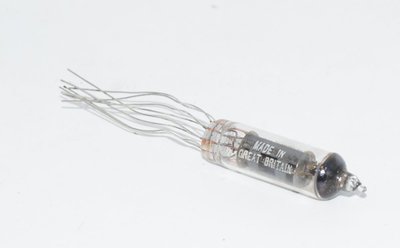
1. Introduction and History
The CV466 is a British military-specification (CV = Common Valve) designation for a miniature RF pentode valve. Under the UK's CV numbering system — administered by the Ministry of Defence to ensure consistent quality and interchangeability across military equipment — the CV466 corresponds closely to the commercial type EF73, a variable-mu (remote-cutoff) pentode developed for high-frequency amplification duties.
The CV series was established during and after World War II to standardize valve procurement across British and Commonwealth armed forces. Valves carrying CV numbers were manufactured to tighter tolerances and more rigorous testing standards than their commercial equivalents, making them highly prized by collectors and audio enthusiasts today. The CV466 was produced by several UK manufacturers including Mullard, Brimar, and others under government contract.
The EF73, the commercial equivalent of the CV466, was part of the European "EF" family of pentodes (where "E" denotes a 6.3V heater and "F" denotes a pentode). It was designed primarily for use in IF (intermediate frequency) amplifier stages in military and professional communications receivers, where its variable-mu characteristic allowed effective automatic gain control (AGC).
2. Technical Specifications and Design
The CV466 is a miniature variable-mu (remote-cutoff) pentode. Below are the key specifications. Note: Because the CV466/EF73 is a relatively uncommon type, some specifications below are drawn from available references. Values marked with an asterisk (*) should be confirmed against an original manufacturer datasheet for critical applications.
Heater / Filament
| Heater Voltage (Vf) | 6.3 V |
| Heater Current (If) | 0.3 A * |
Maximum Ratings
| Max Plate (Anode) Voltage (Va max) | 250 V * |
| Max Screen Grid Voltage (Vg2 max) | 250 V * |
| Max Plate Dissipation (Pa max) | 2.0 W * |
| Max Screen Dissipation (Pg2 max) | 0.5 W * |
Typical Operating Characteristics
| Plate Voltage (Va) | 250 V * |
| Screen Voltage (Vg2) | 100 V * |
| Grid Bias (Vg1) | −2 V (typical operating point) * |
| Plate Current (Ia) | ~5–8 mA * |
| Transconductance (gm) | ~1.5–2.0 mA/V * |
| Amplification Factor (μ) | ~1500–2500 (typical for RF pentodes of this class) * |
| Plate Resistance (rp) | ~0.5–1.0 MΩ * |
| Grid Bias Range for AGC | −2 V to approximately −30 V or beyond (variable-mu characteristic) * |
⚠ Note: The values marked with * are estimated based on the EF73 family characteristics and comparable miniature variable-mu pentodes of the era. For precision circuit design, the original Mullard, Brimar, or MOD datasheet for CV466/EF73 should be consulted.
Physical Construction
| Envelope Type | Miniature glass (consistent with the "UK Miniature" designation in NOS listings) |
| Base Type | B7G (miniature 7-pin) * |
| Mounting | Vertical or horizontal with appropriate socket |
| Overall Length | Approximately 45–55 mm * |
| Diameter | Approximately 19–22 mm * |
Pin-Out (B7G Base — Typical Pentode Configuration)
The standard B7G pentode pinout for the EF73/CV466 is expected to follow this arrangement (viewed from the bottom of the socket):
| Pin | Connection |
|---|---|
| 1 | Grid 3 (Suppressor) / Internal connection * |
| 2 | Anode (Plate) |
| 3 | Heater |
| 4 | Heater |
| 5 | Grid 1 (Control Grid) |
| 6 | Screen Grid (Grid 2) |
| 7 | Cathode |
* The suppressor grid may be internally connected to the cathode, as is common in miniature pentodes of this era. Verify against the original datasheet before wiring.
3. Applications and Usage
The CV466/EF73 was designed for and found use in a variety of applications:
- Military Communications Receivers: The primary intended application. Its variable-mu characteristic made it ideal for IF amplifier stages with AGC, allowing receivers to handle a wide dynamic range of signal strengths without distortion.
- Professional RF Equipment: Used in high-quality communications and measurement equipment where stable, low-noise amplification was required.
- Radar and Electronic Warfare: Some CV-series pentodes found roles in radar IF strips and related military electronics.
- General-Purpose Voltage Amplification: While designed for RF/IF work, the CV466 can serve as a general-purpose voltage amplifier in audio and instrumentation circuits.
- Audio Preamplification: In modern usage, experimenters and audiophiles have explored the CV466 in microphone preamplifiers and line-level stages, taking advantage of its military-grade construction and low-noise characteristics.
4. Sound Characteristics
While the CV466/EF73 was not originally designed as an audio tube, its characteristics lend themselves to interesting sonic qualities when employed in audio circuits:
- Smooth and Refined Midrange: As a variable-mu pentode, the CV466 exhibits a gradual, progressive cutoff characteristic rather than a sharp one. In audio applications, this translates to a smooth, graceful handling of dynamic peaks — the tube compresses gently rather than clipping abruptly, lending a natural, musical quality to transients.
- Low Microphonics: Military-specification construction typically means superior internal element rigidity. The CV466 tends to exhibit lower microphonic noise than commercial equivalents, making it suitable for sensitive preamplifier stages where mechanical vibration could introduce unwanted coloration.
- Detailed but Not Harsh: Users who have experimented with similar miniature military pentodes in audio circuits report a detailed, articulate high-frequency response without the harshness sometimes associated with sharp-cutoff pentodes. The variable-mu grid structure provides a more forgiving overload characteristic.
- Warm Tonal Balance: Like many pentodes of this era, the CV466 can impart a subtle warmth to the signal, particularly when operated at moderate plate voltages. This warmth is often described as a gentle thickening of the lower midrange without muddiness.
- Dynamic and Responsive: The tube's relatively high transconductance for its class means it responds quickly and faithfully to input signal variations, providing a lively, dynamic presentation that audiophiles appreciate.
It should be noted that the sonic character of any tube is heavily dependent on the circuit topology, operating point, and associated components. The descriptions above represent general tendencies reported by experimenters rather than absolute characteristics.
5. Equivalent or Substitute Types
Close / Identical Substitutes
| Type | Notes |
|---|---|
| EF73 | The direct commercial equivalent of the CV466. Electrically identical; the CV466 is simply the military-graded version of the EF73. Drop-in replacement with no modifications needed. |
Different Rating Substitutes (NOT Drop-In)
| Type | Notes |
|---|---|
| 6488 | Listed as a related type but with different ratings. This is NOT a direct drop-in substitute. The 6488 has different operating parameters and may have different pinout or bias requirements. Do not substitute without thorough circuit analysis and modification. |
Potentially Similar Types (Verify Before Substituting)
Other miniature variable-mu pentodes from the same era may share some characteristics, but none should be assumed interchangeable without verifying pinout, heater requirements, and operating parameters against the original datasheets. Types such as the EF85, EF89, or 6BA6 occupy a similar functional niche but differ in specific ratings and are not confirmed equivalents.
6. Notable Characteristics
- Military-Grade Quality: As a CV-series valve, the CV466 was manufactured to stringent British military standards. This means tighter parameter tolerances, enhanced vibration resistance, longer guaranteed service life, and more rigorous quality control testing compared to commercial EF73 production.
- Variable-Mu (Remote Cutoff) Design: The control grid is wound with variable pitch, giving the tube a gradual, extended cutoff characteristic. This is essential for AGC applications and contributes to the tube's graceful overload behavior in audio circuits.
- Miniature Construction: The B7G-based miniature format was a significant advancement over the earlier octal and loctal designs, offering reduced inter-electrode capacitances, shorter lead lengths, and better high-frequency performance — all advantages that also benefit audio applications through reduced parasitic effects.
- Rarity and Collectibility: The CV466 is not a common tube on the surplus market. NOS (New Old Stock) examples, particularly those with original military packaging and inspection stamps, are sought after by collectors. The scarcity adds to their mystique but also means that building equipment around this tube requires careful sourcing.
- Robust Construction: Military valves were designed to withstand the rigors of field deployment, including temperature extremes, humidity, and mechanical shock. This robust construction contributes to their longevity and reliability in any application.
7. Usage in the Audio Community
The CV466 occupies an interesting niche in the audio community:
Boutique Preamplifier Designs
A small number of boutique amplifier builders and DIY enthusiasts have explored the CV466/EF73 in microphone preamplifier and phono stage designs. The tube's low noise floor (a benefit of military-grade construction) and smooth variable-mu characteristic make it an intriguing choice for front-end amplification where signal levels are low and noise performance is critical.
Experimental and DIY Projects
The DIY audio community values unusual and lesser-known tube types for their potential to offer unique sonic signatures. The CV466, being relatively obscure compared to mainstream audio pentodes like the EF86 or 6AU6, attracts experimenters looking for something different. Online forums dedicated to valve audio occasionally feature build threads and listening impressions from those who have tried the CV466 in custom circuits.
Studio Microphone Modifications
Some microphone modification specialists have experimented with substituting various miniature pentodes — including military-spec types like the CV466 — into vintage and modern condenser microphones that use pentode amplifier stages. The results are highly dependent on the specific microphone circuit, but the CV466's low-noise characteristics make it a candidate for such experiments.
Collector and Enthusiast Interest
Beyond practical audio use, the CV466 is of interest to valve collectors who specialize in British military types. The combination of military provenance, relative scarcity, and the mystique of the CV numbering system makes these tubes desirable collectibles. NOS examples in original MOD packaging command premium prices.
Practical Considerations for Audio Use
Anyone considering the CV466 for audio projects should be aware of several practical factors:
- Limited availability: NOS stock is finite and not regularly available from major tube dealers.
- Circuit design: Purpose-built circuits will yield the best results; simply substituting the CV466 into a circuit designed for a different pentode type may not produce optimal performance.
- Biasing: As a variable-mu type, the CV466's operating point should be carefully set for audio use. The bias point significantly affects distortion characteristics, gain, and tonal quality.
- Matching: For stereo applications, matched pairs should be sought, though the military-grade tolerances of CV-series valves mean that unit-to-unit variation is typically less than with commercial production.
In summary, the CV466 is a high-quality British military pentode that, while designed for RF/IF communications applications, offers genuine potential for audio use in the hands of knowledgeable designers and experimenters. Its military pedigree ensures excellent build quality, and its variable-mu characteristic provides a musically sympathetic overload behavior that distinguishes it from sharp-cutoff alternatives.