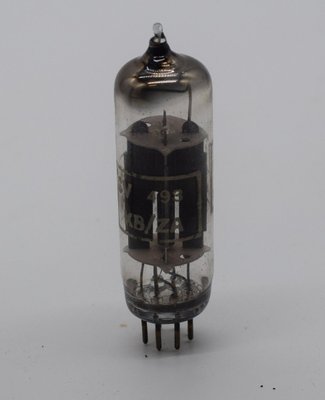
Introduction and History
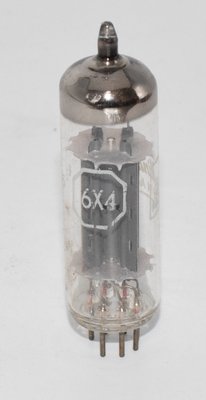
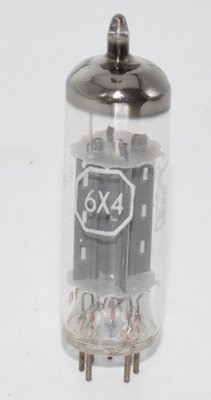
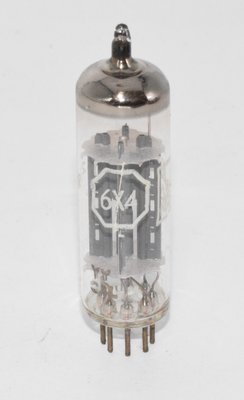
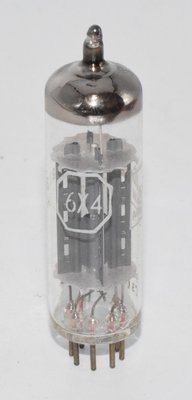
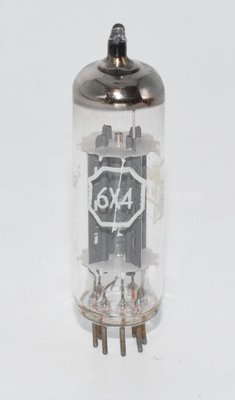
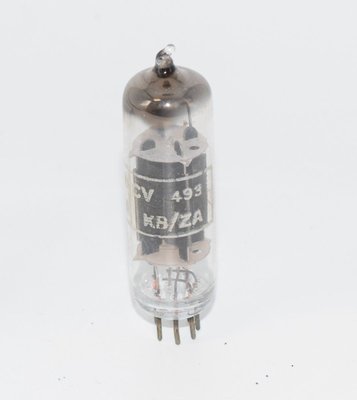
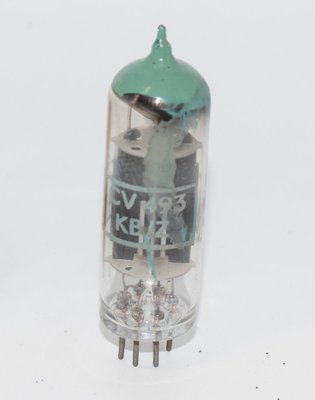
The CV493 is a British military-designated (Common Valve) miniature full-wave vacuum rectifier tube, directly equivalent to the widely known 6X4 (American designation) and EZ90 (Mullard/European designation). Developed in the late 1940s as part of the post-war miniaturization movement in electronics, the CV493 was designed to replace larger octal-based rectifiers like the 6X5GT in applications where space and power consumption were at a premium.
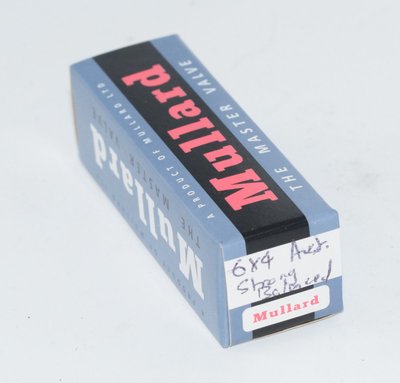
The CV (Common Valve) numbering system was established by the British Ministry of Defence to provide a standardized identification scheme for vacuum tubes used across all branches of the armed forces. The CV493 designation ensured that procurement and logistics could be streamlined regardless of the original manufacturer — whether it was the M-O Valve Company (Marconi-Osram), Mullard, Brimar, or other approved suppliers. Surviving examples frequently bear the markings of the M-O Valve Company, one of Britain's premier valve manufacturers, known for their rigorous quality control and military-grade construction standards.
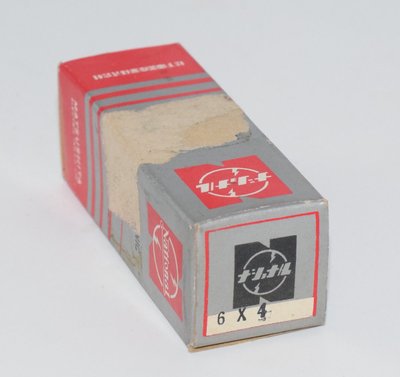
The 6X4 family was introduced by RCA and quickly became one of the most popular miniature rectifier tubes in both consumer and professional electronics. Its compact B7G (miniature 7-pin) envelope made it ideal for the increasingly smaller radio receivers, test equipment, and amplifiers of the 1950s and 1960s. The CV493 military variant was manufactured to tighter tolerances and often subjected to more rigorous testing and screening than its commercial counterparts, making surviving examples particularly prized by collectors and audio enthusiasts.
Technical Specifications and Design
General Description
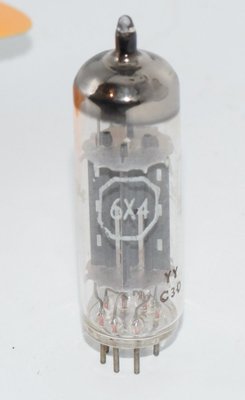
The CV493 is a miniature full-wave vacuum rectifier tube housed in a glass envelope with a B7G (miniature 7-pin) base. It is equivalent in performance to the larger octal-type 6X5GT. The tube is designed for use in power supply circuits of automobile and AC-operated radio receivers and similar equipment.
Heater Ratings
| Parameter | Value |
|---|---|
| Heater Voltage (AC/DC) | 6.3 volts |
| Heater Current | 0.6 ampere |
| Heater-Cathode Voltage (Peak) | +200, −450 volts max |
| Heater-Cathode Voltage (Average) | 100 volts max |
Note: The heater voltage of 6.3V at 0.6A is confirmed by both the verified reference data and the RCA datasheet for the 6X4.
Maximum Ratings (Design-Maximum Values) — Full-Wave Rectifier
| Parameter | Value |
|---|---|
| Peak Inverse Plate Voltage | 1250 volts |
| Steady-State Peak Plate Current (Per Plate) | 245 mA |
| AC Plate Supply Voltage (Per Plate, rms) | See Rating Chart* |
| DC Output Voltage (At filter input) | 350 volts |
| Average Output Current (Each plate) | 45 mA |
| Hot-Switching Transient Plate Current | See notes below |
*Important note on AC Plate Supply Voltage: The maximum AC plate supply voltage per plate depends on the filter configuration. Per the RCA datasheet, for sine wave operation with a capacitor-input filter, the rating is 325 volts RMS per plate; for choke-input filter operation, the rating is 400 volts RMS per plate. The Rating Chart in the datasheet should be consulted for specific operating conditions, as the permissible voltage varies with load current and filter type.
Typical Operation — Full-Wave Rectifier
| Parameter | Sine Wave, Capacitor Input | Sine Wave, Choke Input | Vibrator, Capacitor Input |
|---|---|---|---|
| AC Plate Supply Voltage (Each plate, rms) | 325 V | 400 V | — |
| Filter Input Capacitor | 10 µF | — | 10 µF |
| Effective Plate Supply Impedance (Each plate) | 525 ohms | — | — |
| Filter Input Choke | — | 10 henries | — |
| Average Output Current | 70 mA | 70 mA | 70 mA |
| DC Output Voltage at Input to Filter (Approx.) | 310 V | 340 V | 240 V |
Cathode and Heater Configuration
The CV493/6X4 is a cathode-type rectifier in which the cathode is internally connected to the heater center-tap. This means the cathode is directly tied to the heater rather than being a fully independent, indirectly heated structure. This design is typical of miniature rectifier tubes of this era and allows the tube to be used in circuits where the heater supply is referenced to ground or a specific potential. Designers should be aware that because the cathode is tied to the heater, the heater-cathode voltage ratings must be carefully observed to prevent heater-cathode breakdown.
Pinout (Base: 5BS, Miniature 7-Pin B7G)
The CV493/6X4 uses the standard 5BS base configuration on a miniature 7-pin (B7G) socket. The correct pin assignments, as shown in the manufacturer's base diagram, are:
| Pin | Connection |
|---|---|
| Pin 1 | PD2 (Plate, Diode 2) |
| Pin 2 | Heater |
| Pin 3 | Heater |
| Pin 4 | No Connection (NC) |
| Pin 5 | PD1 (Plate, Diode 1) |
| Pin 6 | No Connection (NC) |
| Pin 7 | Cathode (K) — internally connected to heater center-tap |
Note: Pin 1 is omitted on some versions of the 6X5GT octal equivalent, but on the miniature 7-pin CV493/6X4, all pins are present. The cathode on Pin 7 is internally tied to the heater center-tap. Refer to the manufacturer's basing diagram (5BS) for confirmation.
Direct Interelectrode Capacitances
Specific interelectrode capacitance values for the CV493/6X4 are not detailed in the available RCA datasheet excerpt. These values are generally very low for a rectifier tube and are not typically critical in power supply applications. Consult the full manufacturer datasheet for exact figures if required for RF or sensitive applications.
Physical Characteristics
| Parameter | Detail |
|---|---|
| Base Type | Miniature 7-pin (B7G) |
| Envelope | Glass miniature (T-6½ typically) |
| Outline | 5D (per RCA designation) |
| Mounting Position | Any |
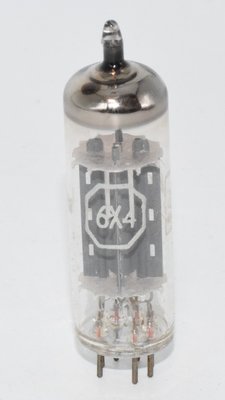
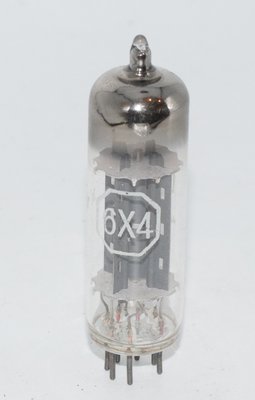
| Getter Type | Square getter (commonly observed on M-O Valve Co. production) |
Like other power-handling miniature tubes, the CV493 should be adequately ventilated during operation to ensure reliable performance and long service life.
Operating Notes from the Datasheet
When the 6X4/CV493 is used in vibrator operation with a minimum duty cycle of 75 percent, specific transient current ratings apply. If hot-switching is regularly required in operation, the use of choke-input circuits is recommended, as such circuits limit the hot-switching current to a value no higher than the peak plate current. When capacitor-input circuits are used, the maximum peak current value per plate of 1.1 amperes during the initial cycles of the hot-switching transient should not be exceeded.
Applications and Usage
The CV493/6X4 was designed for and widely used in the following applications:
- Radio Receiver Power Supplies: The tube's primary application was as a full-wave rectifier in the power supply sections of both AC-operated and automobile radio receivers. Its compact size made it ideal for the increasingly miniaturized consumer electronics of the 1950s.
- Military Electronics: Under the CV493 designation, the tube served in a wide range of British military equipment including communications receivers, test instruments, and field equipment where reliable, compact power supplies were essential.
- Television Receivers: Used in the low-voltage power supply sections of early television sets, particularly in auxiliary supply circuits.
- Test Equipment: Found in oscilloscopes, signal generators, and other laboratory instruments manufactured during the 1950s and 1960s.
- Small Audio Amplifiers: Employed as the rectifier tube in low-power amplifier designs, typically providing B+ supply for amplifiers using tubes such as the 6V6, 6AQ5, or EL84 in the output stage.
- Vibrator Power Supplies: The datasheet specifically addresses operation in vibrator-type power supplies, which were common in mobile and automotive equipment of the era.
The tube's 70 mA average output current capability made it well-suited for powering small to medium receivers and amplifiers, though it was insufficient for larger, more powerful equipment which required rectifiers like the 5Y3GT or GZ34.
Sound Characteristics
As a rectifier tube, the CV493/6X4 does not directly amplify the audio signal, yet it plays a significant role in shaping the sonic character of an amplifier through its influence on the power supply. Audiophiles and experienced amplifier builders have noted the following characteristics:
- Soft and Gradual Rectification: Like all vacuum rectifier tubes, the CV493 exhibits a forward voltage drop and finite internal impedance that solid-state diodes do not. This creates a "softer" power supply with inherently higher output impedance, which many listeners perceive as a more organic, less harsh presentation compared to silicon rectifier replacements.
- Natural Compression: Under dynamic signal demands, the tube rectifier's internal resistance causes a slight sag in the B+ voltage. This "sag" effect produces a subtle, natural compression that is particularly valued in guitar amplifier applications, contributing to a more touch-responsive and dynamically expressive playing experience.
- Warm Tonal Character: Amplifiers using the CV493/6X4 as their rectifier are often described as having a warm, slightly rounded tonal character. The power supply's higher impedance compared to solid-state rectification tends to soften transient attacks slightly, which can be perceived as warmth or musicality.
- Controlled Bass Response: The inherent impedance of the tube rectifier means that bass frequencies, which demand more current, may exhibit a slightly softer and less "tight" character compared to solid-state rectification. In small amplifiers, this is often perceived as a pleasant, vintage-style bass response rather than a deficiency.
- Military-Grade Consistency: CV493 examples, having been manufactured to military specifications, tend to exhibit more consistent performance characteristics than their commercial 6X4 counterparts. Users report that military-spec tubes often provide quieter operation with lower noise floors, which is attributed to tighter manufacturing tolerances and more rigorous quality control.
- Slow Start-Up: The tube's warm-up time provides a gentle, gradual application of B+ voltage to the amplifier circuit, which is kinder to filter capacitors and other components. This soft-start characteristic is valued by those who appreciate the ritual and gentle treatment of vintage equipment.
It should be noted that the sonic differences between a well-functioning CV493 and a commercial 6X4 in the same circuit are subtle at best. The primary tonal influence comes from the use of a vacuum rectifier versus solid-state rectification, rather than from differences between specific tube brands or military versus commercial grades.
Equivalent and Substitute Types
Close/Identical Substitutes (Direct Drop-In Replacements)
| Type | Notes |
|---|---|
| 6X4 | The direct commercial American equivalent. Identical electrical and mechanical specifications. The CV493 IS a 6X4 manufactured to military standards. |
| EZ90 | The European (Mullard/Philips) designation for the same tube. Fully interchangeable with the CV493 and 6X4. |
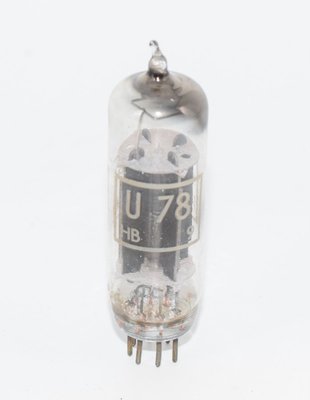
| U78 | British commercial designation. A close/identical substitute for the CV493, fully interchangeable. |
| CV8203 | Another British CV-series designation listed as a close/identical substitute for the CV493. |
| CV8223 | British CV-series designation, close/identical substitute. |
| CV8237 | British CV-series designation, close/identical substitute. |
Different Rating Substitutes (NOT Direct Drop-In)
| Type | Notes |
|---|---|
| 6063 | Related type but with different ratings. Not a direct drop-in replacement — verify specifications before substituting. |
| 12X4 | The 12-volt heater version (12.6V at 0.3A). Electrically similar in rectifier characteristics but requires a 12.6V heater supply instead of 6.3V. NOT interchangeable without heater circuit modification. |
Functional Equivalent (Different Base)
| Type | Notes |
|---|---|
| 6X5GT | The octal-based equivalent. Similar electrical performance but uses an octal (8-pin) socket rather than the B7G miniature base. Requires a different socket and wiring. The RCA datasheet notes that the 6X4 is "equivalent in performance to larger type 6X5GT." |
Note: Some sources may list additional CV-number equivalents. Only those confirmed in the verified reference data are included above. Any additional equivalences should be verified against manufacturer cross-reference documentation before substitution.
Notable Characteristics
- Military-Grade Construction: As a CV-designated tube, the CV493 was manufactured to meet stringent British military specifications. This typically meant tighter parameter tolerances, enhanced vibration resistance, more robust internal construction, and extended shelf life compared to commercial equivalents. M-O Valve Company examples, which are commonly encountered, are particularly well-regarded for their build quality.
- Square Getter Design: Surviving M-O Valve Company CV493 tubes frequently feature a distinctive square getter, as noted in product listings. The getter is the metallic deposit visible inside the glass envelope that maintains the vacuum by absorbing residual gases. The square getter design was characteristic of certain British manufacturers and production periods.
- Cathode-Heater Connection: The CV493/6X4's cathode is internally connected to the heater center-tap. This is an important design consideration — it means the heater is not fully isolated from the cathode, and the heater-cathode voltage ratings (±200V peak for the positive direction, −450V peak for the negative direction, 100V average maximum) must be strictly observed. This is particularly relevant in series-heater circuits or designs where the heater string is elevated above ground potential.
- Compact Form Factor: The miniature B7G base represented a significant size reduction over the octal 6X5GT it was designed to replace, enabling more compact equipment designs without sacrificing electrical performance.
- Rating Chart Dependency: The maximum permissible AC plate supply voltage is not a single fixed value but depends on the filter configuration (capacitor-input vs. choke-input) and the DC load current. The RCA datasheet provides detailed rating charts that must be consulted for proper circuit design. For capacitor-input filter designs, the maximum is 325V RMS per plate at specific impedance and current conditions; for choke-input designs, up to 400V RMS per plate is permissible.
- Ventilation Requirements: Like other power-handling miniature tubes, the CV493 should be adequately ventilated. The concentrated heat dissipation in the small envelope means that proper airflow is important for reliability and longevity.
- Pin 1 Omission on Octal Equivalent: While the 6X5GT octal equivalent may be supplied with Pin 1 omitted, the miniature CV493/6X4 uses all seven pins of the B7G base, with Pin 4 and Pin 6 designated as no connection (NC).
Usage in the Audio Community
The CV493 and its commercial equivalents (6X4, EZ90) occupy a valued niche in the audio community, particularly among builders and enthusiasts of small to medium-power vacuum tube amplifiers:
Small Single-Ended and Push-Pull Amplifiers
The CV493/6X4 is a natural choice for the power supply of amplifiers producing up to approximately 10-15 watts. It pairs excellently with output tubes such as the 6V6GT, 6AQ5/EL90, and EL84/6BQ5 in both single-ended and push-pull configurations. The 70 mA average output current is sufficient for these applications while providing the desirable characteristics of vacuum rectification. Classic amplifier designs from manufacturers like Eico, Heath, and various British firms employed the 6X4 in their power supply sections.
Guitar Amplifier Applications
Small "practice" and recording guitar amplifiers frequently use the 6X4/CV493 as their rectifier. The tube's natural sag characteristic is particularly valued by guitarists who appreciate the dynamic compression and touch sensitivity it imparts. The CV493's military-grade construction makes it an attractive option for gigging musicians who need reliability. Amplifier builders creating "tweed-style" and other vintage-inspired low-wattage designs often specify the 6X4 as their rectifier of choice.
Headphone Amplifiers
The modern resurgence of vacuum tube audio has seen the CV493/6X4 find a new home in high-quality headphone amplifiers. Its modest current capability is more than sufficient for these low-power applications, and the tube rectifier adds the subtle sonic character that headphone audiophiles seek. Several boutique headphone amplifier manufacturers and popular DIY designs incorporate the 6X4 in their power supply topology.
DIY and Kit Amplifier Projects
The 6X4/CV493 is extremely popular in the DIY audio community due to several practical advantages: the B7G miniature socket is compact and inexpensive, the tube itself remains readily available at reasonable prices, and its modest heater current (0.6A) places minimal demands on the power transformer. Numerous published amplifier designs and commercially available kits specify the 6X4 as their rectifier.
Tube Rolling and NOS Collecting
Audiophiles who practice "tube rolling" — swapping different brands and vintages of compatible tubes to find preferred sonic characteristics — actively seek out CV493 examples. The military designation carries a certain cachet, and the perception (often justified) that military-spec tubes offer superior consistency and longevity makes them desirable. M-O Valve Company CV493 tubes with their characteristic square getters are particularly collectible. Other sought-after versions include Mullard-manufactured EZ90s and early RCA 6X4s with specific internal construction features.
Vintage Equipment Restoration
Restorers of vintage radios, amplifiers, and test equipment rely on the continued availability of the 6X4/CV493 family. The tube was used in countless pieces of equipment from the 1950s and 1960s, and NOS (New Old Stock) military-grade CV493 tubes are considered ideal replacements for restoration projects where authenticity and reliability are paramount.
Practical Considerations for Audio Use
When using the CV493 in audio applications, builders should note the following:
- The 70 mA maximum average output current limits the tube to smaller amplifier designs. For larger amplifiers, rectifiers such as the GZ34/5AR4 or 5U4G are more appropriate.
- The cathode-heater connection means that in designs where the heater supply is elevated significantly above ground, the heater-cathode voltage limits must be respected.
- Adequate ventilation should be provided, especially in enclosed chassis designs.
- The capacitor-input filter rating of 325V RMS per plate (with appropriate source impedance) and the choke-input rating of 400V RMS per plate should be carefully observed. The Rating Chart should be consulted for the specific combination of load current and supply voltage in any given design.
- A maximum filter input capacitor of 10 µF is specified for capacitor-input designs with the recommended source impedance values.