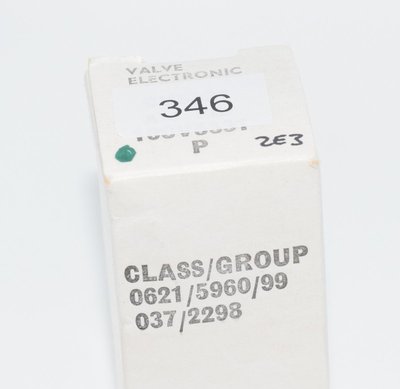
1. Introduction and History
The CV5331 is a British military-specification (CV-series) designation for a high-quality double triode vacuum tube, commercially known as the ECC189 (Mullard/Philips European designation) or 6ES8 (American RETMA designation). Developed in the late 1950s by Philips/Mullard, this valve was designed as a low-noise, high-transconductance frame-grid double triode intended primarily for use in VHF and UHF cascode amplifier circuits, particularly in television tuner front-ends and professional communications equipment.
The CV (Common Valve) numbering system was used by the British Ministry of Defence to standardize valve procurement across manufacturers. A CV number guaranteed that any valve bearing that designation would meet identical performance specifications regardless of the original manufacturer. The CV5331 designation ensured that military and government equipment could be serviced with guaranteed-specification replacements from any approved supplier.
Philips Holland (Amperex in the US market) was a primary manufacturer of this type, and NOS (New Old Stock) examples from their Heerlen factory are particularly sought after by collectors and audio enthusiasts. Mullard (the British Philips subsidiary) also produced this type, as did other European manufacturers under license.
The ECC189/CV5331 belongs to the prestigious ECC family of double triodes from Philips — a lineage that includes the legendary ECC81 (12AT7), ECC82 (12AU7), ECC83 (12AX7), and the closely related ECC88 (6DJ8). The ECC189 was specifically engineered as an improved version of the ECC88, offering tighter specifications, better reliability, and enhanced performance in demanding RF applications.
2. Technical Specifications and Design
Heater / Filament
| Heater Voltage (Vh) | 6.3 V |
| Heater Current (Ih) | 0.365 A |
| Heater Configuration | Series/parallel (pins 4 & 5); can be wired for 6.3 V parallel operation |
Inter-electrode Capacitances
The CV5331 features notably low inter-electrode capacitances, reflecting its design for VHF/UHF service. The two triode sections have slightly different capacitance values, which is typical for double triodes where one section may be optimized for a cascode input stage and the other for the cascode output (grounded-grid) stage:
| Parameter | Section 1 (Triode 1) | Section 2 (Triode 2) |
|---|---|---|
| Grid-to-Cathode Capacitance (Cgk) | 3.5 pF | 6.0 pF |
| Anode-to-Cathode Capacitance (Cak) | 2.4 pF | 0.17 pF |
| Grid-to-Anode Capacitance (Cga) | 1.9 pF | 1.9 pF |
Note: The extremely low Cak of 0.17 pF in Section 2 indicates this section was specifically optimized for grounded-grid (cascode upper) operation, where minimal output-to-input coupling is critical for stable VHF amplification.
Typical Operating Conditions and Electrical Characteristics
The following values are typical for the ECC189/6ES8 family. Values marked with an asterisk (*) should be confirmed against the specific manufacturer's full datasheet, as the CV5331 military specification may have tighter tolerances than the commercial ECC189:
| Maximum Anode (Plate) Voltage | 250 V * |
| Maximum Anode Dissipation (per section) | 2.5 W * (some sources indicate 3.0 W — confirm against specific datasheet) |
| Maximum Cathode Current (per section) | 20 mA * |
| Amplification Factor (μ) | ~33 * |
| Transconductance (gm) | ~12.5 mA/V (12,500 µmhos) * |
| Plate Resistance (rp) | ~2.65 kΩ * |
| Typical Anode Voltage (Va) | 90–130 V * |
| Typical Grid Bias (Vg1) | -1.0 V to -2.0 V * |
| Typical Anode Current (Ia) | 15 mA * |
* These values are based on published ECC189/6ES8 data and are representative of the CV5331. The CV specification may impose tighter limits on certain parameters. Users designing critical circuits should consult the original CV5331 military specification document or the Philips ECC189 datasheet for guaranteed minimum/maximum values.
Physical Construction
| Base Type | Noval (B9A) — 9-pin miniature |
| Envelope | Miniature glass envelope (typically T-6½ or similar small-diameter) |
| Mounting | Vertical or horizontal with appropriate socket |
| Construction | Frame-grid construction for both triode sections |
| Internal Shield | Internal shield between sections (connected to pin 9) |
Pin-out (B9A / Noval Base — Bottom View)
        Pin 1: Anode (Plate) — Triode 1
        Pin 2: Grid — Triode 1
        Pin 3: Cathode — Triode 1
        Pin 4: Heater
        Pin 5: Heater
        Pin 6: Anode (Plate) — Triode 2
        Pin 7: Grid — Triode 2
        Pin 8: Cathode — Triode 2
        Pin 9: Internal Shield (connect to ground)
Note: This pinout follows the standard ECC88/ECC189 convention. Pin 9 (internal shield) should be grounded for optimal performance, particularly in RF applications where inter-section isolation is critical.
Frame-Grid Construction
The CV5331/ECC189 utilizes frame-grid construction, a significant advancement over conventional wound-grid techniques. In frame-grid tubes, the grid wires are wound on a rigid rectangular metal frame with extremely precise spacing. This construction method yields several advantages:
- Much higher transconductance (gm) compared to conventional-grid equivalents
- Tighter manufacturing tolerances and better unit-to-unit consistency
- Lower noise figure, particularly important for RF front-end applications
- Better high-frequency performance due to reduced grid-related parasitics
- Improved microphonic resistance due to the rigid grid structure
3. Applications and Usage
Original Design Applications
The CV5331/ECC189 was designed for demanding professional and military applications:
- VHF/UHF Television Tuners: The primary intended application. The two triode sections were typically configured as a cascode amplifier, providing high gain with excellent stability at VHF frequencies. Section 2, with its extremely low Cak of 0.17 pF, served as the grounded-grid upper stage.
- Military Communications Receivers: The CV5331 designation indicates its qualification for military use in communications equipment requiring low-noise RF front-ends.
- Professional Test Equipment: Used in oscilloscopes, signal generators, and measurement instruments where low noise and high bandwidth were essential.
- Radar Systems: IF amplifier stages in radar receivers benefited from the tube's high gm and low noise characteristics.
- Cascode Amplifiers: The asymmetric capacitance design of the two sections made this tube ideal for cascode configurations without external neutralization.
General Circuit Applications
- Low-noise preamplifier stages
- Wideband video amplifiers
- Cathode follower / buffer stages (excellent due to high gm and low rp)
- Phase splitter circuits
- Regulated power supply error amplifiers
- Audio preamplifier and line-stage circuits (modern usage)
- Headphone amplifier output stages
4. Sound Characteristics
The CV5331/ECC189 has developed a devoted following in the audio community, where its sonic qualities are highly regarded. Audiophiles and audio engineers describe its sound as follows:
Tonal Signature
The CV5331 is generally characterized as having a clean, detailed, and slightly warm tonal balance. It sits in an interesting middle ground — more refined and transparent than the ECC88/6DJ8 family it is related to, yet possessing a natural musicality that avoids clinical sterility.
Key Sonic Attributes
- Transparency and Detail: The frame-grid construction and low-noise design translate directly into exceptional clarity and micro-detail retrieval. Fine textural details in recordings — the rosin on a bow, the breath of a vocalist, the decay of a cymbal — are rendered with precision.
- Low-End Performance: Bass response is tight, well-controlled, and extended. Unlike some high-gm triodes that can sound lean in the bass, the CV5331 delivers satisfying low-frequency weight without bloat or overhang.
- Midrange: The midrange is often described as liquid and natural, with excellent vocal reproduction. There is a subtle richness that adds body to instruments and voices without coloring them excessively. The midrange is less "tubey" than an ECC83 but more organic than a typical solid-state stage.
- Treble: High frequencies are extended and airy, with good shimmer on cymbals and strings. The treble is smooth rather than etched — a characteristic that many listeners attribute to the Philips Holland manufacturing quality.
- Soundstage: The CV5331 is praised for producing a wide, deep, and three-dimensional soundstage. Imaging is precise, with instruments placed convincingly in space. The low inter-electrode capacitances contribute to excellent high-frequency phase behavior, which aids spatial reproduction.
- Dynamics: The high transconductance gives the CV5331 excellent dynamic response — both macro-dynamics (large transients) and micro-dynamics (subtle volume variations) are handled with authority and speed.
- Noise Floor: One of the CV5331's greatest strengths in audio applications is its exceptionally low noise floor. This makes it particularly suitable for phono stages and other high-gain applications where tube noise can be problematic.
Comparison to Related Types
Compared to the ECC88/6DJ8, the CV5331/ECC189 is often described as more refined, with better control in the bass and a smoother, less "grainy" treble. The ECC88 can sometimes exhibit a slight brightness or edge that the ECC189 avoids. Compared to the ECC83/12AX7, the CV5331 offers greater speed, transparency, and bandwidth, though with less of the classic "warm tube glow" that characterizes the ECC83.
NOS vs. Modern Production
NOS Philips Holland CV5331 examples are particularly prized. Audiophiles report that these original production tubes have a refinement and coherence that is difficult to replicate. The Heerlen (Holland) factory examples, often identifiable by their distinctive construction details and factory codes, command premium prices on the vintage tube market.
5. Equivalent or Substitute Types
Direct / Identical Substitutes (Drop-in Replacements)
| Type | Standard | Notes |
|---|---|---|
| ECC189 | Philips/Mullard (Pro-Electron) | The commercial European designation — electrically and physically identical to CV5331 |
| 6ES8 | American (RETMA/EIA) | The American designation — identical tube, same pinout and ratings |
| CV9838 | British CV-series | Another CV designation for the same type; may represent a different revision or specification tier |
All of the above are fully interchangeable with the CV5331 without any circuit modifications. They share the same Noval (B9A) base, identical pinout, and equivalent electrical ratings.
Related but NOT Direct Drop-in Substitutes
| Type | Relationship | Caution |
|---|---|---|
| 6DJ8 / ECC88 | Same family, similar but different ratings | NOT a direct drop-in replacement. The 6DJ8/ECC88 has different maximum ratings and operating parameters. While it shares the same pinout and base type, the ECC189/CV5331 was designed to meet more stringent specifications. Substituting a 6DJ8 for a CV5331 may work in some circuits but is not guaranteed to meet all performance requirements, particularly regarding maximum voltage ratings and long-term reliability. The ECC189 generally has higher maximum plate voltage ratings than the ECC88. |
| E88CC / 6922 | Premium-grade ECC88 | Closer in quality to the CV5331 but still based on the ECC88 specification rather than the ECC189. Not a guaranteed drop-in; check specific circuit requirements. |
| 7308 / E188CC | Premium long-life version | A premium, extended-life variant related to the ECC88 family. May work in some applications but has its own specific ratings. |
Important Note: While the 6DJ8/ECC88 family and the ECC189/CV5331 share the same Noval base and pinout, they are not identical in their ratings. The ECC189 was designed as an improved type with different (generally more robust) specifications. Always verify that your specific circuit can accommodate the differences before substituting one for the other.
6. Notable Characteristics
Frame-Grid Precision
The CV5331's frame-grid construction is one of its defining features. The rigid frame maintains precise grid-wire spacing even under vibration and thermal stress, resulting in consistent performance over the tube's lifetime. This is a key reason why the CV5331 was selected for military applications where reliability under adverse conditions was paramount.
Asymmetric Section Design
A distinctive feature of the CV5331/ECC189 is the deliberately asymmetric capacitance design of its two triode sections. Section 2's remarkably low anode-to-cathode capacitance (0.17 pF vs. 2.4 pF for Section 1) was specifically engineered for grounded-grid cascode operation. This asymmetry means that in cascode circuits, the sections are not interchangeable — Section 1 should be used as the grounded-cathode input stage and Section 2 as the grounded-grid output stage. In audio applications where both sections are used independently (e.g., as separate gain stages for left and right channels), this asymmetry may result in slightly different performance characteristics between the two sections.
Low Noise Performance
The CV5331 was designed to achieve an exceptionally low noise figure at VHF frequencies. This low-noise characteristic carries over directly to audio applications, making it one of the quietest small-signal double triodes available. Equivalent input noise is typically very low, making it suitable for the most demanding phono stage and microphone preamplifier applications.
High Transconductance
With a transconductance of approximately 12.5 mA/V, the CV5331 offers significantly higher gm than conventional audio triodes like the ECC83 (gm ≈ 1.6 mA/V) or ECC82 (gm ≈ 2.2 mA/V). This high transconductance provides excellent gain-bandwidth product and contributes to the tube's fast, dynamic sound character in audio circuits.
Military-Grade Quality
As a CV-designated tube, the CV5331 was manufactured to military specifications that demanded:
- Tighter parameter tolerances than commercial equivalents
- Enhanced vibration and shock resistance
- Extended life testing and burn-in
- Rigorous quality control and inspection
- Consistent performance across a wider temperature range
These military-grade manufacturing standards are a significant reason why NOS CV5331 tubes are prized by audiophiles — the quality control ensures that each tube performs to a high and consistent standard.
Philips Holland Provenance
Many CV5331 tubes encountered on the market were manufactured by Philips at their Heerlen factory in the Netherlands. Philips Holland tubes are widely regarded as among the finest vacuum tubes ever produced, with exceptional build quality, consistency, and longevity. The factory's production codes (typically etched or printed on the glass envelope) allow knowledgeable collectors to identify the exact factory, production date, and sometimes even the specific production line.
7. Usage in the Audio Community
Preamplifier and Line Stage Applications
The CV5331/ECC189 has found a dedicated niche in high-end audio preamplifiers and line stages. Its combination of high transconductance, low noise, and musical tonal character makes it an excellent choice for these applications. Several boutique amplifier manufacturers have designed circuits specifically around the ECC189/6ES8 type, and many more designs intended for the ECC88/6DJ8 can accept the CV5331 with appropriate biasing considerations.
Headphone Amplifiers
The CV5331's low plate resistance and high transconductance make it particularly well-suited for headphone amplifier circuits. Its ability to drive low-impedance loads with authority, combined with its refined sonic character, has made it a favorite among DIY headphone amplifier builders. The tube can be used effectively in both voltage gain stages and as a cathode follower output stage driving headphones.
Phono Stages
The exceptionally low noise floor of the CV5331 makes it an outstanding choice for phono preamplifier stages, where the tiny signals from a phono cartridge demand the quietest possible amplification. Moving-magnet phono stages using the CV5331 can achieve noise performance that rivals solid-state designs while retaining the tonal qualities that attract listeners to tube amplification.
DAC Output Stages
In the modern audio landscape, the CV5331 has found application in tube-buffered digital-to-analog converter output stages. Several high-end DAC manufacturers use ECC88-family tubes in their output stages, and the CV5331/ECC189 is a popular upgrade choice among users of these products. The tube's wide bandwidth and fast transient response complement the precision of modern digital conversion.
Tube Rolling
The CV5331 is a popular "tube rolling" choice for equipment designed around the 6DJ8/ECC88 family. Audiophiles frequently report that substituting a CV5331/ECC189 for a standard 6DJ8 or ECC88 yields improvements in clarity, bass control, and overall refinement. However, as noted in the equivalents section, users should verify that their specific equipment can accommodate any differences in operating parameters between the ECC88 and ECC189 specifications. Many modern audio designs operate these tubes conservatively enough that the substitution is safe and beneficial.
Collectibility and Market
NOS CV5331 tubes, particularly those manufactured by Philips Holland, command significant premiums on the vintage tube market. Matched pairs suitable for stereo audio applications are especially valued. Key factors affecting collectibility and price include:
- Manufacturer: Philips Heerlen (Holland) examples are most sought after, followed by Mullard (Blackburn, UK)
- Testing: Tubes that test at or near NOS specifications on a calibrated tube tester command higher prices
- Matching: Closely matched pairs (for stereo applications) are worth significantly more than individual tubes
- Condition: Original boxes, military packaging, and unmarked glass all add to collectibility
- Date codes: Certain production eras are considered more desirable, though this is somewhat subjective
DIY Community
The CV5331/ECC189 is well-represented in the DIY audio community. Numerous amplifier and preamplifier designs have been published that utilize this tube type, and it is a frequent topic of discussion on audio forums. Its relatively modest heater power requirements (6.3 V at 0.365 A) and straightforward biasing make it accessible to builders of all experience levels. The tube works well in simple single-stage designs as well as more complex multi-stage topologies.
Professional Audio
Beyond the audiophile community, the CV5331/ECC189 has found use in professional audio applications, including studio microphone preamplifiers and recording console input stages. Its low noise and high bandwidth make it technically well-suited for professional use, and its tonal character is appreciated by recording engineers who value the subtle warmth and dimensionality that a well-designed tube stage can add to recorded material.