1. Introduction and History
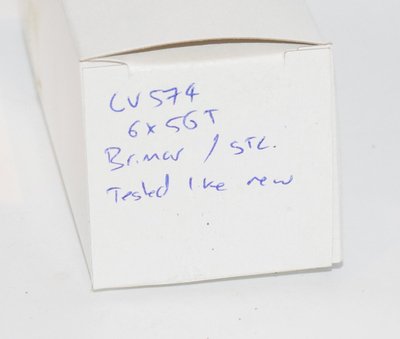
The CV574 is a British military-specification (CV = Common Valve) designation for a full-wave rectifier valve originally developed for use in military and government equipment. The CV numbering system was established by the UK Ministry of Defence to standardize valve procurement across all branches of the armed forces, ensuring consistent quality and interchangeability regardless of the original manufacturer.
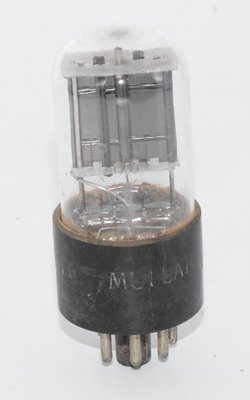
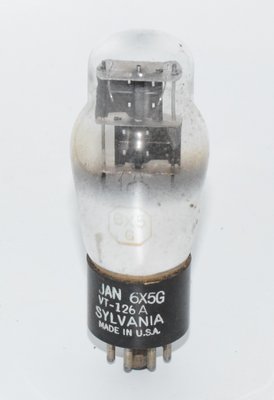
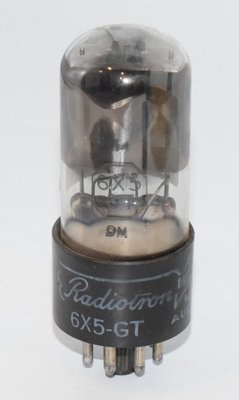
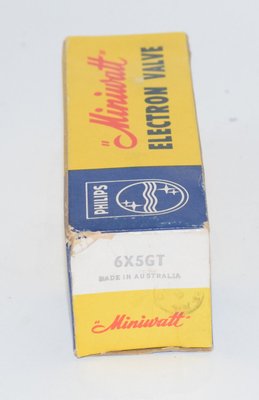
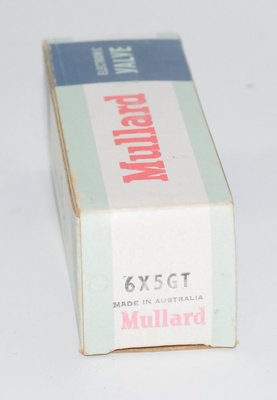
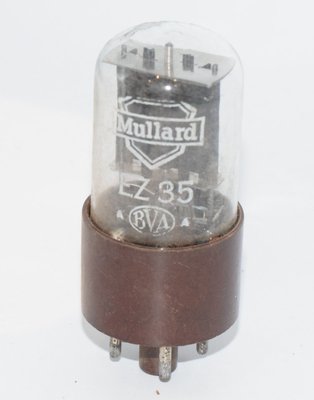
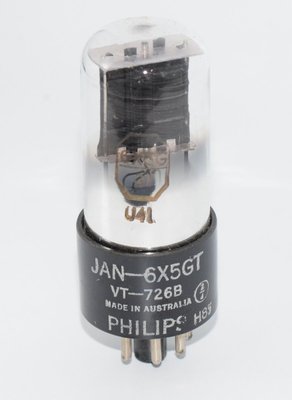
The CV574 is directly equivalent to the EZ35 (Mullard/Philips designation) and closely related to the 6X5GT (American RETMA designation). It was manufactured by several British firms, most notably Brimar (STC), as well as Mullard and others holding government contracts. The valve belongs to the family of indirectly-heated full-wave rectifiers that became popular from the late 1930s onward, offering the significant advantage of using a standard 6.3V heater supply — allowing it to share a common heater winding with the amplifier tubes in a circuit, simplifying transformer design.
The development of indirectly-heated rectifiers like the CV574/EZ35/6X5GT was an important step in valve technology. Earlier rectifiers such as the 5Y3 and 5U4 used directly-heated cathodes, which meant the rectifier's heater winding had to be isolated and could not be shared with other tubes. The indirectly-heated cathode design of the CV574 eliminated this constraint, making it especially attractive for compact and cost-effective equipment designs used in military communications, test equipment, and later in commercial audio amplifiers.
Production of the CV574 spanned from the early 1940s through the 1960s, with Brimar (Standard Telephones and Cables, or STC) being one of the most prolific manufacturers. These valves were built to stringent military quality standards, often featuring ruggedized construction, tighter tolerances, and extended life ratings compared to their commercial equivalents.
2. Technical Specifications and Design
Heater / Filament
| Parameter | Value |
|---|---|
| Heater Voltage (Vh) | 6.3 V (verified) |
| Heater Current (Ih) | 0.6 A (verified) |
| Heater Type | Indirectly heated cathode |
Maximum Ratings
| Parameter | Value | Notes |
|---|---|---|
| Max RMS Plate Voltage per Plate | 350 V | Per plate, for capacitor-input filter |
| Max Peak Inverse Voltage (PIV) | 1250 V | Typical for 6X5GT family; confirm against specific CV574 datasheet |
| Max DC Output Current | 70 mA | With capacitor-input filter |
| Max Peak Plate Current per Plate | 210 mA | Should be confirmed against manufacturer datasheet |
| Max DC Output Current (Choke Input) | 75 mA | Should be confirmed |
Note: As a rectifier valve, the CV574 does not have amplification factor (μ), transconductance (gm), plate resistance (rp), or grid bias specifications — these parameters apply to amplifying valves. The CV574 has no control grid; it is a diode (two-diode) rectifier.
Typical Operating Conditions (Capacitor-Input Filter)
| Parameter | Value |
|---|---|
| AC Plate Voltage (RMS per plate) | 325 V |
| DC Output Voltage (approx.) | 300 V |
| DC Load Current | 50–70 mA |
| Min. Series Resistance per Plate | 50–100 Ω (required to limit peak current) |
Note: The 6X5GT/EZ35 family requires a minimum series resistance (typically from the power transformer secondary winding resistance or an added resistor) to limit peak charging current to the first filter capacitor. Failure to observe this requirement can damage the cathode. The first filter capacitor should typically not exceed 20–40 µF, depending on the specific datasheet revision.
Physical Characteristics
| Parameter | Detail |
|---|---|
| Base Type | Octal (International Octal, IO) (verified) |
| Envelope Type | GT (Glass Tubular) — T-9 envelope |
| Mounting Position | Any (designed for universal mounting) |
| Overall Length | Approx. 100–108 mm (4.0–4.25 inches) |
| Max Diameter | Approx. 32 mm (1.25 inches) |
| Weight | Approx. 35–45 g |
Pin-Out (Octal Base — Bottom View)
| Pin | Connection |
|---|---|
| Pin 1 | No Connection (NC) |
| Pin 2 | Heater |
| Pin 3 | Plate 1 (Anode 1) |
| Pin 4 | No Connection (NC) |
| Pin 5 | Plate 2 (Anode 2) |
| Pin 6 | No Connection (NC) |
| Pin 7 | Heater |
| Pin 8 | Cathode |
Note: The key/spigot on the octal base is located between pins 1 and 8. The pinout follows the standard 6X5GT/EZ35 configuration. Confirm against the specific Brimar or relevant manufacturer datasheet for the CV574 if critical.
Internal Structure
The CV574 contains two diode sections sharing a common indirectly-heated cathode. The cathode sleeve is coated with barium/strontium oxide for efficient electron emission. Each plate (anode) is connected to one half of the center-tapped secondary winding of the power transformer, providing full-wave rectification. The use of an indirectly-heated cathode means the heater is electrically isolated from the cathode, a key advantage over directly-heated rectifiers.
3. Applications and Usage
Original Military and Commercial Applications
- Military radio receivers and transmitters: The CV574 was widely used in British military communications equipment as the power supply rectifier, providing B+ voltage to the amplifier and oscillator stages.
- Test and measurement equipment: Signal generators, oscilloscopes, and other laboratory instruments of the era frequently employed the EZ35/6X5GT family for their power supplies.
- Commercial radio receivers: Many British and European domestic radio sets used the EZ35 (the commercial equivalent) in their power supply sections.
- Small to medium power amplifiers: The 70 mA maximum output current makes the CV574 suitable for amplifiers of up to approximately 15–20 watts, depending on the output stage topology.
Circuit Design Considerations
- Series resistance requirement: A critical design consideration is the minimum series resistance per plate. Unlike directly-heated rectifiers that have inherent filament resistance, the low-impedance indirectly-heated cathode of the CV574 can draw very high peak currents during capacitor charging. A minimum of 50–100 Ω per plate (from transformer winding resistance plus any added series resistance) is essential.
- Filter capacitor limitation: The first filter capacitor in a capacitor-input filter should typically not exceed 20–40 µF to prevent excessive peak currents.
- Warm-up delay: The indirectly-heated cathode provides a natural warm-up delay before the B+ voltage appears, which can be beneficial in protecting other tubes in the circuit from receiving plate voltage before their cathodes are fully emitting.
- Shared heater winding: The 6.3V, 0.6A heater can be powered from the same winding as the signal tubes, simplifying power transformer requirements.
4. Sound Characteristics
While rectifier valves do not directly amplify the audio signal, they have a profound and well-documented influence on the sonic character of a valve amplifier. The CV574/EZ35/6X5GT family is known for the following tonal qualities as described by audiophiles and experienced amplifier designers:
- Soft, organic presentation: Like most valve rectifiers, the CV574 introduces a degree of "sag" under dynamic load conditions. When the amplifier draws more current during loud transients, the output voltage of the rectifier drops slightly, creating a gentle compression effect. This is often described as contributing to a warm, organic, and musically natural sound.
- Smooth midrange: Users frequently describe the 6X5GT/EZ35 family as having a particularly smooth and liquid midrange, with less grain or harshness compared to silicon diode rectification.
- Gentle bass response: The inherent voltage sag means that bass notes may lack the absolute tightness and slam of a solid-state rectified supply, but many listeners find the resulting bass character more tuneful, rounded, and pleasing — particularly with acoustic music, jazz, and vocal recordings.
- Natural dynamics: The soft clipping behavior of the power supply under heavy load creates a dynamic response that many audiophiles find more lifelike and less fatiguing than the hard, unyielding supply provided by silicon rectifiers.
- Brimar/STC production quality: CV574 valves manufactured by Brimar (STC) to military specifications are particularly prized for their consistency, low noise, and reliability. Audiophiles report that military-grade examples often exhibit lower hum and microphonics compared to commercial equivalents.
- Comparison with other rectifiers: Compared to the larger 5U4 or 5AR4/GZ34, the CV574/6X5GT has a higher internal impedance and more pronounced sag, giving it a "softer" character. This makes it particularly well-suited to lower-power single-ended and push-pull amplifiers where the gentle compression enhances the listening experience.
5. Equivalent or Substitute Types
| Type | Designation System | Interchangeability |
|---|---|---|
| EZ35 | Mullard/Philips (European) | Direct equivalent — identical pinout, ratings, and function (verified) |
| U147 | British commercial | Direct equivalent (verified) |
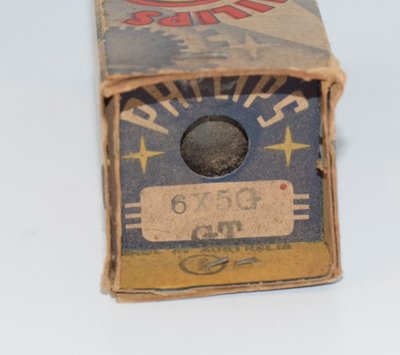
| 6X5GT | American (RETMA) | Direct equivalent — same pinout and ratings; the CV574 is essentially a military-graded 6X5GT |
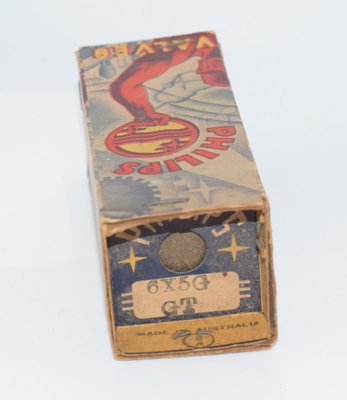
| 6X5G | American (RETMA) | Equivalent electrically; uses the larger ST (shouldered) glass envelope — physically larger but pin-compatible |
| 6X5WGT | American military | Ruggedized military version of 6X5GT; direct substitute with enhanced reliability ratings |
| VT-126 | US military (Signal Corps) | US military designation for 6X5GT; electrically identical |
Types That Are NOT Direct Substitutes
- 5Y3GT: While also a full-wave rectifier in an octal base, the 5Y3 is a directly-heated rectifier with a 5.0V heater and different pinout. Not interchangeable.
- GZ34 / 5AR4: Higher-current rectifier with different pinout and ratings. Not a drop-in replacement.
- EZ80 / 6V4: Noval (B9A) base rectifier — completely different socket. Not interchangeable.
- EZ81 / 6CA4: Also noval base. Not interchangeable.
6. Notable Characteristics
- Military-grade construction: CV574 valves were manufactured to exacting military standards, including tighter parameter tolerances, enhanced vibration resistance, and extended life testing. This makes them highly desirable for critical applications and for audiophiles seeking consistent, reliable performance.
- Indirectly-heated cathode advantage: The electrically isolated cathode allows the heater to be referenced to ground or any convenient potential, and permits sharing the heater winding with other 6.3V tubes — a significant practical advantage in amplifier design.
- Built-in time delay: The thermal inertia of the indirectly-heated cathode means the rectifier does not begin conducting immediately upon power-up. This provides a natural soft-start for the B+ supply, reducing stress on filter capacitors and allowing other tubes' cathodes to warm up before plate voltage is applied.
- Current limitation: The 70 mA maximum DC output current limits the CV574 to small and medium-power applications. Designers must carefully calculate total B+ current draw to ensure it remains within the valve's ratings.
- Voltage regulation: The internal resistance of the CV574 is relatively high compared to larger rectifiers like the GZ34. This means the output voltage will vary more with load current — a characteristic that contributes to the "sag" effect valued in audio applications but which may be undesirable in regulated power supplies.
- Brimar markings: CV574 valves from Brimar/STC typically bear both the CV574 designation and often the commercial equivalent marking (6X5GT or EZ35). Military examples may carry additional markings including date codes, inspection stamps, and the broad arrow (↑) or NATO stock numbers.
7. Usage in the Audio Community
The CV574 and its commercial equivalents (EZ35, 6X5GT) enjoy a dedicated following in the audio community, valued for both their sonic characteristics and their practical design advantages.
In Amplifier Builds
The CV574/6X5GT is a popular choice for low to medium-power valve amplifiers, particularly:
- Single-ended (SE) amplifiers: Many classic and modern SE amplifier designs using output tubes like the EL84/6BQ5, 6V6, or 6L6 in lower-power configurations use the 6X5GT as the rectifier. The gentle sag complements the inherently warm character of single-ended topologies.
- Push-pull amplifiers up to ~15W: Small push-pull designs using pairs of EL84s or 6V6s can operate comfortably within the CV574's current ratings.
- Headphone amplifiers: The growing popularity of high-end valve headphone amplifiers has created new demand for the 6X5GT/EZ35 family, as these amplifiers typically draw modest current and benefit from the tube rectifier's sonic characteristics.
- Preamplifiers: High-end valve preamplifiers sometimes use the CV574 in their power supplies, where the low current draw of preamp tubes is well within the rectifier's capabilities and the sonic benefits are appreciated.
Tube Rolling
Audiophiles frequently experiment with different brands and vintages of 6X5GT/EZ35 in their amplifiers — a practice known as "tube rolling." The CV574 military-specification version is particularly sought after for this purpose because:
- Military-grade valves tend to have lower noise floors and less microphonic behavior.
- The tighter manufacturing tolerances result in more consistent performance between samples.
- The enhanced construction often translates to longer operational life.
- Brimar-manufactured CV574s are especially prized, with many audiophiles reporting a slightly richer tonal character compared to American-made 6X5GTs.
Guitar Amplifiers
The 6X5GT has found a niche in boutique guitar amplifier building, particularly in low-wattage "studio" and "practice" amplifiers. Guitar players value the sag effect for its contribution to touch sensitivity and natural compression, which enhances expressiveness during playing. The CV574's military-grade construction makes it a reliable choice for gigging musicians who need dependable performance.
Market and Availability
As of the current market, CV574 valves are available primarily as New Old Stock (NOS) from military surplus. Brimar/STC examples in original military packaging command premium prices among collectors and audiophiles. While the 6X5GT is still produced by some manufacturers (including Chinese and Russian factories), the original British-made CV574 remains the preferred choice for discerning users. Prices for tested, guaranteed CV574 valves from reputable dealers typically range from moderate to premium, depending on the manufacturer, condition, and remaining emission levels.
Recommended Pairings
In audio amplifier designs, the CV574 pairs particularly well with:
- EF86 / CV4085 — pentode preamplifier stage
- ECC83 / CV4004 (12AX7) — dual triode preamplifier/phase splitter
- EL84 / CV2975 (6BQ5) — output pentode in SE or push-pull configuration
- 6V6GT — output beam tetrode in SE or push-pull configuration
These combinations create amplifiers of modest power output but exceptional tonal refinement — exactly the type of design where the CV574's sonic contributions are most appreciated.