1. Introduction and History
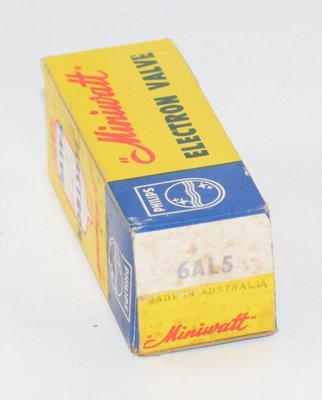
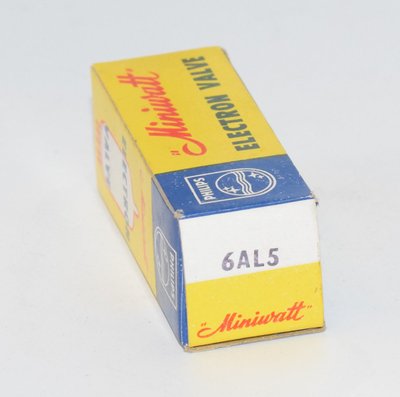
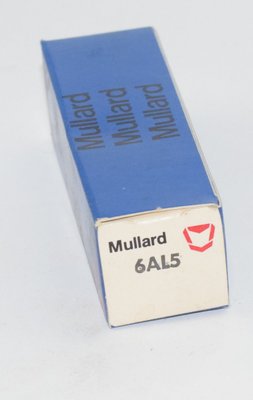
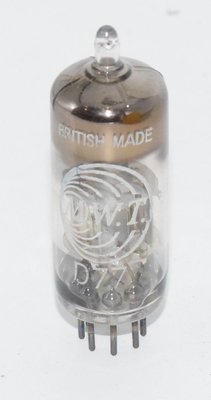
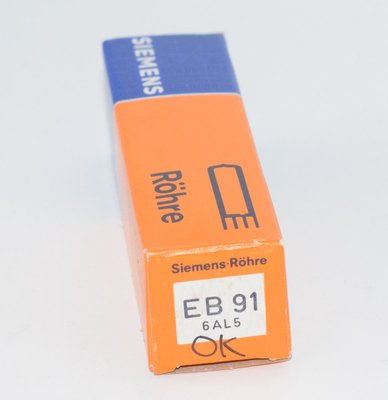
The D77 is a miniature double-diode vacuum tube (valve) manufactured by Marconi's Wireless Telegraph Company Limited of Chelmsford, England. The original datasheet is dated October 1951 (publication reference OV.1554), placing this valve squarely in the post-war era of miniaturised valve design. The D77 is the Marconi designation for what is more widely known internationally as the EB91 (Mullard/European designation) or 6AL5 (American RETMA designation).
The D77 belongs to the family of indirectly heated, twin-diode valves that were developed to replace earlier octal-based double-diodes such as the 6H6. Built on the compact B7G (miniature 7-pin) base, the D77 represented a significant reduction in size and parasitic capacitance compared to its predecessors, making it ideal for use in FM discriminator circuits, AM detector stages, and automatic gain control (AGC) systems in radio and television receivers of the 1950s and beyond.
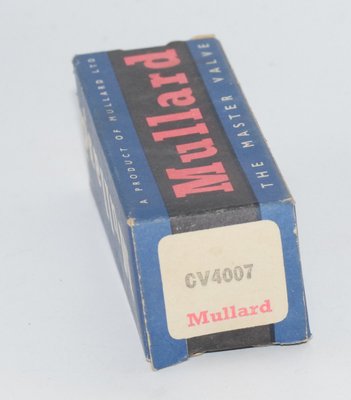
The development of the B7G-based double-diode was a collaborative effort across the major valve manufacturers of the era. In Britain, Marconi, Mullard, Brimar, and others all produced versions under their own type designations. The D77 was widely used in British military and commercial equipment, earning multiple CV (Common Valve) designations for military-approved versions.
2. Technical Specifications and Design
General Description
- Type: Miniature Double-Diode
- Heating: 6.3V Indirectly Heated
- Base: B7G (Miniature 7-pin)
- Bulb: Tubular (T-6½ equivalent)
- Overall Length: 49–55 mm
- Seated Length: 43–49 mm
- Maximum Diameter: 19 mm
Heater Ratings
| Parameter | Value | Unit |
|---|---|---|
| Heater Voltage (Vh) | 6.3 | V |
| Heater Current (Ih) | 0.3 | A |
Maximum Ratings
| Parameter | Value | Unit |
|---|---|---|
| Peak Inverse Voltage (P.I.V.) | 350 max. | V |
| Anode Current (Ia) | 5 max. | mA |
| Peak Anode Current (ia pk) | 50 max. | mA |
Note: As the D77 is a diode, parameters such as amplification factor (μ), transconductance (gm), plate resistance (rp), and grid bias are not applicable. The datasheet provides conductance curves (g in mA/V vs. Ia) rather than triode or pentode characteristic curves.
Capacitances (Screened Valve)
| Parameter | Value | Unit |
|---|---|---|
| Ca'-k' (Anode 1 to Cathode 1) | 2.2 | pF |
| Ca"-k" (Anode 2 to Cathode 2) | 2.2 | pF |
| Ca'-a" (Anode 1 to Anode 2) | 0.025 | pF |
| Ca'-all (Anode 1 to all other electrodes) | 3.5 | pF |
| Ca"-all (Anode 2 to all other electrodes) | 3.5 | pF |
The extremely low inter-anode capacitance of just 0.025 pF is a notable feature, ensuring excellent isolation between the two diode sections — a critical requirement for balanced discriminator and ratio detector circuits.
Pin Configuration (B7G Base — View from Underside)
| Pin | Connection |
|---|---|
| 1 | k" (Cathode 2) |
| 2 | a' (Anode 1) |
| 3 | h (Heater) |
| 4 | h (Heater) |
| 5 | k' (Cathode 1) |
| 6 | s (Internal Screen / Shield) |
| 7 | a" (Anode 2) |
The internal screen (pin 6) provides electrostatic shielding between the two diode sections, contributing to the very low inter-anode capacitance. This screen should typically be connected to ground or the cathode return in circuit applications.
Characteristic Curves
The Marconi datasheet provides two characteristic curves for each diode section:
- Ia (μA) vs. Va (V): A logarithmic plot showing anode current from approximately 1 μA to 10,000 μA (10 mA) over an anode voltage range of −0.8 V to +1.6 V. The curve shows the expected exponential diode characteristic with current beginning to flow at approximately −0.4 V (due to contact potential and thermionic emission effects) and reaching the milliamp range above +0.4 V.
- Ia (μA) vs. g (mA/V): A conductance curve showing the dynamic conductance of each diode section as a function of anode current, ranging from below 1 mA/V at low currents to approximately 5–6 mA/V at the maximum rated current of 5 mA (5,000 μA).
3. Applications and Usage
The D77 was designed for a wide range of signal detection and rectification applications in radio and television receivers:
Primary Applications
- AM Detection: As an envelope detector in AM radio receivers, providing linear demodulation of amplitude-modulated signals.
- FM Discrimination: In Foster-Seeley discriminator circuits for FM demodulation, where the two matched diode sections and low inter-anode capacitance are essential for balanced operation.
- Ratio Detection: In ratio detector circuits, an alternative FM demodulation method that provides inherent AM rejection.
- Automatic Gain Control (AGC): Generating AGC bias voltages from the detected signal to control the gain of preceding IF amplifier stages.
- Noise Limiting: As a series or shunt noise limiter/clipper to reduce impulse noise in AM receivers.
- Video Detection: In television receivers for demodulating the video signal from the IF carrier.
- DC Restoration: Clamping circuits in television video amplifier stages.
Military and Industrial Use
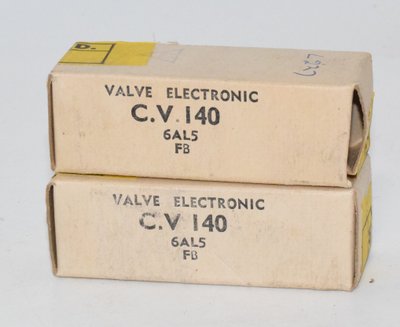
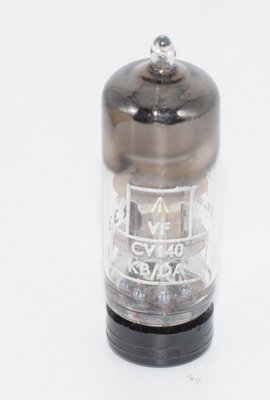
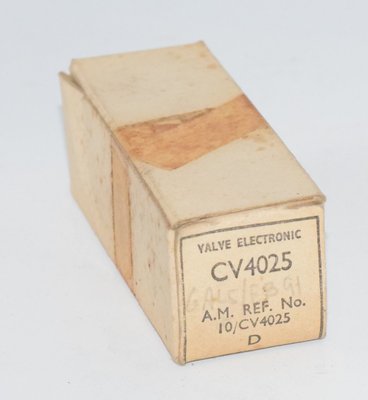
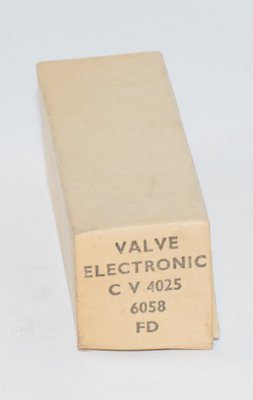
The D77 was approved for military use under multiple CV (Common Valve) designations including CV140, CV283, CV4025, CV8200, CV10324, and CV10328. These designations indicate various grades of selection and testing for military equipment reliability standards. The valve saw extensive use in British military communications equipment, radar systems, and test instrumentation throughout the 1950s and 1960s.
4. Sound Characteristics
As a double-diode, the D77 does not amplify signals in the conventional sense and therefore does not impart the same kind of tonal coloration associated with triode or pentode amplifier tubes. However, when used in signal detection and rectification roles within audio-related circuits, the D77 does have characteristics that are noted by discerning listeners and engineers:
- Smooth Detection: The D77's well-matched diode sections and smooth exponential characteristic curve provide clean, low-distortion detection. In AM tuner circuits, this translates to a natural, unforced quality to the demodulated audio — free from the harshness that can result from poorly matched or semiconductor-based detectors.
- Soft Clipping Behaviour: When used as a noise limiter or signal clipper, the thermionic diode's gradual transition into conduction produces a softer, more musical clipping characteristic compared to silicon diodes. This "soft knee" behaviour rounds off transient peaks rather than hard-clipping them, which is perceived as less fatiguing to the ear.
- Warmth in Rectification: In low-level signal rectification applications (such as AGC generation), the valve's contact potential and slight forward voltage drop characteristics contribute a subtle warmth. The thermionic emission process introduces a gentle, frequency-dependent behaviour that some listeners describe as adding "body" to the recovered audio signal.
- Low Noise Floor: The D77's internal screen and well-designed electrode structure result in a low noise contribution, which is appreciated in high-fidelity tuner applications where the detector stage's noise performance directly impacts the signal-to-noise ratio of the recovered audio.
- Natural Dynamics: Compared to germanium or silicon diode replacements, the D77's thermionic characteristic preserves micro-dynamics in the detected signal, contributing to a sense of "life" and presence in the audio that solid-state substitutes can sometimes flatten.
It should be noted that the sonic contribution of a detector diode is subtle compared to that of amplifying stages. The D77's primary sonic virtue is transparency — it faithfully recovers the audio signal without adding significant artifacts of its own.
5. Equivalent and Substitute Types
Direct Drop-In Equivalents
The following types are electrically identical and pin-compatible with the D77:
| Type | Designation System | Notes |
|---|---|---|
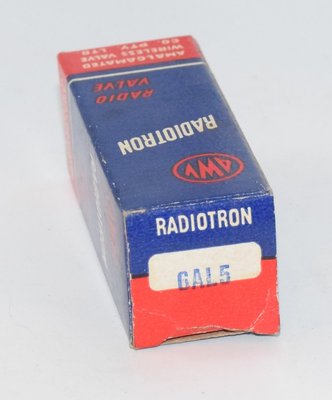
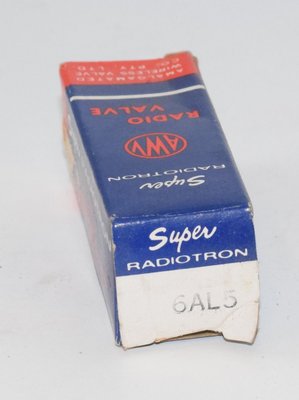
| 6AL5 | American (RETMA) | Most common equivalent designation worldwide |
| EB91 | European (Mullard/Philips) | Mullard designation, widely used in European equipment |
| EAA91 | European | Alternative European designation |
| 6D2 | Various | Direct equivalent |
| CV140 | British Military | Military-grade equivalent |
| CV283 | British Military | Military-grade equivalent |
| CV4025 | British Military | Premium military grade |
| CV8200 | British Military | Military-grade equivalent |
| CV10324 | British Military | Military-grade equivalent |
| CV10328 | British Military | Military-grade equivalent |
Related Types — NOT Direct Drop-In Replacements
The following types are related but differ in heater ratings, construction grade, or other parameters and should not be used as direct substitutes without verifying circuit compatibility:
| Type | Key Difference |
|---|---|
| 5726 / CK5726 | Ruggedised version (6AL5W); tighter specifications but may differ in heater current or mechanical construction |
| 6058 | Special-quality selected version; different rating tolerances |
| E91AA / ED2 | Different rating specifications |
| M8212 | Mullard special-quality designation; tighter tolerances |
| CV5189 / CV8224 / CV8311 | Military designations for special-quality or ruggedised versions |
| 12AL5 | 12.6V heater — NOT compatible in 6.3V heater circuits |
| 3AL5 | 3.15V heater — NOT compatible in 6.3V heater circuits |
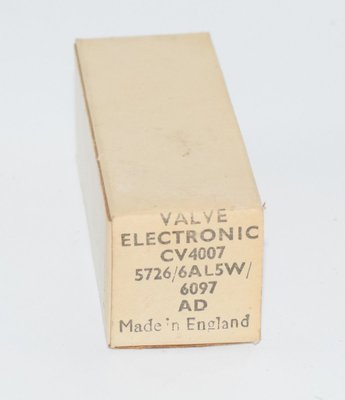
The D77 has also been marketed as the 6AL5W by Marconi (MWT), indicating a ruggedised or military-grade version of the standard 6AL5. NOS (New Old Stock) examples of the D77 / 6AL5W from Marconi are available in the collector and vintage equipment markets.
6. Notable Characteristics
- Exceptionally Low Inter-Anode Capacitance: At just 0.025 pF, the capacitance between the two anode sections is remarkably low, ensuring excellent isolation. This makes the D77 particularly well-suited for balanced discriminator circuits where any coupling between the two diode sections would degrade performance.
- Internal Electrostatic Screen: The inclusion of an internal screen (brought out to pin 6) between the two diode sections is a design feature that contributes to the low inter-anode capacitance and provides additional isolation. Not all equivalent types from other manufacturers include this screen connection.
- Well-Matched Sections: The two diode sections share a common cathode structure and are manufactured to be closely matched in their characteristics, as evidenced by the datasheet specifying a single "Curve of Each Diode" rather than separate curves for each section.
- High Peak Inverse Voltage: The 350V maximum P.I.V. rating provides generous headroom for most receiver applications, where the signal voltages across the diode sections are typically much lower.
- Compact Construction: With a maximum diameter of only 19 mm and overall length of 49–55 mm, the D77 is a true miniature valve, enabling compact receiver designs.
- Robust Design Heritage: The Marconi D77, particularly in its 6AL5W guise, was built to military standards, ensuring long life and reliable performance. NOS examples from the 1950s and 1960s continue to test well and perform reliably decades after manufacture.
7. Usage in the Audio Community
While the D77/EB91/6AL5 is fundamentally a detector and rectifier diode rather than an amplifying device, it holds a respected place in the audio community for several reasons:
Vintage Tuner Restoration
The D77 and its equivalents are essential components in the restoration and maintenance of classic valve-based FM and AM tuners from manufacturers such as Leak, Quad, Rogers, Armstrong, and many others. The FM discriminator or ratio detector stage in these tuners relies on a well-matched double-diode, and the D77/EB91 is the correct original component. Audiophiles restoring these tuners seek out NOS examples of the D77, EB91, or 6AL5 to maintain original performance. The Marconi D77, with its military-grade construction, is particularly prized for this application.
Valve Radio Restoration
Vintage AM radio enthusiasts use the D77 family extensively in restoring classic receivers from the 1950s and 1960s. The valve serves as the AM detector and AGC rectifier in countless British and European radio designs. A fresh, well-matched D77 can noticeably improve the audio quality and AGC performance of a vintage receiver compared to a worn original.
DIY Audio Projects
In the DIY audio community, the D77/6AL5 finds use in several creative applications:
- Signal-Level Rectification: In valve-based VU meters, level indicators, and compressor/limiter side-chains, where a thermionic diode's soft characteristic is preferred over semiconductor alternatives.
- Bias Supply Rectification: In some amplifier designs, a small signal diode like the D77 is used to rectify the bias supply voltage for output tubes, where its gentle characteristic can contribute to a smoother bias voltage.
- Clipping and Limiting Circuits: Guitar amplifier and effects builders sometimes employ the 6AL5/EB91 as a soft-clipping element, exploiting the thermionic diode's gradual conduction onset for a more musical overdrive character than silicon or germanium diodes.
- Experimental FM Tuner Designs: Builders of custom valve FM tuners use the D77/EB91 in discriminator circuits, following classic designs from the golden age of FM broadcasting.
Availability and Collectibility
The D77 and its equivalents were manufactured in enormous quantities by numerous manufacturers worldwide, making NOS examples relatively affordable and readily available compared to many other vintage valve types. Marconi-branded D77 tubes, particularly those with military CV markings, command a modest premium among collectors who value British military-grade construction. Mullard EB91 and American-made 6AL5 examples are also widely available. The abundance of supply means that this is one valve type where audiophiles can afford to be selective, choosing matched pairs for discriminator applications or seeking out preferred manufacturers.
Despite being a humble detector diode rather than a glamorous output tube or exotic preamplifier triode, the D77 remains an indispensable component in the valve audio ecosystem — a quiet workhorse that performs its function with the reliability and grace characteristic of the best British valve engineering of the 1950s.