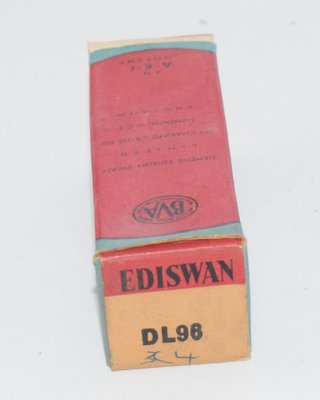
Introduction and History
The DL96 is a miniature output pentode designed specifically for battery-powered portable radio receivers. Developed in the post-war era as part of the European "D" series of 1.4-volt filament tubes, the DL96 was manufactured by several companies including RFT (Rundfunk- und Fernmelde-Technik) in East Germany, Valvo, Telefunken, Philips, and others. The datasheet provided here was prepared in April 1960 by the Zentrallaboratorium für Empfängerröhren at VEB Funkwerk Erfurt and VEB Röhrenwerk Anna Seghers in Neuhaus am Rennweg.
The DL96 carries the American designation 3C4 and was a key component in the battery-operated receiver tube lineup of the 1950s and 1960s. It was designed to deliver usable audio output power while consuming minimal filament current — a critical requirement for sets powered by dry-cell batteries. The tube features a directly heated oxide cathode with a center-tapped filament, allowing operation in both parallel (1.4V at 50mA) and series (2.8V at 25mA) heater configurations, making it extremely versatile for various battery supply arrangements.
The "DL" designation follows the European Mullard–Philips naming convention: "D" indicates a 1.4V directly heated filament, and "L" denotes an output pentode. The "96" places it in the miniature 7-pin (B7G) base family. This tube was a workhorse in countless portable radios throughout Europe and beyond, typically paired with the DF96 (RF/IF pentode), DK96 (frequency converter), and DAF96 (diode-pentode) to form a complete battery receiver lineup.
Technical Specifications and Design
Heater / Filament
| Parameter | Value |
|---|---|
| Heater Type | Directly heated oxide cathode, center-tapped |
| Heater Voltage (parallel) | 1.4 V |
| Heater Current (parallel) | 50 mA (2 × 25 mA) |
| Heater Voltage (series) | 2.8 V |
| Heater Current (series) | 25 mA |
| Additional Heater Voltages | 1.3 V / 48 mA, 2.6 V / 24 mA |
The center-tapped filament design allows the two halves to be connected in parallel (1.4V, 50mA) or in series (2.8V, 25mA), providing flexibility for different battery configurations. This was essential for portable receivers that might use various battery arrangements.
General Static Characteristics (Ua = Ug2 = 85V, Ug1 = −5.2V)
| Parameter | Symbol | Value |
|---|---|---|
| Anode Voltage | Ua | 85 V |
| Screen Grid Voltage | Ug2 | 85 V |
| Control Grid Voltage | Ug1 | −5.2 V |
| Anode Current | Ia | 5 mA |
| Screen Grid Current | Ig2 | 0.9 mA |
| Transconductance (Mutual Conductance) | S (gm) | 1.4 mA/V |
| Internal Resistance (Plate Resistance) | Ri (rp) | 150 kΩ |
Maximum Ratings (Absolute Limits)
| Parameter | Symbol | Value |
|---|---|---|
| Maximum Anode Cold Voltage | UaL max | 110 V |
| Maximum Anode Voltage (operating) | Ua max | 90 V |
| Maximum Anode Dissipation | Qa max | 0.6 W |
| Maximum Screen Grid Cold Voltage | Ug2L max | 110 V |
| Maximum Screen Grid Voltage (operating) | Ug2 max | 90 V |
| Maximum Screen Grid Dissipation | Ng2 max | 0.2 W |
| Maximum Grid Leak Resistance | Rg1 max | 2 MΩ |
| Maximum Cathode Current (parallel filament) | Ikp max | 2 × 3 mA |
| Maximum Cathode Current (series filament) | Iks max | 4.5 mA |
| Grid Current Onset | Ug1 | 0 V (Ig1 ≤ 0.3 µA) |
Interelectrode Capacitances
| Parameter | Symbol | Value |
|---|---|---|
| Input Capacitance | Ce | 4.9 pF |
| Output Capacitance | Ca | 4.8 pF |
| Grid 1 to Anode Capacitance | Cg1a | 0.4 pF |
Operating Conditions — Single-Ended Class A (Filament Halves in Parallel)
| Parameter | Condition 1 | Condition 2 |
|---|---|---|
| Anode Voltage (V) | 85 | 64 |
| Screen Grid Voltage (V) | 85 | 64 |
| Grid Bias (V) | −5.2 | −3.3 |
| Anode Current (mA) | 5 | 3.5 |
| Screen Current (mA) | 0.9 | 0.65 |
| Transconductance (mA/V) | 1.4 | 1.3 |
| Plate Resistance (kΩ) | 150 | 170 |
| Load Resistance (kΩ) | 13 | 15 |
| Output Power (mW) | 200 | 100 |
| Distortion (%) | 10 | 10 |
| Grid AC Voltage (V rms) | 3.5 | 2.4 |
Operating Conditions — Single-Ended Class A (Filament Halves in Series, 90V Supply)
| Parameter | Value |
|---|---|
| Anode Voltage | 90 V |
| Screen Grid Voltage | 90 V |
| Grid Bias | −6.3 V |
| Anode Current | 3.7 mA |
| Screen Current | 0.7 mA |
| Parallel Resistance (Rp) | 680 Ω |
| Load Resistance | 20 kΩ |
| Output Power | 150 mW |
| Distortion | 10% |
| Grid AC Voltage | 2.8 V rms |
Operating Conditions — Economy Mode (Single Filament Half)
| Parameter | Ua=85V | Ua=64V |
|---|---|---|
| Grid Bias (V) | −5.2 | −3.3 |
| Anode Current (mA) | 2.5 | 1.75 |
| Screen Current (mA) | 0.45 | 0.33 |
| Load Resistance (kΩ) | 25 | 30 |
| Output Power (mW) | 100 | 50 |
| Distortion (%) | 10 | 10 |
| Grid AC Voltage (V rms) | 3.6 | 2.6 |
This economy mode, using only one filament half, was a unique feature that allowed battery conservation at the expense of reduced output power — a practical consideration for extending battery life in portable receivers.
Push-Pull Class AB Operation (Filament Halves in Parallel, Ua = 90V)
| Parameter | Value |
|---|---|
| Anode/Screen Voltage | 90 V / 90 V |
| Cathode Resistance (Rk) | 560 Ω |
| Anode-to-Anode Load (Ra/a) | 20 kΩ |
| Output Power | up to ~420 mW |
| Distortion | 4% |
Push-Pull Class B Operation (Filament Halves in Parallel)
| Parameter | Ua=81.5V | Ua=61.5V |
|---|---|---|
| Screen Voltage (V) | 81.5 | 61.5 |
| Grid Bias (V) | −8.5 | −5.8 |
| Load Ra/a (kΩ) | 16 | 20 |
| Max Output Power (mW) | 440 | 220 |
| Distortion at max output (%) | 2.6 | 3 |
Physical Construction
- Base: Miniature 7-pin (B7G / Rimlock-style miniature)
- Envelope: Miniature glass, size designation 38 (Nenngröße 38)
- Construction: Vertically mounted pentode system on a pressed glass base (Preßglasteller)
- Maximum Dimensions: 19 mm diameter, approximately 47.6 mm tall
- Weight: Approximately 8 grams
- Socket Conformance: DIN 41 537 (tube envelope), DIN 41 557 (sockets and shields)
Pin Configuration (Bottom View)
| Pin | Connection |
|---|---|
| 1 | Screen Grid (g2) |
| 2 | Filament Center Tap / Suppressor Grid (fM, g3) |
| 3 | Anode (a) |
| 4 | Internal Connection (do not connect externally) |
| 5 | Control Grid (g1) |
| 6 | Filament Negative (−f) |
| 7 | Filament Positive (+f) |
Important Note: Pin 4 is an internal connection and must not be connected to any external circuit. The suppressor grid (g3) is internally connected to the filament center tap at pin 2. When using series heater operation, the reference point for all voltages is the negative filament end at pin 6 (−f). When using parallel heater operation, the reference point is formed by the filament center tap at pin 2 (fM, g3).
Applications and Usage
The DL96 was designed primarily as the audio output stage in battery-powered portable radio receivers. Its key applications include:
Portable Battery Receivers
The DL96 was the standard output tube in the classic European four-tube battery receiver lineup, typically consisting of:
- DK96 — Frequency converter (mixer/oscillator)
- DF96 — IF amplifier pentode
- DAF96 — Diode-pentode (detector and AF preamplifier)
- DL96 — Output pentode (audio power amplifier)
This combination was used in countless portable radios from manufacturers across Europe throughout the 1950s and 1960s. The entire set could operate from a single 67.5V or 90V B-battery and a 1.5V A-cell, making truly portable reception practical.
Single-Ended Output Stage
In its most common application, the DL96 operates in single-ended Class A configuration, delivering 200 mW of output power at 85V with a 13 kΩ load resistance and 10% THD. While modest by modern standards, this was adequate for driving the small loudspeakers found in portable receivers of the era. At reduced supply voltage (64V), the tube still delivers 100 mW — enough for comfortable listening in quiet environments.
Push-Pull Configurations
For higher output power requirements, two DL96 tubes could be used in push-pull Class AB or Class B configurations. In push-pull Class AB at 90V, a pair of DL96 tubes can deliver approximately 420 mW with only 4% distortion — a significant improvement over the single-ended configuration. In Class B operation at 81.5V, output power reaches 440 mW with just 2.6% distortion, making this an attractive option for higher-fidelity portable applications.
Economy Operation
A unique feature of the DL96 is its ability to operate with only one filament half energized (the "Stromsparschaltung" or current-saving circuit). This halves the filament power consumption while still delivering 50–100 mW of output power, significantly extending battery life at the cost of reduced volume. This was a practical feature for extending listening time when battery replacement was not immediately possible.
Sound Characteristics
The DL96, while designed for utilitarian portable radio service rather than high-fidelity applications, possesses distinctive sonic qualities that have earned it a following among enthusiasts of vintage and low-power audio:
Tonal Character
The DL96 produces a characteristically warm, intimate sound that is typical of low-voltage battery pentodes. Operating at modest plate voltages (64–90V) and very low current levels, the tube exhibits a gentle, rounded tonal quality with a natural emphasis on the midrange frequencies. The sound is often described as "cozy" and "inviting" — qualities that lend themselves well to voice reproduction and acoustic music at low listening levels.
Harmonic Structure
As a pentode, the DL96 generates a mix of even and odd harmonics, though at the very low power levels involved, the harmonic distortion profile tends to be dominated by second and third harmonics. The relatively high plate resistance of 150 kΩ means that the tube's output impedance interacts significantly with the output transformer, and the choice of transformer has a pronounced effect on the final tonal balance. At 10% THD (the rated distortion level for full output), the sound takes on a noticeably compressed, saturated quality that some listeners find musically pleasing for certain genres.
Dynamic Behavior
With only 200 mW of output power available in single-ended mode, the DL96 has very limited dynamic headroom. However, this limitation contributes to a natural compression effect that many listeners find appealing for intimate, late-night listening. The tube clips softly and gracefully when overdriven, without the harsh artifacts associated with solid-state clipping. The transconductance of 1.4 mA/V provides reasonable sensitivity, meaning the tube responds well to small signal variations.
Noise Performance
Being a directly heated tube, the DL96 can exhibit some residual hum, particularly when operated with AC on the filament (which is not its intended use case). In its designed battery-powered application, the tube is remarkably quiet, as DC filament supply eliminates hum entirely. The low operating currents also contribute to low shot noise, making the tube surprisingly quiet in well-designed circuits.
Comparison to Other Output Tubes
Compared to larger output pentodes like the EL84 or 6V6, the DL96 sounds noticeably smaller in scale and more constrained in bandwidth. However, it possesses a delicate, detailed quality in the midrange that larger tubes sometimes lack. The sound has been compared to listening through a fine vintage radio — not high-fidelity in the modern sense, but possessing a musical charm and coherence that transcends its modest specifications.
Equivalent and Substitute Types
| Type | Compatibility | Notes |
|---|---|---|
| 3C4 | Direct equivalent | American RETMA designation for the DL96. Electrically and physically identical. Pin-for-pin compatible. |
| 1P1 | Direct equivalent | Alternative designation. Pin-for-pin compatible with the DL96. |
The DL96 / 3C4 / 1P1 are genuinely interchangeable types with identical pinouts and electrical characteristics. No bias or circuit modifications are required when substituting between these designations.
It should be noted that while other 1.4V battery output pentodes exist (such as the DL94 / 3V4 or DL92 / 3S4), these are not direct substitutes for the DL96. They have different pinouts, different electrical characteristics, and different base configurations. The DL94/3V4 uses a different pin arrangement and has higher current capability, while the DL92/3S4 is a different tube entirely. Substitution between these types requires circuit modification and should not be attempted without careful engineering analysis.
Notable Characteristics
Center-Tapped Filament Design
The DL96's center-tapped filament is one of its most distinctive features. This design allows the tube to operate in three distinct modes:
- Full power (parallel): Both filament halves in parallel at 1.4V, 50mA — maximum transconductance and output power
- Full power (series): Both filament halves in series at 2.8V, 25mA — same performance, different supply voltage
- Economy mode: Single filament half at 1.4V, 25mA — reduced performance but half the filament power consumption
Internal Pin 4 Connection
Pin 4 is designated as an internal connection. This pin must not be connected to any external circuit. This is an important consideration when designing socket wiring or adapters for the DL96.
Very Low Power Consumption
The total power consumption of the DL96 in typical operation is remarkably low. With a filament power of only 70 mW (1.4V × 50mA) and plate dissipation under 0.6W, the entire tube consumes less than 0.7W — making it one of the most efficient output tubes ever produced. This efficiency was essential for battery-powered operation where every milliwatt counted.
High Plate Resistance
The plate resistance of 150 kΩ is notably high, even for a pentode. This means the tube behaves as a nearly ideal current source, and the output power and frequency response are heavily dependent on the output transformer characteristics. A well-designed output transformer is critical for achieving good performance from the DL96.
Robust Construction
Despite its miniature size (19mm diameter, ~47.6mm tall, weighing only about 8 grams), the DL96 was designed for portable equipment and is mechanically robust. The pressed glass base and compact internal structure make it resistant to the vibration and handling typical of portable use.
Usage in the Audio Community
Vintage Radio Restoration
The primary demand for DL96 tubes today comes from the vintage radio restoration community. Countless European portable receivers from the 1950s and 1960s used the DK96/DF96/DAF96/DL96 tube complement, and restorers need replacement DL96 tubes to bring these sets back to working condition. NOS (New Old Stock) examples from manufacturers such as Ediswan, RFT, Valvo, Telefunken, Philips, and Mullard are actively traded among collectors.
Low-Power Audiophile Amplifiers
The DL96 has found a niche following among builders of ultra-low-power single-ended amplifiers. The appeal lies in several factors:
- Simplicity: A complete amplifier can be built with very few components
- Low voltage operation: The 64–90V plate supply is safe and easy to generate, even from battery packs or simple power supplies
- Battery operation: True battery-powered tube amplifiers can be built using the DL96, appealing to those seeking the ultimate in hum-free, portable tube sound
- Desktop/headphone use: The 100–200 mW output power, while inadequate for loudspeaker use in most settings, is more than sufficient for driving high-sensitivity headphones
Headphone Amplifier Projects
The DL96 has become increasingly popular in DIY headphone amplifier projects. Its low voltage requirements make it safer to work with than conventional tube amplifiers, and its output power is well-matched to headphone impedances when used with an appropriate output transformer. Several published designs pair the DL96 with a DAF96 or similar low-voltage preamplifier tube to create a complete battery-powered headphone amplifier that captures the essence of tube sound in a compact, portable format.
Push-Pull Configurations for Audio
Some audio enthusiasts have explored push-pull DL96 configurations for small loudspeaker systems. With up to 440 mW available in Class B push-pull at 81.5V, and 420 mW in Class AB at 90V with only 4% distortion, a pair of DL96 tubes can drive high-efficiency speakers (95+ dB/W/m) to comfortable room levels. These amplifiers have a distinctive, charming sound quality that appeals to listeners who value intimacy and musical engagement over raw power and bandwidth.
Educational and Experimental Use
The DL96's low operating voltages make it an excellent choice for educational purposes and for experimenters new to tube electronics. The maximum plate voltage of 90V is well below the danger threshold, making it much safer to work with than conventional tube circuits operating at 250–400V. This has made the DL96 popular in introductory tube electronics courses and among hobbyists building their first tube amplifier.
Availability and Market
As a tube that was produced in very large quantities by multiple manufacturers over many years, NOS DL96 / 3C4 tubes remain reasonably available on the vintage tube market, though supplies are gradually diminishing. Prices vary depending on manufacturer and condition, with premium brands like Telefunken and Mullard commanding higher prices. RFT-manufactured examples, such as those documented in the attached datasheet, are generally well-regarded for consistent quality and are often available at moderate prices. Ediswan NOS examples are also found in the marketplace.