1. Introduction and History
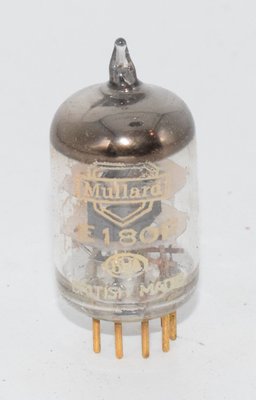
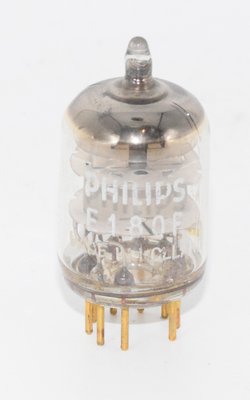
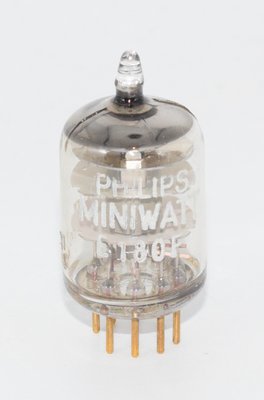
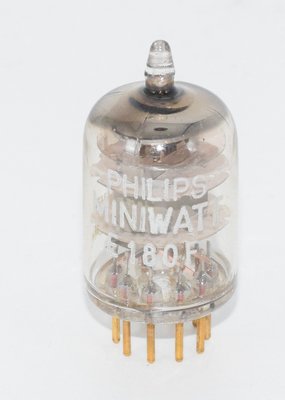
The E180F is a sharp-cutoff (remote designation: "Strmá") VHF pentode designed for high-transconductance broadband amplification in industrial and commercial equipment. Developed under the Philips/Mullard European pro-audio and industrial valve numbering system, the E180F carries the 'E' prefix denoting a 6.3V heater voltage, while '180' and 'F' designate its specific type within the pentode family. The tube was manufactured by several prominent European firms including Philips (Miniwatt), Mullard, Tesla, Valvo, Siemens, and Amperex, with production dating primarily from the late 1950s through the 1970s.
The E180F was conceived as a premium-grade tube for demanding applications where high gain, wide bandwidth, and low noise were paramount. Its design reflects the pinnacle of miniature noval pentode engineering, featuring gold-plated pins on many SQ (Special Quality) variants, an internal shield connected to a dedicated pin, and extremely low grid-to-anode capacitance — all hallmarks of a tube intended for professional and instrumentation-grade service. The Tesla datasheet reproduced here is dated 26 April 1960, confirming the tube's established production status by that era.
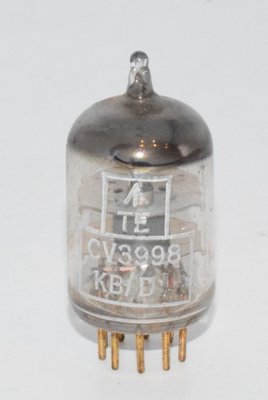
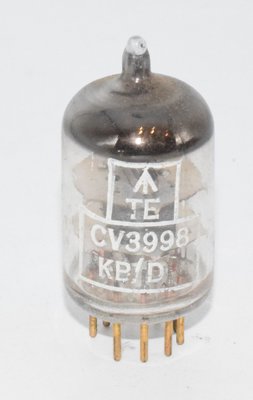
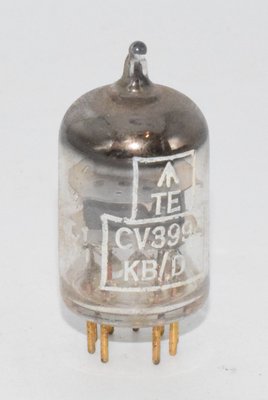
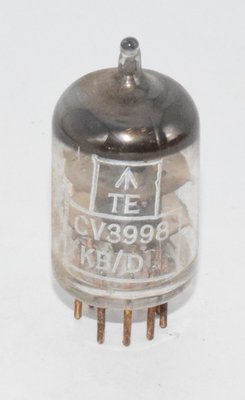
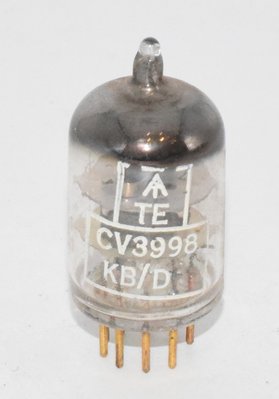
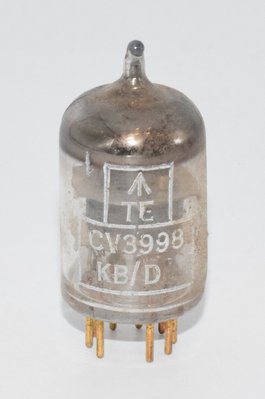
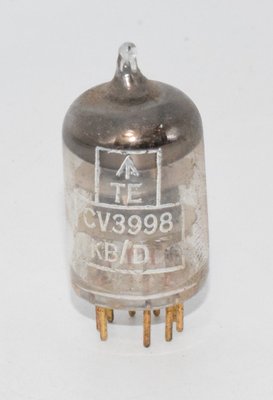
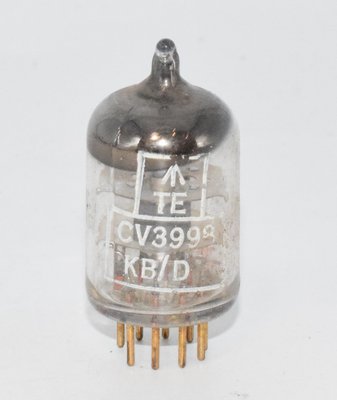
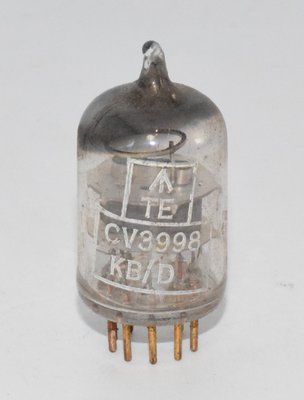
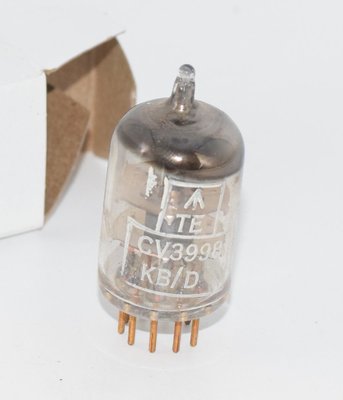
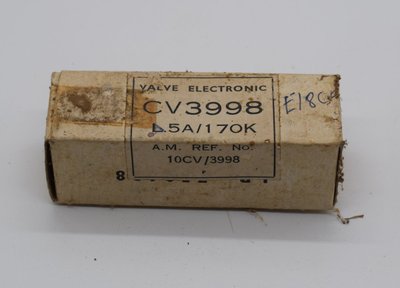
The foreign equivalent listed by Tesla is the 6688, the American JEDEC designation for the same tube type. The military/government designation is CV3998 (UK Ministry of Supply). Today, the E180F enjoys a devoted following among audiophiles and DIY amplifier builders who prize its exceptional linearity, low noise floor, and musical character when used as a voltage amplifier or driver stage.
2. Technical Specifications and Design
General Description
The E180F is an indirectly heated, sharp-cutoff VHF pentode with an oxide-coated cathode. It is housed in an all-glass miniature envelope and uses a 9-pin noval (B9A) base. The suppressor grid (g3) is internally connected along with the internal shield, and the cathode is brought out to two base pins for reduced feedback effects in the anode circuit. Tesla recommends connecting each cathode pin independently to its respective circuit and using a separate cathode lead. The base pins are gold-plated on SQ (Special Quality) versions.
Heater Data
| Parameter | Symbol | Value | Unit |
|---|---|---|---|
| Heater Voltage | Uf | 6.3 ± 5% | V |
| Heater Current | If | 0.3 | A |
| Warm-up Time | tf | 18 | s |
Heating is indirect with parallel AC supply. The heater power consumption is approximately 1.89 W.
Interelectrode Capacitances
(Measured with an internal screening can of 22.2 mm inner diameter)
| Parameter | Symbol | Value | Unit |
|---|---|---|---|
| Input Capacitance (grid 1) | Cg1 | 7.5 ± 0.9 | pF |
| Output Capacitance (anode) | Ca | 2.0 ± 0.5 | pF |
| Grid-to-Anode Capacitance (feedthrough) | Ca/g1 | < 0.03 | pF |
| Control Grid to Heater | Cg1/f | < 0.1 | pF |
| Anode to Cathode | Ca/k | < 0.1 | pF |
The extraordinarily low grid-to-anode capacitance of less than 0.03 pF is a defining characteristic of the E180F, enabling stable high-frequency operation and minimal Miller effect.
Characteristic Values (Pentode Connection)
Conditions: Ua = 190 V, Ug2 = 160 V, Ug3 = 0 V, Ug1 = +9 V (cathode bias via Rk = 630 Ω)
| Parameter | Symbol | Value | Unit |
|---|---|---|---|
| Anode Voltage | Ua | 190 | V |
| Screen Grid Voltage (g2) | Ug2 | 160 | V |
| Suppressor Grid Voltage (g3) | Ug3 | 0 | V |
| Control Grid Voltage (g1) — via cathode bias | Ug1 | +9 (cathode bias) | V |
| Cathode Resistor | Rk | 630 | Ω |
| Anode Current | Ia | 13 ± 0.8 | mA |
| Screen Grid Current | Ig2 | 3.3 ± 0.4 | mA |
| Transconductance (Mutual Conductance) | S (gm) | 16.5 ± 2.3 | mA/V |
| Screen Grid Amplification Factor | μg2/g1 | 50 (−10/+25) | — |
| Internal Resistance (Plate Resistance) | Ri (rp) | > 90 | kΩ |
| S/C Ratio | S/C | 1.6 | mA/V/pF |
Triode Connection
Conditions: g2 connected to anode, g3 connected to cathode; Uba = 160 V, Ubg1 = +9 V, Rk = 620 Ω
| Parameter | Symbol | Value | Unit |
|---|---|---|---|
| Anode Current | Ia | 16.5 | mA |
| Transconductance | S | 18.5 | mA/V |
| Amplification Factor | μ | 50 | — |
| Internal Resistance | Ri | 2.7 | kΩ |
| Equivalent Noise Resistance | Rekv | 225 | Ω |
Maximum Ratings (Absolute Limits)
| Parameter | Symbol | Max | Unit |
|---|---|---|---|
| Heater Voltage | Uf | 6.0 (min) — 6.6 (max) | V |
| Anode Voltage (cold/no signal) | Ua0 | 400 | V |
| Anode Voltage (operating) | Ua | 210 | V |
| Anode Dissipation | Wa | 3 | W |
| Screen Grid Voltage (cold) | Ug20 | 400 | V |
| Screen Grid Voltage (operating) | Ug2 | 175 | V |
| Screen Grid Dissipation | Wg2 | 0.9 | W |
| Cathode Current | Ik | 25 | mA |
| Control Grid Voltage (positive, max) | +Ug1 | 0 | V |
| Control Grid Voltage (negative, max) | −Ug1 | −50 | V |
| Control Grid Voltage (negative, peak) | −Ug1p | −100 | V |
| Grid Leak Resistance (auto bias) | Rg1 | 0.5 | MΩ |
| Grid Leak Resistance (fixed bias) | Rg1 | 0.25 | MΩ |
| Cathode-to-Heater Voltage | Uk/f | 60 | V |
| External Cathode-to-Heater Resistance | Rk/f | 20 | kΩ |
| Bulb Temperature | Tb | 155 | °C |
| Bias for Grid Current Onset (Ig1 < 0.3 μA) | Ug1i | −0.5 | V |
End-of-Life Values
| Parameter | Symbol | Limit | Unit |
|---|---|---|---|
| Anode Current | Ia | > 11.5 | mA |
| Transconductance | S | > 11 | mA/V |
| Reverse Grid Current | −Ig1 | < 1 | μA |
| Insulation Current Between Systems | Iis | < 6 | μA |
Cutoff Characteristics
At Uf = 6.3 V, Ua = 180 V, Ug3 = 0 V, Ug2 = 150 V, Ia = 0.8 mA: the control grid voltage Ug1 is more negative than −4.5 V. This confirms the sharp-cutoff characteristic of the E180F.
Pinout (Noval B9A Base — Bottom View)
| Pin | Connection |
|---|---|
| 1 | g3 (Suppressor Grid) — internally connected to pin 3 |
| 2 | g1 (Control Grid) |
| 3 | Cathode (k) |
| 4 | Heater (f) |
| 5 | Heater (f) |
| 6 | Internal Connection (do not use externally) |
| 7 | Anode (a) |
| 8 | Cathode (k) — second cathode connection |
| 9 | g2 (Screen Grid) |
Important Note: Pin 6 is an internal connection and must not be connected to any external circuit. Pin 1 is internally connected to Pin 3 (suppressor grid to cathode). The cathode is brought out on two pins (3 and 8) to allow separate signal return paths for the input and output circuits, reducing internal feedback at high frequencies. Gold-plated pin sockets are recommended for best contact reliability.
Physical Data
- Base: Noval 9-pin (B9A), per ČSN 35 8904 (S 9/12)
- Envelope: All-glass miniature, maximum diameter 22.2 mm
- Maximum height: approximately 45.2 mm (from seating plane)
- Weight: approximately 11 g
- Mounting: Any position
Broadband Amplifier Operating Data (Class A)
The Tesla datasheet provides three sets of operating conditions for broadband amplifier service:
| Parameter | Condition 1 | Condition 2 | Condition 3 | Unit |
|---|---|---|---|---|
| Supply Voltage (Uba) | 180 | 190 | 190 | V |
| Suppressor Grid (Ug3) | 0 | 0 | 0 | V |
| Screen Supply (Ubg2) | 150 | 160 | 160 | V |
| Grid Bias Supply (Ubg1) | 0 | +9 | +9 | V |
| Cathode Resistor (Rk) | 100 | 630 | 630 | Ω |
| Anode Current (Ia) | 11.5 | 13 | 13 | mA |
| Screen Current (Ig2) | 2.9 | 3.3 | 3.3 | mA |
| Transconductance (S) | 15.9 | 16.5 | 16.5 | mA/V |
| AC Load Resistance (Ra) | — | 14 | — | kΩ |
| DC Load Resistance (Ra) | — | — | 1 | kΩ |
| Output Power (k = 10%) | — | 0.95 | — | W |
| Output Power (k = 2.5%) | — | 0.35 | — | W |
| Equivalent Noise Resistance | — | 460 | 460 | Ω |
| Input Resistance (f = 100 MHz) | — | 2 | — | kΩ |
| Drive Voltage (AC, rms) | — | 0.1 | — | V |
| 2nd Harmonic Distortion | — | 1.6 | — | % |
3. Applications and Usage
The E180F was designed primarily as a high-transconductance broadband VHF amplifier for industrial and commercial equipment. Its original applications included:
- Wideband video amplifiers — The combination of high gm (16.5 mA/V) and low interelectrode capacitances made it ideal for video distribution amplifiers and oscilloscope vertical amplifiers.
- VHF/UHF RF amplifiers — The extremely low grid-to-anode capacitance (< 0.03 pF) enabled stable gain at frequencies well into the VHF range without neutralization.
- IF amplifiers — Used in high-performance communications receivers and radar IF strips where high gain per stage was required.
- Laboratory instrumentation — Employed in precision measurement equipment, spectrum analyzers, and signal generators by firms such as Hewlett-Packard, Rohde & Schwarz, and Wandel & Goltermann.
- Pulse amplifiers — The sharp cutoff characteristic and fast warm-up time (18 seconds) suited it for pulse and timing circuits in nuclear instrumentation and industrial control systems.
- Low-noise preamplifiers — With an equivalent noise resistance of only 225 Ω in triode mode (460 Ω in pentode mode), the E180F was used in sensitive measurement preamplifiers.
- Regulated power supplies — As an error amplifier in stabilized power supply circuits, taking advantage of its high gain.
The tube can also be operated in triode mode by connecting the screen grid (g2) to the anode and the suppressor grid (g3) to the cathode. In this configuration, it achieves a transconductance of 18.5 mA/V, an amplification factor (μ) of 50, and a plate resistance of only 2.7 kΩ — making it an exceptionally capable triode-connected gain stage with very low output impedance.
4. Sound Characteristics
The E180F has earned a distinguished reputation in the audiophile community for its sonic qualities, particularly when used as a small-signal voltage amplifier or driver tube. Its sound character is frequently described in the following terms:
In Pentode Mode
- Highly detailed and resolving — The E180F's very high transconductance and low noise floor allow it to reveal micro-details and subtle textural information in recordings that lesser tubes may obscure. Listeners frequently note an almost "microscopic" level of inner detail.
- Fast and dynamic — The tube's VHF heritage translates into exceptional transient response in audio circuits. Leading edges of notes are rendered with precision and speed, giving music a lively, immediate quality. Percussion instruments benefit particularly from this characteristic.
- Extended and airy treble — The wide bandwidth capability produces a treble that extends naturally without grain or harshness. There is a sense of "air" and space around instruments that contributes to a convincing three-dimensional soundstage.
- Tight, controlled bass — Unlike some pentodes that can sound loose or woolly in the low frequencies, the E180F delivers bass with good definition and control, though some listeners find it slightly leaner than triode-connected alternatives.
- Analytical rather than romantic — In pentode mode, the E180F tends toward a more neutral, revealing presentation. It is not the tube to choose if one seeks a warm, euphonic coloration; rather, it excels at truthful reproduction.
In Triode Mode
- Warmer and more harmonically rich — Triode connection introduces a more even-order harmonic character, softening the presentation slightly while retaining much of the pentode mode's detail and speed.
- Lower output impedance, better drive capability — With Ri of only 2.7 kΩ in triode mode, the E180F can drive subsequent stages or even headphones (through appropriate coupling) with authority.
- Excellent midrange presence — Vocals and acoustic instruments are rendered with a natural, palpable quality that many listeners find highly engaging.
- Reduced noise — The equivalent noise resistance drops from 460 Ω (pentode) to 225 Ω (triode), making triode mode particularly attractive for phono stages and microphone preamplifiers.
Manufacturer Variations
Audiophiles report noticeable sonic differences between manufacturers:
- Philips Miniwatt (Heerlen, Holland) — Considered the gold standard, particularly the SQ (Special Quality) gold-pin versions. Known for exceptional clarity, low noise, and a refined, slightly warm tonal balance. The Heerlen-made tubes with the distinctive Philips shield logo are the most sought-after.
- Mullard (UK) — CV3998-branded examples are highly regarded. They tend to offer a slightly fuller midrange compared to Philips, with excellent bass weight. The Mullard versions are often described as having a more "musical" character.
- Amperex (Holland/USA) — Similar to Philips production (often from the same Heerlen factory), with the characteristic Dutch clarity and detail.
- Tesla (Czechoslovakia) — Good performers at a lower price point, with a slightly more forward and energetic presentation compared to the Dutch and British tubes.
- Siemens/Valvo (Germany) — Known for precision and neutrality, with very low microphonics. German-made examples are particularly prized for instrumentation and measurement applications repurposed for audio.
5. Equivalent or Substitute Types
Direct Equivalents (Drop-in Replacements)
| Type | Notes |
|---|---|
| 6688 | American JEDEC equivalent. Identical specifications and pinout. Direct drop-in replacement. This is the designation listed by Tesla as the foreign equivalent. |
| CV3998 | UK military (Ministry of Supply) designation for the E180F. Identical in all respects; often Mullard-manufactured with military-grade quality control and selection. |
Related but NOT Direct Drop-in Types
| Type | Notes |
|---|---|
| EF861 | Listed as a different-rating substitute. Not a direct drop-in — has different operating parameters. Circuit modifications would be required. Confirm compatibility before substitution. |
| EF86 / 6267 | Sometimes confused with the E180F due to the similar naming convention, but this is a completely different tube — a low-noise audio pentode with much lower transconductance (~2 mA/V) and different pinout. NOT interchangeable. |
| E280F | A related Philips type with higher voltage ratings but different operating points. Not a drop-in replacement. |
| EF184 / 6EJ7 | A consumer-grade VHF pentode with some parametric similarities but different specifications and not a direct substitute. |
Caution: When substituting tubes, always verify that the pinout, heater requirements, and maximum ratings are compatible with the specific circuit. The E180F has an internal connection on pin 6 that must not be connected to external circuitry — ensure any substitute also has this characteristic or that the socket wiring accommodates it.
6. Notable Characteristics
Exceptional Transconductance
At 16.5 mA/V (pentode) and 18.5 mA/V (triode), the E180F offers transconductance figures that rival or exceed many larger frame-grid tubes. This high gm enables very high voltage gain per stage — with a 14 kΩ anode load, the voltage gain approaches 230 (approximately 47 dB) in pentode mode.
Ultra-Low Feedthrough Capacitance
The grid-to-anode capacitance of less than 0.03 pF is remarkably low, even by modern standards. This was achieved through careful internal shielding and the use of a dedicated shield connection (brought out via the internal connection on pin 6). This low capacitance virtually eliminates Miller effect concerns in audio applications and enables stable operation at VHF frequencies.
Dual Cathode Connections
The cathode is brought out on two separate pins (3 and 8), allowing the designer to use independent return paths for the input and output circuits. This reduces common-impedance coupling and improves stability at high frequencies. In audio applications, this feature can be exploited to separate the signal ground from the bias ground, potentially reducing hum and noise.
Low Microphonics
The Tesla datasheet specifies rigorous vibration and shock testing requirements, including testing at 2.5g acceleration at 50 Hz and shock resistance at 300g. The tube was designed for industrial environments where mechanical vibration is present, and this ruggedness translates directly into low microphonic sensitivity — a highly desirable trait for audio preamplifier applications.
Excellent Noise Performance
With an equivalent noise resistance of 225 Ω in triode mode and 460 Ω in pentode mode, the E180F is among the quietest small-signal pentodes available. This makes it suitable for phono preamplifiers, microphone amplifiers, and other applications where the signal source impedance is low to moderate.
Sharp Cutoff Characteristic
The E180F is a sharp-cutoff (non-remote) pentode, meaning its transfer characteristic follows a relatively uniform exponential curve without the extended tail found in variable-mu (remote cutoff) types. Cutoff occurs at approximately −4.5 V on the control grid. This characteristic ensures predictable, low-distortion amplification when properly biased in the linear region of the transfer curve.
Robust Construction
The tube is rated for operation across a wide temperature range (−60°C to +90°C storage, with bulb temperatures up to 155°C in operation) and withstands reduced atmospheric pressure testing at 30 Torr for 10 minutes. These specifications reflect its industrial/military heritage and contribute to long operational life.
7. Usage in the Audio Community
The E180F has become one of the most celebrated small-signal tubes in the high-end audio world, despite — or perhaps because of — its origins as an industrial/instrumentation tube rather than a purpose-designed audio valve. Its adoption by the audio community has been driven by several factors:
Phono Preamplifiers
The E180F's low noise, high gain, and excellent linearity make it a natural choice for moving-coil and moving-magnet phono stages. Several boutique manufacturers have designed phono preamplifiers around this tube, often using it in triode mode for the lowest possible noise. The tube's high transconductance allows sufficient gain for moving-coil cartridges without requiring step-up transformers in some topologies. Notable commercial designs and DIY projects feature the E180F as the first gain stage, where its 225 Ω equivalent noise resistance (triode mode) provides an excellent noise match for cartridge impedances in the 10–500 Ω range.
Line-Stage Preamplifiers
In line-level applications, the E180F provides enormous gain reserves, allowing the designer to apply generous amounts of negative feedback for ultra-low distortion, or to operate with minimal feedback for a more "open" sound. The triode-connected E180F, with its μ of 50 and Ri of 2.7 kΩ, can drive long interconnect cables and low-impedance loads with ease.
Headphone Amplifiers
The low plate resistance in triode mode (2.7 kΩ) has made the E180F attractive for headphone amplifier designs, particularly for driving higher-impedance headphones (300–600 Ω). Some designers use it as a driver for a cathode follower output stage, while others employ it in SRPP (Shunt Regulated Push-Pull) configurations.
Microphone Preamplifiers
Professional and boutique microphone preamplifier designs have employed the E180F for its combination of low noise, high gain, and wide bandwidth. The tube's ability to handle fast transients without smearing makes it particularly suitable for capturing percussion, acoustic guitar, and vocal recordings with high fidelity.
DAC Output Stages and Buffers
Some high-end digital-to-analog converter designs use the E180F as an output buffer or gain stage following the DAC chip, leveraging the tube's linearity and musicality to add analog warmth and dimensionality to the digital signal path.
Driver Stages in Power Amplifiers
The E180F's high gain and current capability make it an effective driver tube for power amplifier output stages. It can develop sufficient voltage swing to drive power pentodes and beam tetrodes to full output, and its low output impedance in triode mode ensures tight coupling to the output stage.
Collectibility and Market
The E180F has become a highly collectible tube, with NOS (New Old Stock) examples commanding premium prices, particularly for the following variants:
- Philips Miniwatt SQ Gold Pin (Holland) — The most sought-after version, often selling for significant premiums. The "SQ" designation indicates Special Quality selection with tighter parameter tolerances and gold-plated pins for superior contact reliability.
- Mullard CV3998 — Military-selected examples with the UK government CV designation, offering guaranteed minimum performance standards.
- Amperex (Holland-made) — Tubes manufactured at the Philips Heerlen facility but branded for the American market under the Amperex name.
The tube's popularity in audio has been sustained by the large quantities originally manufactured for industrial and military use, ensuring a reasonable supply of NOS examples. However, as stocks diminish, prices have steadily increased, particularly for matched pairs and verified low-noise specimens.
Practical Considerations for Audio Use
- Shielding: While the E180F has excellent internal shielding, external tube shields are recommended in sensitive audio applications to minimize electromagnetic interference pickup. The datasheet specifies capacitance measurements with a 22.2 mm internal diameter shield.
- Socket quality: Gold-plated noval sockets are strongly recommended to match the gold-plated pins of SQ versions and ensure reliable, low-resistance contact over time.
- Heater supply: DC heater supplies or elevated AC heater supplies (with a DC offset to maintain the cathode-heater voltage within the 60V maximum) are recommended for the lowest hum in audio applications.
- Pin 6 caution: Designers must ensure that pin 6 (internal connection) is not connected to any external circuit. Some noval socket wiring schemes may inadvertently connect this pin.
- Cathode bypass: The dual cathode pins allow creative grounding strategies. In audio circuits, connecting both cathode pins together at the socket and running a single, short ground lead can minimize ground loop issues.
- Operating point selection: For lowest distortion in audio, the tube should be biased near the center of its linear transfer region. The datasheet's recommended operating point of Ua = 190V, Ug2 = 160V with Rk = 630Ω provides an excellent starting point, yielding Ia = 13 mA with a 2nd harmonic distortion of only 1.6% at the rated output.