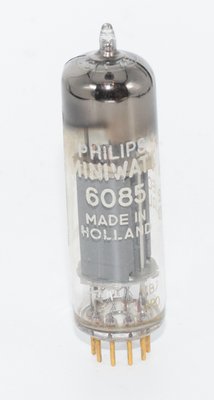
1. Introduction and History
The E80CC is a Special Quality (S.Q.) double triode vacuum tube designed and manufactured by Philips, primarily intended for use as an audio frequency (A.F.) and direct current (D.C.) amplifier. Carrying the RETMA/EIA designation 6085 and the British military CV number CV5989, the E80CC was developed to meet the most demanding requirements of professional broadcast, telecommunications, and instrumentation equipment where long life, low noise, and exceptional reliability were paramount.
The datasheet for the E80CC is dated December 1968, placing its formal specification solidly in the late 1960s, though production examples are known from as early as 1958. Philips manufactured the E80CC at their Heerlen factory in the Netherlands, and the tube was part of the broader Philips "E80" professional series — a family of S.Q. (Special Quality) tubes that included types such as the E80F (pentode), E80L (power pentode), and E80CF (triode-pentode). The "E" prefix denotes a 6.3V heater voltage per the Mullard–Philips naming convention, "80" designates the professional S.Q. series, and "CC" indicates a double triode construction.
The S.Q. designation was not merely a marketing label. It signified that each tube underwent rigorous individual testing and selection, ensuring tighter parameter spreads, lower microphonics, superior shock and vibration resistance, and guaranteed minimum life of 10,000 hours — even after long periods of operation under cut-off conditions, which can cause interface resistance problems in lesser tubes. The E80CC was specifically designed to maintain low interface resistance under such demanding operating regimes.
Among the most prized variants are the early Philips Holland 1958 "Pinched Waist" SQ Gold Pins production, which features a distinctive narrowing of the glass envelope between the two triode sections, and the later Philips Holland 1965 SQ Gold Pins version. Both are highly sought after by collectors and audiophiles for their exceptional build quality and sonic performance.
2. Technical Specifications and Design
General Description
| Type | Double Triode (two independent triode sections) |
| Quality Grade | S.Q. (Special Quality) |
| Intended Application | A.F. and D.C. amplifier |
| Base | Noval (B9A), Gold plated pins |
| Heating | Indirect; A.C. or D.C.; Series or parallel supply |
| Mechanical Quality | Shock and vibration resistant |
| Life Test | 10,000 hours; low interface resistance after long periods of operation under cut-off conditions |
Heater Ratings
| Parameter | Symbol | Parallel Operation | Series Operation | Unit |
|---|---|---|---|---|
| Heater Voltage | Vf | 6.3 | 12.6 | V |
| Heater Current | If | 0.6 | 0.3 | A |
The average heater voltage should be 6.3 V or 12.6 V. Variations of the heater voltage exceeding the range of 6.0 V to 6.6 V or 12.0 V to 13.2 V will shorten tube life.
Electrical Characteristics (at Va = 250 V, Vg = −5.5 V, Rk = 920 Ω)
| Parameter | Symbol | Nominal (I) | Initial Spread (II) | End of Life (III) | Unit |
|---|---|---|---|---|---|
| Anode Voltage | Va | 250 | V | ||
| Cathode Resistor | Rk | 920 | Ω | ||
| Anode Current | Ia | 6.0 | 5.4 – 6.6 | min. 4.3 | mA |
| Transconductance (Mutual Conductance) | S (gm) | 2.7 | 2.2 – 3.2 | min. 1.8 | mA/V |
| Amplification Factor | μ | 27 | — | ||
| Internal Resistance (Plate Resistance) | Ri (rp) | 10 | min. 7 | kΩ | |
| Negative Grid Current | −Ig | max. 0.5 | max. 1.0 | μA | |
| Difference in Anode Current of Two Sections | |Ia−Ia'| | max. 3.0 | mA |
Cut-Off Characteristics
| Cut-off Voltage (at Va = 250 V, Ra = 1 MΩ) | −Vg | 17 V |
| Anode Current at Cut-off | Ia | max. 15 μA |
Hum and Noise
| Hum Voltage (Rg = 0.5 MΩ) | Vg | max. 75 μVRMS |
| Leakage Current between Cathode and Heater (Vkf = 120 V) | Ikf | max. 12 μA |
Absolute Maximum Ratings
| Parameter | Symbol | Maximum | Unit |
|---|---|---|---|
| Anode Voltage (peak) | Vao | 600 | V |
| Anode Voltage (DC) | Va | 300 | V |
| Anode Dissipation (per section) | Wa | 2 | W |
| Cathode Current | Ik | 12 | mA |
| Cathode Current Peak (30 mA grid peak, 0.005 duty, 10 μs pulse) | Ikp | 150 | mA |
| Cathode Current Peak (2 mA grid peak, 0.2 duty, 400 μs pulse) | Ikp | 30 | mA |
| Negative Grid Voltage | −Vg | 200 | V |
| Grid Current, Average | Ig | 0.3 | mA |
| Grid Current, Peak | Igp | 30 | mA |
| Voltage between Cathode and Heater | Vkf | 120 | V |
| Bulb Temperature | tbulb | 170 | °C |
| Grid Resistor (automatic bias) | Rg | 1 | MΩ |
| Grid Resistor (fixed bias) | Rg | 0.5 | MΩ |
Thermal Characteristics
| Cathode Heating Time | 16 sec (max. 23 sec) |
| Cathode Cooling Time | min. 13 sec |
Physical Dimensions
| Maximum Diameter | 22 mm |
| Maximum Overall Height (including pins) | 72 mm (max. 78 mm) |
Pin Configuration (Noval B9A Base — Bottom View)
| Pin | Connection |
|---|---|
| 1 | Anode (Section 1) |
| 2 | Grid (Section 1) |
| 3 | Cathode (Section 1) |
| 4 | Heater (f) |
| 5 | Heater (f) |
| 6 | Anode (Section 2) |
| 7 | Grid (Section 2) |
| 8 | Cathode (Section 2) |
| 9 | Heater center-tap (fc) |
Pin 9 serves as the heater center-tap, allowing the heaters to be connected in parallel (6.3 V at 0.6 A) or in series (12.6 V at 0.3 A).
Interelectrode Capacitances
The E80CC features carefully controlled interelectrode capacitances. With an external screen:
| Capacitance | Symbol | Nominal (I) | Spread (II) | Unit |
|---|---|---|---|---|
| Anode to Cathode and Heater | Ca/kf | 3.5 | 2.8 – 4.2 | pF |
| Grid to Cathode and Heater | Cg/kf | 2.6 | 1.9 – 3.3 | pF |
| Anode to Grid | Cag | 3.0 | 2.4 – 3.6 | pF |
| Grid to Heater | Cgf | max. 0.23 | pF | |
| Cathode to Heater | Ckf | 4.8 | pF | |
| Anode to Anode (other section) | Caa' | 1.3 | 0.9 – 1.7 | pF |
| Grid to Grid (other section) | Cgg' | max. 13 | mpF | |
| Anode to Grid (other section) | Cag' | max. 0.1 | pF | |
| Grid to Anode (other section) | Cga' | max. 65 | mpF |
The extremely low cross-section capacitances (Cgg' max. 13 mpF, Cga' max. 65 mpF) demonstrate the excellent internal shielding between the two triode sections, making the E80CC ideal for sensitive low-level amplification stages.
Shock and Vibration Resistance
The E80CC is tested under the following conditions:
- Shock: Subjected 5 times in each of 4 positions to an acceleration of 500 g, supplied by an NRL shock machine with the hammer lifted over an angle of 30°.
- Vibration: Subjected during 32 hours in each of 3 positions to a vibration frequency of 50 Hz with an acceleration of 2.5 g.
Operating Characteristics — Resistance Coupled A.F. Amplifier
The datasheet provides detailed operating data for three different resistance-coupled amplifier configurations across a range of supply voltages from 200 V to 400 V:
Configuration 1: Ra = 47 kΩ, Rk = 1.2 kΩ, Rg' = 0.15 MΩ
| Vba (V) | Ia (mA) | Vo/Vi | Vo at +Ig=0.3μA (VRMS) | dtot (%) |
|---|---|---|---|---|
| 200 | 1.86 | 18.5 | 20 | 3.3 |
| 250 | 2.45 | 18.5 | 30 | 3.8 |
| 300 | 3.15 | 18.5 | 40 | 4.0 |
| 350 | 3.80 | 18.5 | 50 | 4.1 |
| 400 | 4.40 | 18.5 | 60 | 4.2 |
Configuration 2: Ra = 100 kΩ, Rk = 2.2 kΩ, Rg' = 0.33 MΩ
| Vba (V) | Ia (mA) | Vo/Vi | Vo at +Ig=0.3μA (VRMS) | dtot (%) |
|---|---|---|---|---|
| 200 | 1.00 | 20 | 22 | 3.1 |
| 250 | 1.30 | 20 | 32 | 3.4 |
| 300 | 1.65 | 20 | 42 | 3.5 |
| 350 | 1.95 | 20 | 52 | 3.6 |
| 400 | 2.30 | 20 | 63 | 3.7 |
Configuration 3: Ra = 220 kΩ, Rk = 3.9 kΩ, Rg' = 0.68 MΩ
| Vba (V) | Ia (mA) | Vo/Vi | Vo at +Ig=0.3μA (VRMS) | dtot (%) |
|---|---|---|---|---|
| 200 | 0.52 | 21 | 19 | 2.3 |
| 250 | 0.67 | 21 | 29 | 2.6 |
| 300 | 0.83 | 21 | 38 | 3.0 |
| 350 | 0.99 | 21 | 47 | 3.1 |
| 400 | 1.15 | 21 | 58 | 3.2 |
Note: At lower output voltages, the distortion is proportionally lower.
3. Applications and Usage
The E80CC was designed by Philips for professional and industrial applications where reliability, consistency, and long service life were critical requirements. Its primary applications include:
- Professional Audio Equipment: The E80CC was widely used in broadcast studio equipment, professional mixing consoles, and high-quality audio amplifiers. Its low noise, low microphonics, and tight section matching made it ideal for sensitive preamplifier stages.
- D.C. Amplifiers: The tube's low grid current (max. 0.5 μA initial, max. 1.0 μA end of life) and excellent long-term stability made it suitable for precision D.C. amplifier circuits used in instrumentation and measurement equipment.
- Telecommunications: Used in carrier telephony equipment and other telecommunications infrastructure where tubes needed to operate reliably for years without maintenance.
- Computing and Instrumentation: The tight parameter tolerances and matched sections made the E80CC valuable in early analog computing circuits, servo amplifiers, and precision measurement instruments.
- Differential Amplifiers: The closely matched dual triode sections (anode current difference max. 3.0 mA between sections) made the E80CC excellent for balanced and differential amplifier topologies.
- Resistance-Coupled A.F. Amplifiers: The datasheet provides detailed operating data for resistance-coupled amplifier configurations with voltage gains of approximately 18.5 to 21, depending on the load resistor chosen.
The tube's ability to withstand 500 g shock and sustained vibration at 2.5 g / 50 Hz for 32 hours made it suitable for mobile and military installations where lesser tubes would fail due to microphonic noise or mechanical damage.
4. Sound Characteristics
The E80CC has earned a distinguished reputation among audiophiles and recording engineers for its refined and musical sonic character. Its sound is frequently described in the following terms:
- Transparency and Detail: The E80CC is renowned for its exceptional clarity and resolution. The low noise floor (hum voltage max. 75 μVRMS) and minimal microphonics allow subtle musical details to emerge that might be masked by lesser tubes. Listeners frequently note an almost "window-like" transparency to the sound.
- Tonal Balance: The E80CC presents a beautifully balanced tonal character that avoids the extremes of overly warm or analytically bright. The midrange is often described as liquid, natural, and three-dimensional, with a purity that is characteristic of the finest Philips triode designs.
- Bass Response: The bass is typically described as tight, well-defined, and controlled rather than bloomy or exaggerated. The tube's relatively low plate resistance (10 kΩ nominal) contributes to good damping and authority in the low frequencies.
- Treble Character: The high frequencies are extended and airy without harshness or grain. The E80CC avoids the sometimes overly sweet or rolled-off treble character of some other double triodes, instead presenting high-frequency information with natural shimmer and decay.
- Soundstage: One of the E80CC's most praised attributes is its ability to create a wide, deep, and precisely focused soundstage. The excellent channel separation afforded by the low inter-section capacitances (Cgg' max. 13 mpF) contributes to outstanding stereo imaging when both sections are used in a stereo preamplifier.
- Dynamic Range: The tube handles dynamic contrasts with grace and composure. With a maximum anode dissipation of 2 W per section and the ability to swing significant output voltages (up to 60 VRMS or more depending on configuration), the E80CC delivers convincing macro-dynamics while preserving micro-dynamic nuance.
- Vintage Variants: The early "Pinched Waist" versions from 1958 are often considered the most sonically desirable, with listeners describing an even greater sense of openness, air, and three-dimensionality compared to later production. The 1965 SQ Gold Pin versions are also highly regarded, offering a slightly more neutral and controlled presentation.
Overall, the E80CC is considered one of the finest-sounding small-signal double triodes ever produced, combining the musicality and warmth associated with the best European tube designs with a level of precision and neutrality that satisfies even the most demanding critical listeners.
5. Equivalent or Substitute Types
| Type | Relationship | Notes |
|---|---|---|
| 6085 | Direct equivalent (RETMA/EIA designation) | Identical tube; the 6085 is simply the American type number for the E80CC. Fully interchangeable with no modifications. |
| CV5989 | Direct equivalent (British military designation) | Identical tube manufactured to British military specifications. Fully interchangeable. |
Important Notes on Substitution
The E80CC is not a direct drop-in replacement for the more common ECC80 (12AX7), ECC81 (12AT7), ECC82 (12AU7), or ECC83 (12AX7) family of double triodes, despite superficial similarities in the type designation. Key differences include:
- Heater voltage: The E80CC uses 6.3 V / 0.6 A (parallel) or 12.6 V / 0.3 A (series) heater configuration, which is similar to the ECC8x family. However, the pinout and electrical characteristics differ significantly.
- Electrical parameters: The E80CC has a unique combination of μ = 27, gm = 2.7 mA/V, and rp = 10 kΩ that does not directly correspond to any of the standard ECC8x types. The ECC82 (12AU7) is perhaps the closest in terms of amplification factor (μ ≈ 17 for ECC82 vs. μ = 27 for E80CC), but the operating points and bias requirements are different.
- Pin configuration: While both use the Noval (B9A) base, the specific pin assignments should be verified before attempting any substitution in existing circuits. The E80CC pinout follows the standard double triode convention but circuit modifications may be needed for proper biasing.
Some audiophiles have successfully adapted circuits designed for the ECC82 or ECC81 to use the E80CC, but this requires careful re-biasing and is not a simple plug-in substitution. Purpose-designed E80CC circuits will always yield the best results.
6. Notable Characteristics
- Gold-Plated Pins: All E80CC tubes feature gold-plated Noval base pins, ensuring reliable, low-resistance contact over the tube's long service life. This is not merely cosmetic — gold plating prevents oxidation and maintains consistent contact resistance, which is critical in low-level signal applications.
- Guaranteed 10,000-Hour Life: The E80CC is tested to maintain its end-of-life specifications (Column III) after 10,000 hours of operation at Vf = 6.3 V, Va = 250 V, Rk = 920 Ω. This is significantly longer than the typical life expectancy of standard-quality tubes.
- Low Interface Resistance: A particular design achievement of the E80CC is its resistance to the buildup of interface resistance between the cathode coating and the base metal — a common failure mode in tubes that spend extended periods in cut-off. This makes the E80CC ideal for standby and switching applications.
- Exceptional Section Matching: The maximum allowable difference in anode current between the two triode sections is 3.0 mA (at the nominal operating point of 6.0 mA per section). This tight matching is essential for balanced circuit topologies and contributes to the tube's excellent performance in stereo audio applications.
- Robust Mechanical Construction: The ability to withstand 500 g shock acceleration and sustained 2.5 g vibration at 50 Hz demonstrates the E80CC's superior mechanical construction, with rigid internal element support structures that minimize microphonic noise.
- Low Grid Current: The maximum negative grid current of 0.5 μA (initial) ensures minimal loading of high-impedance source circuits and contributes to the tube's suitability for D.C. amplifier applications where grid current can cause measurement errors.
- High Voltage Capability: With a maximum peak anode voltage of 600 V and DC anode voltage of 300 V, the E80CC offers considerable headroom for high-voltage circuit designs.
- Pinched Waist Construction (Early Production): The 1958-era "Pinched Waist" variant features a distinctive narrowing of the glass envelope between the two triode sections. This construction technique provides additional internal shielding between sections and is believed to contribute to the superior sonic performance attributed to these early examples.
7. Usage in the Audio Community
The E80CC has achieved near-legendary status in the high-end audio community, where it is revered as one of the finest small-signal tubes ever manufactured. Its usage spans several key areas:
High-End Preamplifiers
The E80CC is a favored tube for line-stage and phono preamplifier designs. Its combination of moderate gain (μ = 27), low noise, and excellent linearity makes it particularly well-suited for these critical signal-path positions. Several boutique amplifier manufacturers have designed preamplifiers specifically around the E80CC, taking advantage of its unique electrical characteristics rather than treating it as a substitute for more common types.
Headphone Amplifiers
The E80CC's relatively low plate resistance (10 kΩ) and ability to deliver meaningful current (up to 12 mA cathode current per section) make it an excellent choice for tube-based headphone amplifiers. Its refined sonic character and low output impedance (for a triode) allow it to drive a wide range of headphone impedances with authority and finesse.
DAC Output Stages
In the modern era of digital audio, the E80CC has found a new role as a tube buffer or output stage in high-end digital-to-analog converters. Its transparency and lack of coloration allow it to add the desirable qualities of tube amplification — natural harmonics, spatial depth, and musical engagement — without obscuring the detail and precision of the digital source.
Tube Rolling and Collecting
The E80CC is one of the most actively collected and traded tubes in the audiophile community. A hierarchy of desirability has emerged among the various production vintages:
- Philips Heerlen "Pinched Waist" (late 1950s): The most sought-after and expensive variant, commanding premium prices. Identified by the distinctive narrowing of the glass envelope and early date codes.
- Philips Heerlen SQ Gold Pins (1960s): Including the well-regarded 1965 production. These offer excellent performance and are somewhat more available than the Pinched Waist versions.
- Mullard-manufactured E80CC: Produced at the Mullard Blackburn factory to the same Philips specifications, these are also highly regarded.
- Other European production: Various European manufacturers produced the E80CC or 6085 under license or to the same specifications.
Circuit Design Considerations for Audio
Audio designers working with the E80CC typically note several practical considerations:
- The tube responds well to higher plate voltages within its ratings, with many designers preferring supply voltages in the 250–350 V range for optimal linearity and headroom.
- The 220 kΩ anode resistor configuration (Ra = 220 kΩ, Rk = 3.9 kΩ) yields the lowest distortion figures (2.3% to 3.2% at maximum output) while providing a voltage gain of 21.
- For the lowest distortion at moderate output levels, the higher anode resistor values are preferred, as the datasheet notes that "at lower output voltages the distortion is proportionally lower."
- The tube's heater can be operated on DC to eliminate any residual hum, though the specified hum voltage of max. 75 μVRMS is already very low for AC heater operation.
- The maximum cathode-to-heater voltage of 120 V allows for elevated heater biasing schemes commonly used in low-noise audio designs.
Market and Availability
As a professional-grade tube that was produced in relatively limited quantities compared to consumer types like the ECC83 or ECC82, the E80CC has always been less common on the surplus market. The combination of limited supply and strong audiophile demand has driven prices steadily upward over the years. NOS (New Old Stock) examples in original packaging, particularly the early Philips Heerlen production, command significant premiums. Despite the high prices, many audiophiles consider the E80CC to be a worthwhile investment, as its guaranteed 10,000-hour life and exceptional build quality mean that a good NOS example will provide many years of reliable, high-quality service.