1. Introduction and History
The E88C is a special quality (S.Q.) miniature triode manufactured by Philips and other European tube makers, originally designed for use as a grounded grid aerial amplifier in UHF television bands IV and V. First documented in Philips datasheets dated December 1968, the E88C was developed to meet the demanding requirements of professional broadcast and telecommunications equipment, where low noise, tight parameter tolerances, and exceptional mechanical ruggedness were essential.
The "E" prefix in the European Pro-Electron naming convention denotes a 6.3V heater voltage, while "88" is the type designator and "C" indicates a triode. The "S.Q." (Special Quality) designation signifies that this tube was manufactured to tighter tolerances than standard commercial equivalents, with gold-plated pins for low interface resistance, enhanced shock and vibration resistance, and a guaranteed life test of 10,000 hours. This placed the E88C firmly in the professional/military grade category alongside other renowned Philips SQ types.
The E88C should not be confused with the far more common E88CC (also known as the 6922), which is a double triode. The E88C is a single triode in a noval (B9A) envelope, purpose-built for high-frequency, low-noise grounded grid service. Its relatively high mutual conductance of 13.5 mA/V and low equivalent noise resistance of 240 Ω made it an outstanding performer in UHF front-end amplifier stages.
2. Technical Specifications and Design
General Description
- Type: Special Quality (S.Q.) Triode
- Intended Application: Grounded grid aerial amplifier for Band IV and V (UHF)
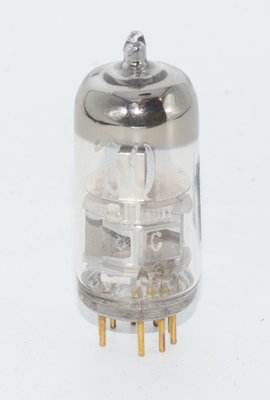
- Base: Noval (B9A), gold-plated pins
- Envelope: Miniature glass, max diameter 22 mm
- Overall Height: Max 55.6 mm (max 49.2 mm to top of glass envelope)
- Heating: Indirect, AC or DC parallel supply
- Life Test: 10,000 hours
- Mechanical Quality: Shock and vibration resistant
Heater Ratings
| Parameter | Symbol | Nominal | Range | Unit |
|---|---|---|---|---|
| Heater Voltage | Vf | 6.3 | 6.0–6.6 | V |
| Heater Current | If | 155 | 147–163 | mA |
Note: The average heater voltage should be 6.3 V. Variation exceeding the range of 6.0 V to 6.6 V will shorten tube life.
Characteristics at Nominal Operating Point
| Parameter | Symbol | Nominal | Unit |
|---|---|---|---|
| Anode Voltage | Va | 160 | V |
| Grid Voltage | −Vg | 1.25 | V |
| Anode Current | Ia | 12.5 | mA |
| Mutual Conductance (Transconductance) | S (gm) | 13.5 | mA/V |
| Amplification Factor | μ | 70 | — |
| Internal Resistance (Plate Resistance) | Ri (rp) | 5.2 | kΩ |
| Equivalent Noise Resistance | Req | 240 | Ω |
| Noise Figure at 850 MHz | F | 9.6 | dB |
Absolute Maximum Ratings
| Parameter | Symbol | Max Value | Unit |
|---|---|---|---|
| Anode Voltage (no signal) | Vao | 400 | V |
| Anode Voltage (with signal) | Va | 200 | V |
| Anode Dissipation | Wa | 2.6 | W |
| Cathode Current | Ik | 16.5 | mA |
| Grid Voltage (negative) | −Vg | 50 | V |
| Grid Dissipation | Wg | 50 | mW |
| Grid Resistor | Rg | 1 | MΩ |
| Voltage between Cathode and Heater (cathode positive) | Vkf(k+) | 125 | V |
| Voltage between Cathode and Heater (cathode negative) | Vkf(k−) | 60 | V |
| Bulb Temperature | tbulb | 170 | °C |
Note on Maximum Ratings: The TDSL database lists Va max as 240 V and Pa max as 2.0 W, while the Philips datasheet specifies Vao (no signal) at 400 V, Va (with signal) at 200 V, and Wa at 2.6 W. The TDSL figures of 240 V / 2.0 W likely represent conservative design-center values. Designers should consult the full Philips datasheet for the specific operating conditions applicable to their circuit. The cathode current maximum is listed as 16.5 mA in the Philips datasheet and 15 mA in the TDSL database; the Philips figure of 16.5 mA is taken as authoritative.
Interelectrode Capacitances
| Parameter | Symbol | Nominal (with screen) | Range (with screen) | Nominal (without screen) | Range (without screen) | Unit |
|---|---|---|---|---|---|---|
| Anode to Cathode and Heater | Ca/kf | 50 | 35–65 | — | — | mpF (i.e., ~50 fF) |
| Grid to Cathode and Heater | Cg/kf | 3.8 | 3.2–4.4 | — | — | pF |
| Anode to Grid | Cag | 1.7 | 1.4–2.0 | 1.1 | 0.9–1.3 | pF |
Note: The TDSL reference data lists Cgk = 3.8 pF, Cak = 1.7 pF, and Cga = 0.055 pF. The Philips datasheet shows Cg/kf = 3.8 pF and Cag = 1.7 pF (with screen) or 1.1 pF (without screen). The 0.055 pF figure from TDSL may represent a specific screened measurement condition or a data entry convention; the Philips datasheet values should be considered authoritative for circuit design.
Resonance Frequencies
- Input Series Resonance Frequency: 1700 MHz
- Output Series Resonance Frequency: 1000 MHz
Leakage and Grid Current
- Grid Current (negative): max. 0.1 μA
- Leakage Current between Cathode and Heater: max. 15 μA (at Vkf = 125 V)
Pin Configuration (Noval / B9A Base, Bottom View)
| Pin | Connection |
|---|---|
| 1 | Grid (g) |
| 2 | Cathode (k) |
| 3 | Grid (g) |
| 4 | Heater (f) |
| 5 | Heater (f) |
| 6 | Grid (g) |
| 7 | Grid (g) |
| 8 | Anode (a) |
| 9 | Grid (g) |
Note: The grid is connected to multiple pins (1, 3, 6, 7, and 9) to minimize lead inductance at UHF frequencies. This multi-pin grid connection is a key design feature enabling effective grounded grid operation at very high frequencies.
Typical Operating Conditions
Grounded Grid Configuration (from datasheet)
| Parameter | Symbol | Condition 1 | Condition 2 | Unit |
|---|---|---|---|---|
| Anode Supply Voltage | Vba | 170 | 161 | V |
| Cathode Resistor | Rk | 820 | 100 | Ω |
| Grid Supply Voltage | Vbg | +9 | 0 | V |
| Anode Current | Ia | 12.5 | 12.5 | mA |
| Mutual Conductance | S | 13.5 (range 10.5–16.5) | 13.5 | mA/V |
Driver or Output Tube (800 MHz, 8 MHz Bandwidth)
- Anode Supply Voltage: 200 V
- Anode Resistor: 1.5 kΩ
- Cathode Resistor: 150 Ω
- Anode Current: 11.4–12.8 mA
- Output Voltage: 0 to 6.0 VRMS
- Inter-modulation Ratio: min. 26 dB
- Sync. Impulse Compression: max. 30%
Shock and Vibration Resistance
- Shock Test: Subjected 5 times in each of 4 positions to an acceleration of 500 g (NRL shock machine, hammer lifted over 30° angle)
- Vibration Test: Subjected during 32 hours in each of 3 positions to a vibration frequency of 50 Hz with an acceleration of 2.5 g
3. Applications and Usage
The E88C was primarily designed for professional and broadcast applications requiring exceptional performance at UHF frequencies:
- Grounded Grid RF Amplifiers: The tube's primary intended application was as a grounded grid aerial (antenna) amplifier for UHF television reception in Bands IV and V (470–890 MHz). The multi-pin grid connection minimized lead inductance, enabling stable gain at these frequencies. The grounded grid topology provided inherent input-output isolation, critical for stable RF amplification.
- UHF Television Tuners: Used in professional-grade television tuner front ends where low noise figure and high gain were paramount. The 9.6 dB noise figure at 850 MHz was competitive for the era.
- Broadcast Transmitter Driver Stages: The datasheet includes specific operating conditions for use as a driver or output tube at 800 MHz with 8 MHz bandwidth, suitable for television relay and distribution equipment.
- Telecommunications Equipment: The SQ designation and gold-plated pins made the E88C suitable for long-life telecommunications installations where reliability and consistent performance were essential.
- Military and Instrumentation: The shock resistance (500 g) and vibration resistance specifications made the E88C suitable for military and field instrumentation applications.
- Low-Noise Audio Preamplification: While not its original design intent, the E88C's low equivalent noise resistance (240 Ω), high transconductance (13.5 mA/V), and SQ manufacturing tolerances have made it attractive for high-end audio preamplifier designs, particularly in microphone preamps and phono stages.
4. Sound Characteristics
Although the E88C was designed as an RF tube rather than an audio tube, its electrical characteristics translate into distinctive sonic qualities when employed in audio circuits. The following observations are drawn from the audio community's experience with this tube type:
- Clarity and Detail: The E88C's high mutual conductance of 13.5 mA/V and low equivalent noise resistance of 240 Ω contribute to an exceptionally clean, detailed, and transparent sound. The tube reveals micro-details and subtle spatial cues in recordings with remarkable precision.
- Low Noise Floor: Being designed for low-noise RF service, the E88C exhibits an impressively quiet noise floor in audio applications. This makes it particularly well-suited for high-gain phono stages and microphone preamplifiers where any residual tube noise would be amplified significantly.
- Fast and Dynamic: The high transconductance and relatively low plate resistance (5.2 kΩ) give the E88C excellent transient response. The sound is often described as fast, punchy, and dynamically alive, with excellent leading-edge definition on percussive instruments.
- Neutral Tonal Balance: Unlike some audio triodes that are prized for a warm, euphonic coloration, the E88C tends toward a more neutral, accurate tonal balance. It does not add significant warmth or romantic coloration, which some listeners prefer and others find less engaging than classic audio triodes.
- Extended High Frequencies: The tube's UHF heritage translates into excellent high-frequency extension and air in audio applications. Cymbals, strings, and vocal sibilants are rendered with clarity and sparkle without harshness.
- Tight, Controlled Bass: The low plate resistance and high transconductance contribute to well-controlled, articulate bass response. Bass notes are tight and well-defined rather than loose or bloomy.
- Imaging and Soundstage: The tight manufacturing tolerances of the SQ designation mean that matched pairs exhibit excellent channel balance, contributing to precise stereo imaging and a well-defined soundstage.
Overall, the E88C is characterized by audiophiles as a "precision" tube — one that prioritizes accuracy, speed, and transparency over the lush, warm coloration associated with some classic audio triodes. It appeals to listeners who value resolution and neutrality.
5. Equivalent or Substitute Types
| Type | Notes |
|---|---|
| CV9155 | Direct equivalent. This is the British military (CV) designation for the E88C. Fully interchangeable — identical pinout, ratings, and specifications. |
| 8255 | The American RETMA/EIA designation for the E88C, as indicated on the Philips datasheet header. Directly interchangeable. |
Important Distinctions — NOT Direct Equivalents:
- E88CC (6922/CV2492): This is a double triode (two triode sections in one envelope) and is not interchangeable with the E88C. The E88CC is far more common in audio applications. Despite the similar type number, these are fundamentally different tubes with different pinouts and internal structures.
- E88C vs. E80CC, E80CF, etc.: Other Philips "E8x" series tubes are not equivalents. Each has distinct characteristics and pinouts.
- EC86 / EC88: These are UHF triodes in the same general application family but have different specifications and are not drop-in replacements for the E88C.
Note: Due to the E88C's specialized nature as a single triode with a multi-pin grid connection, genuine drop-in substitutes are limited to the CV9155 and 8255 designations, which are simply alternate naming conventions for the same tube.
6. Notable Characteristics
- Multi-Pin Grid Connection: Perhaps the most distinctive physical feature of the E88C is that the grid is connected to five of the nine noval pins (pins 1, 3, 6, 7, and 9). This unusual arrangement was specifically engineered to minimize grid lead inductance at UHF frequencies, enabling stable operation up to and beyond 850 MHz. This is a design feature rarely seen in audio-oriented tubes.
- Gold-Plated Pins: The SQ designation includes gold-plated base pins, ensuring low and stable contact resistance over the tube's lifetime. This is particularly valued in audio applications where contact resistance can introduce noise and signal degradation.
- Exceptional Mechanical Ruggedness: The E88C was tested to withstand 500 g shock acceleration and sustained 2.5 g vibration at 50 Hz for 32 hours. This level of mechanical robustness is unusual for a miniature receiving tube and reflects its professional/military heritage.
- 10,000-Hour Life Test: Production samples were tested during 10,000 hours under specified operating conditions (Vba = 170 V, Vbg = +9 V, Rk = 820 Ω), demonstrating the tube's long-term reliability.
- High Amplification Factor: With μ = 70, the E88C offers a high voltage gain capability for a triode, making it versatile in both RF and audio voltage amplifier stages.
- Low Equivalent Noise Resistance: The Req of 240 Ω is remarkably low, making the E88C one of the quieter triodes available. This characteristic is intrinsic to the tube's design for front-end RF amplification where noise performance is critical.
- Tight Parameter Spread: The SQ manufacturing standard ensures that mutual conductance falls within a specified range (10.5–16.5 mA/V in one operating condition, 9.5–16.1 mA/V in another), and anode current is similarly controlled. This consistency is valuable for matched-pair applications in audio.
- High Input and Output Resonance Frequencies: With input series resonance at 1700 MHz and output series resonance at 1000 MHz, the E88C's internal structure is optimized for minimal parasitic effects at very high frequencies.
- Very Low Grid Current: The maximum negative grid current of 0.1 μA indicates an exceptionally clean cathode and grid structure, contributing to low-noise performance and minimal signal loading.
7. Usage in the Audio Community
The E88C occupies a niche but respected position in the audio community. While it lacks the widespread recognition of its double-triode sibling, the E88CC/6922, the E88C has found dedicated adherents among DIY audio enthusiasts and boutique amplifier designers who appreciate its unique combination of characteristics.
Preamplifier and Phono Stage Applications
The E88C's most common audio application is in high-gain preamplifier stages, particularly phono preamplifiers for moving coil (MC) and moving magnet (MM) cartridges. The tube's low equivalent noise resistance of 240 Ω makes it exceptionally well-suited for amplifying the tiny signals from phono cartridges, where any tube noise would be magnified by the high gain required. Its high transconductance of 13.5 mA/V provides ample gain in a single stage, potentially simplifying circuit topology.
Microphone Preamplifiers
Studio and recording engineers have employed the E88C in microphone preamplifier designs, where its low noise and high gain are advantageous. The tube's neutral tonal character is valued in recording applications where coloration-free amplification is desired to preserve the natural character of microphones and acoustic sources.
Headphone Amplifiers
Some headphone amplifier designs have incorporated the E88C as a voltage gain stage, taking advantage of its low output impedance (due to the relatively low 5.2 kΩ plate resistance) and high transconductance to drive headphone output stages effectively.
Collectibility and Market
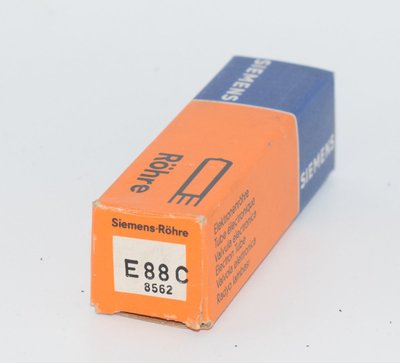
Original Philips Miniwatt SQ E88C tubes with gold pins are sought after by collectors and audio enthusiasts. Siemens-manufactured E88C tubes with gold pins are also highly regarded. As NOS (New Old Stock) supplies are finite and the tube was produced in smaller quantities than mass-market audio types, prices for verified NOS examples have increased over time. The gold-pin SQ versions from Philips and Siemens command premium prices in the vintage tube market.
DIY Community
The E88C has a following in the DIY audio community, where its unusual multi-pin grid connection presents both a design challenge and an opportunity. The multiple grid pins can be used creatively in circuit layouts to optimize grounding and minimize parasitic inductance. Several published DIY designs feature the E88C in SRPP (Shunt Regulated Push-Pull), common cathode, and grounded grid audio topologies.
Comparison with the E88CC/6922
Audio enthusiasts often compare the E88C with the far more common E88CC/6922 double triode. While the E88CC contains two triode sections (each with lower transconductance and different operating parameters), the single E88C triode offers higher transconductance (13.5 mA/V vs. approximately 12.5 mA/V per section for the E88CC) and a higher amplification factor (μ = 70 vs. μ = 33 for the E88CC). The E88C's single-triode construction also eliminates any possibility of crosstalk between sections, which can be an advantage in critical low-level amplification stages. However, the E88CC's dual-triode configuration makes it more versatile and economical for stereo circuits or cascaded gain stages, which accounts for its far greater popularity in audio equipment.
Practical Considerations for Audio Use
Designers adapting the E88C for audio service should note several practical considerations:
- The multi-pin grid connection means that pins 1, 3, 6, 7, and 9 must all be connected to the grid circuit. Leaving any grid pin floating can cause instability or parasitic oscillation.
- The heater voltage must be maintained within the 6.0–6.6 V range to preserve tube life. A regulated heater supply is recommended for audio applications.
- The maximum cathode-to-heater voltage of 125 V (cathode positive) allows for elevated cathode bias schemes common in audio circuits, but designers should verify they remain within this limit.
- The maximum grid resistor of 1 MΩ provides flexibility in input coupling network design.
- With a plate resistance of 5.2 kΩ and μ of 70, the E88C can drive moderate impedance loads effectively and is well-suited for coupling to subsequent stages or interstage transformers.