Introduction and History
The E90CC is a Special Quality (SQ) double triode manufactured by Philips, designed specifically for use in computer and counting circuits. First documented in Philips datasheets from 1957, the E90CC was engineered to meet the demanding reliability requirements of early digital computing equipment, where tubes needed to operate continuously for extended periods in switching and counting applications.
The "SQ" designation in the Philips naming convention denotes Special Quality — tubes manufactured to tighter tolerances and subjected to more rigorous testing than standard production types. The "E" prefix indicates a 6.3V heater voltage, "90" is the type number, and "CC" denotes a double triode configuration. The tube was designed with an emphasis on long operational life, with a rated life expectancy of 10,000 hours under specified conditions. Philips explicitly noted that the tube would maintain its emission capabilities after long periods of operation under cut-off conditions — a critical requirement for computer flip-flop and counting circuits where one triode section might remain cut off for extended periods.
It is important to note that Philips explicitly stated in the datasheet that the E90CC was not intended for applications critical as to microphony, hum, or noise. This is a significant distinction from many other SQ-designated tubes, and it reflects the tube's optimization for digital switching reliability rather than analog signal purity. Despite this original design intent, the E90CC has found a following in the audio community, as discussed in later sections of this article.
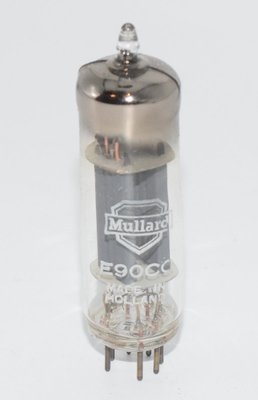
The E90CC was manufactured by Philips in the Netherlands (Heerlen factory) and was also produced under the Mullard brand. Mullard, a British company headquartered in the UK with manufacturing facilities in Mitcham, London and Blackburn, Lancashire, was a subsidiary of Philips. Some E90CC tubes bearing the Mullard brand may have been manufactured at Philips' Dutch facilities, which can lead to confusion about their origin. Early production examples, particularly those from 1957 with pinched glass envelopes, are especially sought after by collectors.
Technical Specifications and Design
Heater
| Parameter | Value |
|---|---|
| Heater Voltage (Vf) | 6.3 V |
| Heater Current (If) | 400 mA (0.4 A) |
| Heater Type | Indirect, AC or DC, series or parallel supply |
| If tolerance at Vf = 6.3 V | ±0.02 A |
| Vf tolerance (parallel supply, for 10,000 hr life) | ±5% (absolute limits) |
| If tolerance (series supply, for 10,000 hr life) | ±1.5% (absolute limits) |
Typical Characteristics (Each Triode Section)
| Parameter | Value | Conditions |
|---|---|---|
| Anode Voltage (Va) | 100 V | — |
| Grid Voltage (Vg) | −2.1 V | — |
| Anode Current (Ia) | 8.5 mA (±4 mA range for new tubes) | — |
| Transconductance (S / gm) | 6.0 mA/V | Va = 100 V, Vg = −2.1 V |
| Amplification Factor (μ) | 27 | Va = 100 V, Vg = −2.1 V |
| Plate Resistance (rp = μ/S) | ~4.5 kΩ | Calculated: 27 / 6.0 = 4.5 kΩ |
With Load Resistor
| Parameter | Value | Conditions |
|---|---|---|
| Anode Voltage (Va) | 100 V | — |
| Load Resistance (Rk) | 250 Ω | — |
| Transconductance (S) | 6.0 mA/V | Range: 4.5–7.5 mA/V |
Absolute Maximum Ratings (Each Triode Section)
| Parameter | Value |
|---|---|
| Max. Anode Supply Voltage (Vao) | 600 V |
| Max. Anode Voltage (Va) | 300 V |
| Max. Anode Dissipation (Wa) | 2.0 W |
| Max. Negative Grid Voltage (−Vg) | 100 V |
| Max. Negative Grid Pulse Voltage (−Vgp) | 200 V |
| Max. Positive Grid Voltage (+Vg) | 0 V |
| Max. Grid Current (Ig) | 250 μA (Tav = max. 10 msec) |
| Max. Grid Pulse Current (Igp) | 1 mA |
| Max. Cathode Current (Ik) | 15 mA (Tav = max. 10 msec) |
| Max. Cathode Peak Current (Ikp) | 75 mA |
| Max. Grid Resistance (Rg) — automatic bias | 1.0 MΩ |
| Max. Grid Resistance (Rg) — fixed bias | 0.5 MΩ |
| Max. Cathode-to-Heater Voltage (Vkf) | 100 V |
| Max. Bulb Temperature | 170 °C |
Interelectrode Capacitances
| Capacitance | Typical Value | Range |
|---|---|---|
| Ca (anode to all, section 1) | 0.35 pF | 0.25–0.45 pF |
| Cg (grid to all, section 1) | 3.4 pF | 2.9–3.9 pF |
| Cag (anode-grid, section 1) | 2.5 pF | 2.0–3.0 pF |
| Cgf (grid-heater) | < 0.15 pF | — |
| Ca' (anode to all, section 2) | 0.4 pF | 0.3–0.5 pF |
| Cg' (grid to all, section 2) | 3.4 pF | 2.9–3.9 pF |
| Ca'g' (anode-grid, section 2) | 2.5 pF | — |
| Ckf (cathode-heater) | 6.5 pF | — |
Physical Construction
| Parameter | Value |
|---|---|
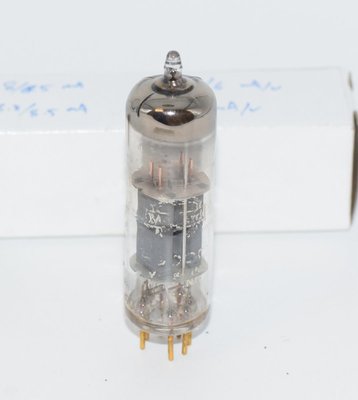
| Base Type | Miniature 7-pin (B7G) |
| Envelope | Miniature glass, max. diameter 19 mm |
| Overall Height (with pins) | Max. 67 mm (max. 66.7 mm per later revision) |
| Seated Height | Max. 61 mm (max. 60.3 mm per later revision) |
| Cathode Heating Time | 12 sec (max. 17 sec) |
Pin Configuration (B7G Base — Bottom View)
| Pin | Connection |
|---|---|
| Pin 1 | Anode (a) — Triode Section 1 |
| Pin 2 | Anode' (a') — Triode Section 2 |
| Pin 3 | Heater (f) |
| Pin 4 | Heater (f) |
| Pin 5 | Grid' (g') — Triode Section 2 |
| Pin 6 | Grid (g) — Triode Section 1 |
| Pin 7 | Cathode (k) — Common |
Note: The E90CC uses a shared common cathode (pin 7) for both triode sections. This is an important design consideration — the two triode sections share a single cathode connection, which affects how the tube can be used in circuit designs. The heater connections are on pins 3 and 4.
Life Test Conditions
The E90CC was rated for a life expectancy of 10,000 hours under the following test conditions: +200 V supply through 2 MΩ and 20 kΩ anode resistors, with a 47 kΩ cathode resistor, Vf = 6.3 V, Ia = 8 mA (active section), Ia' = 0 mA (cut-off section), Vkf = 100 V (k positive). End of life was defined as being reached when one or more of the following conditions occurred: S ≤ 3.0 mA/V, −Ig ≥ 2.5 μA, Ia ≤ 4.5 mA, or Ia ≥ 0.1 mA (for the cut-off section).
Computer Circuit Operating Characteristics
The datasheet provides specific operating characteristics for computer service (each system): Vb = 150 V, Ra = 20 kΩ, Rg = 47 kΩ. Under these conditions with VR = 0 V, Ia = 5.6 mA (min. 5.0 mA, max. 6.2 mA). With VR = −10 V, Ia = 0 mA (max. 0.1 mA). The balance between sections was specified as |VR − VR'| (at Ia = Ia' = 0.1 mA) = max. 0 ± 2.0 V.
Applications and Usage
Original Design Intent
The E90CC was designed specifically for use in computer and counting circuits of the late 1950s. Its primary applications included:
- Flip-flop circuits: The dual triode configuration with common cathode was ideal for bistable multivibrator circuits used as binary memory elements in early computers.
- Counting circuits (scalers): Used in decade counters and binary counters for computing and instrumentation.
- Switching circuits: The tube's ability to maintain emission after long periods in cut-off made it reliable for digital switching applications.
- Gate circuits: Logic gate implementations in early vacuum tube computers.
The datasheet provides a specific computer circuit configuration with Vb = 150 V, Ra = 20 kΩ, and Rg = 47 kΩ, demonstrating the tube's intended use in digital switching applications where one section conducts while the other is cut off.
Design Considerations
The common cathode design of the E90CC is particularly significant. Unlike many dual triodes that have separate cathodes for each section (allowing independent biasing), the E90CC's shared cathode was optimized for flip-flop and differential switching circuits where the common cathode connection is inherent to the circuit topology.
Philips recommended restricting the cathode-to-heater resistance (Rkf) to values less than 20 kΩ for stable operation. The maximum cathode-to-heater voltage of 100 V allowed the tube to be used in circuits with elevated cathode potentials, common in stacked computer circuit designs.
Important limitation: The datasheet explicitly states that the E90CC is not intended for applications critical as to microphony or hum. This means the tube was not designed or optimized for sensitive analog signal processing, microphone preamplifiers, or other applications where low noise and freedom from microphonic effects are essential.
Sound Characteristics
Despite Philips' explicit warning that the E90CC was not designed for applications sensitive to microphony, hum, or noise, the tube has been adopted by some in the audio community. The following observations about its sonic character should be understood in the context of a tube that was never intended for audio use:
The E90CC's electrical characteristics — a moderate amplification factor of 27, relatively high transconductance of 6.0 mA/V, and low plate resistance of approximately 4.5 kΩ — give it a character that some listeners describe as direct, dynamic, and punchy. The low plate resistance means the tube can drive subsequent stages or loads with relatively low output impedance, which can contribute to a sense of authority and control in the bass and midrange.
Users who have experimented with the E90CC in audio circuits report:
- Midrange clarity: The moderate mu of 27 combined with good transconductance produces a midrange that some describe as clear and present, though not as refined or "liquid" as purpose-built audio tubes.
- Dynamic presentation: The tube's fast switching characteristics (designed for computer use) translate to good transient response in audio applications, giving a lively and energetic presentation.
- Potential microphonic issues: Consistent with Philips' warnings, some users report that the E90CC can exhibit microphonic behavior, particularly in high-gain circuits. This can manifest as a ringing or coloration when the tube is physically disturbed, and in some cases as a subtle coloration of the sound even under normal conditions.
- Hum susceptibility: The tube may exhibit higher hum levels than purpose-designed audio tubes, particularly when used with AC heater supplies. DC heater supplies are recommended for audio applications.
It is worth emphasizing that the sonic character of any individual E90CC will depend heavily on the specific circuit it is used in, and that the tube's audio performance was never specified or guaranteed by the manufacturer. Listeners seeking the most refined, quiet, and microphonic-free performance would be better served by tubes specifically designed for audio applications.
Equivalent or Substitute Types
The E90CC occupies a somewhat unique position in the vacuum tube world, and true drop-in equivalents are limited due to its 7-pin B7G base and common cathode configuration.
Different Rating Substitutes (NOT Drop-In)
| Type | Notes |
|---|---|
| 5920 | US military type. Listed as a different rating substitute, NOT a drop-in replacement. While it shares the same base type, the ratings differ. Consult both datasheets carefully before substituting. |
| CV5214 | British military (CV) designation. Listed as a different rating substitute, NOT a drop-in replacement. Ratings may differ from the E90CC. |
| ECC960 | Listed as a different rating substitute, NOT a drop-in replacement. Verify specifications before use. |
Important Warnings About Substitution
The E90CC uses a 7-pin miniature (B7G) base. This immediately rules out any 9-pin (B9A/Noval) tube as a substitute without a complete socket change and circuit redesign. The following popular audio tubes are NOT compatible with the E90CC:
- ECC88 / 6DJ8 / 6922 / E88CC: These are 9-pin B9A tubes with completely different base types, pinouts, and operating characteristics. They cannot be used in E90CC sockets.
- ECC82 / 12AU7: Also a 9-pin B9A tube with a different base, different heater requirements (12.6V/6.3V), and different characteristics. Not a substitute.
- ECC81 / 12AT7, ECC83 / 12AX7: Similarly, these are all 9-pin types and are not compatible.
Additionally, the E90CC's common cathode design (both triode sections share pin 7 as cathode) is different from most dual triodes that provide separate cathode connections for each section. This further limits substitution possibilities, as circuits designed for the E90CC's common cathode topology may not work correctly with tubes having separate cathodes, even if the base type were the same.
Notable Characteristics
- Special Quality (SQ) designation: The E90CC was manufactured to Philips' highest quality standards, with tighter parameter tolerances and more rigorous testing than standard production tubes. This SQ grading is one reason the tube is valued by collectors and audio experimenters.
- Exceptional longevity: Rated for 10,000 hours minimum life under specified computer operating conditions. The tube was designed to maintain emission capability even after prolonged periods of cut-off operation — a demanding requirement that speaks to the quality of the cathode coating and overall construction.
- Common cathode design: The shared cathode between both triode sections is a distinctive feature that makes the E90CC particularly well-suited for differential and flip-flop circuits but limits its flexibility in applications requiring independently biased triode sections.
- Tight section matching: The datasheet specifies that the voltage difference between sections (|VR − VR'|) at Ia = Ia' = 0.1 mA should be within ±2.0 V, indicating good factory matching between the two triode halves.
- High insulation specifications: Insulation resistance between any two arbitrary electrodes was specified at minimum 20 MΩ (at 300 V), and cathode-to-heater insulation at minimum 2 MΩ (at 100 V). These high insulation values reflect the tube's computer-grade construction quality.
- Robust grid specifications: Grid current at Ig = +0.3 μA was specified at 0.2 V (typical) with a maximum of 1.3 V, and grid leakage with Rg = 0.1 MΩ was specified at maximum 0.5 μA. These tight grid specifications ensured reliable switching behavior in computer circuits.
- Not designed for low-noise audio: Unlike many SQ tubes that were optimized for instrumentation or audio, the E90CC was explicitly noted as unsuitable for applications critical to microphony, hum, or noise. This is an important distinction that is sometimes overlooked in audio discussions.
Usage in the Audio Community
The E90CC occupies a curious position in the audio world. Despite being explicitly designed for computer switching circuits and carrying a manufacturer warning against use in microphony- or hum-sensitive applications, the tube has attracted attention from audio enthusiasts and equipment designers for several reasons.
Why Audio Enthusiasts Are Drawn to the E90CC
- SQ build quality: The Special Quality manufacturing standards mean that E90CC tubes are generally well-constructed with tight tolerances. Audio enthusiasts value this consistency, even though the quality control was aimed at switching reliability rather than audio performance.
- Rarity and collectibility: As a relatively uncommon type that was produced in limited quantities for specialized computer applications, the E90CC has the cachet of exclusivity that appeals to collectors and those seeking unusual tubes for their equipment.
- Philips/Mullard heritage: Tubes bearing the Philips SQ or Mullard branding carry significant prestige in the audio community. Early production examples, particularly those with pinched glass envelopes from 1957, command premium prices among collectors.
- Electrical characteristics: The combination of μ = 27, gm = 6.0 mA/V, and rp ≈ 4.5 kΩ provides a useful set of parameters for certain audio circuit topologies, particularly cathode followers, buffers, and driver stages where low output impedance is beneficial.
Audio Applications
In practice, the E90CC has been used in several audio contexts:
- Custom and DIY amplifier projects: Hobbyists and boutique amplifier builders have designed circuits specifically around the E90CC's characteristics and 7-pin base, taking advantage of its moderate gain and low plate resistance.
- Headphone amplifiers: The low plate resistance and moderate gain make the E90CC potentially suitable for headphone amplifier output stages, where it can drive headphones with good authority.
- Buffer and driver stages: The tube's low rp makes it effective as a buffer or driver stage, where its ability to drive subsequent stages or output transformers with low impedance is advantageous.
- DAC output stages: Some tube DAC designs have incorporated the E90CC as an output buffer, taking advantage of its current delivery capability.
Practical Considerations for Audio Use
Anyone considering the E90CC for audio applications should be aware of the following:
- Microphonics: As Philips warned, the tube may exhibit microphonic behavior. Vibration isolation mounting and careful physical placement are recommended. Some individual tubes may be better than others in this regard.
- Hum: DC heater supplies are strongly recommended for audio applications to minimize hum. The tube was not designed with hum rejection as a priority.
- Socket availability: The 7-pin B7G base is less common in modern audio equipment than the 9-pin B9A (Noval) base. Purpose-built equipment or socket adapters may be required.
- Common cathode: The shared cathode limits circuit flexibility. Both sections must share the same cathode bias point unless external circuit techniques are employed to work around this limitation.
- Supply and cost: As a specialized computer tube produced in relatively limited quantities, NOS (New Old Stock) E90CC tubes can be expensive and difficult to source. The limited supply and growing audio demand have driven prices upward, particularly for early Philips and Mullard-branded examples.
- Tube selection: Given that the tube was not designed for audio, individual tube selection and testing for low microphonics and low noise is especially important for audio applications. Not all E90CC tubes will perform equally well in audio circuits.
In summary, while the E90CC was never intended for audio use and carries explicit manufacturer warnings about its unsuitability for noise- and microphony-sensitive applications, its SQ build quality, interesting electrical characteristics, and collector appeal have earned it a niche following in the audio community. Those who choose to use it in audio equipment should do so with realistic expectations and appropriate circuit design considerations.