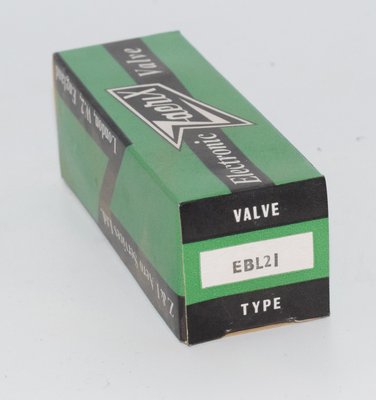
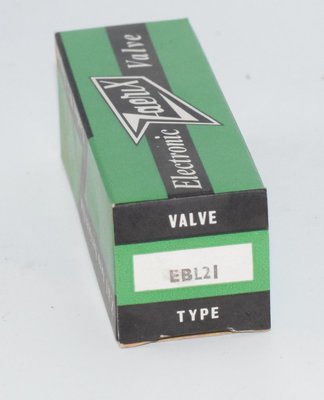
1. Introduction and History
The EBL21 is a European duodiode-pentode (Duodiode-eindpenthode) vacuum tube developed by Philips in the late 1940s as part of the Rimlock (8-pin) valve series. It was designed as a compact, efficient combination tube that integrates two signal diodes and a power output pentode within a single glass envelope. This ingenious design allowed radio manufacturers to build complete detector, AVC (automatic volume control), and audio output stages using a single tube, significantly reducing component count, chassis space, and cost in post-war consumer radio receivers.
The EBL21 represented an evolution from the earlier EBL1, which used the older side-contact base. The move to the Rimlock base brought several advantages: smaller physical dimensions, lower heater current consumption (0.8 A versus 1.18 A for the later EBL1 variant), and improved high-frequency shielding between the diode and pentode sections. The 'E' prefix denotes the 6.3 V heater voltage, 'B' indicates a duodiode, and 'L' signifies a power output pentode — the '21' places it in the Rimlock series.
The EBL21 was manufactured by Philips and its associated companies including Mullard, Valvo, Amperex, and various branded versions. Notably, tubes branded as Zaerix and marked "Made in Holland" have been identified through tube codes as potentially having been manufactured at the Mullard factory in Visseaux, France — a common practice in the European valve industry where production was distributed across multiple Philips-affiliated plants. The design goal for the EBL21 was ambitious: Philips specified that a 60-fold L.F. (audio frequency) voltage amplification between the detector diode and the pentode output should be achievable when powered from a mains transformer, making it an exceptionally capable combination valve.
2. Technical Specifications and Design
General
| Tube Type | Duodiode-Pentode (combined detector/AVC diodes + power output pentode) |
| Base | Rimlock (8-pin, B8A) |
| Envelope | Glass miniature, max diameter 29 mm, max height 80 mm |
| Mounting | Vertical |
| Heater Type | Indirect, AC heated, parallel feed |
Heater Data
| Heater Voltage (Vf) | 6.3 V |
| Heater Current (If) | 0.8 A |
Pentode Section — Dynamic Data (Single-Ended Application)
| Parameter | Condition 1 (Ra=5700 Ω) | Condition 2 (Ra=7000 Ω) |
|---|---|---|
| Anode Voltage (Va) | 250 V | 250 V |
| Screen Grid Voltage (Vg2) | 250 V | 250 V |
| Cathode Resistance (Rk) | 105 Ω | 150 Ω |
| Control Grid Bias (Vg1) | −5.2 V | −6.0 V |
| Anode Current (Ia) | 44 mA | 36 mA |
| Screen Current (Ig2) | 6.0 mA | 4.5 mA |
| Transconductance (S / gm) | 9.5 mA/V | 9.0 mA/V |
| Internal Resistance (Ri) | 50,000 Ω | 50,000 Ω |
| Optimum Load Impedance (Ra) | 5,700 Ω | 7,000 Ω |
| Power Output (Wo) | 4.5 W | 4.5 W |
| Total Harmonic Distortion (dtot) | 7.0% | 10% |
| Required Grid Drive (Vg1eff) at max modulation | 3.9 V | 4.2 V |
| Sensitivity (Wo = 50 mW) | 0.35 V | 0.35 V |
| Amplification Factor (μg2g1) | 23 | 23 |
Pentode Section — Class AB Push-Pull (2 Tubes)
| Anode Voltage (Va) | 300 V |
| Screen Grid Voltage (Vg2) | 300 V |
| Cathode Resistance (Rk) | 130 Ω |
| Optimum Load (Raa') | 9,000 Ω (plate-to-plate) |
| Quiescent Anode Current (Iao) | 2 × 30 mA |
| Max Anode Current (Ia max) | 2 × 36 mA |
| Quiescent Screen Current (Ig2o) | 2 × 3.8 mA |
| Max Screen Current (Ig2 max) | 2 × 6.5 mA |
| Max Power Output (Wo max) | 13.2 W |
| Total Distortion at Max Output (dtot) | 1.8% |
| Required Grid Drive per Tube (Vg1eff) | 7.0 V |
| Sensitivity (Wo = 50 mW) | 0.3 V |
Maximum Ratings — Pentode Section
| Max Anode Voltage (cold) | 550 V |
| Max Anode Voltage (operating) | 300 V |
| Max Anode Dissipation (Wa) | 11 W |
| Max Screen Voltage (cold) | 550 V |
| Max Screen Voltage (operating) | 300 V |
| Max Screen Dissipation (unmodulated, Vg1eff = 0 V) | 1.7 W |
| Max Screen Dissipation (at max modulation) | 2.75 W |
| Max Cathode Current (Ik) | 60 mA |
| Max Grid Bias for Grid Current Onset (Ig1 = +0.3 μA) | −1.3 V |
| Max External Resistance, Grid 1 to Cathode (Rg1k) | 1 MΩ |
| Max External Resistance, Heater to Cathode (Rfk) | 5,000 Ω |
| Max Heater-Cathode Voltage (Vfk) | 50 V |
Maximum Ratings — Diode Section
| Max Voltage on Diode 1 (Vd1) | 200 V |
| Max Voltage on Diode 2 (Vd2) | 200 V |
| Max DC Leakage Current, Diode 1 (Id1) | 0.8 mA |
| Max DC Leakage Current, Diode 2 (Id2) | 0.8 mA |
| Diode 1 Contact Potential (Id1 = +0.3 μA) | −1.3 V |
| Diode 2 Contact Potential (Id2 = +0.3 μA) | −1.3 V |
Interelectrode Capacitances
| Pentode Section | |
|---|---|
| Cag1 (anode to grid 1) | < 1.4 pF |
| Diode Section | |
| Cd1k | 1.8 pF |
| Cd2k | 2.0 pF |
| Cd1d2 | < 0.15 pF |
| Between Diode and Pentode Sections | |
| Cd1g1 | < 0.1 pF |
| Cd1a | < 0.06 pF |
| Cd2g1 | < 0.05 pF |
| Cd2a | < 0.02 pF |
Pin Configuration (Rimlock B8A Base)
Viewed from the bottom of the socket, the EBL21 pin assignments are:
- Pin k — Cathode (shared between pentode and diode sections)
- Pin f, f — Heater (filament) connections
- Pin a — Pentode Anode (plate)
- Pin g1 — Pentode Control Grid (grid 1)
- Pin g2 — Pentode Screen Grid (grid 2)
- Pin g3 — Pentode Suppressor Grid (grid 3) — internally connected or brought out
- Pin d1 — Diode 1 plate
- Pin d2 — Diode 2 plate
The base diagram shows the standard Rimlock arrangement with the locating key for correct socket orientation. The maximum base diameter is 32 mm.
3. Applications and Usage
The EBL21 was designed primarily for use in mains-powered (AC) radio receivers where it served a triple function:
Combined Detector/AVC and Audio Output
In its most common application, the two diodes provided signal detection and automatic volume control (AVC), while the pentode section served as the audio output stage. The very low inter-section capacitances (Cd1g1 < 0.1 pF, Cd2a < 0.02 pF) ensured minimal coupling between the diode and pentode sections, allowing the diode plates to be used for detection at very low signal levels without interference from the output stage.
Philips noted that in many cases, an additional L.F. amplifier tube could be inserted between the diode and pentode sections to increase the receiver's sensitivity. When used with the triode-heptode ECH 21 as a frequency changer and the pentode EF 22 as an IF amplifier, the EBL21 could form part of an outstanding end-stage combination delivering approximately 13 W in push-pull Class AB configuration.
Single-Ended Output Stage
As a single-ended output pentode, the EBL21 delivers 4.5 W into a 5,700 Ω or 7,000 Ω load at 250 V anode and screen voltage. The 11 W maximum anode dissipation rating and high transconductance of 9.0–9.5 mA/V made it a capable performer for domestic radio sets of the era. At the 5,700 Ω load point, total harmonic distortion is 7.0%, while at the 7,000 Ω point it rises to 10% — both figures being acceptable for the consumer radio applications of the period.
Push-Pull Class AB Output
Two EBL21 tubes in Class AB push-pull configuration deliver an impressive 13.2 W of audio output at only 1.8% total harmonic distortion, with anode and screen voltages of 300 V and a plate-to-plate load impedance of 9,000 Ω. This was a remarkably clean output for the era and made the push-pull EBL21 configuration attractive for higher-quality radio-gramophones and small public address systems. In this configuration, the four diodes from the two tubes could be used in a three-diode detection scheme, with one diode remaining as a spare or for additional circuit functions.
Bias Considerations
The negative grid bias must be obtained exclusively through a cathode resistor. Semi-automatic (half-automatic) negative bias can be used provided the cathode current through the bias resistor exceeds 50% of the total current needed to develop the required bias voltage. The grid leak resistance must be kept below the specified maximum values. Due to the high transconductance, a damping resistor of approximately 1,000 Ω should be placed in series with the control grid lead, positioned as close to the grid pin as possible, to prevent parasitic oscillation. This resistor must not be bypassed with a capacitor.
4. Sound Characteristics
The EBL21 occupies an interesting niche in the sonic landscape of European output pentodes. Its sound character is shaped by several key electrical properties:
Tonal Signature
With a transconductance of 9.0–9.5 mA/V and an internal resistance of 50,000 Ω, the EBL21 exhibits the classic European pentode sound — detailed, articulate, and with a forward midrange presence. The high gm gives the tube excellent transient response and a lively, dynamic quality that many listeners find engaging. Compared to lower-transconductance pentodes, the EBL21 has a more immediate, present quality to its sound.
Harmonic Structure
In single-ended operation, the EBL21 produces a mix of even and odd harmonics typical of pentode operation. At moderate power levels (below 2–3 W), the distortion is predominantly lower-order harmonics, giving a warm but clear character. As output approaches the rated 4.5 W, the harmonic content increases significantly (7–10% THD), and the odd-order harmonics become more prominent, adding a certain "bite" or edge to the sound that can be either characterful or fatiguing depending on the listener's preferences and the loudspeaker pairing.
Dynamic Behavior
The EBL21's relatively high power output for its size (4.5 W single-ended, 13.2 W push-pull) combined with its high transconductance gives it excellent dynamic range and punch. The tube responds quickly to transients, making it well-suited for music with sharp attacks — percussion, plucked strings, and vocal consonants are rendered with clarity and definition.
Push-Pull Character
In Class AB push-pull, the EBL21 truly shines sonically. The remarkably low 1.8% THD at full 13.2 W output means the push-pull configuration sounds clean, controlled, and surprisingly refined. The cancellation of even-order harmonics in push-pull gives a more neutral, hi-fi character compared to the single-ended mode, while retaining the tube's inherent liveliness and detail.
Comparison to Contemporaries
Listeners familiar with the EL41 or EL84 will find the EBL21's pentode section somewhat similar in character, though with its own distinct voice. The EBL21 tends to have a slightly warmer, more rounded quality in the upper midrange compared to the EL84, while offering more detail and sparkle than the larger EL41. The integrated diode section, when used for detection, can contribute to a slightly softer, more organic overall sound compared to using separate semiconductor diodes.
5. Equivalent or Substitute Types
The EBL21 is a relatively specialized combination tube, and direct equivalents are limited:
| Type | Compatibility | Notes |
|---|---|---|
| EBL21 (various manufacturers) | Direct equivalent | Philips, Mullard, Valvo, Amperex, Zaerix, and other Philips-affiliated brands produced this type. All are interchangeable. Zaerix-branded examples marked "Made in Holland" may actually have been manufactured at the Mullard Visseaux factory in France. |
| EBL1 | Functional equivalent only — NOT pin-compatible | The predecessor type using the older side-contact (CT8) base. Similar function but different base, higher heater current (1.18 A in later versions), and different pinout. Requires a different socket and potentially different bias arrangements. |
| UBL21 | NOT directly interchangeable | The 'U' series equivalent designed for series-heater (100 mA) AC/DC sets. Different heater voltage and current. Same Rimlock base but different operating conditions. |
There is no direct American (octal or miniature) equivalent for the EBL21, as the American tube industry did not commonly produce combination duodiode-output pentode types of this power level. To replicate the EBL21's function with American types would require separate tubes — for example, a 6AL5 (dual diode) and a 6V6 or 6AQ5 (output pentode) — which would not be pin-compatible or directly substitutable.
Important: When sourcing replacement EBL21 tubes, ensure the Rimlock socket is in good condition, as these sockets can develop contact issues with age. The locating key must be intact for proper insertion.
6. Notable Characteristics
Exceptional Inter-Section Isolation
One of the EBL21's most remarkable design achievements is the extremely low capacitive coupling between the diode and pentode sections. The capacitance between diode 2 and the pentode anode is less than 0.02 pF — an extraordinarily small value that speaks to the careful internal electrode arrangement and shielding. This allowed the diodes to handle very small detection signals without contamination from the relatively high-voltage pentode output stage.
High Transconductance for a Combination Tube
At 9.0–9.5 mA/V, the EBL21's pentode section offers transconductance figures that rival dedicated output pentodes of the era. This high gm was a deliberate design choice to enable the 60-fold voltage amplification target between detector and output that Philips specified.
Versatile Diode Configuration
The four diodes available from two EBL21 tubes (in push-pull) could be configured in various detection and AVC schemes, including three-diode configurations, providing circuit designers with considerable flexibility.
Sensitivity to Parasitic Oscillation
The high transconductance that makes the EBL21 capable also makes it prone to parasitic oscillation. Philips explicitly warned that a damping resistor of approximately 1,000 Ω must be placed in the control grid lead, as close to the grid pin as possible, and that this resistor must never be bypassed with a capacitor. Lead lengths to all electrodes should be kept as short as possible.
Compact and Efficient
The Rimlock envelope (max 29 mm diameter × 80 mm height) contains a remarkable amount of functionality. The 0.8 A heater current is modest for a tube delivering 4.5 W of audio output plus two detector diodes, representing good engineering economy in the heater transformer design.
7. Usage in the Audio Community
Vintage Radio Restoration
The primary demand for EBL21 tubes today comes from the vintage radio restoration community. Many European radio receivers from the late 1940s and 1950s — particularly those from Philips, Telefunken, Grundig, and other Continental manufacturers — used the EBL21 as their output stage. Restorers seek NOS (New Old Stock) examples to maintain originality and performance in these sets. The tube's combination function means that a single failed EBL21 can silence a radio completely, making good replacements essential.
DIY Audio Projects
A small but dedicated group of DIY audio enthusiasts have explored the EBL21 for custom amplifier builds, attracted by several factors:
- Push-pull potential: The 13.2 W at 1.8% THD from two tubes in Class AB is an impressive specification that rivals or exceeds many more common output tube configurations. This makes a two-tube push-pull EBL21 amplifier an attractive project.
- Built-in diodes: Creative builders have used the integrated diodes for power supply rectification, signal detection in radio-amplifier combination projects, or as clipping diodes for guitar amplifier applications.
- Novelty factor: The EBL21 is uncommon enough to be interesting but available enough (as NOS) to be practical for a build.
Availability and Market
EBL21 tubes are available as NOS from various sources, though they are not as plentiful as more common types like the EL84 or 6V6. Prices tend to be moderate, as demand is primarily driven by restoration rather than high-end audio applications. Tubes branded by Philips, Mullard, and Valvo tend to command slight premiums over lesser-known brands. The Zaerix-branded examples, despite their somewhat obscure branding, are generally well-regarded as they were manufactured in established Philips/Mullard facilities.
Limitations in Modern Audio Use
Several factors limit the EBL21's adoption in the modern audio community:
- Rimlock base: B8A Rimlock sockets are less readily available than octal or noval (B9A) types, and their mechanical retention is considered less robust.
- No current production: The EBL21 is not currently manufactured by any tube maker, meaning the supply is finite NOS stock only.
- Combination tube limitations: In a dedicated audio amplifier, the diode sections are often unused, representing wasted complexity. Purpose-built output pentodes like the EL84 offer similar or better performance with wider availability.
- Pentode distortion character: The relatively high THD in single-ended mode (7–10%) means the EBL21 benefits greatly from either push-pull operation or ultralinear/triode-strapped configurations to achieve audiophile-grade distortion levels, though triode strapping would sacrifice much of the available output power.
Recommended Pairings
For those building with the EBL21, Philips recommended pairing it with the ECH 21 (triode-heptode frequency changer) and EF 22 (pentode IF amplifier) for complete radio receiver designs. For pure audio amplifier applications, a high-gain voltage amplifier such as the EF 86 or a dual triode like the ECC83 (12AX7) would make suitable driver stages, given the 3.9–7.0 V grid drive requirement depending on operating conditions.