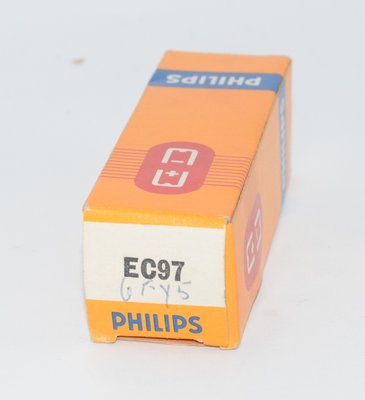
1. Introduction and History
The EC97, also designated as 6FY5 in North American nomenclature, is a specialized vacuum tube that emerged during the mid-20th century as part of the broader development of miniature tube technology. Developed primarily by Philips in Europe, the EC97 represents an important evolution in tube design, combining compact dimensions with reliable performance characteristics.
The tube was introduced during the 1950s, a period when manufacturers were actively miniaturizing electronic components to reduce equipment size and power consumption. The EC97 found its niche in specific applications where its unique electrical characteristics provided distinct advantages over competing tube types. While never as ubiquitous as the 12AX7 or EL84, the EC97 earned respect among engineers and designers who understood its particular strengths.
The dual designation (EC97 and 6FY5) reflects the international tube naming conventions of the era—European manufacturers used the "EC" prefix while American designations employed the numeric system. This nomenclature difference occasionally caused confusion in the vintage tube market, but both designations refer to identical or functionally equivalent tubes.
2. Technical Specifications and Design
Physical Characteristics
The EC97 is a miniature vacuum tube housed in a standard 9-pin (noval) base configuration. The tube measures approximately 2.5 inches (63mm) in height with a glass envelope diameter of roughly 0.75 inches (19mm), making it considerably more compact than earlier octal-based designs.
Electrical Specifications
| Parameter | Value |
|---|---|
| Tube Type | Diode Rectifier |
| Filament Voltage | 6.3V AC / DC |
| Filament Current | 0.45A |
| Maximum Anode Voltage | 330V RMS per anode |
| Maximum DC Output Current | 100mA |
| Peak Inverse Voltage | 330V |
| Heater to Cathode Voltage | 180V maximum |
| Typical Rectified Current | 50-100mA |
| Warm-up Time | 10-15 seconds |
Internal Structure and Design
The EC97 is a dual-diode rectifier tube, meaning it contains two independent diode sections within a single envelope. This dual-diode configuration enables full-wave rectification without requiring a center-tapped transformer secondary, a significant advantage in compact equipment design.
Each diode section consists of a heated cathode and an anode, with the filament serving as the common heating element for both cathodes. The internal geometry is optimized for efficient electron emission and collection, with carefully designed electrode spacing to minimize capacitance while maintaining adequate current-handling capability.
The tube employs indirectly heated cathodes, allowing safe operation with AC filament voltage. The cathode coating, typically a barium-strontium oxide mixture, provides excellent electron emission characteristics across the tube's operational range. The anode structure is designed to dissipate heat effectively, enabling sustained operation at the tube's rated current levels.
Pin Configuration
The EC97 utilizes the standard 9-pin noval base with the following pinout:
- Pin 1: Anode 1
- Pin 2: Cathode 1 / Heater
- Pin 3: Heater
- Pin 4: Cathode 2
- Pin 5: Anode 2
- Pin 6: No connection
- Pin 7: No connection
- Pin 8: No connection
- Pin 9: No connection
3. Applications and Usage
Primary Applications
The EC97 was principally designed for power supply rectification in mid-range consumer and professional equipment. Its moderate current capacity (up to 100mA) made it ideal for amplifiers, receivers, and test equipment requiring compact power supplies without the bulk of larger rectifier tubes.
The tube found particular favor in European equipment design, where space constraints were often more pressing than in American designs. Many Philips, Telefunken, and other European manufacturers incorporated the EC97 into their equipment during the 1950s and 1960s.
Typical Circuit Applications
Full-Wave Rectification: The dual-diode design enables straightforward full-wave rectification from a center-tapped transformer secondary or from two separate secondary windings. This configuration provides superior ripple characteristics compared to half-wave rectification.
Power Supply Design: The EC97 was commonly employed in power supplies for:
- Integrated amplifiers (15-30W range)
- Preamplifiers and tuners
- Oscilloscopes and test equipment
- Radio receivers
- Small professional audio equipment
Voltage and Current Considerations: The 330V maximum anode voltage rating necessitates careful transformer secondary selection. Designers typically selected transformer secondaries in the 220-250V RMS range to maintain adequate safety margins. The 100mA maximum current capability limited the EC97 to lower-power applications; higher-powered amplifiers required more robust rectifier tubes like the EZ81 or larger types.
4. Sound Characteristics in Audio Applications
Rectifier Influence on Sound
While rectifier tubes are not signal-path components, they significantly influence the sonic character of tube amplifiers through their effect on power supply characteristics. The EC97, like all rectifiers, contributes to the overall sound signature of equipment in which it's employed.
Sonic Qualities
Tonal Character: The EC97 is renowned among audio enthusiasts for imparting a smooth, slightly warm character to the power supply. This smoothness translates to a refined, non-fatiguing presentation in the audio signal. The rectifier's relatively soft recovery characteristics produce a subtle compression effect that many listeners find musically pleasing.
Dynamics and Transient Response: Compared to solid-state rectifiers, the EC97 exhibits softer transient response due to its inherent voltage sag characteristics under load. This soft clipping behavior, while reducing peak current availability, produces a more musical compression that enhances sustain and reduces harshness in overdriven signals.
Harmonic Distortion: The EC97's rectification produces a characteristic harmonic distortion signature with predominant even-order harmonics. These even-order harmonics are generally considered musically pleasant, adding warmth and body to the sound without introducing the harsh odd-order characteristics of some solid-state designs.
Frequency Response: The rectifier's influence on power supply impedance affects the amplifier's ability to maintain stable bias and output stage operation across the frequency spectrum. The EC97's moderate current capacity means power supplies using this tube exhibit slightly higher impedance, which can subtly color the midrange and upper bass.
Comparison with Other Rectifiers
Compared to the EZ81 (a more robust European rectifier), the EC97 produces a slightly softer, warmer sound. Compared to solid-state rectifiers, the EC97 exhibits more pronounced voltage sag and softer recovery, characteristics that audio enthusiasts often describe as more "musical" and "forgiving."
The 6FY5 (American designation) produces sonically identical results to the EC97, with any perceived differences attributable to manufacturing variations rather than design differences.
5. Usage in the Audio Community
Vintage Equipment Restoration
The audio restoration community values the EC97 for its reliability and sonic characteristics. Vintage equipment designers and restorers specifically seek NOS (New Old Stock) EC97 tubes to maintain the original sonic signature of classic amplifiers and equipment. The Philips UK version, in particular, is highly sought after for its consistency and sound quality.
Current Availability and Demand
The EC97 remains moderately available in the vintage tube market, though supplies of genuine NOS tubes are tightening as original stock dwindles. Prices for quality examples typically range from $15-40 per tube, depending on manufacturer, testing results, and provenance. The Philips version commands premium prices due to its reputation for reliability and neutral sound.
DIY Amplifier Design
Contemporary tube amplifier designers occasionally specify the EC97 in compact, lower-powered designs where its current capability aligns with amplifier requirements. Its compact footprint and moderate voltage rating make it suitable for 10-30W amplifier designs, particularly in European-style integrated amplifiers.
Tube Rolling and Sonic Optimization
Experienced tube amplifier enthusiasts engage in "tube rolling"—systematic substitution of different tubes to optimize sound. While rectifier tubes offer less dramatic differences than output tubes, the EC97 is frequently experimented with in equipment where it can be safely substituted. Switching between EC97 variants (Philips, Telefunken, Mullard) produces subtle but perceptible tonal shifts.
Audio Collector Interest
Tube collectors value the EC97 as a representative example of mid-century European tube design. Its elegant simplicity and historical significance make it a worthwhile addition to serious tube collections. The 6FY5 variant holds particular interest for collectors focusing on American equipment from the 1950s-60s era.
6. Equivalent or Substitute Types
Direct Equivalents
6FY5: The American designation for the EC97. Functionally identical and sonically equivalent. Tubes marked 6FY5 were manufactured by American tube makers (RCA, Sylvania, GE) and European makers (Philips, Mullard) for export to American markets.
EZ90: A Soviet-era equivalent with similar electrical characteristics. The EZ90 provides nearly identical performance but exhibits slightly different sonic characteristics due to manufacturing variations.
Functional Alternatives (Different Characteristics)
EZ81: A more robust European rectifier with higher current capacity (150mA). The EZ81 can substitute for the EC97 in most applications but produces a slightly different sonic character—somewhat more neutral and less warm. The EZ81 is preferable for higher-powered amplifiers.
EZ83: Another European rectifier with similar voltage rating but different pin configuration. Not a direct substitute without circuit modification.
5U4: American large-bottle rectifier with significantly higher current capacity. Not recommended as a substitute due to different heater voltage (5V) and physical incompatibility.
5Y3: American rectifier with similar voltage rating but lower current capacity and 5V heater. Requires circuit modification for use in EC97 applications.
Solid-State Substitutes
For non-audio applications, solid-state rectifier bridges can replace the EC97, though this eliminates the sonic characteristics prized by audio enthusiasts. Audio purists avoid solid-state substitutes due to the altered power supply character and loss of the tube's musical qualities.
7. Notable Characteristics
Reliability and Longevity
The EC97 is renowned for exceptional reliability. Properly operated tubes frequently achieve lifespans exceeding 10,000 hours, with many examples still functioning after 60+ years of service. This longevity reflects robust internal design and conservative electrical ratings.
Manufacturing Quality Variation
The Philips UK version represents the pinnacle of EC97 manufacturing quality. These tubes exhibit:
- Exceptionally tight electrical tolerances
- Superior internal construction and cleanliness
- Consistent sonic characteristics across production batches
- Excellent long-term stability
Other manufacturers (Mullard, Telefunken, RCA) produced acceptable tubes, but Philips examples command premium prices for good reason.
Thermal Characteristics
The EC97 operates at moderate temperatures, with the anode reaching approximately 300-400°C under full load. This relatively cool operation contributes to the tube's longevity and allows use in compact equipment without extensive heat management.
Heater Considerations
The 6.3V heater voltage is standard for miniature tubes, simplifying integration into equipment using other 6.3V-heater tubes. The 0.45A heater current is moderate, requiring only modest transformer capacity. The tube can operate with either AC or DC heater voltage, offering design flexibility.
Shock and Vibration Resistance
The miniature noval base and compact envelope provide excellent mechanical stability. The EC97 resists shock and vibration better than larger rectifier tubes, making it suitable for portable and mobile equipment.
Conclusion
The EC97 / 6FY5 represents an elegant solution to mid-20th-century power supply design challenges. Its compact dimensions, moderate current capability, and sonic characteristics made it an ideal choice for European equipment manufacturers and continues to appeal to contemporary audio enthusiasts. The tube's reputation for reliability and its influence on amplifier sound signature ensure its continued relevance in vintage audio restoration and modern tube amplifier design.
For collectors, restorers, and audio enthusiasts, the EC97—particularly Philips UK examples—remains a valuable and musically significant component of tube-based audio systems. Its gradual disappearance from the market makes preservation and proper documentation of remaining stock increasingly important for future generations of tube audio enthusiasts.