Introduction and History
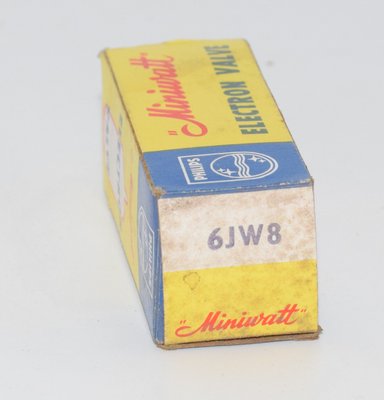
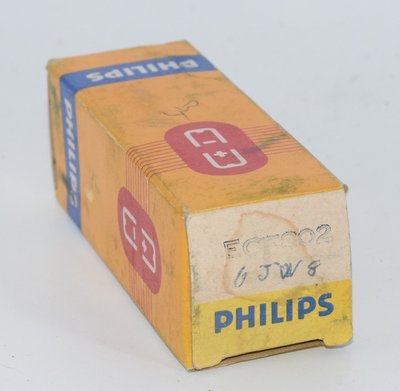
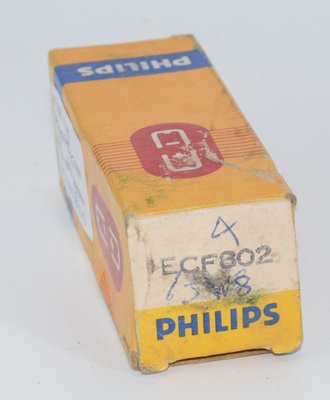
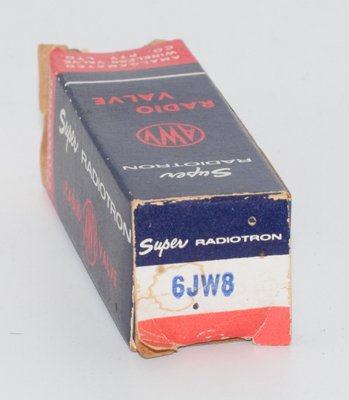
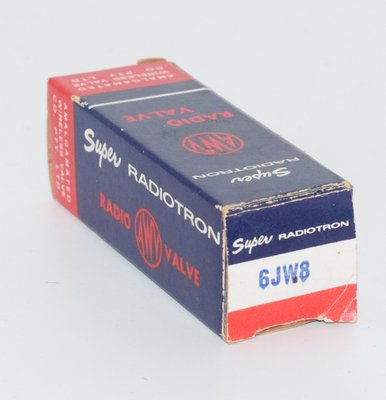
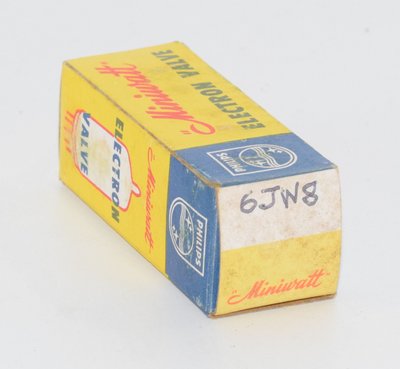
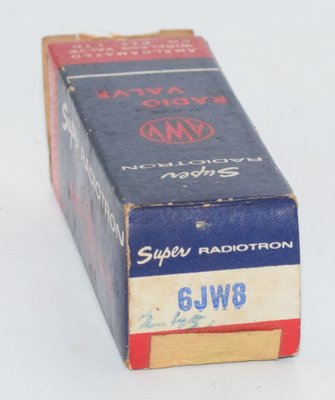
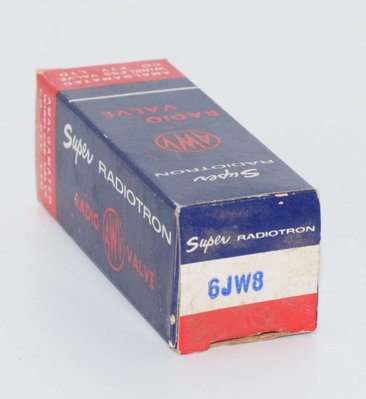
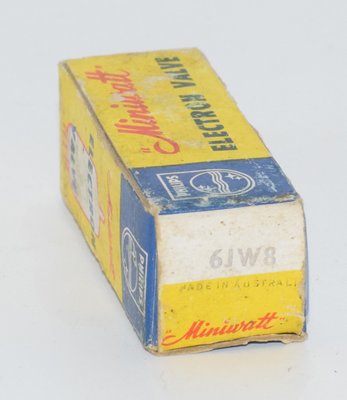
The ECF802 is a miniature triode-pentode combination vacuum tube (valve) originally designed for use as a sinusoidal oscillator and horizontal line scanning (TV line sweep) applications. Manufactured by a number of European companies — most notably by CIFTE under the Mazda-Belvu brand in France, as well as by Philips/Mullard, Siemens, Telefunken, and others — the ECF802 emerged during the late 1950s and early 1960s as part of the European Pro-Electron naming convention. Its American RETMA equivalent is the 6JW8.
The tube was developed during the golden age of television, when manufacturers needed compact, reliable multi-function tubes that could serve as local oscillators and mixers in television receivers. The 'ECF' designation follows the Mullard-Philips coding system: 'E' denotes a 6.3V heater, 'C' indicates a triode section, and 'F' indicates a pentode section. The '802' series number places it among the later-generation noval-based designs.
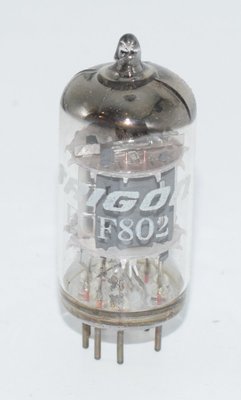
The ECF802 was produced by numerous manufacturers across Europe and was widely used in European television sets, FM tuners, and various industrial oscillator circuits. CIFTE (Compagnie Industrielle Française des Tubes Électroniques), the French manufacturing arm of the Mazda-Belvu consortium, produced particularly well-regarded examples of this tube, as documented in their January 1968 datasheet. Other notable manufacturers included Trigon, whose NOS (New Old Stock) examples remain available to collectors and audio experimenters today.
Technical Specifications and Design
General Characteristics
| Parameter | Value |
|---|---|
| Cathode Type | Indirectly heated (cathode à chauffage indirect) |
| Heater Voltage (Vf) | 6.3 V |
| Heater Current (If) | 430 mA |
| Heater Configuration | Parallel feed |
| Envelope (Bulb) | A22-2 |
| Base | 9C12 (Noval / 9-pin miniature) |
| Mounting Position | Any (quelconque) |
| Maximum Overall Diameter | 22.2 mm |
| Maximum Seated Height | 49.2 mm |
Interelectrode Capacitances
Triode Section
| Parameter | Value |
|---|---|
| Input Capacitance (Ce) | 2.4 pF |
| Anode-to-Grid Capacitance (Ca/g) | 1.5 pF |
| Grid-to-Filament Capacitance (Cg/f) | 100 mpF max (0.1 pF max) |
Pentode Section
| Parameter | Value |
|---|---|
| Input Capacitance (Ce) | 5.4 pF |
| Anode-to-Grid 1 Capacitance (Ca/g₁) | 60 mpF (0.06 pF) |
| Grid 1-to-Filament Capacitance (Cg₁/f) | 100 mpF max (0.1 pF max) |
Pinout (9C12 Noval Base)
| Pin | Connection |
|---|---|
| 1 | Triode Anode (Plate) |
| 2 | Grid No. 1 (Pentode Control Grid / g₁) |
| 3 | Grid No. 2 (Pentode Screen Grid / g₂) |
| 4 | Filament (Heater) |
| 5 | Filament (Heater) |
| 6 | Pentode Anode (Plate) |
| 7 | Cathode, Grid No. 3 (Pentode Suppressor Grid), internal shield |
| 8 | Triode Cathode |
| 9 | Triode Grid |
Note that the pentode and triode sections have separate cathode connections (pins 7 and 8 respectively), allowing independent biasing of each section — a significant design advantage for circuit flexibility.
Maximum Ratings — Pentode Section
| Parameter | Symbol | Value |
|---|---|---|
| Anode Voltage (no current) | Va bl | 550 V max |
| Anode Voltage (operating) | Va | 250 V max |
| Anode Dissipation | Pa | 1.2 W max |
| Screen Grid Voltage (no current) | Vg₂ bl | 550 V max |
| Screen Grid Voltage (operating) | Vg₂ | 250 V max |
| Screen Grid Dissipation | Pg₂ | 0.8 W max |
| Grid 1 Resistance (fixed bias) | Rg₁ | 0.5 MΩ max |
| Grid 1 Resistance (cathode bias) | Rg₁ | 1 MΩ max |
| Cathode Current | Ik | 15 mA max |
| Peak Cathode Current | Ik cr | 50 mA max (1) |
| Heater-to-Cathode Voltage | Vfk | 100 V max |
| Input Impedance at 50 Hz | Ze | 300 kΩ |
(1) Pulse duration limited to 30% of one scanning cycle with a maximum of 30 µs.
Maximum Ratings — Triode Section
| Parameter | Symbol | Value |
|---|---|---|
| Anode Voltage (no current) | Va bl | 550 V max |
| Anode Voltage (operating) | Va | 250 V max |
| Anode Dissipation | Pa | 1.4 W max |
| Grid Resistance (fixed bias) | Rg | 3 MΩ max |
| Cathode Current | Ik | 10 mA max |
| Heater-to-Cathode Voltage | Vfk | 100 V max |
| Input Impedance at 50 Hz | Ze | 50 kΩ |
Nominal Characteristics — Pentode Section
| Parameter | Symbol | Vg₁ = -1 V | Vg₁ = 0 V |
|---|---|---|---|
| Anode Voltage | Va | 100 V | |
| Screen Grid Voltage | Vg₂ | 100 V | |
| Anode Current | Ia | 6 mA | 12.5 mA |
| Screen Grid Current | Ig₂ | 1.7 mA | 3.5 mA |
| Transconductance | S (gm) | 5.5 mA/V | — mA/V |
| Amplification Factor (g₂/g₁) | Kg₂g₁ | 47 | — |
Negative grid 1 voltage for a grid current of +0.3 µA: -Vg₁ = 1.3 V max
Negative grid 1 voltage for a grid current of 10 µA (with Va and Vg₂ = 200 V): -Vg₁ = 16 V max
Nominal Characteristics — Triode Section
| Parameter | Symbol | Value |
|---|---|---|
| Anode Voltage | Va | 200 V |
| Grid Voltage | Vg | -2 V |
| Anode Current | Ia | 3.5 mA |
| Transconductance | S (gm) | 3.5 mA/V |
| Amplification Factor | K (µ) | 70 |
| Internal Resistance (Plate Resistance) | ρ (rp) | 20 kΩ |
| Negative Grid Voltage for Ig = +0.3 µA | -Vg | 1.3 V max |
At an alternative operating point of Va = 200 V, the triode section draws Ia = 10 mA with a grid current Ig of 10 µA.
Applications and Usage
Original Design Intent
The ECF802 was specifically designed as a sinusoidal oscillator for television horizontal line scanning (balayage lignes TV). In this application, the triode section typically served as the oscillator while the pentode section functioned as a reactance modulator or output stage for the horizontal deflection system. This was a common architecture in European television receivers of the 1960s.
Television Receivers
In TV sets, the ECF802 found its primary home in:
- Horizontal oscillator circuits: The triode section generated the line-frequency oscillation (15,625 Hz for 625-line systems) while the pentode provided AFC (Automatic Frequency Control) or served as a reactance tube for frequency correction.
- Sync separator and oscillator combinations: The dual-section design allowed both sync processing and oscillation in a single envelope.
- Local oscillator/mixer stages: In some VHF tuner designs, the triode served as the local oscillator while the pentode functioned as the mixer.
FM Tuners and Receivers
The ECF802 was also employed in FM radio receivers, where the triode section could serve as a local oscillator and the pentode as a mixer or IF amplifier. The separate cathode connections for each section minimized unwanted coupling between the oscillator and mixer functions.
Industrial and Laboratory Equipment
The tube's ability to handle relatively high voltages (550 V in the blocked condition) while maintaining low interelectrode capacitances made it suitable for various industrial oscillator and signal-processing applications.
Sound Characteristics
While the ECF802 was not originally designed for audio applications, it has found a niche among experimenters and DIY audio enthusiasts who appreciate its unique sonic qualities. The following observations reflect the consensus among those who have used this tube in audio circuits:
Triode Section
The triode section of the ECF802, with its amplification factor (µ) of 70 and plate resistance of 20 kΩ, occupies an interesting middle ground between medium-mu triodes like the 12AU7 (µ ≈ 17) and high-mu types like the 12AX7 (µ = 100). Users report:
- Clarity and detail: The relatively high mu combined with moderate plate resistance yields a sound that is articulate and revealing, with good resolution of fine musical detail.
- Warmth without excessive coloration: The triode section produces a pleasantly warm midrange without the sometimes overly lush character of some high-mu triodes.
- Smooth high frequencies: The low interelectrode capacitances (Ce = 2.4 pF, Ca/g = 1.5 pF) contribute to extended and smooth high-frequency response, free from the harshness sometimes associated with tubes having higher internal capacitances.
- Moderate dynamics: With a maximum plate dissipation of only 1.4 W and cathode current limited to 10 mA, the triode section is best suited for small-signal applications where its delicate, nuanced character can shine.
Pentode Section
The pentode section, with its transconductance of 5.5 mA/V and screen-to-control grid amplification factor of 47, offers:
- Higher gain with more edge: As expected from a pentode, the sound has more gain and a slightly more forward, energetic character compared to the triode section.
- Good transient response: The pentode's characteristics lend themselves to crisp, well-defined transients, making it suitable for guitar amplifier preamp stages where note articulation is valued.
- Triode-strapped operation: When the screen grid is tied to the anode (triode-strapped), the pentode section takes on a warmer, more rounded character while still maintaining good gain — a popular configuration among audio experimenters.
Overall Character
The ECF802 is generally described as having a clean, slightly bright European sound signature — characteristic of many tubes from the Philips/Mullard/CIFTE family. It lacks the raw power for output stage duty but excels in preamp and driver applications where subtlety and resolution are prized. The separate cathode connections for each section allow creative biasing arrangements that can further shape the tonal character.
Equivalent and Substitute Types
| Type | Notes |
|---|---|
| 6JW8 | Direct American RETMA equivalent. Electrically and pin-for-pin identical to the ECF802. Fully interchangeable. |
| ECF802 (various manufacturers) | Tubes branded ECF802 from Mullard, Philips, Siemens, Telefunken, Tungsram, Tesla, Trigon, and CIFTE/Mazda-Belvu are all interchangeable, though sonic characteristics may vary slightly between manufacturers due to differences in construction and materials. |
Important notes on substitution:
- The ECF802 should not be confused with the ECF80 (6BL8) or ECF82 (6U8A), which are different triode-pentode types with different pinouts, ratings, and characteristics.
- The ECF802 has a higher amplification factor in its triode section (µ = 70) compared to the ECF80 (µ ≈ 30–40), and different pentode characteristics. These types are not interchangeable.
- Always verify pinout compatibility before substituting any tube, as even tubes within the same family may have different internal connections.
Notable Characteristics
Separate Cathodes
One of the most significant design features of the ECF802 is the provision of separate cathode connections for the triode (pin 8) and pentode (pin 7) sections. This allows each section to be independently biased, which is crucial for optimizing performance in oscillator/mixer applications and provides great flexibility for audio circuit designers.
High Blocked Voltage Rating
Both sections can withstand 550 V in the no-current (blocked) condition, despite having operating voltage limits of 250 V. This generous margin provides excellent reliability in TV scanning circuits where flyback pulses can generate significant voltage spikes.
Low Interelectrode Capacitances
The pentode section's anode-to-grid 1 capacitance of only 60 mpF (0.06 pF) is remarkably low, making the ECF802 well-suited for high-frequency applications. The triode section's anode-to-grid capacitance of 1.5 pF is also quite modest, contributing to stable oscillator performance.
Internal Shield
Pin 7 serves triple duty as the pentode cathode, suppressor grid (grid 3), and internal shield (b.i. — blindage interne). This internal shielding helps minimize coupling between the triode and pentode sections, which is essential for stable oscillator/mixer operation.
Moderate Heater Current
At 430 mA, the ECF802's heater current is moderate for a combination tube, making it relatively easy to incorporate into existing power supply designs. The parallel heater configuration (as opposed to series) is standard for this tube type.
Construction Quality
European-manufactured examples, particularly those from CIFTE/Mazda-Belvu and Mullard, are noted for their robust construction and consistent performance. The A22-2 envelope is compact yet provides adequate heat dissipation for the tube's modest power ratings.
Usage in the Audio Community
The ECF802 occupies an interesting niche in the audio community. While it was never designed as an audio tube, its unique combination of a medium-high-mu triode and a sharp-cutoff pentode in a single envelope has attracted the attention of creative circuit designers and DIY audio enthusiasts.
DIY Preamplifier Projects
The ECF802 has found use in homebrew preamplifier designs where builders take advantage of both sections in a single tube:
- Phono preamps: The pentode section can provide the high gain needed for moving-magnet cartridge amplification, while the triode section serves as a line-level output stage or buffer. The separate cathodes allow optimal biasing of each section independently.
- Line-level preamps: Both sections can be cascaded for a two-stage preamp in a single envelope, simplifying construction and reducing tube count.
- Microphone preamps: The pentode section's high transconductance (5.5 mA/V) provides sufficient gain for microphone-level signals, with the triode section serving as an output driver.
Guitar Amplifier Experimentation
Some guitar amplifier builders have experimented with the ECF802 as a preamp tube, attracted by:
- The ability to get two different gain characters (triode and pentode) from a single tube
- The pentode section's capacity for more aggressive, harmonically rich overdrive characteristics
- The triode section's cleaner, more refined tone for clean channel applications
Headphone Amplifiers
The ECF802's modest power capabilities (1.4 W triode dissipation, 1.2 W pentode dissipation) make it well-suited for headphone amplifier designs, where only milliwatts of output power are needed. The triode section, with its 20 kΩ plate resistance, can drive high-impedance headphones directly or serve as a driver for a solid-state output stage.
Availability and Collectibility
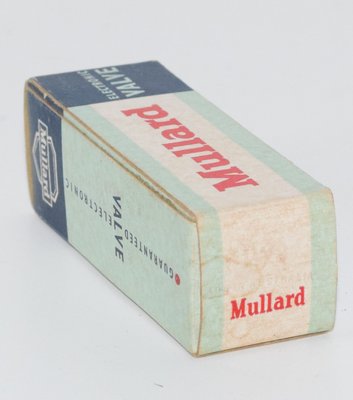
The ECF802 / 6JW8 remains reasonably available as NOS (New Old Stock) from various manufacturers. Trigon-branded examples in original packaging are particularly sought after by collectors. CIFTE/Mazda-Belvu examples are prized for their French manufacturing quality, while Mullard and Telefunken versions command premium prices among audiophiles who believe in the sonic superiority of these brands.
Compared to more common audio tubes like the 12AX7 or EL84, the ECF802 is generally less expensive on the NOS market, making it an attractive option for experimenters on a budget. However, as with all NOS tubes, supplies are finite and prices have been gradually increasing as stocks diminish.
Circuit Design Considerations for Audio Use
Audio designers working with the ECF802 should note several important considerations:
- Pentode section biasing: With a maximum cathode current of 15 mA and grid 1 resistance limits of 0.5 MΩ (fixed bias) or 1 MΩ (cathode bias), the pentode section requires careful biasing to stay within safe operating limits while achieving optimal audio performance.
- Triode section operating point: At Va = 200 V and Vg = -2 V, the triode draws 3.5 mA — a good starting point for audio preamp design. The µ of 70 and gm of 3.5 mA/V provide a useful balance of gain and linearity.
- Heater-cathode voltage: The 100 V maximum heater-to-cathode voltage must be respected, particularly in circuits where the cathode is elevated significantly above ground potential.
- Microphonics: As with any miniature tube originally designed for TV service, microphonic behavior can vary between samples. Selecting low-microphonic examples is advisable for sensitive audio applications, particularly phono stages.