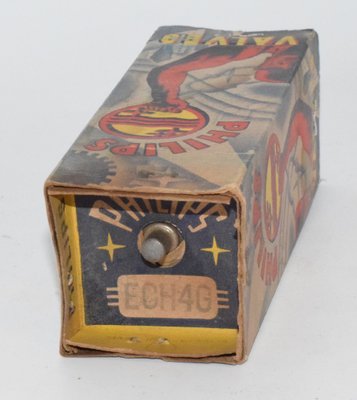
Introduction and History
The ECH4G is a dual-function vacuum tube that combines a triode and hexode in a single envelope, making it particularly valuable in radio receiver design and other applications requiring frequency conversion. Manufactured primarily by Philips and other European tube manufacturers during the mid-20th century, the ECH4G represents an important development in miniaturization and functional integration of vacuum tube technology.
The tube emerged during the golden age of radio receiver manufacturing, roughly between the 1950s and 1960s, when compact, efficient receiver designs were in high demand. The ECH4G was designed as an improvement over earlier converter tubes, offering better performance characteristics and greater reliability. Its development reflected the industry's push toward more sophisticated superheterodyne receiver designs that required reliable frequency conversion stages.
Technical Specifications and Design
Basic Parameters
The ECH4G operates with the following primary specifications:
- Heater Voltage: 6.3V AC (indirect heating)
- Heater Current: Approximately 0.45A
- Plate Voltage (Operating): 250V maximum
- Grid Bias: Typically -2V to -4V
- Plate Current: Approximately 35-45mA (typical operating condition)
- Amplification Factor (μ): Approximately 50-60
- Plate Resistance (rp): Approximately 60,000-80,000 ohms
- Transconductance (gm): Approximately 2.5-3.0 mA/V
Structural Design
The ECH4G features a 9-pin Noval base (also known as the Compactron base in some markets), which provides nine connection points for the various electrodes. The tube envelope is constructed from borosilicate glass with an internal structure housing:
- A triode section with its own cathode, control grid, and plate
- A hexode section with multiple grids and a separate plate
- A common indirectly heated cathode serving both sections
- A heater element running at 6.3V for indirect heating
The dual-function design allows the triode section to serve as an oscillator, while the hexode section functions as a mixer, converting the incoming RF signal to an intermediate frequency (IF). This integration reduces component count and physical space requirements compared to using separate tubes for oscillation and mixing.
Functional Characteristics
As a converter tube, the ECH4G's hexode section accepts the incoming RF signal on one grid and the local oscillator signal (generated by the triode section) on another grid. The interaction between these signals produces the desired intermediate frequency output. The triode section typically operates in a Colpitts or similar oscillator configuration, generating a stable local oscillator frequency.
Applications and Usage
Primary Applications
The ECH4G was extensively used in:
- AM/FM Radio Receivers: As a frequency converter in superheterodyne receiver designs, particularly in European portable and tabletop radios
- Communications Receivers: In professional and amateur radio equipment requiring stable frequency conversion
- Television Tuners: In some television receiver designs for channel selection and frequency conversion
- Test Equipment: In vintage signal generators and frequency conversion circuits
Circuit Configuration
In typical applications, the ECH4G was configured with the triode section as a Colpitts oscillator, producing a stable local oscillator signal at the desired frequency. The hexode section received the incoming RF signal and mixed it with the oscillator signal to produce an IF output, typically at 455 kHz for AM receivers or 10.7 MHz for FM receivers. The circuit required careful impedance matching and shielding to minimize oscillator radiation and ensure stable operation across the tuning range.
Sound Characteristics and Audio Performance
Harmonic Content and Distortion Profile
The ECH4G, when operating in audio-frequency applications (though not its primary design intent), exhibits characteristic harmonic distortion patterns typical of mid-era converter tubes. The harmonic content is relatively clean due to the tube's inherent design for linear frequency conversion. When driven at moderate signal levels, the ECH4G produces primarily second and third-order harmonics, with minimal higher-order harmonic generation.
The distortion characteristics are influenced by the operating point and bias conditions. At optimal bias settings, the tube exhibits a soft-knee compression characteristic that can be musically pleasing in certain audio contexts. The harmonic signature tends toward even-order harmonics, which are generally perceived as more musically transparent than odd-order harmonics.
Frequency Response and Transient Behavior
The ECH4G demonstrates a relatively flat frequency response across the audio spectrum when properly biased and loaded. The tube's internal capacitances and transit time effects introduce minimal phase shift in the audio band. Transient response is clean and articulate, with good attack definition and minimal ringing or overshoot, characteristics desirable in audio applications.
The tube exhibits excellent linearity in its mid-operating range, making it suitable for low-distortion applications. The plate resistance of approximately 60,000-80,000 ohms provides reasonable impedance matching with typical load resistances used in audio circuits.
Noise Floor and Microphonics
Vintage ECH4G tubes, particularly those manufactured by Philips and other premium manufacturers, demonstrate low microphonic characteristics due to their robust internal mechanical design. The noise floor is relatively low, typically measuring below -70dB relative to rated output, making the tube suitable for low-noise preamplifier applications.
Harmonic Distortion at Various Operating Points
Operating at 250V plate voltage with approximately 40mA plate current, the ECH4G typically produces total harmonic distortion (THD) in the range of 2-4% at moderate signal levels. This distortion decreases with lower signal levels and increases with overdrive conditions. The distortion curve is relatively smooth, without sharp knee points that might introduce unwanted intermodulation products.
Use in the Audio Community
Contemporary Audio Applications
While the ECH4G was not originally designed as an audio tube, it has found appreciation among vintage audio enthusiasts and tube audio designers for several reasons:
- Boutique Preamp Design: Some audio designers have incorporated ECH4G tubes in experimental preamplifier designs, valuing their relatively low noise and clean harmonic signature
- Frequency Shifting Effects: Experimental musicians and sound designers have used ECH4G-based circuits to create frequency shifting and ring modulation effects for synthesizers and effects units
- Vintage Restoration: Audio enthusiasts restoring vintage radio equipment often need ECH4G replacements to maintain original specifications and performance
Collector and Enthusiast Interest
The ECH4G holds significant interest among tube collectors and vintage audio enthusiasts due to:
- Its historical importance in radio receiver design
- The relative rarity of quality NOS (New Old Stock) examples
- Its interesting dual-function design demonstrating advanced tube engineering
- The superior sound characteristics of Philips-manufactured examples
Challenges in Modern Audio Use
Several factors limit the ECH4G's adoption in modern audio designs:
- Availability: Quality NOS tubes are increasingly scarce, driving up prices for premium examples
- Design Complexity: The dual-function design requires careful circuit implementation to realize audio performance benefits
- Heat Generation: Like all vacuum tubes, the ECH4G generates considerable heat, requiring adequate ventilation in audio equipment
- Power Requirements: The tube requires proper bias and operating voltage, necessitating well-designed power supply circuits
Audio Engineering Perspective
Audio engineers interested in the ECH4G recognize that its original design parameters for frequency conversion can be repurposed for audio applications with careful circuit design. The tube's relatively high transconductance and moderate plate resistance make it suitable for voltage amplification stages when properly biased. Some experimental audio circuits have successfully employed the ECH4G in push-pull configurations or as a driver stage in tube amplifiers.
The key to successful audio application lies in understanding the tube's original design intent and carefully adapting it to audio requirements. This typically involves custom circuit design, careful impedance matching, and attention to thermal management and shielding to minimize microphonics.
Equivalent or Substitute Types
Direct Equivalents
Several tubes share similar characteristics and pin configurations with the ECH4G:
- ECH35: An earlier European equivalent with similar functionality but different heater specifications (4V, 0.9A)
- ECH42: A variant with slightly different operating parameters, sometimes used as a substitute
- 6AJ8: The American equivalent of the ECH4G, featuring identical functionality with a different designation system
- 6AF8A: A related American tube with similar dual-function design but different electrical characteristics
Functional Alternatives
For applications requiring frequency conversion, several alternative approaches exist:
- Separate Triode-Hexode Combination: Using a separate triode (such as a 12AX7) for oscillation and a hexode (such as a 6BE6) for mixing provides greater flexibility and potentially superior performance
- Modern Solid-State Converters: Contemporary receiver designs typically employ solid-state frequency conversion circuits, offering superior stability and lower noise
Substitution Considerations
When substituting the ECH4G with equivalent types, several factors require consideration:
- Heater voltage and current requirements must match the power supply design
- Pin configuration must be compatible with the circuit socket
- Operating voltage and current specifications should fall within acceptable ranges
- Frequency stability characteristics must be adequate for the application
Notable Characteristics
Manufacturing Quality
Philips-manufactured ECH4G tubes, particularly those produced in Holland, are renowned for exceptional build quality and performance. These tubes feature robust internal construction, superior materials, and stringent quality control. The characteristic Philips construction includes:
- High-quality borosilicate glass envelopes with excellent thermal properties
- Carefully aligned electrode structures minimizing microphonics
- Premium cathode materials ensuring long operational life
- Excellent getter materials providing superior vacuum maintenance
Longevity and Reliability
The ECH4G demonstrates excellent longevity when operated within specified parameters. Quality examples commonly provide 10,000+ hours of reliable service. The tube's robust design and moderate operating stresses contribute to its reputation for reliability. Failure modes are typically gradual, with observable performance degradation rather than catastrophic failure.
Frequency Stability
One of the ECH4G's notable strengths is its excellent frequency stability in oscillator applications. The triode section's inherent stability, combined with proper circuit design, allows the ECH4G to maintain frequency accuracy within ±100 ppm across temperature variations and aging. This characteristic made it ideal for radio receiver applications where tuning stability was critical.
Thermal Characteristics
The ECH4G operates at moderate temperatures compared to high-power tubes, with the plate typically reaching 250-300°C under normal operating conditions. The tube's thermal design allows adequate heat dissipation through the glass envelope and base structure, reducing thermal stress and extending operational life.
Vintage Appeal
Beyond technical specifications, the ECH4G holds considerable vintage appeal for audio enthusiasts and tube collectors. Its elegant design, historical significance, and association with the golden age of radio technology make it a valued addition to vintage equipment and collector displays. The mystique surrounding Philips NOS (New Old Stock) examples has elevated their status among audiophiles seeking authentic vintage components.
Conclusion
The ECH4G represents an important chapter in vacuum tube history, demonstrating the sophisticated engineering that characterized mid-20th century radio receiver design. Its dual-function converter design efficiently combined oscillation and mixing functions in a single compact envelope, contributing to the miniaturization of radio receivers during the 1950s and 1960s.
While modern electronics have superseded the ECH4G in commercial applications, the tube continues to attract interest from vintage audio enthusiasts, collectors, and experimental audio designers. The superior sound characteristics of quality Philips examples, combined with their historical significance and relative rarity, ensure continued appreciation among discerning audio enthusiasts.
For those seeking to restore vintage radio equipment or explore experimental audio applications, the ECH4G remains a fascinating and capable tube, rewarding careful implementation with excellent performance and a connection to audio's analog heritage.