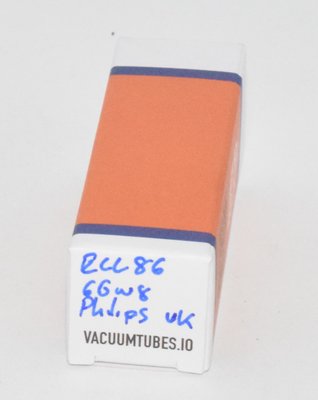
1. Introduction and History
The ECL86 is a compound (combination) vacuum tube containing a medium-gain triode and an audio-frequency output pentode within a single Noval (B9A) envelope. Developed in the late 1950s as part of the European Mullard/Philips valve family, the ECL86 was designed to provide a complete audio amplifier chain — voltage amplification and power output — in a single bottle. Its American RETMA designation is 6GW8, and its NATO/CV designation is CV8297.
The ECL86 was manufactured by virtually every major European valve maker, including Philips/Miniwatt, Mullard (at their famous Blackburn factory), Mazda-Belvu (CIFTE in France), Siemens, Telefunken, Valvo, Tungsram, and others. It was introduced as a successor and improvement upon earlier triode-pentode combinations such as the ECL82 (6BM8), offering higher power output and improved linearity from the pentode section while maintaining a compact single-envelope design.
The tube found its primary commercial application in European radio receivers, record players, tape recorders, and small integrated amplifiers of the 1960s and early 1970s. Its ability to deliver a complete audio channel from a single tube — with the triode serving as the voltage amplifier/driver and the pentode as the output stage — made it extremely popular in cost-effective consumer electronics. The Mazda-Belvu (CIFTE) datasheet from January 1968, which serves as the primary reference for this article, describes it as an "Amplificateur de tension A.F. et amplificateur de puissance A.F." (AF voltage amplifier and AF power amplifier).
Today, the ECL86 enjoys a devoted following among audiophiles and DIY amplifier builders who appreciate its ability to create remarkably simple yet musically satisfying amplifiers with minimal component count.
2. Technical Specifications and Design
General Characteristics
| Parameter | Value |
|---|---|
| Heater Type | Indirectly heated cathode |
| Heater Voltage (Vf) | 6.3 V (parallel operation) |
| Heater Current (If) | 700 mA (per CIFTE datasheet); 660 mA (per TDSL reference) |
| Envelope | A22-4 |
| Base | Noval 9C12 (B9A, 9-pin miniature) |
| Mounting Position | Any (quelconque) |
Note: The heater current is specified as 700 mA in the CIFTE/Mazda-Belvu datasheet and 660 mA in the TDSL reference data. This minor discrepancy between manufacturers is not uncommon; designers should allow for the higher value.
Pin Configuration (Noval 9C12 Base, Bottom View)
| Pin | Connection |
|---|---|
| 1 | Triode Grid |
| 2 | Triode Cathode |
| 3 | Pentode Grid 2 (Screen Grid) |
| 4 | Filament (Heater) |
| 5 | Filament (Heater) |
| 6 | Pentode Anode (Plate) |
| 7 | Pentode Cathode, Pentode Grid 3 (Suppressor), Internal Shield |
| 8 | Pentode Grid 1 (Control Grid) |
| 9 | Triode Anode (Plate) |
Interelectrode Capacitances (Without External Shielding)
Pentode Section
| Parameter | Symbol | Value |
|---|---|---|
| Input Capacitance | Ce | 10 pF |
| Output Capacitance | Cs | 9.5 pF |
| Anode to Grid 1 Capacitance | Ca/g₁ | 0.4 pF max |
| Grid 1 to Filament Capacitance | Cg₁/f | 0.24 pF max |
Triode Section
| Parameter | Symbol | Value |
|---|---|---|
| Input Capacitance | Ce | 2.3 pF |
| Output Capacitance | Cs | 2.5 pF |
| Anode to Grid Capacitance | Ca/g | 1.4 pF |
| Grid to Filament Capacitance | Cg/f | 0.006 pF max |
Between Sections
| Parameter | Symbol | Value |
|---|---|---|
| Triode Anode / Pentode Grid 1 | CaT/g₁P | 0.200 pF max |
| Triode Grid / Pentode Anode | CgT/aP | 0.006 pF max |
| Triode Grid / Pentode Grid 1 | CgT/g₁P | 0.020 pF max |
| Triode Anode / Pentode Anode | CaT/aP | 0.150 pF max |
Maximum Ratings — Pentode Section
| Parameter | Symbol | Value |
|---|---|---|
| Anode Voltage (no signal) | Va bl | 550 V max |
| Anode Voltage (operating) | Va | 300 V max |
| Screen Grid Voltage (no signal) | Vg₂ bl | 550 V max |
| Screen Grid Voltage (operating) | Vg₂ | 300 V max |
| Cathode Current | Ik | 55 mA max |
| Anode Dissipation | Pa | 9 W max |
| Screen Grid Dissipation | Pg₂ | 1.8 W max |
| Screen Grid Peak Dissipation (music/speech) | Pg₂ cr | 3.25 W max |
| Filament-to-Cathode Voltage | Vfk | 100 V max |
| Grid 1 Circuit Resistance | Rg₁ | 0.5 MΩ max |
| Filament-to-Cathode Circuit Resistance | Rfk | 20 kΩ max |
Maximum Ratings — Triode Section
| Parameter | Symbol | Value |
|---|---|---|
| Anode Voltage (no signal) | Va bl | 550 V max |
| Anode Voltage (operating) | Va | 300 V max |
| Anode Dissipation | Pa | 0.5 W max |
| Cathode Current | Ik | 4 mA max |
| Negative Grid Voltage | -Vg₁ | 50 V max |
| Grid Resistance (fixed bias) | Rg₁ | 1 MΩ max |
| Grid Resistance (automatic bias) | Rg₁ | 2 MΩ max |
| Grid Resistance (grid-leak bias) | Rg₁ | 10 MΩ max |
| Filament-to-Cathode Voltage | Vfk | 100 V max |
| Filament-to-Cathode Circuit Resistance | Rfk | 20 kΩ max |
Nominal Characteristics — Pentode Section
| Parameter | Symbol | Value |
|---|---|---|
| Anode Voltage | Va | 250 V |
| Screen Grid Voltage | Vg₂ | 250 V |
| Control Grid Voltage | Vg₁ | -7 V |
| Anode Current | Ia | 36 mA |
| Screen Grid Current | Ig₂ | 6 mA |
| Transconductance | S (gm) | 10 mA/V |
| Internal Resistance (Plate Resistance) | ρ (rp) | 48 kΩ |
| Amplification Factor (g₂/g₁) | Kg₂g₁ | 21 |
| Grid 1 Voltage for +0.3 µA Grid Current | Vg₁ | -1.3 V |
Nominal Characteristics — Triode Section
| Parameter | Symbol | Value |
|---|---|---|
| Anode Voltage | Va | 250 V |
| Grid Voltage | Vg | -1.9 V |
| Anode Current | Ia | 1.2 mA |
| Transconductance | S (gm) | 1.6 mA/V |
| Amplification Factor | K (µ) | 100 |
| Plate Resistance | rp | 62,500 Ω (approx. 62 kΩ) |
| Grid Voltage for +0.3 µA Grid Current | Vg₁ | -1.3 V |
Note: The plate resistance of the triode section can be calculated from µ/gm = 100/1.6 = 62,500 Ω. The TDSL reference gives 62,000 Ω which is consistent.
Physical Dimensions
The ECL86 uses the A22-4 envelope with a maximum diameter of 22.2 mm. The overall height from the base seating plane is approximately 71.4 mm maximum. The tube uses the standard Noval 9C12 (B9A) 9-pin miniature base.
3. Applications and Usage
Single-Ended Class A Power Amplifier (Pentode Section)
The most common application for the ECL86 is as a complete single-ended audio amplifier, with the triode section providing voltage gain and the pentode section delivering output power. The CIFTE datasheet provides two Class A single-ended operating conditions:
Configuration 1: Va = 250 V, Vg₂ = 250 V, Rk = 170 Ω, Ra = 7 kΩ
| Parameter | No Signal | At 0.3 Veff Input | At 3.2 Veff Input | At 3.8 Veff Input (onset of grid current) |
|---|---|---|---|---|
| Ia | 36 mA | — | 37 mA | 36.5 mA |
| Ig₂ | 6 mA | — | 10.2 mA | 13 mA |
| Output Power (Ps) | 0 | 0.05 W | 4 W | 4.5 W |
| Distortion (Dt) | — | 0.95% | 10% | — |
This configuration delivers approximately 4.5 W of output power at the onset of grid current, with about 10% THD at 4 W. At lower power levels, distortion drops dramatically — only 0.95% at 50 mW.
Configuration 2: Va = 250 V, Vg₂ = 250 V, Rk = 270 Ω, Ra = 10 kΩ
| Parameter | No Signal | At 0.28 Veff Input | At 2.7 Veff Input | At 4 Veff Input (onset of grid current) |
|---|---|---|---|---|
| Ia | 26 mA | — | 27 mA | 25.5 mA |
| Ig₂ | 4.4 mA | — | 8 mA | 13 mA |
| Output Power (Ps) | 0 | 0.05 W | 2.8 W | 3.6 W |
| Distortion (Dt) | — | 1.1% | 10% | — |
This more conservative operating point reduces quiescent current and delivers about 3.6 W at the onset of grid current.
Push-Pull Class AB Power Amplifier (Pentode Section)
The datasheet also provides push-pull operating conditions for pairs of ECL86 pentode sections:
Configuration 1: Va = 250 V, Vg₂ = 250 V, Rk = 90 Ω, Raa = 8.2 kΩ
Output power: 10 W at 5.1 Veff input, with distortion less than 0.4% at low levels and 4.5% at full power.
Configuration 2: Va = 300 V, Vg₂ = 300 V, Rk = 130 Ω, Raa = 9.1 kΩ
Output power: 14.3 W at 8.7 Veff input, with distortion of 5% at full power.
Triode Section as AF Preamplifier
The triode section is designed to serve as the voltage amplifier/driver stage. The datasheet provides two preamplifier configurations:
With 680 kΩ Grid Resistance
| Parameter | Condition 1 | Condition 2 |
|---|---|---|
| Anode Voltage (Va) | 200 V | 250 V |
| Anode Current (Ia) | 0.42 mA | 0.6 mA |
| Cathode Resistance (Rk) | 2.6 kΩ | 1.75 kΩ |
| Load Resistance (Ra) | 220 kΩ | 220 kΩ |
| Output Voltage (Vs) | 3.2 Veff | 3.2 Veff |
| Voltage Gain (Av) | 66 | 70 |
| Distortion (Dt) | 0.6% | 0.4% |
With 10 MΩ Grid Resistance
| Parameter | Condition 1 | Condition 2 |
|---|---|---|
| Anode Voltage (Va) | 250 V | 300 V |
| Anode Current (Ia) | 0.6 mA | 0.8 mA |
| Output Voltage (Vs) | 5 Veff | 9 Veff |
| Voltage Gain (Av) | 75 | 80 |
| Distortion (Dt) | 0.4% | 0.4% |
The triode section achieves a voltage gain of 66 to 80 depending on operating conditions, with very low distortion of 0.4–0.6%. This is more than sufficient to drive the pentode section to full output.
Hum and Microphony
The CIFTE datasheet notes that the triode section can be used without special precautions against hum and microphony when the output power of 50 mW is obtained with an input voltage on the triode equal to or greater than 4 mVeff. This indicates good immunity to mechanical vibration and heater-induced noise in typical applications.
Original Commercial Applications
The ECL86 was widely used in:
- European AM/FM radio receivers as the audio output stage
- Record players and portable phonographs
- Reel-to-reel tape recorders
- Television audio output stages
- Intercom systems and public address equipment
- Small integrated stereo amplifiers (one ECL86 per channel)
4. Sound Characteristics
The ECL86 has earned a distinctive reputation among audiophiles and tube enthusiasts for its sonic qualities, which are often described as surprisingly refined for a combination tube originally designed for consumer electronics.
Triode Section
The triode section, with its high amplification factor of 100 and moderate transconductance of 1.6 mA/V, produces a clean, detailed, and slightly warm preamplifier sound. Its high plate resistance of approximately 62 kΩ means it behaves somewhat like a high-mu triode in the mold of the 12AX7/ECC83 family, though with lower gain. The triode section is noted for:
- Low distortion: At typical operating points, the triode section produces only 0.4–0.6% THD, contributing to a clean, transparent signal path.
- Good linearity: The transfer characteristics are smooth and well-behaved, producing predominantly second-harmonic distortion that is musically pleasant.
- Quiet operation: The datasheet confirms good immunity to hum and microphony, which translates to a low noise floor in practice.
Pentode Section
The pentode output section is where the ECL86's character truly shines. With a transconductance of 10 mA/V and plate resistance of 48 kΩ, it delivers a sound that audiophiles frequently describe as:
- Warm and musical: The pentode section produces a rich harmonic spectrum that adds body and warmth to the sound, particularly in the midrange frequencies.
- Sweet and detailed midrange: Vocals and acoustic instruments are rendered with a natural presence and intimacy that belies the tube's modest power output.
- Smooth treble: The high-frequency response is extended but never harsh or fatiguing, with a gentle roll-off that many listeners find pleasing.
- Adequate bass: While not delivering the deep, authoritative bass of larger output tubes, the ECL86 provides surprisingly satisfying low-frequency performance when paired with efficient speakers, though bass can become somewhat soft and loose at higher power levels.
- Dynamic and lively: Despite its modest power rating, the ECL86 has good transient response and a sense of musical energy that keeps the sound engaging.
Overall Character
The combination of the high-mu triode driver and the pentode output stage creates a sonic signature that is distinctly "European" in character — refined, articulate, and musically involving. Compared to the earlier ECL82 (6BM8), the ECL86 is generally considered to offer better clarity, more power, and improved linearity. When operated in single-ended Class A at moderate power levels (1–2 watts), distortion is remarkably low and the sound takes on a purity and directness that many audiophiles find addictive.
The pentode section can also be operated in ultralinear or triode-strapped configurations, which trade output power for reduced distortion and a more "triode-like" sound with lower output impedance. In triode mode, the sound becomes more intimate and refined, with a softer, more rounded character that some listeners prefer for small-scale acoustic music and vocal recordings.
5. Equivalent or Substitute Types
| Type | Relationship | Notes |
|---|---|---|
| 6GW8 | Identical (American RETMA designation) | Direct substitute, same pinout and ratings. The 6GW8 is simply the American type number for the ECL86. |
| CV8297 | Identical (NATO/British military designation) | Direct substitute, same pinout and ratings. Military-grade equivalent with tighter tolerances. |
The ECL86/6GW8 is a unique type with no other directly interchangeable substitutes. While it is sometimes compared to the ECL82 (6BM8), these are not interchangeable — the ECL82 has different pinout, different electrical characteristics, and lower power capability. Similarly, the ECL85 is a different tube designed for different applications (frame timebase output) and is not a substitute.
Manufacturers who produced the ECL86/6GW8 include Philips/Miniwatt, Mullard (notably from their Blackburn factory), Mazda-Belvu (CIFTE), Siemens, Telefunken, Valvo, Tungsram, RFT, Tesla, Ei (Yugoslavia), and various others. Among collectors and audiophiles, Mullard Blackburn production (identifiable by their factory codes) and Philips/Miniwatt examples from the early-to-mid 1960s are particularly sought after for their perceived superior sonic qualities and build quality.
6. Notable Characteristics
Elegant Single-Tube Amplifier Design
The ECL86's most notable characteristic is its ability to provide a complete audio amplifier in a single envelope. The triode section delivers sufficient voltage gain (66–80×) to drive the pentode section to full output from a line-level source, meaning a complete mono amplifier can be built with just one ECL86, a power supply, and an output transformer. A stereo amplifier requires only two ECL86 tubes.
High Power for a Combination Tube
With 9 W maximum anode dissipation on the pentode section and the ability to deliver 4–4.5 W in single-ended Class A or up to 14.3 W in push-pull Class AB, the ECL86 offers significantly more output power than its predecessor, the ECL82 (which typically delivers about 3.5–4 W single-ended). This makes it one of the most powerful triode-pentode combination tubes produced.
Separate Cathodes
A crucial design feature of the ECL86 is that the triode and pentode sections have separate cathodes (pins 2 and 7 respectively). This provides important advantages: it eliminates unwanted coupling between sections through a shared cathode impedance, allows independent biasing of each section, and enables more flexible circuit topologies. The pentode cathode (pin 7) also serves as the connection point for the suppressor grid (grid 3) and the internal shield.
Low Inter-Section Capacitances
The inter-section capacitances are remarkably low — particularly the triode grid to pentode anode capacitance at only 0.006 pF maximum. This excellent internal shielding minimizes unwanted feedback between the output and input stages, contributing to stable operation and clean sound.
High Triode Amplification Factor
The triode section's amplification factor (µ) of 100 is notably high, placing it in the same class as the 12AX7/ECC83 in terms of gain capability. Combined with the 1.6 mA/V transconductance, this provides ample voltage gain to drive the pentode section from typical line-level sources without requiring additional gain stages.
Flexible Grid Resistance Ratings
The triode section allows grid resistance values up to 10 MΩ when using grid-leak bias, which is exceptionally generous and allows direct coupling from high-impedance sources such as crystal/ceramic phono cartridges — a common application in the consumer equipment of its era.
7. Usage in the Audio Community
DIY Single-Ended Amplifiers
The ECL86 has become a favorite among DIY audio enthusiasts for building minimalist single-ended (SE) amplifiers. The appeal is straightforward: a complete stereo amplifier can be built with just two ECL86 tubes, two output transformers, a power transformer, and a handful of passive components. These "two-tube stereo" amplifiers have become a popular first project for newcomers to tube audio, as well as a serious pursuit for experienced builders seeking musical simplicity.
Typical DIY SE amplifier designs operate the pentode section at Va = 250 V, Vg₂ = 250 V with a 170 Ω cathode resistor and a 7 kΩ primary impedance output transformer, delivering approximately 4 W per channel. While 4 watts may seem modest by modern standards, when paired with high-efficiency speakers (93 dB/W/m or higher), this is more than adequate for satisfying listening levels in a typical room.
Push-Pull Amplifiers
More ambitious builders construct push-pull amplifiers using pairs of ECL86 tubes per channel. With the pentode sections operating in Class AB at 300 V, these amplifiers can deliver up to 14.3 W per channel — enough to drive a wide range of loudspeakers comfortably. The triode sections of the two tubes can be configured as a phase splitter (one as a gain stage, the other as a cathodyne or similar), maintaining the elegant simplicity of using only ECL86 tubes throughout.
Headphone Amplifiers
The ECL86 is also popular in headphone amplifier designs. The pentode section's output, when used with an appropriate output transformer or operated at reduced power levels, provides an excellent match for headphone impedances. The low distortion at modest power levels (0.95% at 50 mW in the datasheet's first SE configuration) makes it particularly well-suited to this application, where only milliwatts of power are needed.
Guitar Amplifiers
Some boutique guitar amplifier builders have adopted the ECL86 for small practice amplifiers and recording amplifiers. The pentode section's harmonic character when driven into clipping produces a pleasing overdrive tone, while the 4-watt output level is ideal for bedroom and studio use where power tube saturation at manageable volume levels is desired.
Sought-After Brands and Variants
In the audio community, certain production variants of the ECL86 are particularly prized:
- Mullard Blackburn (UK): Widely considered among the finest-sounding ECL86 tubes produced. Identifiable by Mullard factory codes, these tubes from the early-to-mid 1960s command premium prices. They are noted for a rich, warm, and detailed sound with excellent bass definition.
- Philips Miniwatt (Holland/various): Original Philips production is highly regarded for consistency and refined sound quality. Philips Miniwatt branded tubes from the Heerlen factory are especially collectible.
- Telefunken (Germany): Known for clarity, detail, and a slightly more analytical presentation compared to Mullard production. Diamond-bottom versions are particularly sought after.
- Siemens (Germany): Similar to Telefunken in character, with excellent build quality and a clean, precise sound.
- Mazda-Belvu / CIFTE (France): French production tubes are increasingly appreciated for their musical qualities and represent good value compared to Mullard and Telefunken examples.
Current Availability
The ECL86/6GW8 is no longer in production by any major manufacturer, making it a NOS (New Old Stock) only tube. However, because it was produced in enormous quantities during the 1960s and early 1970s, good NOS examples remain readily available from tube dealers worldwide at reasonable prices compared to more famous audio tubes. This accessibility, combined with its excellent sonic qualities and circuit simplicity, ensures the ECL86's continued popularity in the audio community for years to come.
Community Resources
Numerous ECL86 amplifier designs are shared on DIY audio forums and websites, with complete schematics, parts lists, and construction guides. The tube has inspired a dedicated community of builders who continue to explore and refine circuit topologies that extract the best possible sound from this versatile and musical valve.