1. Introduction and History
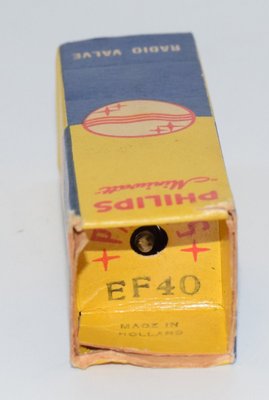
The EF40 is an indirectly heated audio-frequency (A.F.) pentode designed and manufactured by Philips. It belongs to the Philips Rimlock (8-pin) series of miniature valves developed in the late 1940s, a family that represented a significant step forward in European valve design for high-fidelity audio and broadcast receiver applications. The EF40 was specifically engineered for high-sensitivity A.F. amplification in high-fidelity receivers and amplifiers, with particular emphasis on achieving the lowest possible levels of hum, noise, and microphony.
What sets the EF40 apart from many contemporary pentodes is its remarkably straight characteristic curve and its slope (transconductance) of 1.85 mA/V, which made it an excellent choice as a voltage amplifier stage in quality audio equipment. Philips invested considerable engineering effort into the mechanical construction of the EF40, incorporating twice the usual number of mica supports to create a particularly rigid electrode system. This double-mica construction was directly responsible for the tube's pronounced reduction in microphony — a critical attribute for use as a first-stage amplifier in microphone preamplifiers and sensitive audio circuits.
The EF40 was manufactured primarily in the Netherlands by Philips (Miniwatt) and was also produced under the Mullard brand in the UK. It saw widespread use throughout Europe in broadcast receivers, high-fidelity amplifiers, and professional audio equipment from the late 1940s through the 1960s. Its military equivalent is the CV3885.
2. Technical Specifications and Design
General Description
- Type: A.F. Pentode (indirectly heated)
- Base: Rimlock (8-pin), Philips type 59690
- Envelope: Miniature glass
- Mounting: Vertical (recommended)
- Maximum dimensions: 22 mm diameter × 60 mm height (excluding pins)
Heater Data
| Parameter | Symbol | Value |
|---|---|---|
| Heater Voltage | Vf | 6.3 V (A.C. or D.C., series or parallel feed) |
| Heater Current | If | 0.2 A (200 mA) |
Interelectrode Capacitances (Cold Valve)
| Parameter | Symbol | Value |
|---|---|---|
| Input Capacitance | Cg1 | 4.5 pF |
| Output Capacitance | Ca | 5.2 pF |
| Anode to Control Grid | Cag1 | < 0.04 pF |
| Control Grid to Heater | Cg1f | < 0.002 pF |
Typical Characteristics (Pentode Operation)
| Parameter | Symbol | Value |
|---|---|---|
| Anode Voltage | Va | 250 V |
| Screen Grid Voltage (g2) | Vg2 | 140 V |
| Grid 3 Voltage | Vg3 | 0 V |
| Grid Bias (g1) | Vg1 | −2 V |
| Anode Current | Ia | 3.0 mA |
| Screen Grid Current | Ig2 | 0.55 mA |
| Mutual Conductance (Transconductance) | S (gm) | 1.85 mA/V |
| Internal Resistance | Ri | 2.5 MΩ |
| Amplification Factor (g2 w.r.t. g1) | μg2g1 | 38 |
Maximum Ratings (Limiting Values)
| Parameter | Symbol | Maximum Value |
|---|---|---|
| Anode Voltage (valve biased to cut-off) | Vao | 550 V |
| Anode Voltage | Va | 300 V |
| Anode Dissipation | Wa | 1 W |
| Screen Grid Voltage (valve biased to cut-off) | Vg2o | 550 V |
| Screen Grid Voltage | Vg2 | 200 V |
| Screen Grid Dissipation | Wg2 | 0.2 W |
| Cathode Current | Ik | 6 mA |
| Grid Current Starting Point | Vg1 (Ig1 = +0.3 μA) | −1.3 V |
| External Resistance (g1 to cathode, Wa < 0.2 W) | Rg1 | 10 MΩ |
| External Resistance (g1 to cathode, Wa > 0.2 W) | Rg1 | 3 MΩ * |
| External Resistance (heater to cathode) | Rfk | 20 kΩ |
| Voltage between Heater and Cathode | Vfk | 100 V |
* If the grid bias is obtained only by means of the grid leak, the maximum value for Rg1 is 22 MΩ.
Pin Connections (Rimlock Base, Bottom View)
| Pin | Connection |
|---|---|
| 1 | Heater (f) |
| 2 | Grid 2 (Screen Grid) — also connected via internal connection (i.c.) |
| 3 | Grid 3 (Suppressor Grid) — also connected via internal connection (i.c.) |
| 4 | Grid 3 (Suppressor Grid) |
| 5 | Grid 1 (Control Grid) |
| 6 | Grid 2 (Screen Grid) |
| 7 | Cathode (k) / Screen (s) |
| 8 | Heater (f) |
| Anode (a) | Top Cap |
The central bush of the Rimlock base must be earthed and should be used as the central earthing point of the input circuit. A screening plate between contacts is soldered to this central bush for hum suppression.
Operating Characteristics as A.F. Amplifier (Pentode Mode)
The datasheet provides four sets of operating conditions at supply voltages of 250 V and 100 V:
| Parameter | Condition 1 | Condition 2 | Condition 3 | Condition 4 |
|---|---|---|---|---|
| Supply Voltage Vb | 250 V | 250 V | 100 V | 100 V |
| Anode Resistor Ra | 0.33 MΩ | 0.22 MΩ | 0.33 MΩ | 0.22 MΩ |
| Screen Grid Resistor Rg2 | 1.5 MΩ | 1.0 MΩ | 1.2 MΩ | 1.0 MΩ |
| Grid Leak Rg1 | 1 MΩ | 1 MΩ | 1 MΩ | 1 MΩ |
| Cathode Resistor Rk | 2.2 kΩ | 1.5 kΩ | 4.7 kΩ | 3.3 kΩ |
| Anode Current Ia | 0.58 mA | 0.86 mA | 0.20 mA | 0.28 mA |
| Screen Grid Current Ig2 | 0.12 mA | 0.18 mA | 0.05 mA | 0.06 mA |
| Voltage Amplification Vo/Vi | 210 | 180 | 125 | 120 |
| Distortion at Vo = 4 VRMS | 0.6% | 0.5% | 1.1% | 1.1% |
| Distortion at Vo = 8 VRMS | 0.9% | 0.7% | 1.7% | 1.6% |
| Distortion at Vo = 12 VRMS | 1.2% | 1.0% | 2.6% | 2.5% |
Operating Characteristics as A.F. Triode (Screen Grid Connected to Anode)
| Parameter | Condition 1 | Condition 2 | Condition 3 | Condition 4 |
|---|---|---|---|---|
| Supply Voltage Vb | 250 V | 250 V | 100 V | 100 V |
| Anode Resistor Ra | 0.22 MΩ | 0.1 MΩ | 0.22 MΩ | 0.1 MΩ |
| Cathode Resistor Rk | 1.8 kΩ | 1.2 kΩ | 4.7 kΩ | 2.7 kΩ |
| Anode Current Ia | 0.84 mA | 1.5 mA | 0.27 mA | 0.47 mA |
| Voltage Amplification Vo/Vi | 31 | 29 | 27 | 26 |
| Distortion at Vo = 4 VRMS | 0.6% | 0.6% | 1.0% | 1.0% |
| Distortion at Vo = 8 VRMS | 0.8% | 0.7% | 1.5% | 1.7% |
| Distortion at Vo = 12 VRMS | 1.1% | 1.0% | 1.8% | 2.2% |
3. Applications and Usage
The EF40 was designed primarily for the following applications:
- High-fidelity audio voltage amplification: The EF40's straight characteristic and low microphony made it ideal as a high-gain voltage amplifier stage in quality audio equipment. In pentode mode, voltage gains of 120 to 210 are achievable depending on operating conditions.
- Microphone preamplifiers: Philips specifically noted the EF40's suitability as a first valve in microphone amplifiers. Every effort was made to eliminate hum, with the equivalent hum voltage on the control grid being less than 5 μV — meaning the hum level is 60 dB below the input signal required for maximum output from the output valve.
- Broadcast receivers: In broadcast receivers, the maximum permissible amplification corresponds to an input voltage of not less than 0.5 mV for an output of 50 mW, assuming 5% acoustic efficiency and a 10 cm listening distance.
- Triode-connected operation: With the screen grid connected to the anode, the EF40 can be used as an A.F. triode with gains of approximately 26–31, offering lower distortion characteristics suitable for applications where linearity is paramount.
The datasheet emphasizes that the EF40 can be used in an amplifier where the gain is increased to a point at which the input required for maximum output power is not less than 5 mV. At this level, the sound output is equivalent to that of a loudspeaker having 5% acoustic efficiency with 5 W input power, located 10 cm from the valve — illustrating the remarkable sensitivity achievable with this tube.
Circuit Design Considerations
Philips provided detailed guidance for minimizing hum when using the EF40:
- The valve should be placed as far as possible from transformers and chokes to avoid stray magnetic fields.
- A high-quality valveholder should be used; the Philips type 5904/03 was specifically recommended.
- Residual hum can be reduced by connecting a wire-wound potentiometer of about 50 ohms in parallel with the heater, with the sliding contact earthed and adjusted for minimum hum.
- The heater contacts of the valveholder should be screened by a metal plate soldered to the central bush.
- The bifilar type of heater is used to suppress the magnetic field, and the heater current is kept low at 200 mA.
- The central bush must be earthed and used as the central earthing point of the input circuit.
- Heater leads should be twisted to reduce their magnetic field.
4. Sound Characteristics
The EF40 is regarded by audiophiles and audio engineers as a tube with distinctly refined sonic qualities, largely attributable to its low-noise, low-microphony design and its remarkably straight transfer characteristic. Here is how the EF40's sound is typically described:
- Clarity and transparency: The EF40 is known for exceptional clarity in the midrange and treble frequencies. Its straight characteristic curve translates to low harmonic distortion, which manifests as a clean, transparent sound that reveals fine detail in recordings. The distortion figures — as low as 0.5% at 4 VRMS output in pentode mode — support this subjective impression.
- Low noise floor: With equivalent hum voltage below 5 μV on the control grid, the EF40 provides an exceptionally quiet background. This "black background" quality is highly prized in phono stages and microphone preamplifiers, where the signal levels are extremely low and any noise is immediately audible.
- Smooth, refined character: In triode-connected mode, the EF40 exhibits a warm, smooth tonal quality with gentle, predominantly even-order harmonic distortion. The lower gain (approximately 26–31) in triode mode is traded for a more linear, musically pleasing presentation.
- Excellent dynamics: The high internal resistance of 2.5 MΩ and the high amplification factor give the EF40 excellent dynamic range and transient response. Listeners often note the tube's ability to handle sudden dynamic shifts in music without compression or smearing.
- Pentode vs. triode voicing: In pentode mode, the EF40 offers a more detailed, analytical sound with greater gain and a slightly more forward presentation. In triode mode, the sound becomes warmer, more relaxed, and more "tube-like" in the classic sense, with a rounder bass response and a more forgiving treble.
- Microphony-free performance: Thanks to the double-mica support structure, the EF40 is remarkably resistant to mechanical vibration. This means it does not add the subtle ringing or coloration that microphonic tubes can introduce, resulting in a purer, more accurate reproduction of the source material.
5. Equivalent or Substitute Types
| Type | Manufacturer/Standard | Notes |
|---|---|---|
| CV3885 | UK Military (Common Valve) | Direct equivalent; military-grade version of the EF40. Fully interchangeable with identical pinout and specifications. |
The EF40 uses the Rimlock base, which limits direct substitution to other Rimlock-based types. There is no direct octal or noval equivalent with identical characteristics. The EF40 should not be confused with the EF86 (noval base, different specifications) or the EF36/EF37A (octal base), though these tubes serve similar roles as low-noise A.F. pentodes in different socket families.
Note: Some sources may suggest other Rimlock pentodes as potential substitutes, but designers should verify pinout compatibility and operating parameters carefully before substitution. The EF40's specific combination of low microphony, low hum, and high gain is not easily replicated by other types.
6. Notable Characteristics
- Double-mica construction: The EF40 incorporates twice the usual number of mica supports, creating a particularly rigid electrode system. This is the primary reason for its outstanding low-microphony performance and is clearly visible in X-ray photographs of the tube.
- Extremely low grid-to-heater capacitance: At less than 0.002 pF, the capacitance between the control grid and heater is remarkably low, contributing to the tube's excellent hum rejection.
- Bifilar heater: The heater uses a bifilar winding to suppress its magnetic field, further reducing hum induction into the signal path.
- Straight characteristic: The EF40 was specifically designed with a straight (linear) transfer characteristic, which is essential for low-distortion audio amplification. This is in contrast to many pentodes that exhibit variable-mu characteristics.
- High voltage gain: Voltage amplification of up to 210 in pentode mode makes the EF40 one of the highest-gain single-stage A.F. amplifiers available in the Rimlock family.
- Versatile operation: The tube can be operated in pentode mode for maximum gain or triode-connected (screen tied to anode) for lower distortion, giving designers flexibility in circuit topology.
- Low operating currents: With anode currents typically between 0.2 mA and 3.0 mA depending on operating conditions, the EF40 is very economical in terms of power consumption.
- Screening plate on valveholder: Philips designed a special screening plate between the heater contacts and other electrodes on the valveholder, soldered to the central bush, to further minimize hum pickup — a level of engineering attention that underscores the tube's intended use in critical audio applications.
- Input damping: Under typical operating conditions, the input damping of the EF40 is approximately 6 MΩ, which should be considered when designing the preceding stage.
7. Usage in the Audio Community
The EF40 occupies a respected but somewhat niche position in the modern audio community. While it never achieved the widespread fame of the EF86 or 12AX7, those who have discovered it often become devoted advocates of its sonic qualities.
Phono Preamplifiers
The EF40's combination of high gain, low noise, and low microphony makes it an excellent candidate for phono preamplifier stages. The very low equivalent hum voltage (less than 5 μV) is particularly valuable when amplifying the tiny signals from moving-magnet or moving-coil cartridges. Some boutique phono stage designers have used the EF40 as a first-stage amplifier, taking advantage of its pentode gain to minimize the number of amplification stages required.
Microphone Preamplifiers
Philips originally designed the EF40 with microphone amplification in mind, and this application remains relevant today. Studio engineers and DIY audio enthusiasts building vintage-style microphone preamplifiers appreciate the EF40's ability to amplify very low-level signals without introducing audible hum or microphonic artifacts. The tube's double-mica construction is especially valuable in studio environments where mechanical vibrations from monitors or HVAC systems might otherwise cause problems.
High-Fidelity Amplifier Input Stages
In vintage European high-fidelity amplifiers, the EF40 was commonly used as the input or driver stage. Modern restorers of these amplifiers seek out NOS (New Old Stock) Philips Miniwatt EF40 tubes, which are considered the gold standard. The Philips Holland-made examples are particularly sought after for their consistent quality and sonic refinement.
Triode-Connected Applications
Many audio enthusiasts prefer to use the EF40 in triode-connected mode (screen grid tied to anode), sacrificing gain for improved linearity and a warmer tonal character. With a gain of approximately 26–31 in triode mode and distortion figures below 1% at moderate output levels, the triode-connected EF40 offers performance that rivals dedicated triode types while providing the flexibility to switch to pentode mode if higher gain is needed.
Collectibility and Availability
NOS EF40 tubes are becoming increasingly scarce and command moderate to high prices on the vintage tube market. Philips Miniwatt Holland-made examples are the most desirable, followed by Mullard-branded versions. The CV3885 military equivalent is also sought after, as military-grade tubes typically underwent more rigorous testing and selection. Due to the Rimlock base format, which fell out of favor by the mid-1960s in favor of the Noval (B9A) base, the EF40 is primarily of interest to collectors, restorers of vintage European equipment, and DIY audio enthusiasts willing to work with the less common socket format.
DIY Community
The DIY audio community has shown renewed interest in the EF40, particularly for building high-gain, low-noise preamplifier circuits. The tube's detailed datasheet — with multiple operating conditions for both pentode and triode modes — provides an excellent foundation for circuit design. The availability of the Philips application data, including specific recommendations for hum suppression and valveholder selection, makes the EF40 an unusually well-documented tube for the experimenter.
Some DIY builders have experimented with using the EF40 in RIAA phono stages, line-level preamplifiers, and even as driver tubes for power amplifiers. The tube's ability to deliver high voltage swing with low distortion makes it versatile in these roles, though the Rimlock socket requirement adds a layer of complexity to chassis design.