Introduction and History
The EF86 is a low-frequency, low-noise pentode valve (vacuum tube) designed primarily for use as a voltage amplifier in the input stages of high-fidelity audio equipment. Developed in the early 1950s under the Philips/Mullard European Pro-Electron naming convention, the EF86 quickly became one of the most celebrated small-signal pentodes in audio history. Its designation follows the standard European system: 'E' denotes a 6.3V heater, and 'F' indicates a sharp-cutoff pentode designed for audio-frequency use.
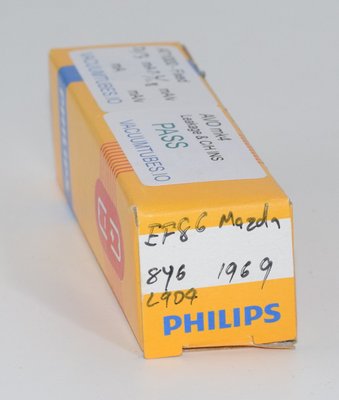
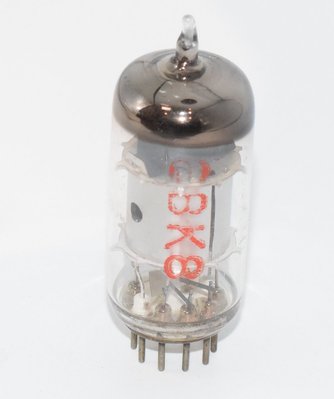
The EF86 was conceived to replace earlier types such as the EF12k and EF40, offering superior noise performance and microphony rejection in a compact Noval (B9A) miniature glass envelope. It was manufactured by virtually every major European valve producer — Mullard (Blackburn, UK), Philips (Eindhoven, Netherlands), Valvo and Telefunken (Germany), Mazda (Belgium and France), Ediswan (England), and GEC — as well as by Toshiba in Japan. The tube was also produced under the American RETMA designation 6267 and was cross-referenced as 6BK8 in some markets.
The Tesla factory in Czechoslovakia produced the EF86 as a "Nízkofrekvenční Pentoda" (low-frequency pentode), with their datasheet dated 2 March 1959 providing comprehensive application data. The tube found its way into countless high-fidelity preamplifiers, tape recorder electronics, and guitar amplifiers throughout the 1950s and 1960s, and remains in active production and high demand today.
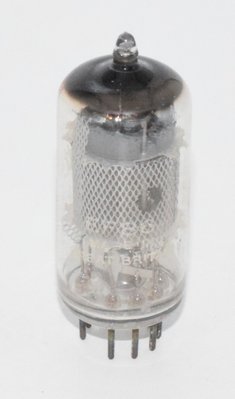
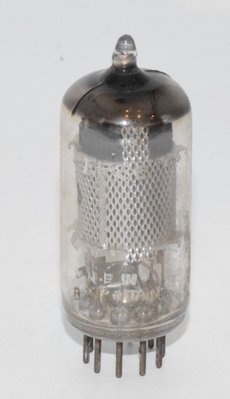
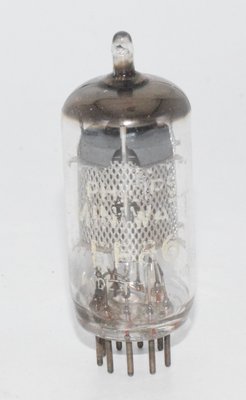
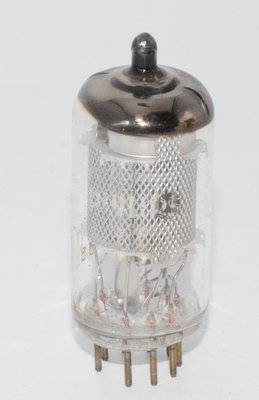
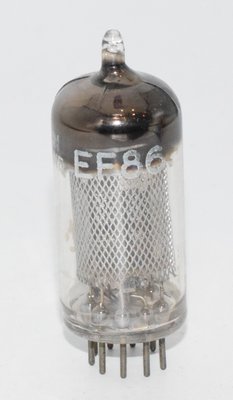
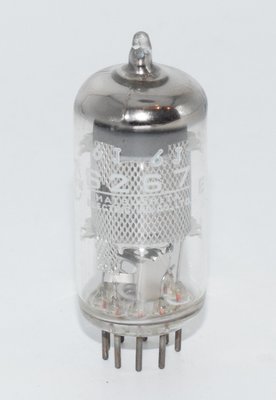
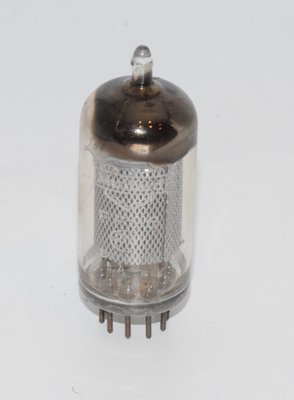
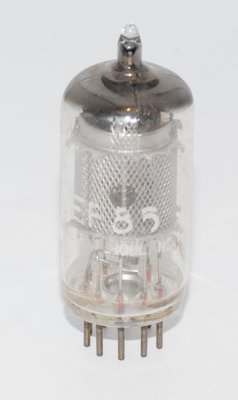
The EF86 was specifically engineered to meet the demanding requirements of high-gain audio input stages where microphony, hum, and noise must be minimised. Special construction techniques — including internal shielding, carefully supported electrode structures, and in many variants, mesh (ladder) anode plates — were employed to achieve these goals. The suppressor grid (g3) and internal screen are brought out to separate pins on the base, allowing flexible grounding and shielding arrangements.
Technical Specifications and Design
Heater Data
| Parameter | Symbol | Value |
|---|---|---|
| Heater Voltage | Vf | 6.3 V |
| Heater Current | If | 0.2 A |
| Heater Type | — | Indirectly heated, parallel feed (AC or DC) |
Interelectrode Capacitances
| Parameter | Symbol | Value |
|---|---|---|
| Input Capacitance (grid-cathode) | Cgk | 3.8 pF |
| Output Capacitance (anode-cathode) | Cak | 5.4 pF |
| Feedback Capacitance (grid-anode) | Cga | 0.025 pF |
| Control grid to heater capacitance | Cg1/f | <0.003 pF |
Note: The Tesla datasheet specifies slightly different values measured without a screening can: Cin = 3.5 pF, Cout = 5 pF, Cfeedback < 0.05 pF. The TDSL reference values of 3.8 pF, 5.4 pF, and 0.025 pF are the more commonly cited figures across multiple manufacturer datasheets.
Characteristic Data (Pentode Mode)
| Parameter | Symbol | Value |
|---|---|---|
| Anode Voltage | Va | 250 V |
| Screen Grid Voltage (g2) | Vg2 | 140 V |
| Control Grid Voltage (g1) | Vg1 | −2.0 V |
| Suppressor Grid Voltage (g3) | Vg3 | 0 V |
| Anode Current | Ia | 3.0 mA |
| Screen Grid Current | Ig2 | 0.6 mA |
| Transconductance (Mutual Conductance) | S (gm) | 2.0 mA/V |
| Amplification Factor | μ | 38 |
| Internal Resistance (Plate Resistance) | Ri (rp) | 2.5 MΩ |
| Anode Load Resistance | Ra | 2.5 MΩ |
Maximum Ratings
| Parameter | Symbol | Value |
|---|---|---|
| Max Anode Voltage (cold) | Va0 | 550 V |
| Max Anode Voltage (operating) | Va | 300 V |
| Max Anode Dissipation | Wa | 1.0 W |
| Max Screen Grid Voltage (cold) | Vg2,0 | 550 V |
| Max Screen Grid Voltage (operating) | Vg2 | 200 V |
| Max Screen Grid Dissipation | Wg2 | 0.2 W |
| Max Cathode Current | Ik | 6 mA |
| Max Cathode-Heater Voltage | Vhk | 100 V (cathode positive), 50 V (cathode negative) |
| Max Grid Bias for Grid Current Onset (Ig1 ≤ 0.3 μA) | Vg1 | −1.3 V |
Grid Resistor Limits
| Condition | Max Rg1 |
|---|---|
| Bias via cathode resistor (Wa ≥ 0.2 W) | 3 MΩ |
| Bias via cathode resistor (Wa < 0.2 W) | 10 MΩ |
| Bias via grid current flow (Rk = 0) | 22 MΩ |
Physical Construction
- Base: Noval (B9A) — 9-pin miniature glass base, per ČSN 35 8904 (S 9/12)
- Envelope: All-glass miniature construction (no top cap)
- Weight: Approximately 15 g
- Maximum Diameter: 22.2 mm
- Maximum Seated Height: Approximately 56.3 mm (excluding pins)
- Internal Shielding: Both the suppressor grid and internal shield are brought out to separate base pins
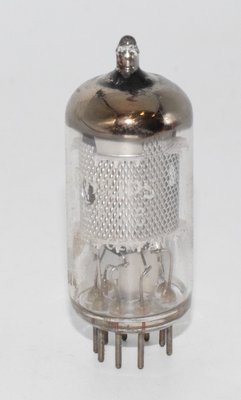
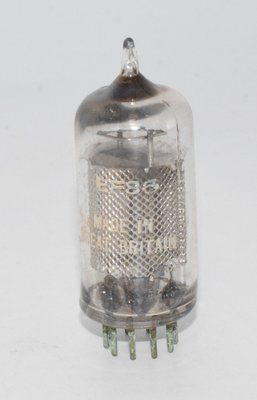
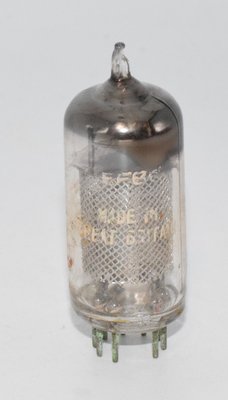
- Anode Construction: Varies by manufacturer — mesh (ladder) plate or solid plate versions exist
Pin Configuration (Noval B9A, bottom view)
| Pin | Connection |
|---|---|
| 1 | Internal Shield / Signal Ground |
| 2 | Anode (Plate) |
| 3 | Suppressor Grid (g3) |
| 4 | Heater |
| 5 | Heater |
| 6 | Cathode |
| 7 | Screen Grid (g2) |
| 8 | Internal Shield / Signal Ground |
| 9 | Control Grid (g1) |
Note: Pins 1 and 8 are the internal shield connections. The suppressor grid (pin 3) and internal shields (pins 1, 8) are brought out separately, allowing independent grounding for optimal noise and hum rejection.
Hum and Microphony Specifications
Under conditions of Va = 250 V, Ra = 100 kΩ, Rg2 = 400 kΩ, Rk = 1 kΩ, Ck = 100 μF, and Rg1 = 0.5 MΩ, the equivalent hum noise voltage (eefn) must not exceed 5 μV.
When the input signal is greater than 0.5 mV, no special precautions against noise, hum, and microphony are needed, provided the grid leak resistor Rg1 is less than 1 MΩ. For output power levels of 50 mW at frequencies above 500 Hz, the medium-frequency acceleration sensitivity must not exceed 0.015 g; at lower frequencies, it must not exceed 0.06 g. Spring-loaded (anti-microphonic) valve holders are recommended, and a metal screening can should be fitted over the tube.
Applications and Usage
Original Design Intent
The EF86 was designed expressly for the input stages of low-frequency (audio) amplifiers where low noise, low microphony, and low hum are essential requirements. The Tesla datasheet describes it as intended for "vstupní obvody nízkofrekvenčních zesilovačů, u nichž se požaduje malá mikrofonie a nepatrné bručení" — input circuits of audio amplifiers requiring low microphony and negligible hum.
Pentode Mode Applications
In pentode mode, the EF86 delivers high voltage gain with excellent linearity. The Tesla datasheet provides extensive operating data for resistance-coupled amplifier service:
- High-gain configuration (250V supply, 220 kΩ anode load, 1 MΩ screen dropper): Voltage gain of 180–200, with 5% distortion at output swings of 46–73 V depending on cathode resistor value.
- Medium-gain configuration (250V supply, 100 kΩ anode load, 400 kΩ screen dropper): Voltage gain of approximately 112–175, with distortion as low as 0.5–1.1% at output levels of 4–8 V peak.
- Low-voltage operation (100V supply): The tube operates satisfactorily with reduced gain (95–150) and lower output swing, making it suitable for equipment with modest power supplies.
Triode Mode Applications
The EF86 can be operated in triode mode by connecting the screen grid (g2) to the anode. In this configuration, the datasheet shows:
- At Vb = 250 V, Ra = 100 kΩ: Gain of approximately 27, anode current of 1.5 mA
- At Vb = 250 V, Ra = 200 kΩ: Gain of approximately 29, anode current of 0.85 mA
- At Vb = 100 V, Ra = 100 kΩ: Gain of approximately 26, anode current of 0.48 mA
Triode mode operation yields lower gain but significantly reduced distortion and output impedance, making it attractive for high-fidelity applications where ultimate linearity is valued over maximum gain.
Typical Circuit Applications
- Phono preamplifier input stages: The EF86's low noise floor makes it ideal for amplifying the tiny signals from magnetic phono cartridges.
- Microphone preamplifiers: Used in studio and broadcast equipment where signal levels are very low.
- Tape head preamplifiers: Found in many high-quality reel-to-reel tape recorders of the 1950s and 1960s.
- Guitar amplifier input stages: Famously used in the Vox AC15 and AC30 amplifiers in the "Normal" channel.
- High-fidelity preamplifier stages: Used in classic designs by Leak, Quad, Rogers, Radford, and many others.
- Phase inverter driver stages: When used as a phase inverter immediately before the output stage, the cathode-to-heater resistance limit is increased to 120 kΩ maximum.
Sound Characteristics
The EF86 has earned a devoted following among audiophiles and musicians for its distinctive sonic qualities. Its sound character varies notably depending on whether it is operated in pentode or triode mode, and significant tonal differences exist between manufacturers and construction variants.
Pentode Mode Sound
In pentode mode, the EF86 is prized for its rich, harmonically complex sound with a lush, slightly warm character. The high gain (up to 200×) means the tube is working with very small input signals, and the pentode topology introduces a characteristic blend of even and odd harmonics that many listeners describe as "full" and "three-dimensional." The midrange is particularly expressive — detailed and present without being aggressive. Bass reproduction is tight and well-defined, while the treble has a smooth, slightly rolled-off quality that avoids harshness. The very high plate resistance (2.5 MΩ) means the tube's output impedance is high, which interacts with the following stage's input capacitance to create a natural, gentle high-frequency roll-off that many find musically pleasing.
Triode Mode Sound
Wired as a triode, the EF86 takes on a different character — cleaner, more transparent, and with a more linear harmonic structure dominated by even-order harmonics. The lower gain (approximately 26–31×) means less amplification of noise and microphony, and the reduced plate resistance gives a more controlled, damped sound. Many audiophiles prefer triode mode for its greater clarity and more "direct" presentation, though it sacrifices the pentode mode's richness and gain.
Manufacturer Variations
Experienced listeners report significant sonic differences between manufacturers:
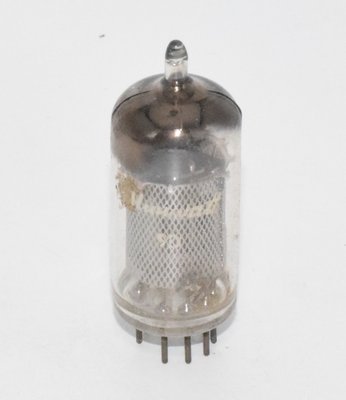
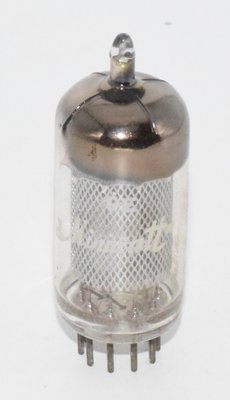
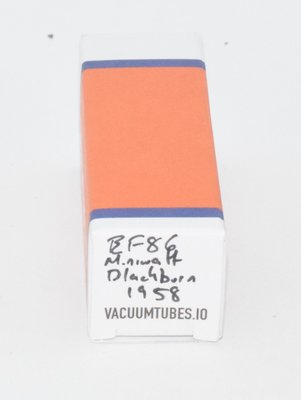
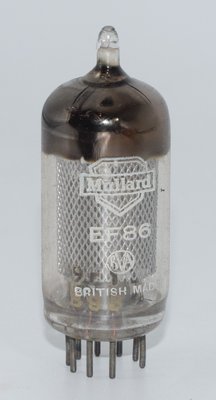
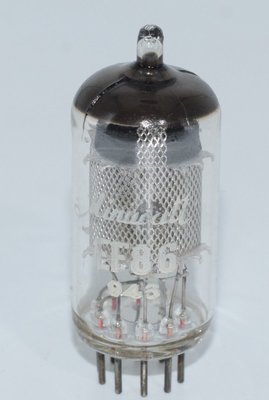
- Mullard (Blackburn, UK) — Mesh Plate: Widely considered the gold standard. The long mesh plate versions from the late 1950s and early 1960s are especially prized for their warm, liquid midrange, excellent detail retrieval, and low microphony. These are among the most sought-after and expensive NOS EF86 variants.
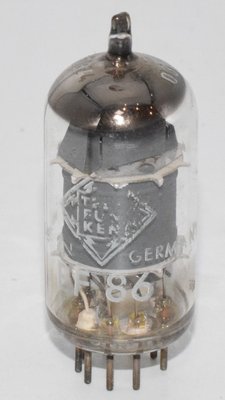
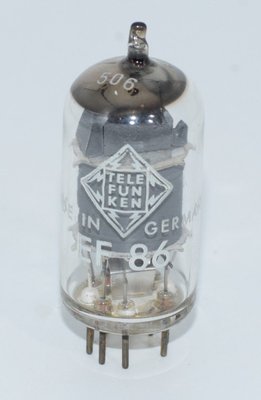
- Telefunken (Germany) — Diamond Bottom: Known for exceptional clarity, precision, and a slightly more neutral tonal balance compared to Mullard. The smooth-plate Telefunken EF86 with the characteristic diamond-shaped mark on the base is considered one of the finest examples. Excellent noise performance.
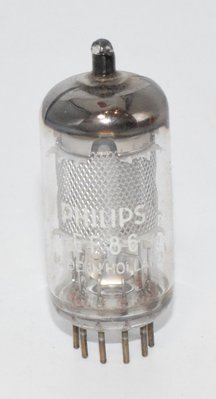
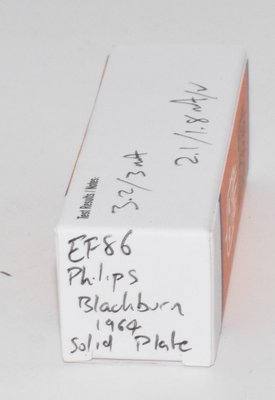
- Philips/Miniwatt (Holland/Various): Generally warm and musical, with good noise performance. Quality varies depending on the actual factory of manufacture — many Philips-branded tubes were actually made at the Mullard Blackburn plant or by Toshiba in Japan.
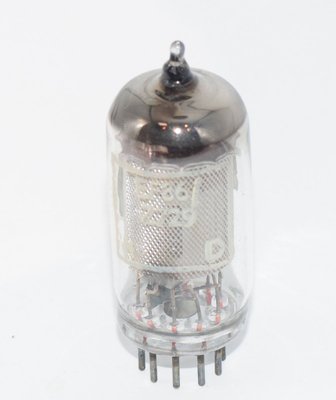
- GEC/Marconi-Osram (England): Often branded as Z729 (the British military/CV designation). Noted for a slightly more forward, detailed sound with excellent dynamics. Highly regarded and increasingly rare.
- Valvo (Germany): Typically Philips/Mullard designs manufactured in Hamburg. Sound quality is generally on par with other Philips-family production.
- Toshiba (Japan): Produced under the 6267 designation and sometimes labelled as Philips Miniwatt. Generally competent performers with a clean, neutral sound, though not as highly regarded as the best European production.
- Mesh Plate vs. Solid Plate: Across all manufacturers, mesh (ladder) plate variants are generally preferred by audiophiles for their slightly warmer, more open sound and often lower microphony. Solid plate versions tend to be slightly more robust and may offer marginally better noise performance in some cases.
In Guitar Amplifiers
In guitar amplifier applications, the EF86 contributes a distinctive character quite different from the more common 12AX7/ECC83. The pentode's higher gain and different harmonic structure produce a thicker, more complex overdrive tone with greater sustain. Clean tones through an EF86 input stage have a characteristic "chime" and shimmer — the hallmark of the Vox AC15 and AC30 "Normal" channel sound. When pushed into distortion, the EF86 produces a creamy, compressed overdrive that is harmonically rich without being harsh.
Equivalent and Substitute Types
Direct Equivalents (Drop-in Replacements)
| Type | Notes |
|---|---|
| 6267 | American RETMA designation. Electrically identical to EF86. Direct drop-in replacement. |
| 6F22 | Equivalent designation. Direct replacement. |
| CV10098 | British military (CV) designation for EF86. Direct replacement. |
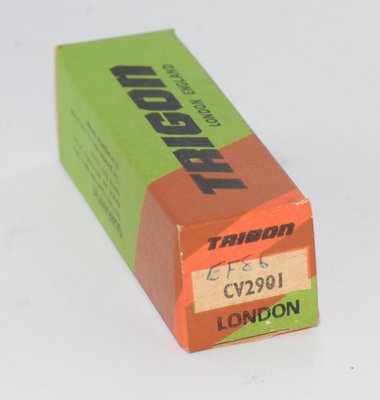
| CV2901 | British military (CV) designation for EF86. Direct replacement. |
| CV8068 | British military (CV) designation for EF86. Direct replacement. |
| Z729 | GEC/Marconi-Osram designation. Electrically identical to EF86. Direct drop-in replacement. Highly sought after by collectors. |
| 6BK8 | Listed by Tesla as a direct equivalent. Direct replacement with possible base change — confirm pin compatibility before use. |
Related Types (NOT Direct Drop-in Replacements)
| Type | Notes |
|---|---|
| EF806S | Telefunken premium "Special Quality" version of the EF86. Tighter manufacturing tolerances, lower noise, and lower microphony. Electrically similar but selected/specified to higher standards. Generally usable as a drop-in but may have slightly different operating characteristics. Extremely rare and expensive. |
| UF86 | 100 mA series heater version (U = 100 mA heater series). Different heater voltage/current — NOT a drop-in replacement for EF86 without heater circuit modification. |
| EF12k | Older type that the EF86 was designed to replace. Different base (Rimlock or side-contact). Not interchangeable. |
| EF40 | Older Rimlock-based type that the EF86 replaced. Not interchangeable without adapter. |
Notable Characteristics
Exceptional Low-Noise Design
The EF86's most notable characteristic is its extraordinarily low noise floor for a pentode valve. The combination of internal shielding (brought out to pins 1 and 8), separate suppressor grid connection (pin 3), and careful electrode construction results in hum and noise levels that approach those of the best triodes. The specified maximum equivalent noise voltage of 5 μV under standard test conditions was remarkable for its era and remains impressive today.
Ultra-Low Feedback Capacitance
The grid-to-anode capacitance of just 0.025 pF is exceptionally low, even by pentode standards. This minimises Miller effect and ensures stable, predictable high-frequency performance even at high gain settings. The Tesla datasheet specifies the control grid to heater capacitance at less than 0.003 pF, further demonstrating the effectiveness of the internal shielding.
Microphony Sensitivity
While the EF86 was designed for low microphony, this remains its Achilles' heel in practice. The high gain means that any mechanical vibration of the electrode structure is amplified significantly. The Tesla datasheet specifies that at frequencies above 500 Hz, the medium-frequency acceleration sensitivity must not exceed 0.015 g, and at lower frequencies, not more than 0.06 g. Spring-loaded valve holders and metal screening cans are strongly recommended. Worn or poorly manufactured examples can exhibit significant microphony, which is why NOS (New Old Stock) examples from premium manufacturers command such high prices.
Versatile Operating Range
The EF86 operates effectively across a wide range of supply voltages, from 100V to 400V, as documented extensively in the Tesla datasheet. This versatility makes it suitable for everything from portable equipment to high-voltage audiophile designs. The tube can be operated in pentode, triode (screen tied to anode), or ultra-linear configurations.
High Amplification Factor
With an amplification factor (μ) of 38 in pentode mode and transconductance of 2.0 mA/V, the EF86 delivers substantial voltage gain from a single stage. In resistance-coupled amplifier service with appropriate load resistors, voltage gains of 95 to 200 are readily achievable, depending on operating conditions and supply voltage.
Construction Variants
Two principal anode construction methods exist across manufacturers:
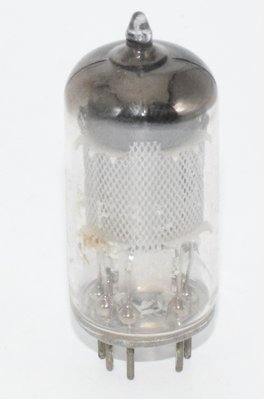
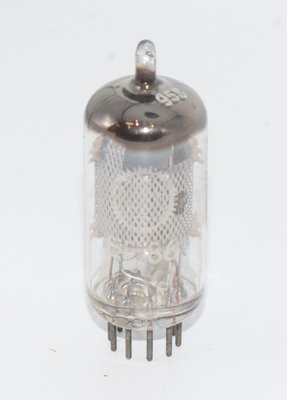
- Mesh (Ladder) Plate: An open-frame anode structure that allows better heat dissipation and is generally associated with lower microphony. Preferred by most audiophiles. Mullard's "long mesh" plates from the late 1950s are particularly celebrated.
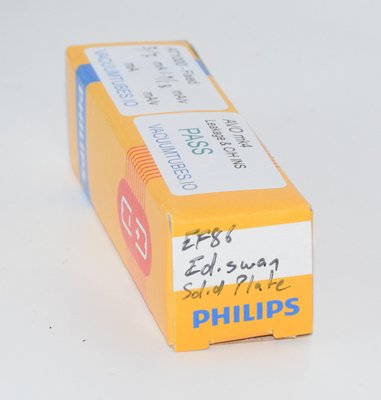
- Solid Plate: A conventional pressed-metal anode. Generally more robust and sometimes offering slightly better shielding, but potentially more prone to microphony in some designs.
Usage in the Audio Community
High-Fidelity Preamplifiers
The EF86 is a cornerstone of classic British hi-fi design. It was the input valve of choice for many of the most respected preamplifiers of the golden age of valve audio:
- Leak Point One and Varislope preamplifiers: Harold Leak's legendary designs used the EF86 as the critical first gain stage.
- Quad 22 preamplifier: Peter Walker's iconic design employed EF86 valves.
- Rogers Cadet and Master preamplifiers: Classic British designs built around the EF86.
- Radford STA series preamplifiers: Arthur Radford's highly regarded designs.
In modern hi-fi, the EF86 continues to be used in boutique and DIY preamplifier designs. Its combination of high gain, low noise, and musical character makes it attractive for phono stages, line-level preamplifiers, and headphone amplifier input stages. Many contemporary designers use the EF86 in triode mode for its lower distortion and more predictable behaviour, accepting the reduced gain in exchange for greater linearity.
Guitar Amplifiers
The EF86's most famous guitar amplifier application is in the Vox AC15 (original 1958 design) and the Vox AC30 ("Normal" or "Top Boost" channel in various iterations). The EF86 input stage gives these amplifiers their characteristic chiming, harmonically rich clean tone and their creamy, singing overdrive. The tube's high gain means that a single EF86 stage can drive an output stage or tone stack directly, simplifying circuit design.
Other notable guitar amplifier applications include:
- Matchless DC30 and Lightning: Modern boutique amplifiers inspired by the Vox heritage.
- Dr. Z Route 66 and Carmen Ghia: Acclaimed boutique designs featuring EF86 input stages.
- 65amps London and Lil' Elvis: Contemporary designs exploiting the EF86's unique tonal character.
- Various boutique and custom amplifiers: The EF86 has experienced a renaissance in the boutique amplifier world, with many builders offering EF86-based designs as an alternative to the ubiquitous 12AX7.
A practical consideration for guitar amplifier use is that the EF86's sensitivity to microphony can be problematic in high-volume stage environments. Quality NOS tubes, anti-vibration socket mounts, and proper screening cans are essential for reliable performance.
Recording Studio Equipment
The EF86 was widely used in professional recording equipment during the 1950s and 1960s, including microphone preamplifiers, mixing console input stages, and tape machine electronics. Vintage studio equipment featuring EF86 valves is highly prized in the recording community for its warm, musical character. Modern boutique microphone preamplifier designs sometimes incorporate the EF86 for its distinctive sonic signature.
The NOS Market
The EF86 is one of the most actively traded NOS (New Old Stock) valve types in the audio community. Prices vary enormously depending on manufacturer, date of production, construction type, and tested performance:
- Mullard Blackburn Long Mesh Plate (late 1950s–early 1960s): Among the most expensive and sought-after. These are considered the benchmark for EF86 sound quality.
- Telefunken Diamond Bottom: Equally prized, particularly the smooth-plate versions. Known for their exceptional clarity and low noise.
- GEC Z729: Increasingly rare and commanding premium prices. Valued for their dynamic, detailed sound.
- Philips Miniwatt (various origins): Widely available and generally good performers. Buyers should be aware that many Philips-branded tubes were actually manufactured at the Mullard Blackburn factory or by Toshiba in Japan — factory codes on the tube glass can reveal the true origin.
- Ediswan (England): Relatively uncommon and valued by collectors. Solid plate construction is typical.
Current production EF86 tubes are available from manufacturers including JJ Electronic (Slovakia), Electro-Harmonix/Sovtek (Russia), and others. While these modern production tubes are serviceable, most experienced listeners find them somewhat inferior to the best NOS examples in terms of noise performance, microphony rejection, and overall sonic refinement. The JJ EF86 is generally well-regarded among current production options.
Practical Considerations for Audio Use
- Socket quality: Use high-quality ceramic or PTFE Noval sockets. Poor socket contact can introduce noise and intermittent connections.
- Screening can: Always use a grounded metal screening can to minimise hum pickup and electrostatic interference.
- Anti-vibration mounting: Spring-loaded or rubber-damped socket mounts significantly reduce microphony.
- Heater wiring: Twisted heater leads, or DC heater supplies with careful grounding, minimise hum injection. The cathode-to-heater voltage rating of 100V (cathode positive) allows the use of elevated heater supplies for hum reduction.
- Grid resistor value: Keep the grid leak resistor below 1 MΩ for best noise performance when the input signal exceeds 0.5 mV.
- Power supply quality: The EF86's high gain means it will faithfully amplify any power supply noise. Well-filtered, low-ripple supplies are essential.