Introduction and History
The EL33 is a high-sensitivity output pentode designed by Mullard (Philips) for use in A.C. mains-operated audio equipment. Developed during the golden era of European valve design, the EL33 was conceived as a versatile power output tube capable of delivering meaningful audio power from a relatively modest drive signal. Its designation follows the Mullard-Philips European Pro-Electron naming convention, where 'E' denotes a 6.3V heater voltage and 'L' indicates an output pentode.
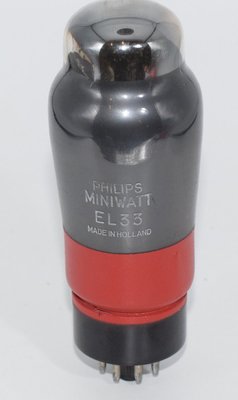
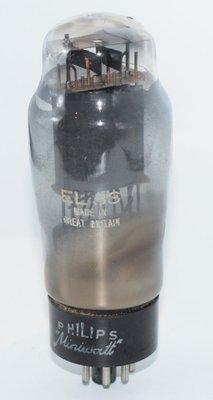
The EL33 emerged during a period when European manufacturers were developing families of output pentodes optimized for domestic radio receivers and small amplifiers. Its high sensitivity — requiring only modest input voltage to reach full output — made it particularly attractive for designs where fewer gain stages were desired, simplifying circuit topology and reducing cost. The tube was manufactured primarily by Mullard in the United Kingdom and by Philips across various European factories, including the notable Wiener Radio Werke (WIRAG) facility in Vienna, Austria. Examples from the WIRAG plant are considered quite rare by collectors today.
While never achieving the widespread fame of its cousins the EL34 or EL84, the EL33 carved out a respected niche in mid-20th century audio equipment and continues to attract interest from vintage audio enthusiasts and collectors who appreciate its distinctive sonic character and historical significance.
Technical Specifications and Design
Heater
| Parameter | Value |
|---|---|
| Heater Voltage (Vh) | 6.3 V |
| Heater Current (Ih) | 0.9 A |
Interelectrode Capacitance
| Parameter | Value |
|---|---|
| Ca-g1 | 1.0 pF (µµF) |
Limiting Values (Absolute Maximum Ratings)
| Parameter | Value |
|---|---|
| Max. Anode Voltage Va(b) | 550 V |
| Max. Anode Voltage Va | 250 V |
| Max. Anode Dissipation Wa | 9 W |
| Max. Screen Grid Voltage Vg2(b) | 550 V |
| Max. Screen Grid Voltage Vg2 | 275 V |
| Max. Screen Dissipation Wg2 (zero signal) | 1.2 W |
| Max. Screen Dissipation Wg2 (max. signal) | 2.5 W |
| Max. Cathode Current Ik | 55 mA |
| Max. Grid 1 Voltage Vg1 (at Ig1 = 0.3 µA) | -1.3 V |
| Max. Grid 1 Leak Resistance R(g1-a) | 1 MΩ |
| Max. Heater-Cathode Voltage Vh-k | 50 V |
| Max. Heater-Cathode Resistance Rh-k | 5,000 Ω |
Operating Conditions — Class 'A' Single-Ended Pentode
| Parameter | Value |
|---|---|
| Anode Voltage (Va) | 250 V |
| Screen Grid Voltage (Vg2) | 250 V |
| Anode Current (Ia) | 36 mA |
| Control Grid Voltage (Vg1) | -6 V |
| Screen Grid Current (Ig2) | 4 mA |
| Transconductance (gm) | 9 mA/V |
| Anode Resistance (ra) | 50,000 Ω |
| Amplification Factor µ(g1g2) | 23 |
| Output Power (Wout) | 4.5 W |
| Optimum Load Impedance (Ra) | 7,000 Ω |
| Input Voltage Vin(rms) | 4.2 V |
| Input Sensitivity Vin(rms) (50 mW) | 0.33 V |
| Total Harmonic Distortion (Dtot) | 10% |
| Cathode Resistor (Rk) | 150 Ω |
Operating Conditions — Push-Pull (Two Valves)
| Parameter | Value |
|---|---|
| Anode Voltage (Va) | 250 V |
| Screen Grid Voltage (Vg2) | 250 V |
| Quiescent Anode Current (Iao) | 2 × 24 mA |
| Max. Anode Current (Ia max.) | 2 × 28.5 mA |
| Quiescent Screen Current (Ig2o) | 2 × 2.8 mA |
| Max. Screen Current (Ig2 max.) | 2 × 4.6 mA |
| Cathode Resistor (Rk) | 140 Ω |
| Load Impedance Ra (anode to anode) | 10,000 Ω |
| Output Power (Wout) | 8.2 W |
| Input Voltage Vin(rms) | 6.7 V |
| Total Harmonic Distortion (Dtot) | 3.1% |
Operating Conditions — Triode Mode (g2 connected to anode)
| Parameter | Value |
|---|---|
| Anode Voltage (Va) | 250 V |
| Anode Current (Ia) | 20 mA |
| Control Grid Voltage (Vg) | -8.5 V |
| Transconductance (gm) | 6.5 mA/V |
| Amplification Factor (µ) | 20 |
| Anode Resistance (ra) | 3,000 Ω |
| Cathode Resistor (Rk) | 425 Ω |
| Optimum Load Impedance (Ra) | 7,000 Ω |
| Output Power (Wout) | 1.1 W |
| Total Harmonic Distortion (Dtot) | 5% |
| Input Voltage Vin(rms) | 5.9 V |
| Input Sensitivity Vin(rms) (50 mW) | 1.1 V |
Physical Construction
| Parameter | Value |
|---|---|
| Base Type | Octal (International Octal, IO) |
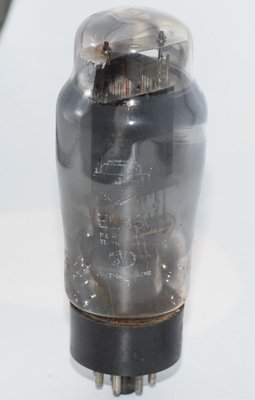
| Envelope | Glass, ST-shape (shouldered) |
| Maximum Diameter | 46 mm |
| Maximum Height | 126 mm |
| Mounting Position | Any |
Pin Configuration (Octal Base, viewed from below)
| Pin | Connection |
|---|---|
| Pin 1 | No connection (key position) |
| Pin 2 | Heater (h) |
| Pin 3 | Anode (a) |
| Pin 4 | Screen Grid (g2) |
| Pin 5 | Control Grid (g1) |
| Pin 6 | No connection |
| Pin 7 | Heater (h) |
| Pin 8 | Cathode (k) |
| Top Cap | Not applicable — suppressor grid (g3) is internally connected to cathode |
Note: The suppressor grid (g3) is internally connected to the cathode. The arrangement of electrodes shows g1, g2, g3, anode, with the cathode at the bottom of the structure.
Applications and Usage
The EL33 was designed primarily as an output pentode for A.C. mains-operated equipment, and its applications span several categories:
Radio Receivers
The EL33's primary intended application was as the audio output stage in domestic radio receivers. Its high sensitivity — requiring only 0.33 V rms input for 50 mW output, or 4.2 V rms for full 4.5 W output in pentode mode — meant it could be driven directly by a simple detector or single voltage amplifier stage. This reduced component count and manufacturing cost, making it ideal for consumer radio sets of the 1940s and 1950s.
Small Audio Amplifiers
In single-ended Class A pentode configuration, the EL33 delivers 4.5 W into a 7,000 Ω load at 250 V. While modest by modern standards, this was entirely adequate for domestic listening in the era of high-efficiency speakers. A pair of EL33s in push-pull delivers 8.2 W with only 3.1% total harmonic distortion at 250 V, with a 10,000 Ω anode-to-anode load — a very respectable performance for a medium-power amplifier.
Triode-Connected Operation
When operated as a triode (screen grid connected to anode), the EL33 produces 1.1 W at 5% distortion with a 7,000 Ω load. The triode-connected mode yields a much lower anode resistance of 3,000 Ω (compared to 50,000 Ω in pentode mode), providing significantly better damping factor and a more linear transfer characteristic. This mode is favored by audiophiles who prioritize tonal purity over output power.
Public Address and Industrial Equipment
The EL33 found use in smaller public address systems, intercommunication equipment, and industrial audio applications where its reliable performance and moderate power output were well-suited to the task.
Sound Characteristics
The EL33 occupies an interesting sonic territory that reflects its design as a high-sensitivity output pentode with a relatively modest power rating. Its sound character varies significantly depending on the operating mode chosen:
Pentode Mode
In pentode configuration, the EL33 exhibits a lively, dynamic sound with good transient response. The high anode resistance of 50,000 Ω means that the output transformer's characteristics play a dominant role in shaping the frequency response, and careful transformer selection is essential. The harmonic distortion spectrum in pentode mode tends to include higher-order harmonics, which can lend a sense of presence and detail to the midrange. At moderate listening levels — well below the 4.5 W maximum — the EL33 in pentode mode can sound surprisingly open and articulate, with a characteristic "British" warmth that distinguishes it from the more aggressive American beam tetrode sound.
The 10% THD at full output is typical for a single-ended pentode of this era, and in practice, most listeners will find the tube sounds its best at lower power levels where distortion drops considerably. The distortion characteristics and power output curves provided in the Mullard datasheet show that at around 2-3 W output, distortion falls to more manageable levels with a more benign harmonic structure.
Triode Mode
Triode-connected, the EL33 transforms into a gentler, more refined performer. With an amplification factor (µ) of 20 and an anode resistance of only 3,000 Ω, the tube provides excellent damping and a smoother, more linear transfer characteristic. The 1.1 W output at 5% distortion may seem limited, but paired with efficient speakers (95 dB/W/m or higher), this provides ample volume for intimate listening environments.
In triode mode, listeners describe the EL33 as having a warm, liquid midrange with a natural, unforced quality. The lower-order harmonic distortion profile — predominantly second harmonic — creates a pleasing euphonic coloration that enhances vocal reproduction and acoustic instruments. Bass response benefits from the dramatically lower output impedance, providing tighter and more controlled low-frequency performance compared to pentode operation.
Overall Character
The EL33 is generally described as a refined, well-mannered tube that lacks the raw power and aggression of larger output pentodes but compensates with finesse and musicality. Its high sensitivity makes it particularly responsive to the quality of the preceding driver stage, and it rewards careful circuit design with a cohesive, engaging sound. The tube's European heritage is evident in its tonal balance, which tends toward a slightly warm, smooth presentation rather than the brighter, more forward character associated with some American output tubes.
Equivalent and Substitute Types
Direct Equivalents (Drop-in Replacements)
| Type | Notes |
|---|---|
| CV2938 | British military (Common Valve) designation for the EL33. Electrically and physically identical; direct drop-in replacement. Often found in excellent condition due to military quality control and storage standards. |
Related Types (NOT Direct Drop-in Replacements)
| Type | Notes |
|---|---|
| 6AG6 | Listed as a related type with different ratings. This is NOT a direct substitute and should not be used as a drop-in replacement without careful verification of all operating parameters and pin compatibility. Circuit modifications may be required. |
Important: The EL33 should not be confused with the EL34, which is a substantially different and more powerful output pentode. While both are European octal-based output pentodes, they have entirely different electrical characteristics and are not interchangeable.
Notable Characteristics
Exceptional Sensitivity
Perhaps the most distinctive feature of the EL33 is its remarkably high sensitivity. With a transconductance of 9 mA/V in pentode mode and requiring only 4.2 V rms for full output, the EL33 can be driven to full power by a single medium-gain triode stage. The 50 mW sensitivity figure of just 0.33 V rms is particularly impressive, meaning that even a crystal pickup or simple detector stage could provide adequate drive for background listening levels.
Moderate Power with Low Supply Requirements
Operating at 250 V on both anode and screen, the EL33 does not demand the high-voltage power supplies required by larger output pentodes. The total cathode current of 40 mA (36 mA anode + 4 mA screen) in pentode mode keeps power supply demands reasonable, making it suitable for compact amplifier designs.
Versatile Operating Modes
The EL33's ability to operate effectively in pentode, ultralinear (with appropriate output transformer taps), and triode modes gives designers considerable flexibility. The push-pull configuration nearly doubles the output power to 8.2 W while dramatically reducing distortion from 10% to just 3.1%, demonstrating excellent push-pull cancellation characteristics.
Robust Construction
With a maximum anode voltage (boost) rating of 550 V and a maximum cathode current of 55 mA, the EL33 has considerable headroom above its normal operating point. The maximum anode dissipation of 9 W provides a comfortable margin when operating at the typical 4.5 W output level, contributing to long tube life and reliable operation.
Self-Bias Operation
The EL33 is well-suited to cathode (self) bias operation. In pentode mode, a 150 Ω cathode resistor (bypassed with a 50 µF capacitor) establishes the correct -6 V bias. In triode mode, a 425 Ω cathode resistor provides the required -8.5 V bias. This eliminates the need for a separate negative bias supply, simplifying amplifier design.
Usage in the Audio Community
The EL33 occupies a distinctive position in the contemporary audio community — it is not a mainstream choice for new amplifier builds, but it commands respect and interest among several groups of enthusiasts:
Vintage Equipment Restoration
The most common encounter with the EL33 today is in the restoration of vintage British and European radio receivers and amplifiers from the 1940s and 1950s. Restorers seek original or NOS (New Old Stock) EL33 tubes to maintain authenticity in their restorations. Mullard-branded examples are particularly sought after, and specimens from the Philips Miniwatt Wiener Radio Werke (WIRAG) factory in Vienna are considered rare collector's items.
Single-Ended Triode (SET) Amplifiers
A small but dedicated group of SET enthusiasts has discovered the EL33 as an interesting candidate for low-power triode amplifiers. With 1.1 W in triode mode and a pleasingly low 3,000 Ω anode resistance, the EL33 can drive high-efficiency speakers with a refined, intimate sound. The tube's high sensitivity means that a single 12AX7 or 12AT7 dual triode can serve as both input and driver stage, enabling very simple two-stage amplifier designs.
Push-Pull Amplifier Projects
The push-pull configuration of the EL33, delivering 8.2 W at only 3.1% THD with a 10,000 Ω anode-to-anode load, represents an attractive option for builders seeking a vintage-flavored amplifier with enough power for moderately efficient speakers. The relatively low supply voltage requirement of 250 V simplifies power supply design and improves safety margins.
Collector Interest
As with many vintage European valves, the EL33 has become a collector's item. Military-grade CV2938 examples are prized for their typically superior construction and testing standards. Philips Miniwatt branded tubes, especially those from less common production facilities, attract premium prices. The tube's relative scarcity compared to more common types like the EL34 or EL84 adds to its collectibility.
Availability and Pricing
The EL33 is no longer in production, and all available stock is NOS or used/tested vintage inventory. Supplies are limited but not yet critically scarce, and tested examples from reputable dealers — often AVO-tested for emission and mutual conductance — can still be found at reasonable prices compared to more fashionable vintage output tubes. Buyers should ensure tubes are properly tested, as decades of storage can affect emission and reliability.
Practical Considerations for Modern Builders
For those considering the EL33 for a new build, several practical factors should be noted: the octal base is readily available and easy to work with; suitable output transformers with 7,000 Ω primary impedance (single-ended) or 10,000 Ω anode-to-anode (push-pull) can be sourced from specialist manufacturers; and the moderate operating voltages and currents make the EL33 a relatively forgiving tube to design around. The main challenge is securing a sufficient supply of matched tubes for push-pull applications, given the tube's NOS-only availability.