1. Introduction and History
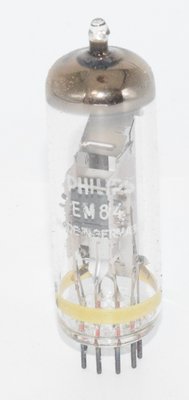
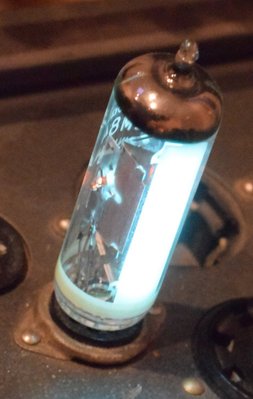
The EM84 is a miniature magic eye tuning indicator tube (valve) developed in the late 1950s as part of the European Noval-based indicator tube family. Unlike the classic circular "cat's eye" indicators such as the EM80 or EM34, the EM84 features a bar-graph style fluorescent display, where a luminous strip on the screen expands or contracts along the axis of the tube's envelope in response to the voltage applied to its control grid. This linear display format made it particularly well-suited for use in FM tuners, tape recorders, and measuring instruments where a precise null or peak indication was required.
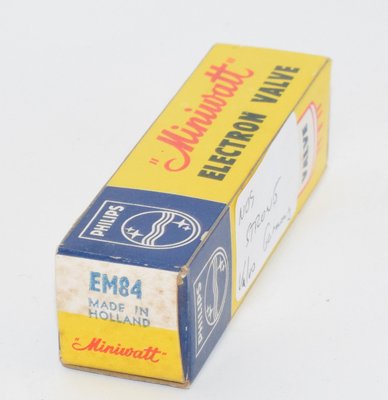
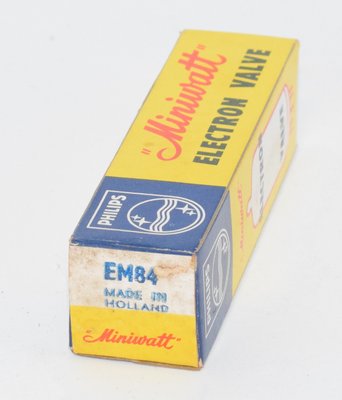
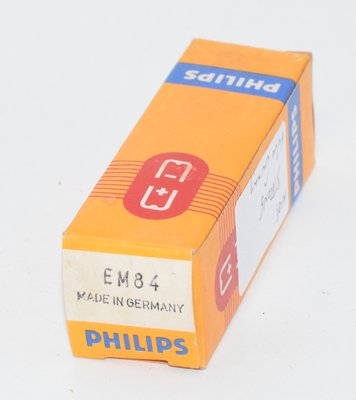
The EM84 was manufactured by numerous European valve makers, including Philips (Miniwatt), Tesla, Mullard, Valvo, and Siemens. The Tesla datasheet from October 1958 (Ministerstvo Přesného Strojírenství) provides one of the most detailed published specifications for this type. Philips Miniwatt produced highly regarded NOS examples in Holland that remain sought after by collectors and restorers today.
The EM84 was designed as a successor and complement to earlier round magic eye types, offering a more modern aesthetic and improved visibility in slim-profile radio and hi-fi chassis. Its all-glass miniature construction with a Noval (B9A) base made it easy to integrate into the compact equipment designs of the late 1950s and 1960s.
2. Technical Specifications and Design
General Description
The EM84 is an all-glass miniature tuning indicator with a Noval base, containing a single triode system. The indicator displays a luminous bar along the axis of the screen on the tube's envelope. The maximum deflection of the display corresponds to the maximum luminous area on the screen. The triode control system and the indicator target share a common cathode.
Heater Data
| Parameter | Symbol | Value |
|---|---|---|
| Heater Voltage | Uf | 6.3 V |
| Heater Current | If | 0.27 A |
The heater is indirectly heated with an oxide-coated cathode, designed for parallel AC supply operation.
Note: The TDSL reference database lists the heater current as 0.21 A, while the Tesla manufacturer datasheet specifies 0.27 A. The 0.27 A figure from the original Tesla datasheet is used here as the primary source. Users should verify against the specific manufacturer's datasheet for their particular tube sample, as slight variations between manufacturers are possible.
Interelectrode Capacitance
| Parameter | Symbol | Value |
|---|---|---|
| Anode to Cathode Capacitance | Ca/k | 0.8 pF |
Operating Conditions (D connected to a — triode section)
| Parameter | Symbol | Condition 1 | Condition 2 | Unit |
|---|---|---|---|---|
| Supply Voltage | Ub = Ul | 250 | V | |
| Anode Load Resistor | Ra | 0.5 | MΩ | |
| Grid Leak Resistor | Rg1 | 3 | MΩ | |
| Control Grid Voltage | Ug1 | 0 | −22 | V |
| Screen Current | Il | 1.1 | 1.6 | mA |
| Anode Current | Ia + Il | 0.45 | 0.06 | mA |
| Bar Length (luminous strip) | b | 21 | 0 | mm |
| Bar Length (minimum visible) | >15 | <3 | mm | |
At zero grid bias (Ug1 = 0 V), the luminous bar is at its maximum length of approximately 21 mm. As the grid voltage is driven to −22 V, the bar closes down to essentially zero length. This provides a clear, intuitive visual indication of signal strength or tuning accuracy.
Absolute Maximum Ratings
| Parameter | Symbol | Value | Unit |
|---|---|---|---|
| Maximum Anode Voltage | Ua max | 300 | V |
| Maximum Anode Dissipation | Wa max | 0.5 | W |
| Maximum Screen (Target) Voltage | Ul max | 300 | V |
| Minimum Screen (Target) Voltage | Ul min | 150 | V |
| Maximum Grid Leak Resistance | Rg1 max | 3 | MΩ |
| Maximum Cathode Current | Ik max | 3 | mA |
| Maximum Cathode-Heater Voltage | Uk/f max | 100 | V |
| Maximum Bulb Temperature | Tbulb max | 120 | °C |
Note: The EM84 is a tuning indicator tube, not an amplifying valve. Parameters such as amplification factor (μ), transconductance (gm), and plate resistance (rp) are not typically specified in manufacturer datasheets for this tube type, as they are not relevant to its intended indicator function.
Physical Details
- Base Type: Noval (B9A), 9-pin miniature — Socket: S 9/12 ČSN 35 8904
- Envelope: All-glass miniature, maximum diameter 22.2 mm, maximum length approximately 70 mm
- Weight: Approximately 14 g
- Mounting: Vertical (recommended for optimal display visibility)
Pin Configuration (Noval B9A — bottom view)
| Pin | Connection |
|---|---|
| 1 | Fluorescent target/screen (l) |
| 2 | Internal connection (do not use) |
| 3 | Anode (a) |
| 4 | Heater (f) |
| 5 | Heater (f) |
| 6 | Control grid (g1) |
| 7 | Cathode (k) / Deflection electrode (D) |
| 8 | Internal connection (do not use) |
| 9 | Cathode (k) / Control grid connection (kg1) |
Important: Pins 2 and 8 are internal connections and must not be connected to any external circuit. The deflection electrode (D) is connected to the anode (a) in normal operation, as specified in the operating conditions.
Characteristic Curve
The Tesla datasheet provides a characteristic curve showing the luminous bar length a as a function of control grid voltage Ug1, measured at Ub = 250 V, Ul = 250 V, Ra+D = 470 kΩ, and Rg = 3 MΩ. The curve shows an exponential-like response: the bar length remains near zero for grid voltages more negative than approximately −22 V, begins to open around −20 V, and increases rapidly as the grid approaches 0 V, reaching a maximum of approximately 21–25 mm.
3. Applications and Usage
The EM84 was designed primarily for the following applications:
- FM and AM Radio Tuning Indication: The EM84 served as a visual tuning aid in radio receivers. Connected to the AGC (automatic gain control) line, the bar display would reach maximum width when the receiver was precisely tuned to a station, providing an intuitive visual confirmation of correct tuning.
- Television Receiver Tuning: As noted in the Tesla datasheet, the EM84 was suitable for use as a tuning indicator in television receivers.
- Null and Level Indicators: The linear bar-graph display made the EM84 ideal for use in measuring instruments, audio level meters, and bridge-balance indicators where a zero or peak reading needed to be displayed.
- Tape Recorder Level Indication: Many European reel-to-reel tape recorders of the 1960s used the EM84 (or its close relatives) as a recording level indicator, with the bar length corresponding to the signal level being recorded.
- Signal Strength Meters: In communications receivers and test equipment, the EM84 provided a convenient visual signal strength display.
The typical circuit configuration connects the EM84's control grid to the AGC voltage of the receiver through a high-value resistor (up to 3 MΩ). The anode and deflection electrode are connected together through a 470–500 kΩ load resistor to the B+ supply (250 V). The fluorescent target is fed directly from the B+ supply. As the AGC voltage becomes more negative (indicating a stronger received signal), the bar closes, and as the receiver is tuned to the exact center frequency, the AGC voltage reaches its most negative point, causing the bar to reach its minimum width — or, depending on the circuit polarity, its maximum width.
4. Sound Characteristics
It is important to note that the EM84 is not an audio amplification tube — it is a visual indicator valve. It does not appear in the audio signal path in any conventional application and therefore does not directly contribute to the "sound" of an amplifier or preamplifier in the traditional sense.
However, in the context of audio equipment and the audiophile community, the EM84's characteristics are discussed in terms of its indirect influence on the audio experience:
- No Direct Tonal Contribution: Since the EM84 operates as a display device, it does not color, shape, or influence the audio signal. Any claims about its "sound" would be unfounded from an engineering perspective.
- Potential for Noise: Like all vacuum tubes, the EM84 generates some level of electrical noise. In poorly designed or poorly shielded circuits, the heater and plate supply connections to the EM84 could theoretically introduce minor hum or noise into adjacent audio circuitry. Well-designed equipment isolates the indicator circuit from the audio path, rendering this a non-issue.
- Psychoacoustic and Aesthetic Impact: Audiophiles frequently note that the presence of a glowing magic eye indicator enhances the perceived listening experience. The warm green glow of the EM84's fluorescent display creates an engaging, retro-aesthetic ambiance that many listeners associate with the "warmth" of vintage tube audio. While this is a psychological rather than acoustic effect, it is a genuine part of the listening experience for many enthusiasts.
- Indicator Accuracy: In tuner applications, a well-functioning EM84 helps the user achieve precise tuning, which does directly affect sound quality. A properly tuned FM station will exhibit lower distortion, better stereo separation, and reduced noise compared to a slightly off-tune signal. In this indirect sense, the EM84 contributes to better sound by enabling more accurate tuning.
5. Equivalent and Substitute Types
Direct/Identical Substitutes (Drop-in Replacements)
| Type | Notes |
|---|---|
| 6FG6 | American designation equivalent of the EM84. Electrically and physically identical. Direct drop-in replacement. |
| CV5434 | British military (CV) designation for the EM84. Identical specifications. Direct drop-in replacement. |
Related Types (NOT Direct Drop-in Replacements)
| Type | Notes |
|---|---|
| UM84 | Series-heater version of the EM84 family, designed for AC/DC (transformerless) receivers. Different heater voltage and current ratings. Not a direct substitute without circuit modification. |
| PM84 | Another heater-variant in the same family. Different heater specifications. Not a direct drop-in replacement. |
| 4FG6 | American designation related type with different ratings. Not a direct substitute. |
Functionally Similar Indicator Tubes (Different Pinout/Display Style)
- EM80 — Round "cat's eye" indicator, Noval base, but different display style and pinout. Not interchangeable.
- EM87 — Bar-type indicator similar in concept to the EM84 but with different specifications and pinout. Not a direct substitute; verify datasheet before attempting substitution.
- EM800 — Another bar-type indicator in the same family. Check pinout and ratings carefully.
Caution: Only the 6FG6 and CV5434 are confirmed identical substitutes for the EM84. All other types listed require verification of pinout, heater ratings, and operating conditions before use.
6. Notable Characteristics
- Linear Bar-Graph Display: Unlike the classic circular "cat's eye" magic eye tubes (EM34, EM80), the EM84 displays a luminous bar that extends along the tube's axis. This provides a more modern, precise visual indication that is easier to read at a glance, particularly in equipment with narrow front panels.
- Wide Control Range: The EM84 responds to a grid voltage swing of 0 to −22 V, providing a bar length variation from approximately 21 mm down to zero. This wide control range makes it versatile for various indicator applications.
- Low Power Consumption: With a total cathode current of only 3 mA maximum and a maximum anode dissipation of just 0.5 W, the EM84 places minimal demands on the power supply.
- Distinctive Green Glow: The phosphor-coated target produces the characteristic green fluorescent glow common to European magic eye tubes. The brightness and color of this glow are highly valued by collectors and restorers.
- Phosphor Wear: Like all magic eye tubes, the EM84's fluorescent screen degrades over time with use. The phosphor coating gradually loses brightness, and heavily used tubes may show a dim or uneven display. This is the primary failure mode for these tubes, and it is irreversible. NOS (New Old Stock) examples with fresh, bright phosphors are therefore highly prized.
- Internal Connections on Pins 2 and 8: These pins are used for internal structural or electrical connections within the tube and must not be connected to external circuitry. This is an important detail for anyone designing or repairing equipment using the EM84.
- Minimum Screen Voltage Requirement: The fluorescent target requires a minimum of 150 V to produce adequate luminosity. Below this voltage, the display will be dim or non-functional.
7. Usage in the Audio Community
The EM84 enjoys a special place in the audio community, valued not for its sonic contribution but for its visual charm, nostalgic appeal, and practical utility as a signal indicator:
Vintage Equipment Restoration
The EM84 is commonly found in European hi-fi tuners, receivers, and reel-to-reel tape recorders from the late 1950s through the 1970s. Restorers of equipment from manufacturers such as Grundig, Telefunken, Saba, Nordmende, and Philips frequently need replacement EM84 tubes, as the original phosphor screens often fade after decades of use. NOS Philips Miniwatt EM84 tubes from Holland are particularly sought after for their bright, even phosphor coating and long service life.
Custom Tube Amplifier Projects
Many DIY tube amplifier builders incorporate the EM84 as a VU meter or signal level indicator in their custom designs. The tube's control grid is driven by a rectified and filtered version of the audio signal, causing the bar display to respond to the music's dynamics. This provides a visually captivating, retro-style level meter that moves with the music. Popular implementations include:
- Stereo pairs of EM84 tubes mounted on the front panel of integrated amplifiers
- Recording level indicators in custom tube-based microphone preamplifiers
- Signal presence indicators in headphone amplifiers
Aesthetic and Decorative Use
The warm green glow of the EM84 has made it a favorite for purely decorative applications in the audio community. Some builders create standalone "magic eye" display units that sit atop or beside their audio equipment, driven by the speaker output or line-level signal. These serve no technical purpose but add a mesmerizing visual element to the listening experience. The bar-graph style of the EM84 is often preferred over circular magic eyes for its modern, clean appearance.
Market and Availability
As of the 2020s, the EM84 is no longer in production. The available supply consists entirely of NOS (New Old Stock) and used/tested examples. Prices have risen significantly as stocks diminish, particularly for premium brands like Philips Miniwatt. Tesla-manufactured EM84 tubes remain more readily available and are generally more affordable, though they too are becoming scarce. The tube is typically sold as AVO-tested or otherwise verified for phosphor brightness and triode section functionality, as a tube with a working triode but a faded phosphor is of limited use.
Community Tips
- Preserving Phosphor Life: Experienced users recommend running the EM84 at reduced screen voltage (closer to the 150 V minimum rather than the 300 V maximum) when possible, as this significantly extends the phosphor's useful life.
- Testing: Standard tube testers may not adequately evaluate the EM84's display function. Visual inspection of the phosphor brightness under operating conditions is the most reliable test.
- Circuit Design: When using the EM84 as an audio level indicator, a simple rectifier/filter circuit driven from the audio signal, with appropriate scaling to produce a 0 to −22 V control range, will drive the full bar-length deflection.