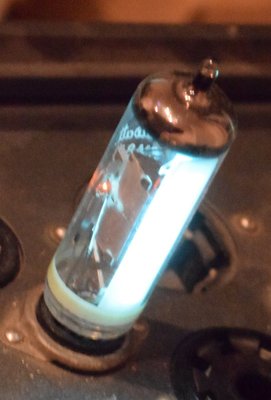
1. Introduction and History
The EM87 is a miniature tuning indicator tube (also known as a "magic eye" tube) with an integrated amplifying triode section, manufactured by several European companies including Philips, Mazda-Belvu (CIFTE), Valvo, and others during the late 1950s and 1960s. It belongs to the European noval-based family of indicator tubes that succeeded the earlier octal-based EM34 and EM35 types.
Unlike the classic circular "cat's eye" display of earlier magic eye tubes such as the EM34 or 6E5, the EM87 features a linear bar-graph style fluorescent display. This design represented a modernization of the tuning indicator concept, offering a more compact form factor on the 9-pin noval (B9A) base while providing a clear, easily readable indication. The linear display format was considered more aesthetically suited to the sleek, modern radio and hi-fi equipment designs of the late 1950s and 1960s.
The tube was widely used in European AM/FM radio receivers, tape recorders, and high-fidelity equipment as a visual tuning aid and recording level indicator. Its built-in triode amplifier section allowed it to be driven directly from an AGC (automatic gain control) or AVC (automatic volume control) line without requiring an additional amplifier stage, simplifying circuit design considerably.
The EM87 was manufactured by CIFTE (Compagnie Industrielle Française des Tubes Électroniques) under the Mazda-Belvu brand, by Philips Miniwatt in Holland, and by various other European manufacturers. The datasheet referenced here is the Mazda-Belvu CIFTE datasheet dated January 1968.
2. Technical Specifications and Design
General Characteristics
| Parameter | Value |
| Type | Tuning indicator with amplifying triode |
| Cathode | Indirectly heated |
| Heater Voltage (Vf) | 6.3 V |
| Heater Current (If) | 300 mA |
| Filament Configuration | Series or parallel operation |
| Envelope (Bulb) | A22-7 |
| Base | 9C12 — Noval (B9A) |
| Mounting Position | Any (arrow on base diagram indicates viewing direction of target) |
Maximum Ratings (Average Limits System)
| Parameter | Symbol | Value |
| Anode Voltage (no current) | Va bl | 550 V max |
| Anode Voltage | Va | 300 V max |
| Control Electrode Voltage (no current) | Vj bl | 550 V max |
| Control Electrode Voltage | Vj | 300 V max |
| Target Voltage (no anode current) | Vc bl | 550 V max |
| Target Voltage (max) | Vc | 300 V max |
| Target Voltage (min) | Vc | 170 V min |
| Anode Dissipation | Pa | 0.6 W max |
| Cathode Current | Ik | 5 mA max |
| Triode Grid Circuit Resistance | RgT | 3 MΩ max |
| Resistance between Filament and Cathode | Rfk | 100 kΩ max |
| Voltage between Filament and Cathode | Vfk | 250 V max |
| Maximum Bulb Temperature (hottest point) | — | 120 °C max |
Normal Operating Conditions
Control electrode (blade) connected to triode anode:
| Parameter | Symbol | Values | ||
| Supply Voltage | VN | 250 V | ||
| Target Voltage | Vc | 250 V | ||
| Anode Resistance | Ra | 100 kΩ | ||
| Triode Grid Circuit Resistance | RgT | 3 MΩ | ||
| Triode Grid Voltage (VgT) | — | 0 V | −10 V | −15 V |
| Anode + Control Electrode Current (Iaj) | — | 2 mA | 0.5 mA | 0.2 mA |
| Target Current (Ic) | — | 1.0 mA | 1.8 mA | 2.0 mA |
| Shadow Length (l) | — | 21 mm | 0 mm | −1.5 mm * |
* A negative shadow length value of −1.5 mm indicates that the two luminous sections of the target overlap by 1.5 mm.
Physical Dimensions
- Maximum diameter: 22.2 mm
- Maximum overall length: 65.8 mm
- Seated height (max): approximately 32.6 mm above the base reference plane
- Base pin circle: standard noval 9-pin
Pin Configuration (Noval / 9C12 Base — Bottom View)
| Pin | Function |
| 1 | Triode Grid |
| 2 | Internal Connection (do not connect) |
| 3 | Cathode and Indicator Control Grid |
| 4 | Filament (Heater) |
| 5 | Filament (Heater) |
| 6 | Target (Fluorescent Screen) |
| 7 | Control Electrode (Blade/Knife) |
| 8 | Internal Connection (do not connect) |
| 9 | Triode Anode |
Important Note: Pins 2 and 8 are internal connections and must not be connected to any external circuit.
Triode Section Characteristics
The EM87's built-in triode section serves as a DC amplifier that drives the indicator's control electrode (blade). The triode grid (pin 1) receives the input signal — typically an AGC/AVC voltage — and the amplified output at the triode anode (pin 9) controls the deflection of the electron beam on the fluorescent target. With the control electrode tied to the triode anode through the 100 kΩ anode resistor, the triode provides sufficient gain to produce a full-range display deflection from the typical AGC voltage swing of 0 to −15 V.
Note: Specific triode parameters such as amplification factor (μ), transconductance (gm), and plate resistance (rp) are not explicitly listed in the CIFTE/Mazda-Belvu datasheet provided. These values should be confirmed against additional manufacturer documentation. Typical values for the EM87 triode section reported in other sources suggest a μ of approximately 18–20 and a gm of approximately 1.5–1.8 mA/V, but these should be verified against a Philips or Telefunken datasheet for certainty.
3. Applications and Usage
The EM87 was designed primarily for the following applications:
Radio Tuning Indication
The most common application was as a tuning indicator in AM and FM radio receivers. The tube was connected to the AGC (Automatic Gain Control) line of the receiver. When the radio was correctly tuned to a station, the AGC voltage reached its most negative value, causing the luminous bar display to close (the shadow narrows or the two luminous bars meet/overlap). This gave the user a precise visual indication of optimal tuning — far more accurate than relying on audio quality alone.
Recording Level Indication
The EM87 found extensive use in reel-to-reel tape recorders and early cassette decks as a recording level indicator. The linear bar-graph display was particularly well-suited to this application, as the length of the luminous bar could be intuitively read as a signal level. Many European tape recorders from Grundig, Telefunken, Philips, and others used the EM87 or its equivalents for this purpose.
Signal Strength Metering
In communications receivers and some test equipment, the EM87 served as a simple signal strength indicator, providing a quick visual reference without the cost and complexity of a moving-coil meter.
Typical Circuit Configuration
The standard application circuit, as shown in the CIFTE datasheet, connects the tube with:
- +250 V supply to the target (pin 6) and through a 100 kΩ anode resistor to the triode anode (pin 9)
- The control electrode (pin 7) connected to the triode anode (pin 9)
- A 3 MΩ grid resistor from the triode grid (pin 1) to the AGC/signal source
- Cathode (pin 3) to ground (or through a cathode bias network)
An alternative configuration shown in the datasheet adds a 33 kΩ resistor in the target supply line, which modifies the display characteristic curve slightly for different applications.
4. Sound Characteristics
As a tuning indicator tube, the EM87 does not directly process audio signals and therefore does not have "sound characteristics" in the traditional sense that audio amplifier tubes do. However, the EM87 has earned a place in audio discussions for several indirect reasons:
The Triode Section as an Audio Amplifier
Creative audio experimenters have repurposed the EM87's built-in triode section as a small-signal voltage amplifier in low-power audio circuits. When used in this unconventional role, the triode section exhibits characteristics typical of a low-mu triode with moderate transconductance. Users who have experimented with the EM87 triode in audio circuits report a warm, soft tonal quality with gentle harmonic distortion — predominantly second-order harmonics, as is typical of triode operation. The sound is described as pleasant and musical, though the limited gain and current capability restrict its use to very low-level signal applications or as a novelty.
Psychoacoustic and Aesthetic Impact
In the context of vintage and modern tube audio equipment, the EM87's most significant contribution to the listening experience is psychological and aesthetic rather than electrical. The warm green glow of the fluorescent target, responding dynamically to the audio signal when used as a level indicator, creates a deeply satisfying visual feedback loop that enhances the perceived quality of the listening experience. Many audiophiles report that the presence of a functioning magic eye tube makes the entire system feel more "alive" and engaging. This visual element has become an integral part of the "tube sound experience" for many enthusiasts.
As a VU/Level Indicator
When used as a recording or playback level indicator, the EM87's response characteristics — being driven by the AGC or a rectified audio signal — provide a smooth, averaged indication that many users find more musically meaningful than fast-responding LED meters. The gentle, organic movement of the luminous bar is often described as more pleasant and less fatiguing to watch during long recording or listening sessions.
5. Equivalent and Substitute Types
| Type | Manufacturer/Standard | Notes |
| CV10407 | British military designation | Direct equivalent — identical specifications and pinout |
| EM87 (various) | Philips, Valvo, Telefunken, RFT, CIFTE, Tungsram | All are interchangeable; manufactured to the same specification across European producers |
Related but NOT Directly Interchangeable Types
- EM84: Another noval-based bar-graph indicator tube, but with different internal construction and electrical characteristics. While it serves a similar function and uses the same base, the pinout and operating parameters differ — it is not a drop-in replacement.
- EM85: A noval indicator tube with a different display pattern and different electrical specifications. Not interchangeable.
- EM80: An earlier noval magic eye with a fan-shaped display. Different pinout and characteristics — not interchangeable.
- 6E5 / EM34: Classic circular "cat's eye" types on octal bases. Completely different base, pinout, and electrical requirements.
Caution: Only the CV10407 is confirmed as a genuine direct substitute for the EM87. Any other substitution should be carefully verified against datasheets for both pinout compatibility and electrical operating conditions before attempting.
6. Notable Characteristics
Linear Bar-Graph Display
The EM87's most distinctive feature is its linear bar-graph fluorescent display, which differs markedly from the circular "cat's eye" pattern of earlier indicator tubes. Two luminous bars extend from opposite sides of the display toward the center. When no signal is applied (triode grid at 0 V), the bars are fully extended with a shadow length of 21 mm — the bars are widely separated. As the grid voltage becomes more negative (stronger signal), the bars move toward each other. At −10 V, the bars just meet (0 mm shadow). At −15 V, the bars actually overlap by 1.5 mm, providing a clear indication that the signal has exceeded the threshold.
Integrated Triode Amplifier
The built-in triode section eliminates the need for an external amplifier stage, making the EM87 a self-contained indicator system requiring only passive components (resistors) for a complete tuning indicator circuit.
Longevity and Phosphor Wear
Like all fluorescent indicator tubes, the EM87's target phosphor degrades over time with use. The fluorescent coating gradually loses brightness, particularly in areas of constant electron bombardment. This is why NOS (New Old Stock) examples with bright, even phosphor are highly prized by collectors. The minimum target voltage of 170 V specified in the datasheet is important — operating below this voltage can cause uneven phosphor wear and reduced display quality.
Sensitivity and Range
The EM87 provides useful indication over a triode grid voltage range of 0 to −15 V, which corresponds well to the typical AGC voltage range of European radio receivers. The display response is non-linear (as shown in the characteristic curves), with the most rapid change occurring in the −5 V to 0 V region, providing good sensitivity near the tuning point.
Low Power Consumption
With a heater consumption of only 6.3 V at 300 mA (1.89 W) and a maximum anode dissipation of 0.6 W, the EM87 adds minimal power demand to a receiver or amplifier circuit.
7. Usage in the Audio Community
Vintage Equipment Restoration
The EM87 remains in strong demand among vintage radio and hi-fi restorers. It was used in countless European receivers and tape recorders from the late 1950s through the 1970s, and finding working replacements with good phosphor brightness is a common restoration challenge. NOS Philips Miniwatt Holland examples are particularly sought after for their consistent quality and bright, long-lasting phosphor. AVO-tested NOS tubes command premium prices in the collector market.
Custom Tube Amplifier Builds
Modern tube amplifier builders frequently incorporate the EM87 as a visual level indicator or power meter in custom designs. The tube's compact noval base, attractive green glow, and responsive bar-graph display make it an ideal addition to the front panel of a handmade amplifier. Common implementations include:
- Output level indication: A rectified sample of the audio output signal is applied to the triode grid, providing a real-time visual display of output power.
- Bias monitoring: The EM87 can be configured to display the bias point of output tubes, providing a visual confirmation that the amplifier is operating correctly.
- Aesthetic enhancement: Many builders include the EM87 purely for its visual appeal, driven by the audio signal to create a dynamic, music-responsive light display.
DIY and Maker Projects
The EM87 has become popular in the DIY electronics community for projects beyond traditional audio applications. Its visually striking display has been used in:
- Standalone VU meters for recording studios and home studios
- Decorative "Nixie clock" style projects where the tube serves as an ambient display element
- Sound-reactive art installations
- Novelty single-tube amplifier projects using the triode section
Market and Availability
As of recent years, the EM87 is no longer in production, and all available stock is NOS (New Old Stock) or used pulls from vintage equipment. Prices have risen significantly as supplies diminish and demand from the audio and maker communities continues. Key sources include:
- European NOS tube dealers specializing in Philips, Valvo, and Telefunken production
- Eastern European sources offering RFT (East German) and Tungsram (Hungarian) manufactured examples
- Online auction platforms where tested NOS examples regularly appear
When purchasing, buyers should look for tubes with bright, even phosphor (best assessed in person or through seller testing), strong emission on the triode section, and intact glass envelope without darkening or internal deposits that might indicate prior heavy use.
The EM87 in the Context of the Magic Eye Revival
The EM87 is part of a broader revival of interest in magic eye indicator tubes within the audio community. As modern audio equipment has become increasingly digital and visually sterile, many enthusiasts have embraced the warm, organic visual feedback of fluorescent indicator tubes as a counterpoint. The EM87, with its clean linear display and compact form factor, is particularly well-suited to integration into modern equipment designs while maintaining the vintage charm that draws people to tube audio in the first place.