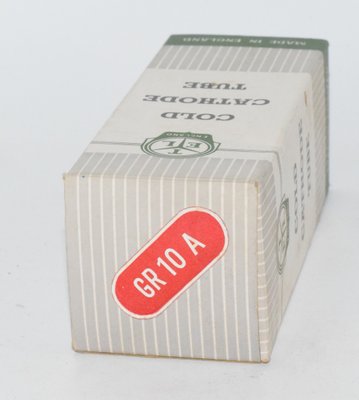
1. Introduction and History
The GR10A is a specialized vacuum tube belonging to the Dekatron family, a unique class of gas-filled counting and display tubes developed primarily during the mid-20th century. The term "Dekatron" is derived from "decade counter tube," reflecting its primary function in electronic counting circuits. The GR10A, manufactured by Telefunken (TEL) in the United Kingdom, represents a significant advancement in counting tube technology.
Dekatron tubes emerged during the 1950s and 1960s, a period when digital electronics were still in their infancy. These tubes served as essential components in early computer systems, frequency counters, and industrial control equipment before being largely superseded by solid-state electronics. The GR10A specifically was designed for applications requiring reliable decade counting with minimal external circuitry.
The development of Dekatron tubes represented a bridge between analog and digital electronics, enabling engineers to perform counting operations with vacuum tube technology. The Telefunken UK-manufactured GR10A is particularly sought after by vintage electronics enthusiasts and restoration specialists due to its robust construction and consistent performance characteristics.
2. Technical Specifications and Design
Physical Characteristics
The GR10A is a gas-filled counting tube utilizing a neon-argon gas mixture, housed in a standard glass envelope with a 10-pin base configuration. The tube measures approximately 2.5 inches (63mm) in height and features a distinctive glow pattern visible through its transparent envelope.
Electrical Specifications
- Tube Type: Gas-filled decade counter (Dekatron)
- Base Type: 10-pin (Dekatron base)
- Operating Voltage: Typically 500-600V DC for main anode
- Cathode Voltage: 400-500V DC
- Glow Current: 5-10mA per cathode
- Counting Frequency: Up to 100 kHz (depending on circuit configuration)
- Decade Division: 10:1 (counts from 0-9)
- Reset Time: Typically less than 1 microsecond
- Warm-up Time: Approximately 5-10 seconds to stable operation
Internal Construction
The GR10A features a sophisticated internal electrode arrangement consisting of:
- Main Anode: Central electrode receiving the primary counting pulses
- 10 Cathodes: Arranged in a circular pattern around the main anode, each representing a decimal position (0-9)
- Guide Electrodes: Specialized electrodes that control the glow transfer between cathodes
- Neon-Argon Gas Fill: Optimized mixture providing stable glow discharge characteristics
The electrode geometry is precisely engineered to ensure smooth glow transfer from one cathode to the next with each input pulse, creating a visible light pattern that indicates the current count position.
Performance Parameters
The GR10A demonstrates excellent linearity across its operational range, with consistent counting accuracy maintained from zero to maximum specified frequency. The tube exhibits minimal hysteresis and offers reliable operation across a wide temperature range, typically -10°C to +50°C for standard applications.
3. Applications and Usage
Historical Applications
During its active production period, the GR10A served in numerous industrial and scientific applications:
- Frequency Counters: Direct counting of AC signals up to 100 kHz
- Event Counters: Tallying discrete events in manufacturing and quality control
- Digital Display Systems: Pre-LED era numeric displays for instruments
- Control Systems: Sequential control logic in industrial machinery
- Early Computer Systems: Counting and timing circuits in first-generation computers
- Radiation Detection: Pulse counting in radiation monitoring equipment
Modern Vintage Electronics Applications
Today, the GR10A is primarily sought by:
- Vintage electronics collectors and restoration specialists
- Steampunk and retro-computing enthusiasts building period-accurate equipment
- Museum curators maintaining historical scientific instruments
- Hobbyists constructing functional vintage counter displays
- Educational institutions demonstrating vacuum tube technology
4. Sound Characteristics and Audio Applications
Acoustic Properties
While the GR10A is not primarily an audio-frequency tube, it does produce distinctive acoustic characteristics when operating:
- Glow Discharge Sound: A subtle crackling or clicking sound accompanying each counting pulse
- Frequency Range: Acoustic output primarily in the 1-10 kHz range, depending on counting frequency
- Volume Level: Generally very low, typically 40-50 dB at 1 foot distance
- Harmonic Content: Minimal harmonic distortion due to the discrete nature of the glow transfer
Audio Community Interest
The GR10A has gained unexpected interest within the audio enthusiast community for several reasons:
- Vintage Aesthetic: The visible glow and audible clicking provide nostalgic sensory feedback valued by retro-audio designers
- Experimental Music: Electronic musicians have incorporated Dekatron tubes into modular synthesizer designs, using the counting pulses as clock signals and the acoustic output as percussive elements
- Tube Amplifier Modifications: Some high-end audio enthusiasts have experimented with Dekatron-based frequency display circuits in premium amplifiers
- Audio Metering: Vintage-style VU meter circuits incorporating Dekatron tubes for retro-aesthetic measurement displays
- Sonic Branding: The distinctive acoustic signature has been used in limited-edition audio equipment emphasizing vintage character
Sonic Characteristics in Audio Applications
When incorporated into audio systems, the GR10A exhibits:
- Transient Response: Extremely fast attack characteristics due to the instantaneous nature of gas discharge
- Frequency Response: Minimal audio frequency content, primarily useful as a timing reference rather than signal-processing element
- Noise Floor: Low electrical noise when properly shielded, though acoustic noise is unavoidable
- Coloration: No measurable audio signal coloration, as the tube functions as a switching device rather than an amplifier
5. Notable Characteristics
Reliability and Longevity
The GR10A is renowned for exceptional reliability, with typical tube life exceeding 10,000 hours of continuous operation. The gas-filled design eliminates cathode emission degradation issues common in thermionic tubes, contributing to extended operational lifespan.
Telefunken UK Manufacturing Quality
Telefunken's UK manufacturing facility produced components recognized for superior construction standards. The GR10A exemplifies this heritage with:
- Precision-engineered electrode spacing ensuring accurate counting
- High-quality glass envelope with excellent gas purity
- Robust base construction minimizing contact resistance
- Consistent performance across production runs
Visual Feedback
A distinctive feature of the GR10A is its visible glow pattern. As the tube counts, a luminous band visibly rotates around the circular cathode arrangement, providing immediate visual confirmation of counting operation. This characteristic makes the tube particularly valued in display applications and educational demonstrations.
Minimal External Circuitry
The GR10A requires relatively simple supporting circuitry compared to other counting methods of its era. The integrated electrode design handles much of the counting logic internally, reducing component count and increasing system reliability.
NOS (New Old Stock) Availability
Original Telefunken UK-manufactured GR10A tubes in NOS (New Old Stock) condition remain available through specialized vintage electronics suppliers. These unused tubes offer the assurance of original specifications and full operational capability, making them highly sought after by purists and restoration specialists.
Collectibility
The GR10A occupies a unique position in vacuum tube collecting. Its combination of technical significance, manufacturing heritage, visual appeal, and relative scarcity makes it a valued addition to serious tube collections. The Telefunken UK variant commands particular premium due to its reputation for reliability and consistent performance.
6. Equivalent or Substitute Types
Several tubes share similar functionality with the GR10A, though direct substitution requires careful consideration of circuit requirements:
- GR10 (Telefunken): Earlier variant with similar specifications
- Z5300 (Mullard): British-manufactured decade counter with comparable performance
- OA10 (Siemens): German-made Dekatron with slightly different electrode configuration
- GR10-80 (Telefunken): Enhanced variant designed for higher frequency operation
- GR10/80 (Telefunken): Variant optimized for 80-position counting applications
Important Note: While these tubes share the Dekatron principle, direct substitution is not always possible without circuit modification. The specific electrode configuration and gas fill characteristics may differ, affecting counting accuracy and maximum frequency. Consultation with technical documentation is essential before substitution.
Conclusion
The GR10A Dekatron tube represents a significant chapter in the history of electronic counting technology. Its sophisticated internal design, exceptional reliability, and distinctive operating characteristics have ensured its continued relevance to enthusiasts and collectors decades after its initial production. The Telefunken UK-manufactured variant exemplifies the quality standards that defined this era of vacuum tube manufacturing.
Whether valued for its historical significance, technical capabilities, or aesthetic appeal, the GR10A continues to serve as a bridge between the analog and digital eras of electronics. For those seeking authentic vintage components or exploring the sonic possibilities of retro technology, the NOS GR10A remains a compelling choice that combines proven reliability with undeniable character.