1. Introduction and History
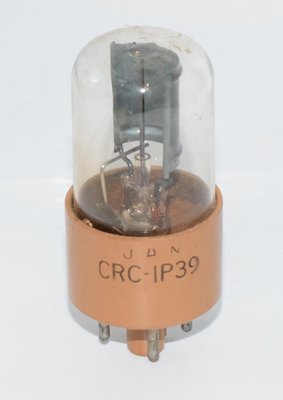
The IP39 is a specialized photocell vacuum tube (valve) that was manufactured by RCA (Radio Corporation of America) and designated with a Joint Army-Navy (JAN) specification, indicating its military-grade quality and reliability. These photocell tubes were particularly prevalent during the 1950s and 1960s, with the specific CRC-IP39 model being produced in 1961.
Photocell vacuum tubes like the IP39 represent an important development in the evolution of photoelectric technology. They were designed to convert light energy into electrical signals, making them crucial components in various detection and measurement applications during the pre-solid-state electronics era. The military designation suggests that the IP39 was developed to meet rigorous standards for reliability and performance in demanding environments.
As part of the broader family of gas-filled phototubes, the IP39 would have been developed during a period when vacuum tube technology was reaching its pinnacle of refinement, just before being gradually replaced by semiconductor devices in many applications.
2. Technical Specifications and Design
The IP39 photocell tube features a specialized design optimized for photoelectric applications. While specific documentation on this particular model is limited, based on similar photocell tubes from the era, we can infer several key technical characteristics:
- Construction: Likely a gas-filled phototube with a light-sensitive cathode and an anode collector
- Envelope: Glass envelope, possibly with a specialized window or coating to optimize for specific light wavelengths
- Cathode: Photosensitive material, typically cesium, cesium-antimony, or similar photoemissive compounds
- Gas Filling: Probably contains a noble gas such as argon at low pressure to provide gas amplification of the photoelectric current
- Spectral Response: Likely optimized for visible to near-infrared light detection, depending on the specific cathode material
- Sensitivity: Military-grade photocells typically offered enhanced sensitivity compared to commercial variants
- Operating Voltage: Typically between 90-250V for similar photocell tubes of this era
- Base Configuration: Likely a standard octal or specialized base depending on the specific application requirements
The JAN-CRC designation indicates that this tube met specific military requirements for consistency and reliability, with CRC potentially referring to the specific military contract or specification code.
3. Applications and Usage
The IP39 photocell vacuum tube would have been employed in various applications requiring light detection and measurement, particularly in military and industrial contexts:
- Military Systems: Likely used in targeting systems, detection equipment, or communication devices
- Industrial Controls: Applications such as flame detection, safety systems, and automated process control
- Scientific Instrumentation: Light measurement devices, spectrophotometers, and analytical equipment
- Sound-on-Film: Possibly used in film projection equipment to read optical soundtracks
- Security Systems: Early photoelectric beam alarm systems and perimeter monitoring
- Counting and Sorting: Production line item detection and counting applications
The military specification suggests the IP39 was designed to function reliably under extreme conditions, including temperature variations, humidity, and mechanical stress that might be encountered in field operations.
4. Equivalent or Substitute Types
While exact equivalents would depend on the specific characteristics of the IP39, several photocell tubes from the same era might serve as potential substitutes in certain applications:
- 927: A common RCA gas phototube used in similar applications
- 931A: A photomultiplier tube for applications requiring higher sensitivity
- IP21/922: Gas-filled phototubes with comparable characteristics
- 1P40: Another military-specification phototube with similar applications
- 5581: Industrial phototube used in control applications
- CE25/CE26: European equivalents that might offer similar performance
It's important to note that direct substitution would require matching not only the electrical characteristics but also the spectral response and sensitivity of the original IP39. In modern applications, solid-state photodetectors like photodiodes, phototransistors, or specialized integrated circuits would typically replace these vintage photocell tubes.
5. Notable Characteristics
The IP39 photocell tube would have exhibited several distinctive characteristics that defined its performance and application suitability:
- Gas Amplification: Unlike vacuum phototubes, gas-filled types like the IP39 offered internal current amplification due to gas ionization, providing higher sensitivity but potentially sacrificing frequency response
- Military Reliability: The JAN specification indicates enhanced quality control, extended operational life, and performance consistency
- Environmental Tolerance: Likely designed to operate across a wide temperature range and under conditions of shock and vibration
- Specialized Response: Possibly tailored spectral sensitivity for specific military applications
- Historical Significance: Represents an important transitional technology in photoelectric detection before the widespread adoption of solid-state devices
Collectors and vintage electronics enthusiasts particularly value these military-specification tubes for their quality construction and historical significance. The IP39, as a specialized photocell with military heritage, represents an interesting artifact from the golden age of vacuum tube technology.
For modern applications requiring similar functionality, contemporary photodetector technologies offer superior performance, reliability, and energy efficiency, though they lack the distinctive aesthetic and historical value of tubes like the IP39.