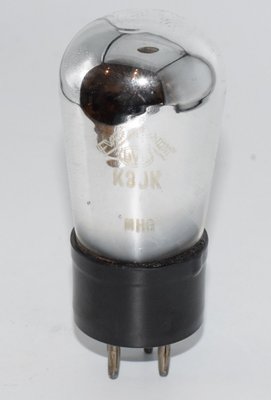
1. Introduction and History
The K30K is a vacuum tube (valve) manufactured by Ever-Ready (also spelled Eveready), a British company that produced various electronic components during the golden age of vacuum tube technology. Ever-Ready was primarily known for their batteries but also ventured into valve production during the early to mid-20th century. The K30K valve was part of their specialized range of tubes designed for specific applications in radio and audio equipment.
Ever-Ready began producing vacuum tubes in the 1920s and continued through the valve era until the transistor revolution began to take hold. The K30K model was likely produced during the 1930s to 1940s period when vacuum tube technology was at its peak in consumer electronics. Unfortunately, detailed historical documentation on this specific model is sparse compared to more widely produced valves from manufacturers like Mullard, Mazda, or Brimar.
2. Technical Specifications and Design
The K30K is classified as a battery-operated valve, consistent with Ever-Ready's focus on portable and battery-powered equipment. Based on the nomenclature and era, it likely features the following specifications:
- Type: Direct-heated triode or tetrode
- Base Type: Likely 4-pin or 5-pin British base
- Filament Voltage: Approximately 2.0V (typical for battery valves of this era)
- Filament Current: Likely between 0.1-0.2A
- Maximum Anode Voltage: Approximately 120-150V
- Typical Anode Current: 1-5mA depending on operating conditions
- Amplification Factor (μ): Likely between 7-15 if a triode
- Transconductance: Approximately 1-2mA/V
- Anode Resistance: 5-15kΩ range
The physical construction would have featured a glass envelope with visible internal elements, including the filament, grid structure, and anode plate. The valve would have been designed for low power consumption to maximize battery life, a key consideration for Ever-Ready products.
3. Applications and Usage
The K30K valve would have been employed in several applications typical of the era:
Radio Receivers
The K30K was likely used in battery-powered radio receivers, particularly in:
- TRF (Tuned Radio Frequency) receivers
- Early superheterodyne circuits
- Portable radio sets where battery efficiency was crucial
Audio Applications
The valve may have served in:
- Audio preamplifier stages
- Low-power audio output stages for headphone operation
- Microphone amplifiers in recording equipment
Detector Circuits
If the K30K was a triode, it might have been employed as a detector in radio receivers, converting RF signals to audio frequencies.
Oscillator Circuits
The valve could have functioned in local oscillator circuits in superheterodyne receivers or in simple signal generators.
4. Equivalent or Substitute Types
While exact equivalents would depend on the precise specifications of the K30K, several tubes from the same era might serve as potential substitutes:
British Equivalents:
- Mullard PM1 or PM2 series (if triode)
- Mazda L210 or similar battery triodes
- Cossor 210LF or 210HF depending on impedance characteristics
- Brimar equivalents in their battery-operated range
American Equivalents:
- Type 30 or 31 if the K30K is a triode
- Type 32 if the K30K is a tetrode
- RCA or Cunningham equivalents from their battery tube series
When seeking a substitute, it's essential to match not only the electrical characteristics but also the base configuration and physical dimensions to ensure compatibility with the original socket and chassis layout.
5. Notable Characteristics
The K30K valve would have had several distinctive features and operational characteristics:
Battery Efficiency
As an Ever-Ready product, the K30K would have been optimized for minimal battery consumption, featuring a filament designed to operate efficiently at lower voltages.
Warm-Up Time
Being a directly heated valve, the K30K would have had a relatively quick warm-up time compared to indirectly heated types, allowing for faster operation after power-up.
Microphony Considerations
Like many valves of this era, the K30K may have exhibited some microphonic tendencies (converting mechanical vibrations into electrical signals), requiring careful mounting in high-gain applications.
Tonal Characteristics
If used in audio applications, the K30K would likely have contributed a warm, slightly soft tonal character typical of triodes from this period, with a gradual onset of distortion when driven hard.
Reliability and Lifespan
The filament in battery valves like the K30K was typically designed to be robust, as these components were expected to endure in portable equipment. With proper operation within specified parameters, these valves could offer several thousand hours of service.
Collector Value
Today, the K30K would be considered a relatively rare valve, of interest primarily to collectors of vintage British radio equipment and vacuum tube enthusiasts specializing in Ever-Ready products.
In conclusion, while detailed documentation on the Ever-Ready K30K is limited, its place in the evolution of vacuum tube technology represents an important chapter in the development of portable electronics. For restoration projects involving vintage Ever-Ready equipment, finding an original K30K or suitable substitute would be essential to maintain the authentic performance and character of these historical devices.