1. Introduction and History
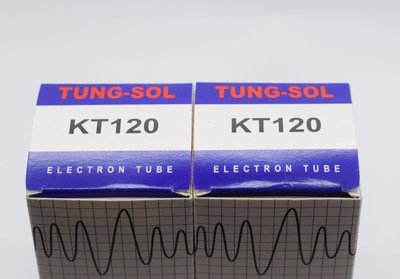
The KT120 is a beam power tetrode vacuum tube manufactured by New Sensor Corporation under the Tung-Sol brand name. Introduced around 2009–2010, the KT120 represented a significant milestone in modern vacuum tube production — it was the first entirely new beam power tetrode design to emerge in decades, rather than a reissue or copy of a classic type. The tube was designed to fill a gap in the market for a high-power output tube that could deliver substantially more power than the venerable KT88/6550 family while maintaining compatibility with many existing amplifier designs (with appropriate rebiasing).
The "KT" designation follows the tradition established by the original Marconi-Osram Valve Company (GEC/MOV) in the 1950s, where "KT" stands for "Kinkless Tetrode" — a reference to the beam-forming plates that eliminate the characteristic kink in the tetrode's plate curves. The "120" designation reflects the tube's enhanced power capability, positioning it above the KT88 and KT90 in the power hierarchy.
Manufactured at the New Sensor factory in Saratov, Russia (the same facility that produces modern Electro-Harmonix, Mullard, Gold Lion, Svetlana, and Sovtek branded tubes), the KT120 quickly gained popularity among audiophiles and amplifier manufacturers seeking greater headroom and power output from push-pull amplifier designs. Its introduction was followed by the even more powerful KT150 in 2013.
2. Technical Specifications and Design
Electrical Ratings
| Parameter | Value |
|---|---|
| Heater Voltage (Ef) | 6.3 V |
| Heater Current (If) | 1.85 A |
| Maximum Plate Voltage (Va max) | 800 V (absolute maximum) |
| Maximum Screen Voltage (Vg2 max) | 400 V |
| Maximum Plate Dissipation (Pa max) | 60 W |
| Maximum Screen Dissipation (Pg2 max) | ~6 W (some sources cite up to 6.5 W — confirm against manufacturer datasheet for exact rating) |
| Transconductance (gm) | Approximately 6,000–7,000 µmhos (depending on operating point) |
| Plate Resistance (rp) | Several thousand ohms in beam tetrode mode (exact value varies with operating conditions; typical values are in the range of approximately 4,000–8,000 Ω — consult the manufacturer datasheet for specific operating point data) |
| Amplification Factor (µ) | Derived from µ = gm × rp. Given the transconductance and plate resistance ranges above, the amplification factor is typically in the range of approximately 24–50 depending on operating conditions. Note: The exact published µ value should be confirmed against the Tung-Sol/New Sensor datasheet, as it is operating-point dependent. |
| Grid Bias Range (Vg1) | Typically operated with negative grid bias in the range of approximately −40 V to −80 V depending on plate voltage and desired operating class. Specific bias points depend on the amplifier circuit design. |
| Maximum Cathode Current | Approximately 250 mA (confirm against datasheet) |
Typical Operating Conditions (Class AB1 Push-Pull, per tube)
The following are representative operating conditions commonly cited for the KT120 in push-pull Class AB1 service:
| Parameter | Value |
|---|---|
| Plate Voltage | 550–600 V |
| Screen Voltage | 300–400 V |
| Grid Bias | Approximately −50 V to −65 V |
| Plate Current (quiescent) | ~60–90 mA per tube (varies with bias point) |
| Power Output (pair) | ~100–140 W (depending on circuit topology and operating voltages) |
Note: Exact operating conditions and maximum ratings should always be verified against the official Tung-Sol / New Sensor KT120 datasheet. The values above are compiled from commonly referenced sources and may vary slightly between datasheet revisions.
Physical Specifications
| Parameter | Value |
|---|---|
| Base Type | Octal (International Octal, 8-pin) |
| Envelope Type | Large shouldered glass envelope (ST-19 style bulb, significantly larger than KT88) |
| Overall Height | Approximately 160 mm (6.3 inches) including pins |
| Maximum Diameter | Approximately 60–65 mm (2.4–2.6 inches) |
| Mounting Position | Any (vertical preferred for optimal convection cooling) |
Pin-Out (Octal Base, Bottom View)
The KT120 follows the standard octal beam power tetrode pin configuration, identical to the KT88 and 6550:
| Pin | Connection |
|---|---|
| Pin 1 | No Connection (or internal shield on some versions) |
| Pin 2 | Heater |
| Pin 3 | Plate (Anode) |
| Pin 4 | Screen Grid (G2) |
| Pin 5 | Control Grid (G1) |
| Pin 6 | No Connection |
| Pin 7 | Heater |
| Pin 8 | Cathode |
The center spigot/key on the octal base provides mechanical alignment and prevents incorrect insertion.
Internal Construction
The KT120 features a robust internal structure designed to handle its high power dissipation. Key construction features include:
- Large plate structure: Oversized carbonized nickel plates with enhanced heat radiation capability to support the 60 W dissipation rating
- Beam-forming plates: Internal beam confining electrodes that direct electron flow into concentrated beams, producing the "kinkless" tetrode characteristics and improved power efficiency
- Heavy-duty cathode: Large oxide-coated cathode designed for high emission current capability
- Robust grid winding: Gold-plated grid wire for improved reliability and consistent performance
- Dual getters: Two getter assemblies to maintain high vacuum over the tube's operational life
- Thick glass envelope: The large, heavy glass bulb provides mechanical strength and allows adequate heat dissipation
3. Applications and Usage
The KT120 was designed primarily for high-fidelity audio amplification, though its robust specifications make it suitable for several applications:
Primary Applications
- High-power push-pull audio amplifiers: The KT120's primary application, where a pair can deliver 100–140 watts in Class AB1 configuration
- Single-ended (SE) amplifiers: With 60 W plate dissipation, the KT120 can deliver meaningful power in single-ended Class A operation (typically 20–30 W depending on circuit design)
- Integrated amplifiers: Used in high-end integrated amplifier designs where power and sonic quality are both priorities
- Upgrade/retrofit: As a higher-power replacement for KT88 and 6550 tubes in amplifiers designed to accommodate the additional heater current draw and physical size
Commercial Amplifiers Designed for KT120
Several notable amplifier manufacturers have designed products specifically around the KT120, including:
- Audio Research Corporation — Reference series and VS series amplifiers (e.g., REF 75, REF 150, VS115)
- PrimaLuna — DiaLogue and EVO series (with adaptive autobias)
- Rogue Audio — Stereo 100, Atlas Magnum series
- Cayin — Various integrated and power amplifier models
- Jolida/Black Ice Audio — Select models designed for KT120 compatibility
- Primaluna, Quicksilver, Cary Audio — Various models with KT120 compatibility
Important Retrofit Considerations
While the KT120 shares the same octal pin-out as the KT88 and 6550, retrofitting is not always a simple drop-in replacement. Key considerations include:
- Heater current: At 1.85 A, the KT120 draws more heater current than a KT88 (~1.6 A) or 6550 (~1.6 A). The power transformer must have adequate heater winding capacity.
- Physical clearance: The KT120's larger envelope may not fit in amplifiers with tight tube spacing or enclosed chassis designs.
- Bias adjustment: The amplifier must be rebiased for the KT120's operating characteristics. Fixed-bias amplifiers require careful adjustment; auto-bias (cathode-biased) amplifiers may self-adjust but should still be verified.
- Power supply capacity: The higher current draw of the KT120 at full power requires adequate B+ supply current capability.
- Manufacturer approval: Always check with the amplifier manufacturer before substituting KT120 tubes for KT88 or 6550 types.
4. Sound Characteristics
The KT120 has developed a strong reputation in the audiophile community for its distinctive sonic signature. While subjective descriptions vary, several consistent themes emerge from reviewers and experienced listeners:
Tonal Balance and Character
- Extended and controlled bass: The KT120 is widely praised for its deep, authoritative bass response. Compared to the KT88, many listeners describe the low-frequency performance as tighter, more controlled, and more extended — with greater slam and impact. This is often attributed to the tube's higher power reserves and lower output impedance in typical circuits.
- Clean, detailed midrange: The midrange is frequently described as transparent, open, and slightly less "warm" or "lush" than classic KT88 or EL34 tubes. The KT120 tends toward accuracy and neutrality rather than the romantic coloration some associate with vintage tube types.
- Smooth, extended treble: High-frequency reproduction is generally described as airy and well-extended without harshness or grain. The KT120 avoids the slight treble roll-off sometimes noted with older tube designs.
- Dynamic headroom: One of the most consistently praised attributes is the KT120's dynamic capability. The 60 W plate dissipation and high current capability translate to effortless dynamic swings, particularly on demanding orchestral, percussion, and large-scale musical passages.
Comparative Sonic Impressions
- vs. KT88: The KT120 is generally perceived as more powerful, more controlled in the bass, and slightly more neutral/analytical. The KT88 is often preferred by those seeking a warmer, more "classic tube" midrange character.
- vs. 6550: The KT120 offers greater power and dynamics with a more refined top end. The 6550 can sound slightly drier and more clinical by comparison.
- vs. EL34: The KT120 delivers significantly more power and bass authority, while the EL34 is often preferred for its sweeter, more harmonically rich midrange — the classic "British" sound.
- vs. KT150: The KT150 extends the KT120's qualities further with even more power and control, though some listeners find the KT120 slightly more musically engaging and less "solid-state-like" than the KT150.
Overall Sonic Signature
The KT120 occupies an interesting position in the tube audio landscape — it bridges the gap between the warm, harmonically rich character traditionally associated with tube amplification and the precision, control, and authority more commonly associated with solid-state designs. It is often described as sounding "modern" for a tube, with excellent resolution, wide bandwidth, and commanding dynamics. Listeners who prioritize accuracy, bass control, and dynamic impact tend to favor the KT120, while those seeking maximum midrange warmth and harmonic richness may prefer the KT88 or EL34.
5. Equivalent or Substitute Types
The KT120 is a unique modern design, and there is no exact equivalent from any other manufacturer. However, several tubes share the same octal pin-out and can be considered in the same family, with important caveats:
Potentially Compatible Types (with caveats)
| Tube Type | Pin Compatible? | Notes |
|---|---|---|
| KT88 | Yes (same octal pin-out) | Lower power (42 W plate dissipation). Can typically replace KT120 in amplifiers designed for KT88 with rebias. The reverse substitution (KT120 for KT88) requires verification of heater supply capacity and physical clearance. Different bias requirements. |
| 6550 | Yes (same octal pin-out) | Lower power (~35–42 W plate dissipation). Similar considerations as KT88 substitution. Different bias requirements. |
| KT90 | Yes (same octal pin-out) | Closer in power rating (~50 W). The KT90 (originally by Ei of Yugoslavia) is now rare. Physical dimensions differ. Bias adjustment required. |
| KT150 | Yes (same octal pin-out) | Higher power (70 W plate dissipation). Even larger physical envelope than KT120. Higher heater current (~1.95 A). Amplifier must be verified for compatibility. Different bias requirements. |
| KT170 | Yes (same octal pin-out) | The newest and most powerful in the family (~85 W plate dissipation). Very large envelope. Requires amplifier verification. |
Important Substitution Warnings
- Never substitute tubes without verifying amplifier compatibility. While the pin-out is shared across the KT88/6550/KT120/KT150 family, the electrical characteristics differ significantly.
- Bias must always be adjusted when changing tube types in fixed-bias amplifiers.
- Heater current differences can overload power transformers not rated for the higher-current types.
- EL34 / 6CA7: While these share the octal base, they have a different pin-out (the screen grid and control grid pins are swapped compared to the KT88/6550/KT120 configuration). EL34 tubes are NOT directly interchangeable with KT120 unless the amplifier has been specifically designed with switching circuitry to accommodate both pin configurations.
6. Notable Characteristics
Strengths
- Highest power in its generation: At its introduction, the KT120's 60 W plate dissipation was the highest of any currently manufactured audio beam tetrode, surpassing the KT88's ~42 W by roughly 40%.
- Robust construction: The KT120 is built to withstand demanding operating conditions, with heavy-duty internal structures and a thick glass envelope.
- Excellent linearity: The beam tetrode design provides clean, linear amplification characteristics well-suited to high-fidelity audio applications.
- Good reliability and longevity: When operated within specifications, the KT120 has earned a reputation for good tube life, typically 2,000–5,000+ hours depending on operating conditions and bias settings.
- Consistent manufacturing: As a current-production tube from a single source, matched pairs and quartets are readily available with tight matching tolerances.
- Wide industry adoption: Numerous amplifier manufacturers have validated the KT120 in their designs, providing a strong ecosystem of compatible equipment.
Limitations and Considerations
- Single source: The KT120 is manufactured only by New Sensor Corporation (Tung-Sol brand). There are no alternative manufacturers, NOS (New Old Stock) versions, or vintage equivalents. This creates potential supply chain vulnerability.
- Physical size: The large envelope can create fitment issues in amplifiers not specifically designed for the KT120.
- Heater current demand: The 1.85 A heater current (per tube) is higher than KT88/6550 types and must be accounted for in the power supply design.
- Screen voltage limitation: The maximum screen voltage of 400 V is a notable constraint that designers must respect. Some amplifier circuits designed for KT88 or 6550 may run screen voltages that approach or exceed this limit, requiring verification before substitution.
- No direct historical equivalent: Unlike the KT88 or 6550, there is no vintage reference point for the KT120, making it impossible to compare modern production against a historical standard.
Thermal Considerations
With 60 W of plate dissipation plus heater power (approximately 11.7 W per tube), the KT120 generates significant heat. Adequate ventilation is essential, and amplifier designers must ensure sufficient spacing between tubes and adequate chassis ventilation. The total power dissipated per tube (plate + screen + heater) can approach 75–80 W under full operating conditions.
7. Usage in the Audio Community
Market Position and Popularity
The KT120 has carved out a significant niche in the high-end audio community since its introduction. It is particularly popular among audiophiles who:
- Want the sonic character of tube amplification with greater power and dynamic headroom than KT88-based designs can provide
- Drive inefficient or power-hungry loudspeakers that benefit from the additional watts available from KT120-equipped amplifiers
- Seek a more modern, controlled, and extended sonic presentation compared to classic tube types
- Value the ability to upgrade existing KT88/6550 amplifiers (where manufacturer-approved) for improved performance
Matched Pairs and Quartets
The KT120 is widely available as factory-matched pairs and quartets, which is essential for push-pull amplifier applications. The Tung-Sol KT120 Matched Pair is one of the most popular configurations, offering closely matched transconductance and plate current characteristics for balanced operation. Matched sets minimize crossover distortion and ensure even power sharing between tubes in push-pull circuits.
Tube Rolling
Unlike tubes with extensive vintage production histories (such as the 12AX7, EL34, or KT88), the KT120 offers no "tube rolling" options — there is only one manufacturer and one version. However, many KT120 users engage in tube rolling by comparing the KT120 against other compatible types (KT88, 6550, KT150) in the same amplifier, exploring the sonic differences between these related but distinct tube types.
Community Reception
The audio community's reception of the KT120 has been overwhelmingly positive. Key themes in user feedback include:
- Upgrade path: Many users report significant improvements in bass control, dynamics, and overall authority when upgrading from KT88 or 6550 tubes to KT120s in compatible amplifiers.
- Reliability: The KT120 has generally earned good marks for reliability, though as with any vacuum tube, individual failures can occur.
- Value proposition: Priced moderately above KT88 tubes, the KT120 is widely considered to offer excellent value given its performance improvements.
- Amplifier manufacturer endorsement: The adoption of the KT120 by respected manufacturers like Audio Research Corporation lent significant credibility to the tube and accelerated its acceptance in the audiophile community.
Guitar Amplifier Usage
While primarily designed for hi-fi applications, the KT120 has found some use in high-power guitar amplifier applications, particularly among players seeking maximum clean headroom. However, its adoption in the guitar world is far less widespread than in hi-fi, as most guitar amplifiers are designed around EL34, 6L6, or 6V6 tubes, and the KT120's sonic character — prized in hi-fi for its neutrality — is not always what guitar players seek.
Purchasing Recommendations
When purchasing KT120 tubes for audio use, the following guidelines are recommended:
- Buy matched pairs or quartets from reputable dealers who test and match tubes on calibrated equipment
- Verify amplifier compatibility before purchasing — consult the amplifier manufacturer's documentation or support team
- Purchase from authorized dealers to ensure genuine Tung-Sol production and valid warranty coverage
- Consider buying a spare pair for critical listening systems, as production availability can fluctuate
- Allow adequate burn-in time — the KT120 typically requires 50–100 hours of operation to reach its optimal sonic performance
The KT120 in Context
The KT120 represents an important chapter in the ongoing story of vacuum tube audio. In an era when tube manufacturing is limited to a handful of factories worldwide, the development of an entirely new tube type — rather than simply reissuing classic designs — demonstrated that innovation in vacuum tube technology is still possible. The KT120 proved that there was strong market demand for higher-performance tube types, paving the way for the subsequent KT150 and KT170 designs. Together, these modern power tubes have expanded the performance envelope of tube amplification, allowing designers to create amplifiers that combine the sonic qualities valued by tube enthusiasts with power and control specifications that approach or match solid-state alternatives.