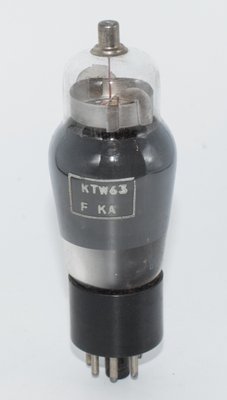
1. Introduction and History
The KTW63 is a German-manufactured vacuum tube (valve) that represents an important chapter in mid-20th century tube amplifier development. Produced primarily by Osram, a leading German electronics manufacturer, the KTW63 emerged during the post-World War II era when European tube manufacturers were re-establishing production capabilities and competing with American and British tube designs.
The KTW63 belongs to the family of medium-power output tubes that gained prominence in European audio and industrial applications throughout the 1950s and 1960s. While not as widely documented in English-language sources as American counterparts like the EL34 or 6L6, the KTW63 maintained steady use in European amplifier designs and continues to be sought after by tube enthusiasts and vintage equipment restorers.
Osram's commitment to quality manufacturing meant that KTW63 tubes were built to exacting standards, with careful attention to internal geometry, electrode spacing, and materials selection. This heritage of precision engineering contributes to the tube's reputation among audio professionals today.
2. Technical Specifications and Design
Basic Specifications
| Parameter | Value |
| Tube Type | Power Pentode |
| Heater Voltage (Uh) | 6.3V AC/DC |
| Heater Current (Ih) | ~1.0A |
| Maximum Plate Voltage (Ua max) | 550V |
| Maximum Plate Dissipation | ~30W |
| Typical Output Power | 20-25W (single tube) |
| Tube Base | Noval (9-pin) |
| Pentode Configuration | 5-electrode design |
Operational Characteristics
The KTW63 is configured as a power pentode, featuring five active electrodes: a heated cathode, control grid, screen grid, suppressor grid, and plate. This pentode design provides superior control of electron flow compared to tetrodes, resulting in better linearity and reduced distortion characteristics.
The tube's heater requires 6.3 volts at approximately 1.0 ampere, making it compatible with standard amplifier heater supplies used in European designs. The relatively modest heater current consumption makes the KTW63 practical for compact amplifier designs without requiring excessive power supply capacity.
Typical operating conditions for the KTW63 in Class AB1 push-pull configuration yield approximately 20-25 watts of output power per tube when used in pairs. The maximum plate voltage rating of 550V accommodates standard European power supply designs, though many amplifiers operated the tube at somewhat lower voltages (400-480V) for extended tube life and reduced stress on output transformers.
Internal Design Features
The KTW63's internal construction reflects German manufacturing precision. The tube features:
- Robust cathode design: Heavy-duty nickel-plated cathode capable of sustained high-current operation
- Precise grid geometry: Carefully spaced control grid and screen grid for optimal amplification characteristics
- Suppressor grid configuration: Engineered to minimize secondary emission effects and improve linearity
- Plate structure: Substantial plate with excellent heat dissipation properties for reliable operation at rated power levels
- Internal shielding: Careful attention to internal lead routing and shielding to minimize parasitic oscillations
3. Sound Characteristics and Audio Performance
Tonal Properties
The KTW63 is prized in the audio community for its distinctive sonic character. Users consistently report the following tonal attributes:
Midrange Presence: The KTW63 exhibits a pronounced and articulate midrange, making vocals and instruments in the 500Hz-4kHz region particularly clear and present. This characteristic makes the tube especially suitable for amplifiers designed around vocal reproduction and acoustic instruments.
Bass Response: The tube delivers tight, controlled bass reproduction with good definition. The bass is neither bloated nor thin, providing a balanced foundation to the overall frequency response. This makes the KTW63 popular in designs emphasizing musical accuracy.
Treble Characteristics: The high-frequency response is smooth and extended without excessive harshness or brittleness. The tube's pentode design contributes to controlled treble reproduction that remains detailed without fatiguing listeners during extended listening sessions.
Harmonic Distortion Profile: When operated within its rated parameters, the KTW63 generates primarily second and third-order harmonics, which are generally perceived as musically pleasant. The harmonic structure contributes to the tube's reputation for warm, organic sound character that many audio enthusiasts prefer to more clinical solid-state designs.
Dynamic Performance
The KTW63 demonstrates excellent transient response and dynamic capability. The tube's ability to handle rapid signal changes without compression or distortion makes it suitable for a wide range of musical content, from classical recordings requiring precise dynamic reproduction to rock and jazz applications demanding impact and punch.
The tube's grid structure allows for relatively low distortion at moderate signal levels, while maintaining musicality when driven harder. This characteristic makes the KTW63 forgiving of various input levels and source material characteristics.
4. Applications and Usage in the Audio Community
Professional Audio Applications
The KTW63 has found use in several professional audio domains:
Studio Monitoring Amplifiers: European recording studios, particularly those with vintage equipment, often employ amplifiers using KTW63 tubes for studio monitoring. The tube's accurate midrange and controlled dynamics make it suitable for critical listening environments where accurate reproduction is essential.
Mastering Applications: Some mastering facilities maintain tube amplifiers with KTW63 output stages for reference monitoring, valuing the tube's tonal characteristics and the way it reveals detail in recordings.
High-Fidelity Consumer Audio
The KTW63 has become increasingly sought after in the high-fidelity community:
Integrated Amplifiers: European manufacturers, particularly those focusing on vintage restoration and retro designs, incorporate KTW63 tubes in integrated amplifiers. These typically deliver 20-30 watts per channel, sufficient for many listening environments while maintaining the sonic benefits of tube amplification.
Tube Amplifier Restoration: Vintage European amplifiers originally designed with KTW63 tubes continue to be restored and used by audiophiles. The tube's continuing availability (though limited) makes restoration projects feasible.
Custom Amplifier Builds: Audio enthusiasts and small amplifier manufacturers design new amplifiers around the KTW63, valuing its combination of power output, sonic character, and relative affordability compared to more exotic output tubes.
Vintage Equipment Enthusiasts
The KTW63 holds particular appeal for collectors and users of vintage European audio equipment. Many post-war European amplifiers, particularly German and Dutch designs, specified KTW63 tubes, and enthusiasts maintain these amplifiers for their historical significance and musical performance.
DIY and Audio Community Projects
The tube's specifications and availability make it popular in DIY amplifier projects, particularly among builders seeking to create authentic reproductions of classic European amplifier designs or develop new designs with European sonic character.
5. Equivalent and Substitute Types
Direct Equivalents
The following tubes are considered direct electrical equivalents to the KTW63:
- EL84: While slightly lower in power output (typically 15-18W single tube), the EL84 shares similar heater requirements and can function as a substitute in many applications, though with reduced output power
- 6BQ5/EL85: An American equivalent offering similar power output and electrical characteristics
- KT63: A variant designation sometimes used for KTW63 tubes from different manufacturers
Functional Alternatives
For applications requiring similar power output with different sonic characteristics:
- EL34: Higher power output (25-30W single tube) with different tonal characteristics, more commonly available
- 6L6/5881: American power pentodes with comparable power output but different sonic signature
- KT77: A more modern design with similar power ratings but enhanced specifications
Important Substitution Notes
While some substitutions are electrically feasible, they may not be sonically equivalent. Amplifier designers typically optimized their designs specifically for the KTW63's characteristics, and substitution may not yield identical performance. Additionally, output transformer impedance matching becomes critical when substituting tubes with different plate resistance characteristics.
6. Notable Characteristics and Distinctive Features
Manufacturing Quality
Osram KTW63 tubes are renowned for consistent quality and reliability. The manufacturer's reputation for precision engineering ensures:
- Tight electrical parameter tolerances
- Consistent sonic characteristics between individual tubes
- Extended operational lifespan (typically 5,000-10,000 hours with proper operation)
- Minimal microphony and noise
Availability and Collectibility
The KTW63 occupies an interesting position in the current tube market. While not as common as American tubes like the 6L6 or 5881, the KTW63 remains available from specialized tube suppliers, particularly those focusing on European equipment. This relative scarcity has contributed to the tube's desirability among collectors and enthusiasts.
Original Osram KTW63 tubes command premium prices in the used market, particularly examples with original boxes and documentation. Mint-condition tubes from the 1950s-1960s are increasingly difficult to locate, making them valuable to collectors of vintage audio equipment.
Operational Longevity
Properly operated KTW63 tubes demonstrate excellent longevity. The tube's robust construction and Osram's quality control mean that many examples from the 1950s and 1960s continue to function reliably today, testament to the engineering standards of the era.
Sonic Signature
Perhaps the most distinctive characteristic of the KTW63 is its sonic signature. The tube's combination of clear midrange, controlled dynamics, and smooth high-frequency response creates a distinctive tonal character that many audio professionals and enthusiasts consider superior to more modern alternatives for certain applications.
The tube's performance characteristics suggest it was designed with careful attention to musicality rather than purely maximizing power output or efficiency, a philosophy reflected in much European audio engineering of the mid-20th century.
Conclusion
The KTW63 represents an important chapter in the history of vacuum tube amplifier development. While less famous in English-speaking countries than American counterparts, this German power pentode has earned respect among audio professionals and enthusiasts for its combination of reliable performance, distinctive sonic character, and solid engineering. Whether restoring vintage European equipment, building new amplifiers with classic sonic character, or simply appreciating the craftsmanship of mid-century tube design, the KTW63 remains a tube of genuine interest and value to the audio community.
For those seeking authentic reproduction of vintage European audio equipment or desiring the specific sonic characteristics this tube provides, the KTW63 continues to justify its reputation as a quality output tube worthy of careful application in well-designed amplifier circuits.