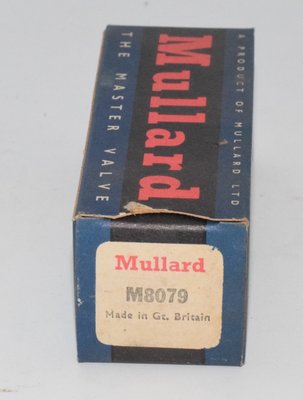
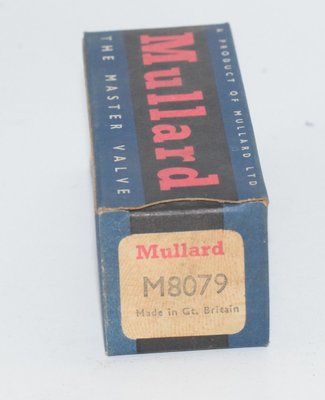
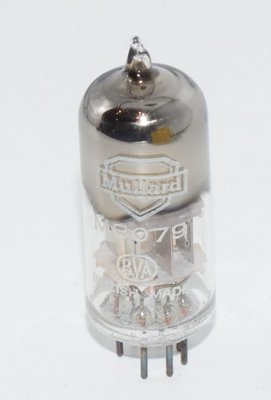
Introduction and History
The Mullard M8079 is a special quality miniature double diode valve, manufactured to exacting military and professional standards by Mullard in the United Kingdom. First documented in June 1960, the M8079 was designed specifically for use in equipment where mechanical vibration and shocks are unavoidable, and where statistically controlled major electrical characteristics are required. It carries the UK military designation CV4025 and is closely related to the commercial 6AL5W type.
The "M" prefix in Mullard's numbering system denotes their Special Quality (SQ) range — valves that underwent far more rigorous testing, tighter parameter selection, and enhanced mechanical construction compared to their commercial equivalents. The M8079 was produced primarily at Mullard's Whyteleafe factory in Surrey, England, a facility renowned for producing some of the finest valves in the world. These SQ valves were originally destined for military communications equipment, professional broadcast infrastructure, precision test instruments, and other critical applications where reliability and consistency were paramount.
The double diode configuration — two independent diode sections sharing a common envelope with separate cathodes — made the M8079 particularly versatile for detection, demodulation, and rectification duties. The inclusion of internal screening between sections was a key design feature, ensuring minimal crosstalk and interference between the two diode halves.
Technical Specifications and Design
Heater
| Parameter | Value |
|---|---|
| Heater Voltage (Vh) | 6.3 V |
| Heater Current (Ih) | 300 mA |
| Heater Operation | Suitable for series or parallel operation, AC or DC |
Interelectrode Capacitances (measured with external shield)
| Parameter | Value |
|---|---|
| Ca′–k′+h+s+S | 3.2 pF |
| Ca″–k″+h+s+S | 3.2 pF |
| Ck′–a′+h+s+S | 3.9 pF |
| Ck″–a″+h+s+S | 3.9 pF |
| Ca′–a″ | <26 mpF |
Absolute Maximum Ratings (each section)
| Parameter | Value |
|---|---|
| Peak Inverse Voltage (P.I.V.) max. | 460 V |
| Anode Current (Ia) max. | 10 mA |
| Peak Anode Current (ia(pk)) max. | 60 mA |
| Heater-to-Cathode Voltage (Vh-k) max. | 360 V |
| Input Voltage (Vin(r.m.s.)) max. | 165 V |
| Minimum Load Resistance (RLm) per anode | 600 Ω |
| Maximum Continuous Acceleration | 2.5 g |
| Maximum Shock (short duration) | 500 g |
| Maximum Bulb Temperature (Tbulb) | 165 °C |
Test Conditions
Standard test conditions as specified by Mullard: Vh = 6.3 V, Va(r.m.s.) = 165 V, Rload = 11 kΩ, C = 8.0 µF.
| Parameter | Min | Max | Unit |
|---|---|---|---|
| Heater Current | 275 | 325 | mA |
| Heater to Cathode Leakage (Vh-k = 100V, cathode negative) | — | 5.0 | µA |
| Heater to Cathode Leakage (Vh-k = 100V, cathode positive) | — | 5.0 | µA |
| Output Current | 16 | — | mA |
| Emission (Va = 10V) | 40 | — | mA |
Additional Test Parameters
- Anode current (Va = 0V, Ra = 40kΩ): Bogey 2.0 µA, max 20 µA
- Anode current difference between sections (Va = 0V, Ra = 40kΩ): max 5.0 µA
- Change in emission (Vh = 5.7V, Va = 7.0V): max 15%
- Hum (Vh = 7.0V, tested in specified circuit): max 10 mV (r.m.s.)
- Insulation (a-rest, screen-rest measured at −300V): min 100 MΩ
Physical Construction
| Parameter | Detail |
|---|---|
| Base Type | B7G (Miniature 7-pin) |
| Envelope | Miniature glass, T-6½ style |
| Maximum Diameter | 19 mm |
| Maximum Seated Height | 47.5 mm |
| Maximum Overall Height | 54.5 mm |
| Mounting | Any position |
| Dimensions Standard | BS448, Section B7G |
Pin Configuration (B7G Base, bottom view)
| Pin | Connection |
|---|---|
| 1 | Anode (a″) — Section 2 |
| 2 | Cathode (k″) — Section 2 |
| 3 | Heater (h) |
| 4 | Heater (h) |
| 5 | Cathode (k′) — Section 1 |
| 6 | Anode (a′) — Section 1 |
| 7 | Screen / Shield (s) |
Note: The internal construction features separate cathodes for each diode section and an internal screen (shield) between sections, connected to pin 7. The Mullard internal reference drawing number is 4942.
Intermittent Life Test (Group F)
The M8079 was tested in a full-wave rectifier circuit with a load resistor of 11 kΩ and a reservoir capacitor of 8 µF. The supply impedance was adjusted so that the peak anode current was not less than 60 mA for a nominal valve, with the cathode-to-heater voltage provided by the output voltage in series with 117 V r.m.s. Life test endpoints at 500 and 1000 hours included measurements of heater current (275–325 mA), heater-to-cathode leakage (max 10 µA at ±100V), emission at Va = 10V (min 35 mA at 500 hours, min 30 mA at 1000 hours), change in emission (max 20%), anode current, and insulation (min 50 MΩ).
Applications and Usage
The M8079 was designed for a range of professional and military applications where reliable diode performance was essential:
- Signal Detection and Demodulation: The dual diode configuration made it ideal for AM detection circuits, where one section could handle signal detection while the other provided AGC (Automatic Gain Control) voltage derivation.
- Full-Wave Rectification: With both sections used together, the M8079 served as an efficient full-wave rectifier for low-current power supply applications, particularly in sensitive instrument circuits where low noise was critical.
- Discriminator Circuits: In FM receivers and communications equipment, the matched dual diode sections were used in ratio detector and Foster-Seeley discriminator circuits for frequency demodulation.
- Clamping and DC Restoration: Television and radar equipment used double diodes like the M8079 for DC restoration in video circuits.
- Noise Limiting: Series or shunt noise limiter circuits in communications receivers frequently employed dual diodes.
- Military and Avionics Equipment: The M8079's exceptional vibration resistance (2.5 g continuous, 500 g shock) and wide heater-to-cathode voltage rating (360 V) made it suitable for airborne and shipboard electronics where environmental conditions were severe.
- Precision Test Equipment: The tight statistical control of parameters ensured consistent performance in measurement instruments where diode characteristics directly affected accuracy.
The datasheet specifies a microphonic noise test condition with both sections in parallel, Rk = 4.7 kΩ, Ia = 20 mA, at 50 c/s and 2.0 g peak acceleration, with a maximum noise level of 5.0 mV (r.m.s.) — demonstrating the valve's suitability for low-noise applications.
Sound Characteristics
While the M8079 is a diode rather than an amplifying valve, it nonetheless has a meaningful impact on the sonic character of circuits in which it is employed. Audiophiles and engineers who have used the M8079 in detector, rectification, and signal processing roles report the following characteristics:
- Exceptional Quietness: The special quality construction, with its internal screening between sections and rigorously tested low leakage currents (max 5.0 µA heater-to-cathode), results in an extremely quiet valve. Background noise and hum are notably lower than commercial-grade equivalents like the standard 6AL5.
- Clean, Transparent Recovery: When used as a detector diode in AM or shortwave receivers, the M8079 is praised for its clean signal recovery with minimal distortion. The matched sections contribute to symmetrical detection, reducing even-order harmonic artifacts.
- Smooth Rectification: In low-level power supply applications within preamplifier stages, the M8079 provides smooth, low-noise DC with minimal ripple artifacts. Users report a "blacker" background compared to silicon diode replacements or lesser-quality valve diodes.
- Natural Dynamics: The valve's diode characteristic curve — as shown in the datasheet's anode current vs. anode voltage plot — exhibits a smooth, progressive conduction onset. This gentle knee contributes to what listeners describe as a more natural, less "hard" clipping behavior in limiter and AGC circuits.
- Microphonic Resilience: The special quality construction means the M8079 introduces virtually no microphonic coloration, even in vibration-prone environments. This is a significant advantage in turntable-adjacent equipment or in chassis subject to transformer hum.
Overall, the M8079's sonic contribution is best described as "invisible" — it performs its diode function with minimal coloration, noise, or artifact, which is precisely what a high-quality diode should do. Its value lies not in adding character but in removing the imperfections that lesser diodes introduce.
Equivalent and Substitute Types
| Type | Relationship | Notes |
|---|---|---|
| CV4025 | Direct equivalent | UK military designation for the M8079. Identical specifications and pinout. Fully interchangeable. |
| 6AL5W | Near equivalent | The ruggedized military version of the 6AL5. The M8079 is essentially a Mullard SQ-grade 6AL5W with tighter parameter control. Pin-compatible and interchangeable in most circuits. |
| 6AL5 / EB91 | Commercial equivalent | The standard commercial double diode with the same pinout and general characteristics. The 6AL5/EB91 will work in M8079 circuits but does not meet the same stringent quality standards for leakage, noise, vibration resistance, or parameter matching. |
| 6058 | Related SQ type | Another special quality variant of the 6AL5 family. Should be verified for specific parameter compatibility before substitution. |
| EAA91 | European designation | The Philips/European pro-electron designation for the same basic double diode type. Pin-compatible. |
| D77 | Mullard commercial type | Mullard's own commercial designation for the basic EB91/6AL5 type. Lower quality tier than the M8079. |
Important: While the commercial 6AL5 and EB91 are pin-compatible substitutes, they should not be used as replacements in applications that specifically require the M8079's special quality characteristics — particularly in military equipment, precision instruments, or circuits where low leakage, low microphonics, and tight parameter matching are essential. The M8079's inter-section anode-to-anode capacitance of less than 26 mpF (millipico-farads, i.e., femtofarads) and its maximum heater-to-cathode leakage of 5.0 µA are specifications that commercial equivalents may not meet.
Notable Characteristics
- Internal Screening: The M8079 features an internal screen (shield) between the two diode sections, brought out to pin 7. This is a critical design feature that minimizes capacitive coupling between sections (Ca′–a″ < 26 mpF), enabling the valve to be used in circuits where section isolation is important, such as discriminators and balanced detector circuits.
- Separate Cathodes: Unlike some double diode designs that share a common cathode, the M8079 has independent cathodes for each section. This allows each diode to operate with different DC reference potentials, greatly expanding circuit design flexibility.
- Exceptional Vibration and Shock Resistance: Rated for 2.5 g continuous acceleration and 500 g short-duration shock, the M8079 was built to survive in the most demanding mechanical environments. Post-fatigue and post-shock testing (Group E) verified that the valve maintained its electrical characteristics after prolonged vibration exposure (170 c/s, 5 g peak, for 33 hours in each of 3 mutually perpendicular planes).
- High Heater-to-Cathode Voltage Rating: The 360 V maximum Vh-k rating is notably generous, allowing the M8079 to be used in circuits where the cathode operates at a significant potential above or below the heater supply — common in stacked or series-heater designs.
- Statistical Quality Control: As a Mullard Special Quality valve, every M8079 was subject to comprehensive group testing (Groups A through G) including insulation tests, emission tests, leakage measurements, hum tests, microphonic noise evaluation, fatigue testing, shock testing, and intermittent life testing to 1000 hours. The Acceptable Quality Level (A.Q.L.) percentages specified for each test group ensured batch-level consistency.
- Low Microphonic Noise: Specified at a maximum of 5.0 mV r.m.s. under defined acceleration conditions, the M8079 was designed to contribute negligible microphonic noise even in vibrating environments.
- Shelf Life Testing (Group G): Valves were held for 28 days and retested, with an inoperative rate not exceeding 0.5% — demonstrating excellent storage stability.
Usage in the Audio Community
The Mullard M8079 occupies a niche but respected position in the audio community, valued primarily for its exceptional build quality and the Mullard Special Quality pedigree. Here are the main ways it is used by audio enthusiasts and professionals:
Vintage Receiver Restoration
The M8079 is a prized replacement for the 6AL5/EB91 in high-end vintage AM/FM receivers and tuners. Restorers of classic equipment from manufacturers like Leak, Quad, Rogers, and others seek out M8079s to replace worn commercial-grade diodes, knowing that the SQ valve will provide lower noise, better section matching, and longer service life. In FM tuner discriminator circuits, the matched sections of the M8079 contribute to improved stereo separation and lower distortion.
High-End DAC and Preamplifier Designs
Some boutique audio manufacturers and DIY builders have incorporated the M8079 into hybrid DAC output stages and preamplifier circuits where a valve diode is used for signal clamping, DC restoration, or as part of a tube rectified power supply for sensitive analog stages. The M8079's low leakage and low noise make it particularly suitable for these applications.
Tube Rectified Power Supplies
While the M8079's 10 mA maximum anode current per section limits its use in high-current power supply applications, it is well-suited for low-current B+ supplies in phono preamplifiers and other sensitive front-end circuits. The smooth rectification characteristics of the valve diode, combined with the M8079's low noise floor, contribute to what audiophiles describe as a more organic and three-dimensional soundstage compared to silicon rectification.
Collectibility and NOS Market
Mullard M8079 valves, particularly those confirmed as originating from the Whyteleafe factory, command a premium on the NOS (New Old Stock) market. They are typically found with the CV4025 military marking and are sold at several times the price of standard 6AL5 tubes. Collectors value them not only for their sonic performance but also as examples of the pinnacle of British valve manufacturing quality. The distinctive Mullard shield logo and the SQ quality markings make them desirable collector's items.
Test Equipment and Studio Gear
Professional audio engineers maintaining vintage studio equipment — particularly BBC-specification gear where CV-numbered valves were originally specified — use the M8079/CV4025 as the correct replacement to maintain original performance standards. The BBC and other broadcasting organizations originally specified CV4025 valves in their equipment for good reason, and maintaining that specification during restoration preserves the equipment's intended performance characteristics.
In summary, the Mullard M8079 represents the highest expression of the double diode valve type — built to military standards, tested to extraordinary levels of rigor, and capable of providing decades of reliable, low-noise service. While it may lack the glamour of famous amplifying valves, its contribution to circuit performance is real and measurable, making it a worthy component in any serious audio system where a double diode is required.