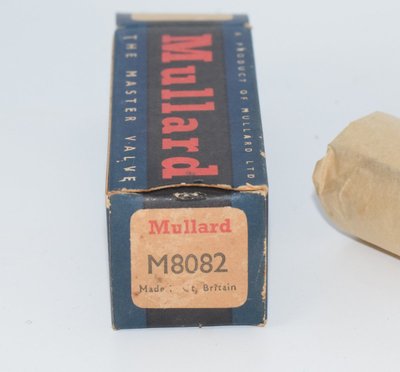
1. Introduction and History
The Mullard M8082 is a Special Quality output pentode designed and manufactured by Mullard Ltd., one of Britain's most revered valve manufacturers. Bearing the Mullard "M" prefix denoting its special quality (SQ) classification, the M8082 was developed for use in professional, military, and industrial equipment where mechanical vibration and shocks are unavoidable, and where statistically controlled major electrical characteristics are required. The datasheet dates from April 1960 (with revisions through May 1962), placing its development firmly in the late 1950s era of high-reliability British valve engineering.
The M8082 belongs to Mullard's prestigious Special Quality range — a family of valves manufactured to tighter tolerances, subjected to more rigorous testing (including fatigue, shock, vibration, and extended life tests), and individually screened to ensure consistent performance. These valves were primarily intended for military communications equipment, airborne electronics, and professional instrumentation where failure was not an option. The "Special Quality" designation meant that every valve was tested across multiple groups of parameters (Groups A through G in the datasheet), covering everything from insulation resistance and reverse grid current to microphonic noise, fatigue endurance, shock resistance, and intermittent life testing over hundreds and thousands of hours.
The M8082 is closely related to the well-known EL84 (6BQ5) family of output pentodes, but manufactured to the exacting standards required by the British military CV (Common Valve) system. Its compact B7G miniature envelope and robust construction made it ideal for space-constrained equipment that had to endure harsh operating environments.
2. Technical Specifications and Design
General Description
| Type Designation | M8082 |
| Function | Special Quality Output Pentode |
| Manufacturer | Mullard Ltd. |
| Base Type | Miniature 7-pin (B7G), per BS448 Section B7G |
| Mounting Position | Any |
| Maximum Bulb Temperature | 180°C |
| Maximum Bulb Diameter | 19 mm max |
| Overall Height (seated) | 47.5 mm min to 54.5 mm max |
Heater
| Heater Voltage (Vh) | 6.3 V |
| Heater Current (Ih) | 200 mA |
Interelectrode Capacitances
(Measured with an external shield)
| Input Capacitance (Cin) | 3.8 pF |
| Output Capacitance (Cout) | 6.5 pF |
| Anode-to-Grid 1 Capacitance (Ca-g1) | < 300 mpF (0.3 pF) |
Typical Characteristics
(At Va = 250 V, Vg2 = 250 V)
| Anode Voltage (Va) | 250 V |
| Screen Grid Voltage (Vg2) | 250 V |
| Anode Current (Ia) | 16 mA |
| Screen Grid Current (Ig2) | 2.3 mA |
| Mutual Conductance (gm) | 2.5 mA/V |
| Anode Resistance (ra) | 130 kΩ |
| Amplification Factor (μg1-g2) | 12 |
| Cathode Resistance (Rk) | 0 Ω |
| Control Grid Voltage (Vg1) | −13.5 V |
Absolute Maximum Ratings
| Parameter | Value | Unit |
|---|---|---|
| Maximum Frequency (f max.) | 100 | Mc/s |
| Maximum Anode Voltage, boost (Va(b) max.) | 550 | V |
| Maximum Anode Voltage (Va max.) | 300 | V |
| Maximum Anode Dissipation (pa max.) | 4.75 | W |
| Maximum Screen Grid Voltage, boost (Vg2(b) max.) | 550 | V |
| Maximum Screen Grid Voltage (Vg2 max.) | 275 | V |
| Maximum Screen Grid Dissipation (pg2 max.) | 800 | mW |
| Maximum Negative Control Grid Voltage (−Vg1 max.) | 110 | V |
| Maximum Grid 1 to Grid 2 Voltage (Vg1-g2 max.) | 300 | V |
| Maximum Grid 1 Current (Ig1 max.) | 3.3 | mA |
| Maximum Cathode Current (Ik max.) | 23 | mA |
| Maximum Grid 1 to Cathode Resistance, fixed bias (Rg1-k max.) | 220 | kΩ |
| Maximum Heater-to-Cathode Voltage (Vh-k max.) | 150 | V |
| Maximum Continuous Acceleration | 2.5 | g |
| Maximum Shock (short duration) | 500 | g |
Pin Configuration (B7G Base)
Viewed from the underside of the base:
- Pin 1: g1 (Control Grid)
- Pin 2: g2 (Screen Grid)
- Pin 3: Heater (h)
- Pin 4: Heater (h)
- Pin 5: Anode (a)
- Pin 6: NC (No Connection — internal connection only)
- Pin 7: Cathode (k), connected to g3 (Suppressor Grid)
Note: Pin 6 is an internal connection and must not be used for external wiring. The suppressor grid (g3) is internally connected to the cathode (k) at pin 7.
3. Applications and Usage
The M8082 was designed primarily for professional and military applications where reliability under adverse conditions was paramount. Its key application areas include:
Military and Professional Equipment
As a Special Quality valve, the M8082 was specified for use in military communications equipment, airborne electronics, shipboard systems, and other environments subject to severe mechanical vibration and shock. The datasheet specifies continuous acceleration tolerance of 2.5 g and short-duration shock resistance of 500 g — remarkable figures that attest to the robustness of its construction. The extensive testing regime (Groups A through G) ensured that every valve delivered met stringent reliability criteria, including fatigue testing with cycling on/off at 170 c/s for 33 hours, and intermittent life testing over 500 and 1000 hours.
Audio Output Stage
In its typical operating conditions (Va = 250 V, Vg2 = 250 V), the M8082 delivers 16 mA of anode current with a transconductance of 2.5 mA/V, making it suitable as a single-ended or push-pull output stage in small to medium power audio amplifiers. The datasheet includes a dynamic life test configuration as a trebler (frequency multiplier) at Vb = 300 V with combined anode and screen current of 20 mA, grid 1 current of 1.6 mA, and output power of 900 mW at 70 to 75 Mc/s, demonstrating its versatility across a wide frequency range.
Triode-Connected Operation
The datasheet provides comprehensive characteristic curves for triode-connected operation, where the screen grid is tied to the anode. In this configuration, the combined anode dissipation limit (Pa+g2) is 5.4 W, and the tube exhibits the lower distortion and lower output impedance characteristic of triode operation. This mode is particularly valued in audio applications.
RF and IF Amplification
With a maximum operating frequency of 100 Mc/s and low interelectrode capacitances (Cin = 3.8 pF, Cout = 6.5 pF, Ca-g1 < 300 mpF), the M8082 is also suitable for RF power amplification and frequency multiplication stages in communications equipment.
4. Sound Characteristics
The M8082, as a Special Quality variant within the EL84 family, is prized by audiophiles for sonic qualities that reflect both its pentode heritage and its exceptional manufacturing standards:
Tonal Character
Like its EL84 relatives, the M8082 is known for a lively, articulate midrange that brings vocals and acoustic instruments to life. The sound is characteristically "British" — warm yet detailed, with a sweetness in the upper midrange that avoids the harshness sometimes associated with lesser pentodes. The tight manufacturing tolerances of the Special Quality designation mean that M8082 specimens tend to be remarkably consistent in their sonic character, with less sample-to-sample variation than standard production EL84s.
Dynamics and Transient Response
The M8082's robust construction and carefully controlled electrode geometry contribute to excellent transient response. The tube handles dynamic peaks with authority, delivering a punchy, immediate quality that makes it particularly engaging with rhythmically complex music. The relatively modest anode dissipation of 4.75 W means the tube is typically operated in a regime where it delivers its best linearity, resulting in clean, uncompressed dynamics at moderate listening levels.
Pentode vs. Triode Mode
In pentode mode, the M8082 delivers higher power with the characteristic pentode brightness and extended treble response. The high anode resistance of 130 kΩ means that the output transformer's characteristics play a significant role in shaping the final sound. In triode-connected mode, the M8082 offers a more intimate, harmonically rich presentation with lower output impedance, providing better damping of the loudspeaker and a more controlled bass response. Many audiophiles prefer the triode-connected sound for its naturalness and reduced odd-order harmonic content.
Microphonic Performance
The Special Quality construction specifically addresses microphonic noise — the datasheet specifies microphonic noise testing at 50 c/s with 2.0 g minimum peak acceleration, with maximum noise levels of 15 mV (r.m.s.) under specified conditions. This superior microphonic rejection makes the M8082 noticeably quieter than standard EL84 production, particularly in equipment subject to vibration or placed near loudspeakers. Audiophiles report a "blacker" background and greater resolution of low-level detail compared to standard-grade equivalents.
Harmonic Signature
The M8082 produces a harmonic distortion spectrum that is predominantly second-harmonic in triode mode, lending a warm, musical quality to the sound. In pentode mode, the harmonic spectrum is more complex but remains well-ordered, with the characteristic EL84 family "chime" in the upper harmonics that adds sparkle and air to the presentation without becoming fatiguing.
5. Equivalent or Substitute Types
The M8082 is a Special Quality version within the EL84 family. The following types are generally interchangeable, though with important caveats:
| Type | Manufacturer/Standard | Notes |
|---|---|---|
| CV2975 | UK CV (Common Valve) number | The direct military equivalent designation for the M8082. Fully interchangeable. |
| EL84 | Mullard / Philips (Pro Electron) | The standard commercial equivalent. Same pinout and electrical characteristics, but manufactured to standard (not Special Quality) tolerances. Suitable as a replacement in non-critical applications. |
| 6BQ5 | American RETMA designation | The American equivalent of the EL84. Same pinout (B7G) and essentially identical electrical characteristics. Widely available from multiple manufacturers. |
| N709 | Mullard designation | An earlier Mullard designation for the same basic type. Should be confirmed against specific datasheet for exact equivalence. |
| 7189 | American designation | A higher-rated variant of the 6BQ5/EL84 with increased maximum plate voltage (400V vs 300V) and plate dissipation (6W vs 4.75W). Pin-compatible but not identical in ratings — can substitute for the M8082 but the reverse substitution should be done with care regarding voltage limits. |
Important Notes on Substitution: While the standard EL84/6BQ5 is pin-compatible and electrically similar, the M8082's Special Quality designation means it has been manufactured and tested to significantly tighter tolerances. Substituting a standard EL84 for an M8082 in military or professional equipment may compromise reliability and performance consistency. For audio applications, the substitution is generally acceptable, though the M8082's superior construction may yield audibly better results, particularly regarding microphonic noise and long-term stability.
6. Notable Characteristics
Exceptional Mechanical Robustness
The M8082's most distinguishing feature is its extraordinary mechanical resilience. With a continuous acceleration rating of 2.5 g and short-duration shock tolerance of 500 g, this valve was built to survive conditions that would destroy standard production tubes. This robustness is achieved through reinforced internal electrode supports, precision-aligned grid structures, and careful attention to the mechanical resonance characteristics of the internal assembly.
Comprehensive Statistical Quality Control
The M8082 datasheet reveals an extraordinarily thorough testing regime organized into seven groups (A through G):
- Group A: Insulation and reverse control-grid current testing
- Group B: Heater current, heater-to-cathode leakage, anode current, screen-grid current, and mutual conductance measurements with specified bogey values and individual min/max limits
- Group C: Anode current stability, mutual conductance change, reverse control-grid current under elevated conditions, and microphonic noise
- Group D: Glass strain, base strain, and capacitance measurements (shielded)
- Group E: Fatigue testing (33 hours of cycling at 170 c/s with 5g peak acceleration) followed by post-fatigue electrical verification, plus 500g shock testing with post-shock electrical verification
- Group F: Stability life testing and intermittent life testing over 500 and 1000 hours, with specified limits for mutual conductance change, heater current, leakage, and reverse grid current at each test point
- Group G: 28-day shelf storage testing for inoperatives and reverse control-grid current
Amplification Factor
The amplification factor μg1-g2 of 12 is relatively modest for a pentode, reflecting the tube's design optimization for output stage service rather than voltage amplification. This moderate μ contributes to the tube's excellent linearity and manageable bias requirements.
Low Heater Current
At only 200 mA heater current (6.3 V), the M8082 is economical in terms of heater power consumption — just 1.26 W — making it suitable for battery-powered or portable equipment, a consideration that was important in its military applications.
Triode-Connected Versatility
The comprehensive triode-connected characteristic curves provided in the datasheet (Pages C8 and C9) demonstrate that Mullard anticipated and supported triode-mode operation. In triode connection, the combined anode and screen dissipation limit rises to 5.4 W (as shown on the triode-connected plate characteristic curves), offering slightly more headroom than the 4.75 W pentode-mode anode dissipation alone.
Dynamic Life Testing
The dynamic life test conditions specified in the datasheet are particularly revealing: the tube was tested as a trebler (frequency tripler) at Vb = 300 V with a 1.0 kΩ decoupling resistor, combined anode and screen current of 20 mA, grid 1 current of 1.6 mA, output power of 900 mW, and operating frequency of 70 to 75 Mc/s. After 100 hours, the change in output power was required to be no more than 20%. This demanding test confirms the tube's suitability for continuous-duty RF service.
7. Usage in the Audio Community
Boutique Amplifier Builds
The M8082 has found a devoted following among builders of boutique single-ended and push-pull amplifiers. Its Special Quality construction, with tighter tolerances and superior microphonic rejection, makes it particularly attractive for high-end audio applications where every detail matters. Builders of single-ended triode (SET) amplifiers appreciate the M8082 in triode-connected mode, where it can deliver approximately 1-2 watts of pure Class A power with exceptionally low noise — ideal for driving high-efficiency loudspeakers in near-field listening environments.
Push-Pull Configurations
In push-pull configuration, a pair of M8082s can deliver meaningful output power while maintaining the sweet, articulate character of the EL84 family. The tight manufacturing tolerances of the Special Quality designation mean that matched pairs are more easily obtained, and the tubes tend to remain well-matched over their operating life — a significant advantage in push-pull circuits where balance between the two halves is critical for cancellation of even-order harmonics and minimization of power supply noise.
Guitar Amplifier Applications
While the M8082 was not designed for guitar amplification, its relationship to the EL84 — one of the most beloved guitar amp output tubes — means it occasionally appears in premium guitar amplifier builds. The Vox AC15 and AC30, which famously use EL84s, can benefit from the M8082's superior construction, particularly in terms of reduced microphonics and more consistent performance. However, the M8082's rarity and cost typically limit its use to the most discerning players and custom builders.
NOS (New Old Stock) Collectibility
Mullard M8082 valves in NOS condition are highly sought after by collectors and audiophiles. The Mullard name carries enormous prestige in the audio community, and the Special Quality designation adds an additional layer of desirability. NOS M8082s command significant premiums over standard EL84s, reflecting both their superior manufacturing quality and their increasing scarcity. Collectors particularly prize examples with original Mullard boxing and clear date codes, as these provide assurance of authenticity and manufacturing provenance.
Headphone Amplifier Applications
The M8082's low noise characteristics and modest power output make it an excellent candidate for high-end headphone amplifiers. Several boutique headphone amplifier designs have been built around the EL84/6BQ5 family, and the M8082 represents the pinnacle of this type for such applications. The 200 mA heater current means minimal heater-induced hum, and the Special Quality microphonic specifications ensure that the tube remains quiet even in desktop environments where vibration from computer fans or other equipment might be present.
Comparison with Standard EL84s in Audio Use
Audiophiles who have compared M8082s directly with standard production EL84s consistently report several differences: a quieter noise floor, more refined and detailed treble response, tighter and more controlled bass, and greater consistency between samples. Whether these differences justify the significant price premium is a matter of personal priorities, but for those building reference-quality systems where every component is chosen for maximum performance, the M8082 represents the ultimate expression of the EL84 type.
Recommended Operating Points for Audio
For audio service, the M8082 performs well at its rated conditions of Va = 250 V, Vg2 = 250 V, with a control grid bias of −13.5 V, yielding 16 mA anode current and 2.3 mA screen current. For extended tube life in audio applications, some designers prefer to operate at slightly reduced voltages (Va = 200-220 V, Vg2 = 200-220 V), which reduces stress on the tube while still delivering excellent sonic performance. The comprehensive characteristic curves provided in the Mullard datasheet at Vg2 = 150 V, 200 V, and 250 V allow designers to optimize operating points for their specific requirements.