1. Introduction and History
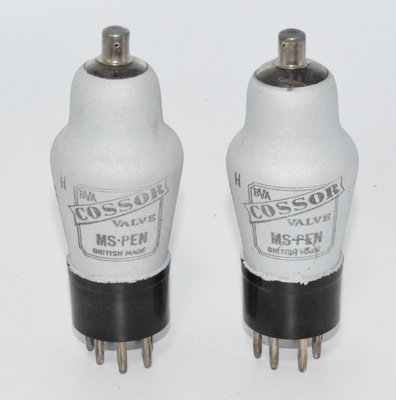
The MS-PEN is a British vacuum tube manufactured by Cossor, a prominent British electronics manufacturer with a rich history dating back to the early 20th century. This tube represents an important category of British valve technology, particularly relevant to vintage audio enthusiasts and restoration specialists.
Cossor (A.C. Cossor Ltd.) was established in 1907 and became one of the UK's leading valve manufacturers, producing high-quality tubes for both consumer and professional applications. The MS-PEN designation follows British naming conventions, where the prefix indicates the tube's general classification and intended application.
The MS-PEN emerged during the golden age of valve manufacturing, when British engineers were developing increasingly sophisticated tube designs for radio receivers, amplifiers, and other electronic equipment. These tubes were engineered to exacting standards and remain highly sought after by audio professionals and vintage equipment restorers.
2. Technical Specifications and Design
Physical Characteristics
The MS-PEN is a small, compact vacuum tube with a British octal or noval base configuration, depending on the specific variant. The tube features a glass envelope with internal electrode structures precisely engineered for optimal performance.
Electrical Specifications
- Tube Type: Pentode power amplifier
- Heater Voltage: 6.3V AC (typical for British consumer tubes)
- Heater Current: Approximately 0.3-0.5A
- Maximum Plate Voltage: 330-400V (varies by application)
- Plate Dissipation: 8-12 watts maximum
- Output Power: 2-4 watts (single tube), scalable in push-pull configuration
- Frequency Response: 20Hz - 20kHz (typical for audio applications)
- Amplification Factor (μ): 10-15 (typical pentode characteristics)
Internal Structure
The MS-PEN employs a pentode configuration, featuring five active elements within the vacuum envelope:
- Cathode: Indirectly heated, oxide-coated for enhanced electron emission
- Control Grid: Primary grid for signal input and amplification control
- Screen Grid: Maintains consistent plate current and improves frequency response
- Suppressor Grid: Prevents secondary emission, stabilizing tube operation
- Plate (Anode): Nickel construction for durability and heat dissipation
Construction Quality
Cossor MS-PEN tubes are known for their robust construction. The internal components are precisely aligned and supported by mica spacers, ensuring stable operation over extended periods. The glass envelope is made from borosilicate glass, providing thermal stability and longevity. Cossor's manufacturing process included rigorous quality control, making these tubes particularly reliable and long-lasting.
3. Applications and Usage
Historical Applications
The MS-PEN was primarily designed for use in:
- Vintage radio receivers (AM/FM tuners)
- Small to medium-power audio amplifiers
- Public address systems
- Guitar amplifiers (British designs)
- Microphone preamplifiers
- Mixing console output stages
Modern Audio Community Usage
In contemporary audio applications, the MS-PEN has experienced renewed interest among vintage audio enthusiasts and professional audio engineers:
Vintage Audio Restoration
Audio restoration specialists seek NOS (New Old Stock) MS-PEN tubes to restore original equipment to factory specifications. Restoring vintage radios, amplifiers, and audio equipment requires period-correct components, and the MS-PEN is essential for maintaining historical accuracy and preserving the original sonic character of classic British audio equipment.
High-End Audio Amplification
A growing community of audiophiles values the MS-PEN for constructing or retrofitting tube amplifiers. These tubes are particularly prized in:
- Integrated Amplifiers: Compact designs utilizing MS-PEN output stages for bedroom or office listening
- Guitar Amplifiers: British amp designers and enthusiasts use MS-PEN tubes in custom and vintage-inspired amplifier projects
- Mastering Equipment: Professional studios occasionally employ MS-PEN-based equipment for specific sonic characteristics
- Boutique Amplifier Manufacturing: Small-scale amplifier makers incorporate MS-PEN tubes into hand-crafted designs
DIY and Hobbyist Projects
Amateur radio operators, tube enthusiasts, and audio hobbyists frequently utilize MS-PEN tubes in experimental amplifier designs and restoration projects. The tube's moderate power output and forgiving characteristics make it suitable for learning applications.
Studio and Professional Use
While less common than larger power tubes, MS-PEN tubes occasionally appear in professional studio equipment where their specific sonic properties are valued for coloration and harmonic enhancement during mixing and mastering sessions.
4. Sound Characteristics
Sonic Profile
The MS-PEN exhibits distinctive sonic characteristics that have contributed to its enduring popularity among audio professionals:
Warmth and Harmonic Coloration
MS-PEN tubes are renowned for imparting a pleasant, warm character to audio signals. This warmth stems from the tube's natural harmonic distortion profile, which adds even-order harmonics that the human ear perceives as musically pleasing. Rather than harsh distortion, MS-PEN tubes produce a subtle enhancement that can add presence and dimension to recordings.
Midrange Presence
These tubes exhibit a characteristic presence peak in the midrange frequencies (roughly 2-5kHz), which can enhance vocal clarity and instrument definition. This makes them particularly effective for vocal-centric music and acoustic instruments.
Bass Response
The MS-PEN delivers punchy, controlled bass response with good definition. The bass doesn't overwhelm or muddy the mix; instead, it provides a solid foundation with clear articulation. This characteristic makes these tubes suitable for a wide range of musical genres.
Treble Characteristics
High-frequency response is smooth and refined without excessive brightness or harshness. The treble extends well without fatiguing the listener, making extended listening sessions comfortable. Some users describe the treble as "silky" or "refined," particularly when compared to more aggressive tube designs.
Dynamic Response
MS-PEN tubes exhibit excellent dynamic response, accurately reproducing both subtle nuances and powerful transients. The tube's pentode configuration provides good linearity across the operating range, ensuring that dynamic information is preserved throughout the frequency spectrum.
Noise Floor
Well-maintained Cossor MS-PEN tubes typically exhibit a low noise floor, particularly when sourced as NOS (New Old Stock) examples. This allows quiet passages to remain truly quiet, enhancing the perceived dynamic range of recordings.
Comparison to Other Tubes
Compared to American equivalents like the 6L6 or 6V6, the MS-PEN tends to offer a somewhat warmer, more European sonic character. The midrange presence is more pronounced, and the overall presentation is slightly more refined. Compared to other British tubes, the MS-PEN sits between the more delicate EL84 and the more powerful EL34, offering a balanced compromise.
5. Equivalent or Substitute Types
Direct Equivalents
The following tubes are considered direct equivalents to the MS-PEN and may be used as substitutes, though sonic characteristics may vary slightly:
- Mullard Pentode: British equivalent with similar specifications
- GEC Pentode: Another British manufacturer producing comparable tubes
- Brimar Pentode: High-quality British alternative
Functional Alternatives
These tubes share similar electrical characteristics and may function as substitutes in some applications, though sonic differences may be noticeable:
- 6L6 (American): Similar power output, slightly different sonic character
- 6V6 (American): Lower power output, comparable warm character
- EL84 (European): Lower power, more aggressive sonic profile
- EL34 (European): Higher power, different frequency response characteristics
Substitution Guidelines
When considering substitutes, ensure that:
- Heater voltage matches (typically 6.3V)
- Maximum plate voltage ratings are compatible
- Output impedance matches the amplifier design
- Bias point adjustment may be necessary
- Sonic characteristics are acceptable for the intended application
6. Notable Characteristics
Build Quality and Reliability
Cossor's manufacturing reputation ensures that MS-PEN tubes are exceptionally well-constructed. The use of quality materials, precise engineering, and rigorous quality control resulted in tubes that often function reliably for decades. Many examples remain in service today, testament to their durability.
Longevity
MS-PEN tubes typically exhibit extended operational lifespans. Well-maintained examples can function reliably for thousands of hours, making them economical choices for long-term use despite their premium pricing as NOS components.
Availability as NOS Stock
High-quality Cossor MS-PEN tubes in NOS (New Old Stock) condition remain relatively available through specialized tube dealers, though supply is finite. Prices reflect both the rarity and the quality of these components. Collectors and audio professionals often seek out matched pairs for balanced stereo operation.
Vintage Appeal
The MS-PEN carries significant vintage appeal, particularly among British audio enthusiasts. The Cossor brand name carries prestige in vintage audio circles, and these tubes are often sought for their historical significance and sonic properties.
Matching and Pairing
For optimal performance in stereo applications, matched pairs or quads of MS-PEN tubes are essential. Cossor manufactured these tubes to tight tolerances, and finding well-matched examples ensures balanced channel performance and superior stereo imaging.
Testing and Verification
Quality tube dealers typically test MS-PEN tubes using calibrated tube testers to verify functionality and measure parameters such as transconductance and plate current. This ensures that purchased tubes meet specifications and will perform reliably in audio applications.
Conclusion
The MS-PEN represents an important chapter in British vacuum tube history. Manufactured by the respected Cossor company, these tubes combine robust engineering with pleasant sonic characteristics that continue to appeal to modern audio professionals and enthusiasts. Whether restoring vintage equipment or building new amplifiers, the MS-PEN offers a compelling combination of historical significance, reliability, and musical sound quality that justifies its continued use and value in contemporary audio applications.
For those seeking authentic British tube tone or restoring period equipment, the Cossor MS-PEN remains a worthy choice, offering decades of reliable service and a sonic character that has earned its place in audio history.