1. Introduction and History
The Osram MU14 is a full wave rectifier valve (tube) featuring an indirectly heated cathode system, manufactured by the General Electric Company (GEC) under the Osram Valves brand in England. Alongside its lower-voltage sibling, the MU12, the MU14 was designed to serve as a reliable power supply rectifier in radio receivers and audio equipment that employed indirectly heated output valves.
The MU14 was developed during the golden era of British valve manufacturing, when GEC and its associated companies — including Marconi-Osram Valve Co. (MO Valve Co.) — were producing a wide range of high-quality valves for domestic and professional use. The "MU" designation in Osram's naming convention indicated a full wave rectifier type, and the MU14 represented the higher-voltage variant capable of handling anode voltages up to 500V RMS per plate.
The use of an indirectly heated cathode was a deliberate design choice. As stated in the original Osram datasheet, this construction enabled the valve to attain a low effective impedance while its slow heating properties were "of value in preventing high voltage surges when switching on in a receiver employing Indirectly Heated output valves." This soft-start characteristic made the MU14 particularly well-suited for use in amplifiers and receivers where sudden voltage spikes at switch-on could damage sensitive components or shorten the life of other valves in the circuit.
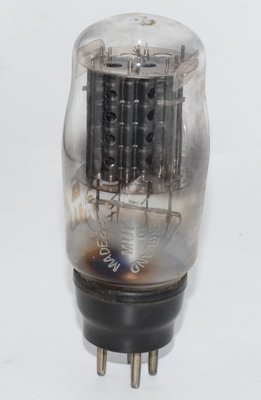
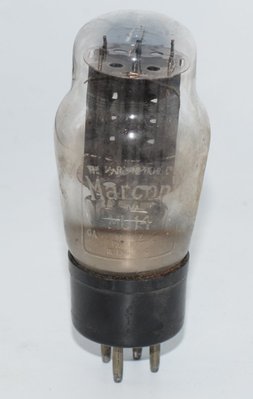
The MU14 was manufactured by several entities within the GEC/Marconi-Osram group. Surviving examples have been identified as products of Marconi, GEC, and MO Valve Co., all bearing the "Made in England" designation. These valves are now considered rare collectibles, prized by vintage radio restorers and audiophiles alike.
2. Technical Specifications and Design
Electrical Characteristics
| Parameter | MU14 Value |
|---|---|
| Heater Voltage | 4.0 V |
| Heater Current | 2.5 A (approx. max.) |
| Anode Voltage R.M.S. (each anode) | 500 V |
| Rectified Current D.C. (smoothed with 4 mfd condenser) | 120 mA / 60 mA |
| D.C. Output Volts (for max. rated A.C. volts input) | 540 V (at 60 mA) / 620 V (at lower loads) |
Note: The MU14 is a rectifier valve and therefore does not have amplification factor (μ), transconductance (gm), or plate resistance (rp) ratings in the conventional sense, as these parameters apply to amplifying valves. Grid bias range is not applicable as this is a diode rectifier with no control grid.
The D.C. output current should in no case exceed the maximum of 120 mA under smoothed conditions using a 4 mfd input filter capacitor. The characteristic curves provided in the original Osram datasheet show output voltage versus input voltage at various load currents (30 mA, 60 mA, 90 mA, and 120 mA), taken with a 4 mfd smoothing condenser and making no allowance for voltage drop through smoothing chokes.
Physical Specifications
| Parameter | Value |
|---|---|
| Base Type | 4-Pin base |
| Envelope Type | Glass bulb, ST-type (shoulder) shape |
| Maximum Overall Length (including pins) | 130 mm |
| Diameter of Bulb | 51 mm |
| Cathode Type | Indirectly Heated |
| Rectification Type | Full Wave |
Pin Configuration (4-Pin Base)
View looking at the underside of the base:
| Pin | Connection |
|---|---|
| Pin 1 | Anode |
| Pin 2 | Anode |
| Pin 3 | Heater / Cathode |
| Pin 4 | Heater / Cathode |
The two anodes (pins 1 and 2) connect to opposite ends of the high-voltage secondary winding of the power transformer, while pins 3 and 4 serve the dual function of heater supply and cathode connection. This combined heater-cathode arrangement on two pins is characteristic of the 4-pin base configuration used for indirectly heated full wave rectifiers of this era.
Operating Conditions
The original Osram datasheet specifies several important operating guidelines:
- Variations in output voltage should never be made by dimming the filament (heater).
- Voltage adjustment may be made by: (1) tappings in the transformer secondary, (2) use of a high resistance in series with the output, or (3) use of a potentiometer, in which case the total current taken by the potentiometer and load should not exceed 120 mA.
- The D.C. output current should in no case exceed the maximum of 120 mA under smoothed conditions using a 4 mfd input filter.
3. Applications and Usage
The MU14 was designed primarily as a power supply rectifier for radio receivers and audio amplifiers. Its principal applications include:
- Radio Receiver Power Supplies: The MU14's primary intended application was in domestic radio receivers of the 1930s and 1940s. Its full wave rectification capability, combined with the indirectly heated cathode, made it ideal for sets using indirectly heated output valves where controlled warm-up was essential.
- Audio Amplifier Power Supplies: The valve's ability to deliver up to 120 mA of smoothed D.C. at voltages up to 540V made it suitable for powering push-pull output stages and other demanding amplifier configurations.
- Test Equipment: The MU14 found use in laboratory power supplies and test equipment where stable, well-regulated high-voltage D.C. was required.
- Military and Government Equipment: The existence of the CV1296 military designation confirms that the MU14 (or its equivalent) was approved for use in British military and government equipment, where reliability and consistency were paramount.
The MU14's higher voltage rating (500V RMS per anode versus 350V for the MU12) made it the preferred choice for equipment requiring higher B+ voltages, such as amplifiers using larger output valves like the KT66 or PX25.
4. Sound Characteristics
As a rectifier valve, the MU14 does not directly amplify the audio signal, but it has a significant and measurable influence on the sonic character of any amplifier in which it serves as the power supply rectifier. Audiophiles and experienced amplifier builders have noted several characteristics:
- Soft, Gradual Power Delivery: The indirectly heated cathode provides a slow, controlled warm-up that results in a gentle rise of B+ voltage. This "soft start" characteristic translates into a power supply that responds to dynamic demands with a slight natural sag — a quality that many listeners find musically pleasing, as it imparts a sense of warmth and organic flow to the sound.
- Smooth and Refined Tonal Quality: British rectifier valves of this era, particularly those from GEC/Osram, are often described as contributing to a smooth, refined, and slightly warm tonal balance. The MU14 is no exception. Compared to silicon diode rectification, the MU14 introduces a subtle softening of transient edges that many audiophiles find desirable, particularly with acoustic music, jazz, and vocal recordings.
- Dynamic Sag and Compression: Like all valve rectifiers, the MU14 exhibits a degree of internal resistance that causes the output voltage to drop slightly under heavy current demand. This natural compression effect is subtle but perceptible — it tends to round off the hardest transient peaks while preserving the overall dynamic envelope, creating a presentation that feels less fatiguing over extended listening sessions.
- Midrange Presence: Users of GEC/Osram rectifiers frequently report a slightly enhanced midrange presence and body compared to more modern rectifier types. This quality makes the MU14 particularly appealing for vocal-centric listening and for amplifiers driving full-range or horn-loaded speakers where midrange clarity is paramount.
- Bass Character: The power supply sag inherent in valve rectification means that bass response may be slightly less taut and controlled compared to solid-state rectification. However, many listeners prefer this characteristic, describing the bass as "fuller," "rounder," and more naturally weighted.
It should be noted that the sonic influence of a rectifier valve is always secondary to the design of the power supply as a whole — the transformer, filter capacitors, chokes, and overall circuit topology all play significant roles. Nevertheless, the choice of rectifier valve is a meaningful variable, and the MU14 is regarded as a high-quality component in this regard.
5. Equivalent or Substitute Types
The following types are considered genuine equivalents or close substitutes for the MU14:
| Type | Notes |
|---|---|
| AU3A | Direct equivalent. Same electrical characteristics and pin configuration. |
| CV1296 | British military (Common Valve) designation for the MU14. Identical specifications; manufactured to tighter military tolerances and quality control standards. |
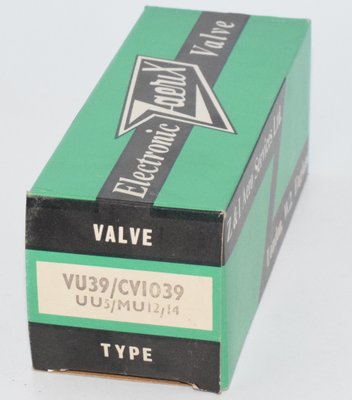
| VU39 | Equivalent type. Interchangeable with the MU14 in standard applications. Verify pin compatibility in specific equipment. |
Important Notes on Substitution:
- The MU12 is not a direct substitute for the MU14. While sharing the same heater voltage (4.0V), heater current (2.5A), and physical form factor, the MU12 has a significantly lower maximum anode voltage rating of 350V RMS versus 500V RMS for the MU14. Using an MU12 in place of an MU14 in a circuit designed for the higher voltage rating could result in anode voltage breakdown and valve failure.
- The MU14 may potentially be substituted into circuits designed for the MU12, as it can handle the lower voltages, but the output characteristics may differ slightly. Always consult the specific equipment's service manual before making substitutions.
- When sourcing equivalents, be aware that the MU14 uses a 4-pin base. Ensure that any substitute valve uses the identical base type and pinout configuration.
6. Notable Characteristics
- Indirectly Heated Cathode for Surge Protection: Perhaps the most notable design feature of the MU14 is its indirectly heated cathode. Unlike directly heated rectifiers (such as the 5U4G or 5V4G), the MU14's cathode takes time to reach operating temperature. This delay means that the B+ voltage rises gradually, protecting electrolytic capacitors and other circuit components from the damaging voltage surges that can occur at switch-on. This was particularly important in receivers and amplifiers of the era, which often used paper and early electrolytic capacitors with limited surge ratings.
- Low Effective Impedance: The indirectly heated cathode system allows the MU14 to achieve a low effective internal impedance, resulting in better voltage regulation under varying load conditions compared to some directly heated rectifier types.
- Robust Construction: GEC/Osram valves were renowned for their build quality. The MU14 features a well-constructed electrode assembly within a sturdy glass envelope, contributing to long operational life when operated within its rated parameters. The datasheet specifically states that "the valves are designed for long life and constant emission when operated at their rated voltage and output."
- Full Wave Rectification: The dual-anode construction allows full wave rectification of both half cycles of the A.C. input when used with a centre-tapped transformer secondary. This provides more efficient rectification and easier filtering compared to half-wave designs.
- 4-Pin Base Configuration: The use of a 4-pin base, with the heater pins also serving as the cathode connection, results in a simple and reliable connection scheme. However, this also means the valve requires a dedicated heater winding on the power transformer, as the cathode is at high D.C. potential relative to the chassis.
- Rarity: The MU14 is now considered a rare valve. Production ceased decades ago, and surviving examples — particularly those from Marconi or bearing the Osram brand — command premium prices among collectors and restorers. Examples from unknown manufacturers marked simply "Made in England" may have been produced by GEC or MO Valve Co. for third-party branding.
7. Usage in the Audio Community
The MU14 occupies a niche but respected position within the audio community, valued for several reasons:
Vintage Amplifier Restoration
The primary demand for MU14 valves comes from restorers of vintage British radio receivers and amplifiers from the 1930s through the 1950s. Many classic British designs specified the MU14 or its equivalents, and authentic restoration requires the correct valve type. Equipment from manufacturers such as Leak, Quad, and various British radio makers may have originally used the MU14 or compatible types in their power supply sections.
Custom and DIY Amplifier Builds
A small but dedicated group of DIY audio enthusiasts seek out the MU14 for use in custom-built amplifiers, particularly those designed around classic British valve topologies. The MU14's 500V RMS anode rating and 120 mA maximum output current make it suitable for powering a range of output valve configurations, from single-ended designs using valves like the PX4 or PX25 to push-pull configurations using KT66 or similar types.
The "British Sound"
Among audiophiles who subscribe to the philosophy that every component in the signal chain — including the power supply — contributes to the overall sonic character, the MU14 is valued as a component of the quintessential "British sound." This is characterised by warmth, smoothness, and a refined midrange that is often contrasted with the more forward, dynamic presentation associated with American valve types. Using a British rectifier like the MU14 in conjunction with British output and driver valves is seen by some enthusiasts as essential to achieving an authentic vintage British amplifier sound.
Collectibility and Market
Due to their rarity, MU14 valves — particularly those with original Marconi or Osram branding — are sought-after collectibles. Valves that "light up nicely" (indicating an intact and functional heater/cathode assembly) command higher prices, even when full electrical testing has not been performed. The CV1296 military equivalent is also highly prized, as military-spec valves were typically manufactured to higher standards and subjected to more rigorous quality control.
Practical Considerations for Audio Use
Audio enthusiasts considering the MU14 for use in amplifier projects should be aware of several practical considerations:
- Heater Supply: The 4.0V heater at 2.5A requires a dedicated transformer winding. This winding must be well-insulated, as the cathode (and therefore the heater) sits at high D.C. potential above ground.
- Input Capacitance: The datasheet ratings assume a 4 mfd (microfarad) input filter capacitor. Using significantly larger input capacitors (as is common in modern builds) may increase peak charging currents beyond the valve's ratings, potentially shortening its life. This is an important consideration given the valve's rarity and replacement cost.
- Voltage Regulation: As with all valve rectifiers, the MU14 exhibits poorer voltage regulation than solid-state alternatives. The output voltage will vary with load current, as clearly shown in the characteristic curves. Designers should account for this when specifying operating points for the amplifier's output and driver stages.
- Availability of Equivalents: Given the scarcity of original MU14 valves, builders may wish to consider the equivalent types (AU3A, CV1296, VU39) to broaden their sourcing options. All are becoming increasingly scarce, however, and builders should consider designing power supplies that can accommodate alternative rectifier types if long-term valve availability is a concern.