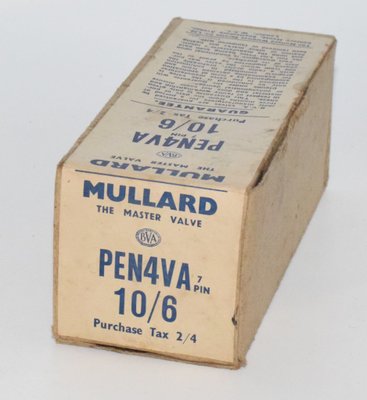
1. Introduction and History
The PEN4VA is a power pentode vacuum tube developed during the mid-20th century, representing an important advancement in tube amplifier design. Manufactured primarily by Mullard, a renowned British valve manufacturer, the PEN4VA was engineered to provide efficient power amplification with moderate output capabilities suitable for a variety of audio and industrial applications.
The pentode configuration—featuring five active elements (cathode, grid 1, grid 2, grid 3, and plate)—offered superior performance compared to earlier triode and tetrode designs. The PEN4VA emerged during a period when valve technology was at its peak, before the eventual transition to solid-state electronics in the 1960s and 1970s. Despite this technological shift, the PEN4VA remains highly valued by vintage audio enthusiasts and restoration specialists.
Mullard's manufacturing reputation ensured that PEN4VA tubes met stringent quality standards, making NOS (New Old Stock) examples particularly sought after by audiophiles seeking authentic vintage tone in restored amplifiers.
2. Technical Specifications and Design
Basic Electrical Specifications
- Tube Type: Power Pentode
- Heater Voltage: 4V AC (nominal)
- Heater Current: Approximately 1.4A
- Maximum Plate Voltage: 330V DC
- Maximum Plate Dissipation: 8W
- Typical Plate Current: 50-80mA (depending on bias conditions)
- Amplification Factor (μ): Approximately 20-25
- Plate Resistance (rp): Approximately 8-10 kΩ
- Transconductance (gm): Approximately 2.5-3.5 mS
Physical Characteristics
The PEN4VA features an octal base (8-pin configuration) with a glass envelope containing the pentode elements. The tube measures approximately 3.5 inches in height and 1 inch in diameter, making it suitable for compact amplifier designs. The octal base pinout follows standard conventions, with heater connections on pins 4 and 5, cathode on pin 3, and control grid on pin 2.
Design Features
Pentode Configuration: The addition of a suppressor grid (grid 3) prevents secondary emission effects that plagued earlier tetrode designs, resulting in more linear amplification characteristics and reduced distortion at higher power levels.
Beam-Forming Plates: Some variants employ beam-forming geometry to enhance efficiency and reduce parasitic oscillations, improving stability in demanding applications.
Robust Construction: Mullard's manufacturing process employed high-quality materials, including nickel-plated components and carefully processed cathodes, contributing to extended tube life and consistent performance.
3. Applications and Usage
Original Applications
The PEN4VA was designed for use in:
- Audio Amplifiers: Output stages of low to medium-power tube amplifiers, typically in the 5-15W range per tube
- Radio Receivers: Power amplification stages in AM/FM radio equipment
- Public Address Systems: Compact PA amplifiers requiring moderate output power
- Guitar Amplifiers: Single-ended and push-pull output configurations
- Industrial Equipment: Control and signaling circuits in industrial applications
Modern Usage in Audio Community
Today, the PEN4VA experiences renewed interest among vintage audio enthusiasts and professional restoration specialists. Audiophiles appreciate the tube's warm, musical character and its ability to produce harmonically rich distortion when driven into saturation. The PEN4VA is particularly valued in:
- Tube Amplifier Restoration: Replacing original tubes in vintage guitar and hi-fi amplifiers to restore authentic vintage tone and performance characteristics
- Custom Amplifier Design: Boutique amplifier manufacturers incorporate PEN4VA tubes into hand-built amplifiers targeting the vintage amplifier market
- Studio Recording: Some professional recording studios maintain vintage amplifiers equipped with PEN4VA tubes for their distinctive sonic character
- Vintage Guitar Tone: Musicians seeking authentic vintage amplifier tones specifically seek amplifiers equipped with PEN4VA tubes, as they contribute to the characteristic warmth and compression associated with classic amplifier designs
- Collector Interest: Tube collectors value Mullard PEN4VA examples, particularly NOS (New Old Stock) specimens, as investments and display pieces
4. Sound Characteristics
Tonal Qualities
The PEN4VA is renowned for producing a warm, smooth, and musically pleasing tone characteristic of British valve design philosophy. When properly biased and operated within its design envelope, the tube exhibits several distinctive sonic characteristics:
Frequency Response
The PEN4VA delivers a relatively flat frequency response across the midrange and upper midrange, with a gentle rolloff in the extreme high frequencies (above 15kHz). The low-frequency response remains tight and controlled, making the tube suitable for both music and speech reproduction. This balanced frequency response contributes to the tube's versatility across different audio applications.
Harmonic Distortion Character
When driven at moderate levels, the PEN4VA produces predominantly second and third-order harmonic distortion, which is perceived as musically pleasant and adds perceived warmth to the signal. The harmonic structure is smooth and non-fatiguing, even at elevated listening levels. When pushed into saturation, the tube produces a smooth, compressed character that is particularly prized by electric guitar players seeking vintage overdrive tones.
Dynamic Response
The tube exhibits excellent transient response with natural compression characteristics. Sudden signal peaks are handled gracefully without harsh breakup, contributing to a forgiving, musical amplifier character. This dynamic behavior makes the PEN4VA particularly suitable for live performance applications where dynamic control is desirable.
Noise Floor
Mullard's manufacturing quality ensures low microphonic noise and thermal noise characteristics. NOS examples typically exhibit extremely quiet operation, with minimal hum and noise contribution to the audio signal.
Compression and Saturation Character
As the tube approaches saturation, it exhibits smooth, musical compression rather than harsh clipping. This characteristic makes the PEN4VA particularly valued for guitar amplifiers, where the natural compression adds sustain and musical character to the played notes.
5. Equivalent or Substitute Types
Several tubes can serve as substitutes for the PEN4VA, though each possesses slightly different characteristics:
- EL84: A more commonly available pentode with similar power output but different bias characteristics and slightly brighter tonal balance
- 6V6GT: An American equivalent with comparable power ratings and similar audio characteristics, though with different heater voltage requirements
- EL86: A smaller pentode with reduced power output, suitable for lower-power applications
- 6L6: A higher-power pentode for applications requiring greater output capability
- KT66: A British power pentode with higher power output and different sonic characteristics
Important Note: Substitution requires careful consideration of bias requirements, plate voltage ratings, and load impedance matching. Improper substitution can result in reduced tube life, excessive distortion, or amplifier damage.
6. Notable Characteristics
Manufacturing Quality
Mullard's reputation for quality is evident in the PEN4VA's robust construction and consistent performance. NOS examples often exhibit minimal wear and retain the original specifications after decades of storage.
Longevity
With proper bias and operating conditions, the PEN4VA typically achieves 2,000-5,000 hours of service life, making it economical for regular use in vintage amplifiers.
Availability
While no longer in production, NOS Mullard PEN4VA tubes remain available through specialized tube dealers, though prices reflect their vintage status and desirability among collectors and audio enthusiasts.
Collector Value
Mullard-branded examples, particularly matched pairs and quads in original packaging, command premium prices in the vintage tube market, reflecting their reputation and sonic qualities.
Compatibility Considerations
The octal base configuration ensures mechanical compatibility with any amplifier designed for octal tubes, though electrical specifications must be verified before installation.
Conclusion
The PEN4VA represents a significant achievement in vacuum tube design, combining British engineering excellence with practical audio performance. Its warm, musical character and robust construction continue to make it highly valued among vintage audio enthusiasts and professional musicians. Whether restoring vintage amplifiers or building new designs with classic tube aesthetics, the PEN4VA remains a respected choice for those seeking authentic vacuum tube tone and reliability.