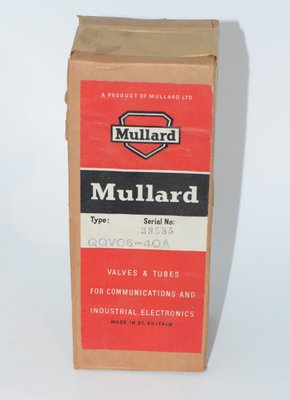
1. Introduction and History
The QQV06-40A, also known by its American designation 5894, is a double (dual) tetrode vacuum tube developed in the mid-20th century primarily by Mullard, a subsidiary of Philips. The designation follows Mullard's naming convention where 'QQV' indicates a double tetrode, '06' refers to the approximate heater voltage (6.3V), and '40A' denotes the approximate power handling capability (40 watts per section).
First introduced in the 1950s, this tube was designed specifically for VHF and UHF applications where high power and efficiency were required in compact equipment. Mullard, based in the United Kingdom, was renowned for producing high-quality vacuum tubes, and the QQV06-40A became one of their flagship RF power tubes. The tube gained significant popularity in military communications, broadcast transmitters, and later in amateur radio applications.
2. Technical Specifications and Design
Physical Construction
- Configuration: Double beam tetrode (two independent tetrode sections in one envelope)
- Base: Octal with top caps for anodes
- Envelope: Glass with forced-air cooling fins
- Height: Approximately 111 mm (4.37 inches)
- Diameter: Approximately 56 mm (2.2 inches)
Electrical Parameters
- Heater Voltage: 6.3V
- Heater Current: 1.8A
- Maximum Anode Voltage: 600V
- Maximum Screen Grid Voltage: 300V
- Maximum Anode Dissipation: 40W (per section)
- Maximum Screen Dissipation: 6W (per section)
- Transconductance: Approximately 12.5 mA/V
- Amplification Factor: Approximately 6.2
- Capacitances:
- Input: 13.5 pF
- Output: 5.5 pF
- Anode to Grid: 0.3 pF
Design Features
The QQV06-40A features a robust internal construction with aligned grids that minimize electron interception, resulting in higher efficiency. The tube employs beam-forming plates to direct electron flow efficiently to the anode while reducing secondary emission effects. The dual tetrode design in a single envelope allows for various circuit configurations including push-pull, parallel, and cascode arrangements.
The tube's cooling fins are designed for forced-air cooling, which is essential when operating at maximum ratings. The metal base ring serves as both a structural support and a thermal path for heat dissipation.
3. Applications and Usage
RF Power Amplification
The primary application of the QQV06-40A is as an RF power amplifier in the VHF (30-300 MHz) and UHF (300-3000 MHz) bands. The tube excels in these frequencies due to its low interelectrode capacitances and efficient internal geometry. Specific applications include:
- VHF/UHF broadcast transmitters
- Military communications equipment
- Amateur radio linear amplifiers (particularly for 2m and 70cm bands)
- Industrial RF heating equipment
- Scientific equipment requiring RF power
Circuit Configurations
The dual tetrode design enables various circuit configurations:
- Push-Pull: The most common configuration, offering balanced operation and even-harmonic cancellation
- Parallel: For maximum power output when higher current capability is needed
- Cascode: Used in some VHF/UHF applications for improved high-frequency performance
- Grounded-Grid: Often employed for stability in VHF amplifiers
Operating Considerations
When designing circuits with the QQV06-40A, several factors require attention:
- Adequate cooling is essential, typically requiring forced-air cooling for operation at full ratings
- Proper RF bypassing of electrodes to prevent self-oscillation
- Neutralization may be required in some circuit configurations
- Screen grid current should be monitored to prevent exceeding dissipation ratings
- Proper heater warm-up time (approximately 10 seconds) before applying high voltage
4. Equivalent or Substitute Types
The QQV06-40A has several equivalents and near-equivalents that can be used as substitutes in many applications:
- 5894: The American designation for the same tube
- QQV06-40: Earlier version with slightly different specifications
- QQV03-20A: Lower-power version (20W per section)
- QQV07-50: Higher-power version (50W per section)
- 829B: Similar dual beam tetrode but with lower ratings and different pinout
- 832A: Lower-power alternative with similar characteristics
When substituting tubes, it's critical to verify not only the electrical parameters but also the physical dimensions and cooling requirements. Base connections may differ between types, requiring circuit modifications.
5. Notable Characteristics
Performance Advantages
- High Power Gain: The QQV06-40A provides excellent power gain at VHF/UHF frequencies, typically 10-15dB depending on the circuit configuration
- Efficiency: Can achieve plate efficiencies of 60-70% in properly designed Class AB or Class C circuits
- Frequency Range: Maintains good performance up to 500 MHz, with usable operation extending to 1 GHz in specialized circuits
- Linearity: When properly biased in Class AB, offers good linearity for SSB and AM service
Practical Considerations
- Reliability: Mullard-manufactured QQV06-40A tubes are known for their exceptional reliability and long service life when operated within ratings
- Availability: Though no longer in production, NOS (New Old Stock) units are still available from specialty suppliers
- Collector Value: Has become a collectible item among vacuum tube enthusiasts
- Testing: Requires specialized equipment to fully test at operating frequencies
Historical Significance
The QQV06-40A represents an important milestone in vacuum tube development for VHF/UHF applications. Its robust design and reliable performance made it a standard in many broadcast and communication systems through the 1960s and 1970s. Even after solid-state devices became common, the QQV06-40A remained in use for high-power RF applications where its combination of power handling, linearity, and tolerance to mismatched loads offered advantages over early transistor designs.
Amateur radio operators continue to value these tubes for building vintage-style linear amplifiers, particularly for the 144 MHz (2m) and 432 MHz (70cm) bands, where a pair of QQV06-40A tubes can deliver several hundred watts of RF power.
Conclusion
The QQV06-40A stands as a testament to the sophisticated engineering of the vacuum tube era. Its dual tetrode design, optimized for VHF/UHF operation, continues to find applications in specialty equipment and among enthusiasts who appreciate its robust performance characteristics. While modern solid-state devices have replaced vacuum tubes in most new equipment, the QQV06-40A remains a benchmark against which high-frequency RF power amplification is often measured.